
From Campaigns to Systems: Why AEO and GEO Are the Future of SEO
• December 4, 2025 • 6 minutes to readMost marketing teams are still running search like it’s 2015: spin up a “campaign,” chase a handful of high-volume keywords, ship some content, report on rankings, repeat. It’s busy. It’s trackable. It kind of works. But it doesn’t compound. And it definitely doesn’t match how people or machines are searching today.
If your search program feels like a string of one-off pushes instead of a predictable engine, it’s not because you’re bad at your job. You’re just stuck in campaign mode. The future of search belongs to systems, specifically to two mindsets quietly rewriting the rules: Answer Engine Optimization (AEO) and Generative Engine Optimization (GEO).
AEO and GEO are about earning trust with machines so you can be more visible to humans. That means less “How do we rank for this keyword next month?” and more “How do we become the obvious, reliable source every time this problem shows up — in any search experience?”
Classic SEO was built on a simple idea: someone types into a search bar, a list of links appears, and your job is to show up near the top. Today, that linear flow is fractured. People get answers from AI overviews, chat interfaces, voice assistants, app search, marketplaces, and, yes, traditional search results, often in the same buying journey.
Algorithms aren’t just matching words anymore; they’re parsing context, entities, and relationships. They’re deciding, “Who is probably right about this, and who is just repeating what everyone else already said?” That’s where AEO and GEO come in.
Search Engine Optimization is the practice of structuring your content so that search engines and AI systems can confidently surface your content in featured answers, overviews, snippets, and other “zero-click” surfaces. You’re not just trying to win a position; you’re trying to be the source.
Generative Engine Optimization builds on that by asking, “How do we show up inside AI-generated responses?” When someone asks an AI assistant a question your company should own, you want your brand, your language, your frameworks, and your proof to be the material those models pull from.
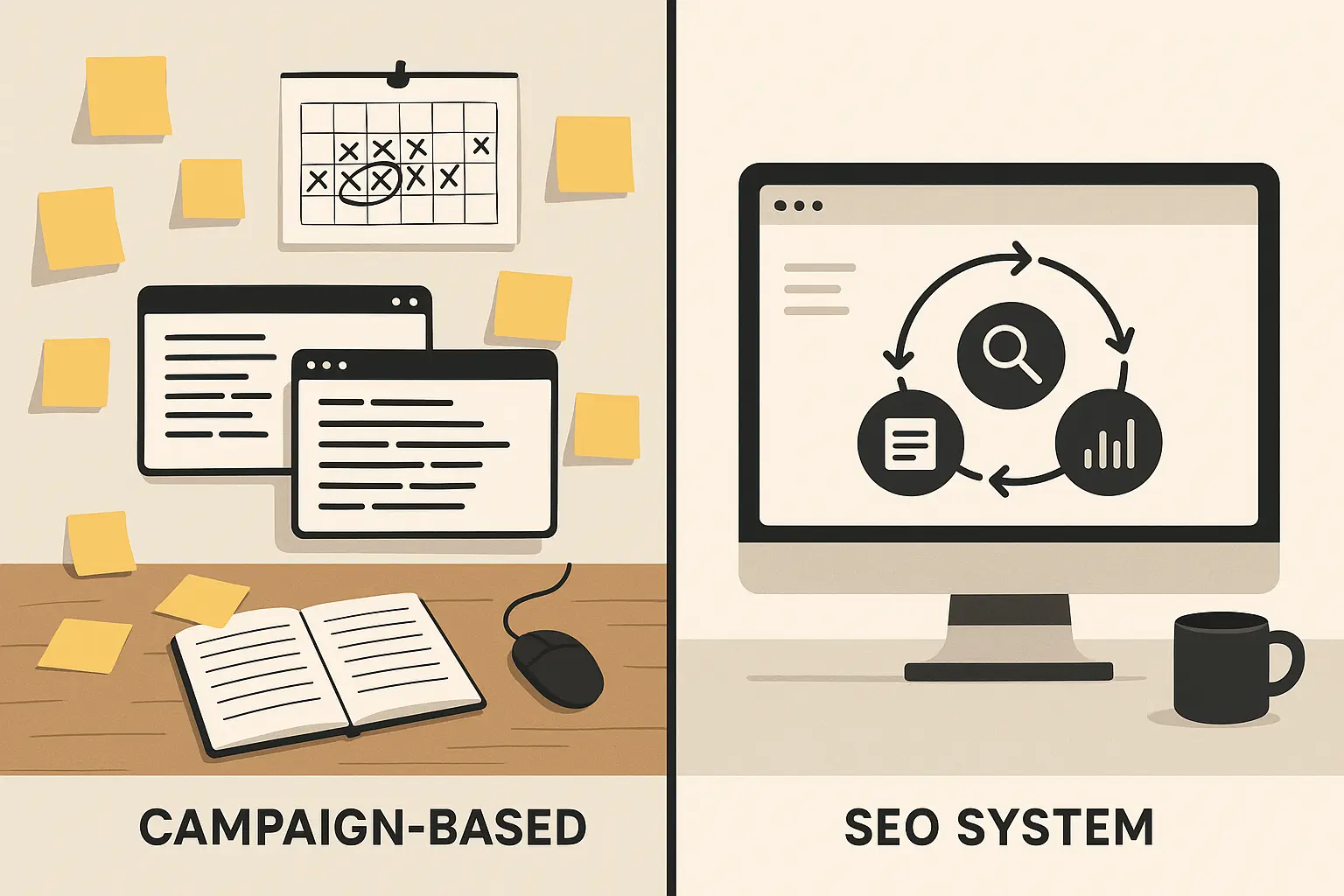
Why campaign thinking breaks in an AEO/GEO world
Campaigns are sprints. AEO and GEO are infrastructure.
Campaign mode keeps you stuck on short time horizons: this quarter’s offer, this month’s traffic goal, this week’s content drop. That rhythm can drive bursts of visibility, but it rarely builds the kind of deep topical authority that answer engines are looking for.
Answer engines reward consistency, clarity, and coherence:
- Consistency: You maintain aligned messaging and facts across your site, content hubs, profiles, and third-party mentions.
- Clarity: You explain things in a structured, scannable way that machines can parse without guessing.
- Coherence: Your content all connects back to a clear set of entities, problems, and solutions you’re known for.
You don’t get that from a string of disconnected pushes. You get it from a system.
An AEO/GEO-first approach isn’t a new “channel.” It’s the backbone under everything else you publish. Instead of asking, “What’s the next campaign?” you start asking, “What’s the next brick in the system that will still be paying off a year from now?”
That shift turns search from a set of tactics into an operating model. The system decides what to build, how to structure it, and how each piece connects. Campaigns become short bursts of attention layered on top of a foundation that already works.

What an AEO/GEO system actually looks like
AEO and GEO can sound abstract, so let’s ground them in how they show up in your day-to-day work. A healthy system usually includes:
1. A clear problem graph
Instead of a static keyword list, you maintain a living map of the problems your ideal customers are trying to solve: symptoms, root causes, adjacent questions, and “what now?” moments. Every piece of content has a job inside that graph.
2. Structured, machine-readable answers
You don’t just write blog posts. You create answer blocks: tight, direct explanations backed by schema markup, internal links, and supporting assets. These are your building blocks for featured snippets, AI overviews, FAQ experiences, and more.
3. Durable, modular content hubs
Your “hero” guides, product pages, and resource centers act as stable anchors. Around them, you build smaller, more focused pieces that handle edge cases, niche questions, and emerging language from your audience and sales team.
4. Feedback loops from honest conversations
AEO and GEO thrive on relevance. That means feeding the system with actual words from discovery calls, support tickets, chat logs, and sales notes. Those inputs update your problem graph, not just your next campaign.
5. Measurement that goes beyond “rankings.”
You still track positions and traffic, but you also care about:
- Share of voice in AI and rich results
- Branded mentions in third-party content and answer surfaces
- Engagement quality (time on site, depth of visit, assisted conversions)
- How often does your content show up in sales conversations and customer questions?
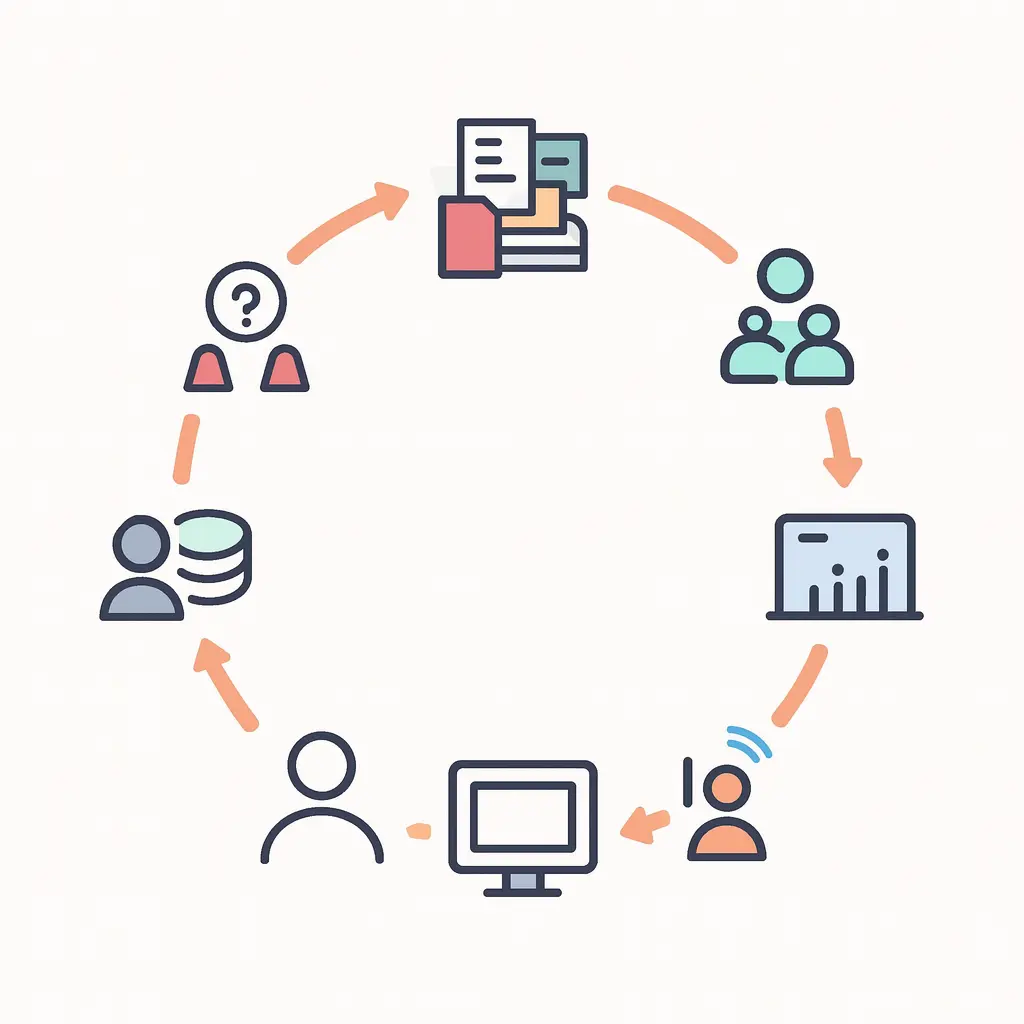
Moving from random acts of content to a real system
If you’re thinking, “Cool, but my calendar is already full,” you’re not alone. The goal isn’t to burn everything down. It’s about gradually moving from campaign-first to system-first.
Here’s a simple way to start:
Step 1: Pick one problem you should absolutely own
Choose a high-value problem where you already have some content, customer proof, and expertise. This isn’t about volume; it’s about importance. Ask: “If we could be the go-to answer for just one thing, what would it be?”
Step 2: Audit your footprint around that problem
List out:
- Every URL that touches this problem
- Every sales or support question related to it
- Any talk tracks, decks, or one-pagers your team uses
Look for gaps, contradictions, and outdated language. Ask: “If an AI system crawled this today, would it walk away with a clear, confident understanding of how we solve this?”
Step 3: Upgrade your core answer
Create or refine one primary, definitive resource on that problem. Make it:
- Ridiculously clear
- Structured with headings, FAQs, and concise summaries
- Linked to and from your related pages
- Marked up with the correct schema wherever it makes sense
Step 4: Spin out supporting answers
From there, build smaller pieces that tackle variations: use cases, objections, “versus” comparisons, implementation questions, and mistakes to avoid. These help answer engines understand the depth of your expertise.
Step 5: Instrument and revisit
Tag everything connected to that problem. Watch how it performs in organic search, in AI-style result types, and in downstream metrics like demo requests or qualified opportunities. Revisit quarterly to tighten, expand, and restructure.
Why this future is actually good news
On the surface, AEO and GEO sound like “one more thing” to keep up with. Underneath, they’re a forcing function to do what thoughtful marketers have wanted for years: move away from vanity metrics and into durable, compounding visibility.
Instead of chasing every new trend in search, you double down on being deeply, demonstrably helpful on the problems that matter most — and you package that expertise in ways both humans and machines can trust.
You don’t need a hundred more campaigns. You need a system that makes it impossible to ignore you whenever your core problems show up in the search bar, the chat box, or the AI overview.
Slow is smooth. Smooth is fast. Build the system once, then let AEO and GEO turn it into the engine that feeds the whole machine.