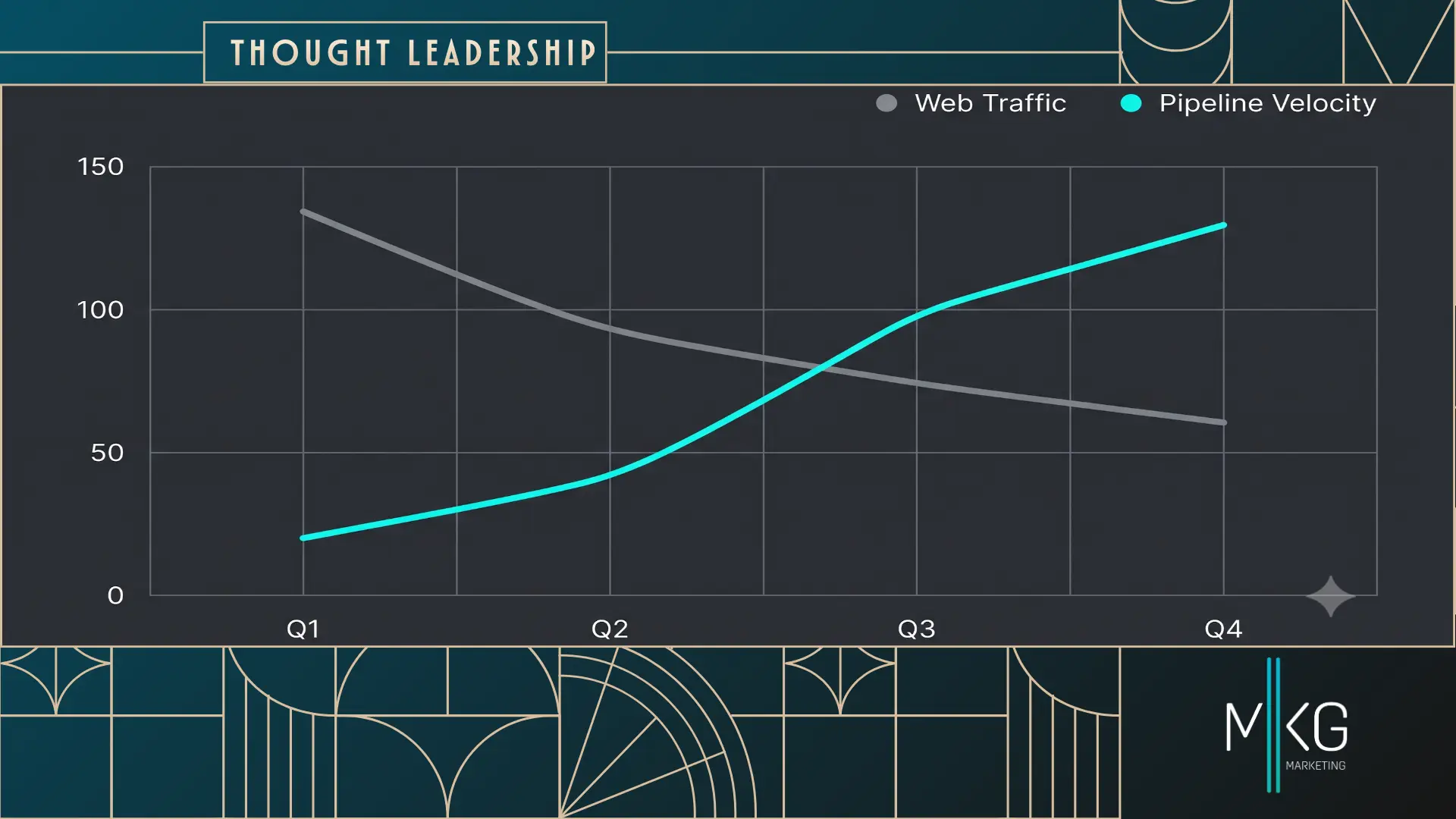
Let’s answer the question on every marketing leader’s mind right away: No, AI content is not inherently bad for SEO. Google does not automatically penalize text simply because an artificial intelligence model generated it. In fact, Google’s official Search guidelines state that the search engine ranks content based on its helpfulness, relevance, and quality—not on who (or what) typed the words.
However, there is a massive caveat that every modern CMO and VP of Marketing must understand: publishing unedited, mass-produced AI text is a fast track to losing traffic.
While AI can drastically accelerate your research and drafting phases, relying on raw algorithm outputs to power your organic search strategy will inevitably hurt your brand. The internet is quickly becoming flooded with synthesized, low-effort fluff. Search engines are aggressively updating their algorithms to identify and down-rank generic copy that fails to bring new value to the web.
So, does AI-generated content impact SEO? Absolutely—for better or for worse depending entirely on how you use it. To navigate this new era of search, B2B software and tech companies must learn how to safely leverage AI as an efficiency tool while keeping senior human strategy in full control.  What Google Actually Cites About AI-Generated Content
A widespread myth floating around boardrooms is that Google possesses a universal "AI detector" that immediately penalizes any site using machine learning tools. This misconception has led to two extreme behaviors: organizations either banned AI entirely out of fear, or they went all-in, firing editorial teams and pumping out hundreds of unvetted AI articles a month.
Both approaches are flawed. Google’s position on AI content is clear and consistent:
- Intent matters over medium: If you use automation, including generative AI, primarily to manipulate search rankings, it is considered a violation of Google's spam policies.
- Quality is the ultimate benchmark: If your content offers original information, insightful analysis, and clear utility to the searcher, Google will reward it—regardless of whether AI helped draft the paragraphs.
This distinction rests on Google’s E-E-A-T framework: Experience, Expertise, Authoritativeness, and Trustworthiness.
Generative AI models are trained on existing web data; by design, they scrape, synthesize, and regurgitate information that has already been published. They cannot draw from personal background, run proprietary benchmark studies, or conduct interviews with industry veterans. Therefore, raw AI content inherently lacks the "First-Hand Experience" and deep "Expertise" required to satisfy modern search criteria.
Why Copy-Pasting AI Copy Destroys Your Organic Traffic
If Google doesn't penalize AI text on principle, why are so many tech sites seeing their organic impressions plummet after launching automated content initiatives? The answer lies in the subtle traps of machine-generated prose.
1. The Information Gain Problem
Search engine algorithms are increasingly prioritizing Information Gain—a metric that measures whether a piece of content adds new facts, perspectives, or data points to a topic compared to existing index results. When an AI tool drafts an article, it simply summarizes what the top ten results on Google are already saying. It offers zero information gain. If your page is merely an average of what is already online, Google has no incentive to rank you above established competitors.
2. Hallucinations and Brand Risk
Large Language Models (LLMs) are predictive engines, not factual databases. They routinely invent statistics, misquote technical documentation, and present incorrect product capabilities with total confidence. Publishing hallucinated facts erodes consumer trust and signals to search crawlers that your site lacks basic editorial integrity.
3. The Homogenization of Brand Voice
B2B tech buyers are sophisticated. They can spot low-effort, synthetic writing instantly. Text bloated with hollow transitions ("In today's fast-paced digital landscape..." or "It is crucial to leverage...") signals to prospects that your company lacks real point-of-view authority. If your content sounds identical to every competitor using the same prompts, you lose your market positioning.
Expert Insight from MKG Marketing:
"The AI has no reason to pick yours over theirs. It's looking for something it can confidently reuse, and if your version doesn't add anything new, you're background noise.
So instead of writing more, I'm going page by page through what already exists and asking one question: does this page say something that no other page on the internet says?
Original data. A real client pattern you documented. A first-person account of what actually happened when you tried the thing everyone recommends.
That's what AI pulls in. The generic stuff is what AI already has forty versions of. It doesn't need yours."
— Kerry Guard, CEO of MKG Marketing
 How to Safely Use AI as a Marketing Assistant (Not a Lead Strategist)
To succeed in search today, modern tech companies don't need to abandon AI; they need to integrate it into a human-led editorial workflow. AI should act as the junior analyst that handles heavy administrative lifting, while senior strategists serve as the editorial director.
Here is how high-growth organizations use AI tools safely without putting their search performance at risk:
1. Accelerate Research and Formatting
Use AI to synthesize lengthy transcripts, cluster search intent, organize raw data, and draft initial structural outlines. Asking an AI tool to suggest five logical structural flows for a technical guide saves hours of brainstorming without diluting your editorial voice.
2. Inject Proprietary Data and Human Storytelling
Once a rough outline or foundational draft exists, a subject matter expert (SME) must step in. Inject real-world elements that an algorithm can never produce:
- Customer case studies and real implementation metrics.
- Direct quotes from internal product architects or sales engineers.
- Unique takeaways or counter-intuitive opinions that challenge status-quo industry advice.
3. Rigorous Fact-Checking and Editorial Oversight
Every claim, statistic, and technical instruction generated during the drafting phase must be verified by a human editor. Ensure the tone matches your brand guidelines and eliminate boilerplate AI phrasing.
Want to see how your current search strategy measures up against the latest engine updates? Explore our comprehensive Search Visibility Optimization (SVO) services or book an initial search strategy review with our senior team today.
 Beyond Traditional SEO: Preparing for Search Visibility Optimization (SVO)
The debate over whether AI-generated content is good for seo is part of a much larger shift in how users find information. Search is no longer confined to a list of ten blue links on a traditional search results page.
With the rapid adoption of AI Overviews, ChatGPT, Claude, and Perplexity, users are increasingly getting direct answers synthesized and generated right inside search interfaces. This shift means that optimizing purely for keyword clicks is no longer enough. You must optimize for total brand visibility across AI search models and traditional engines alike.
This evolution is what we call Search Visibility Optimization (SVO).
To win in an SVO-driven ecosystem, your content must be authoritative enough that AI models choose to cite your brand as the primary source of truth. Generic, auto-generated articles will never be cited by AI search tools because those articles lack original authority. The only way to capture mindshare in both AI answers and traditional search lists is by publishing high-gain, expert-driven content that clearly demonstrates E-E-A-T.
If your organic reach is stalling due to changing algorithms, taking a holistic view of your digital presence is essential. Aligning your organic content strategy with high-intent paid acquisition via Digital Advertising and measuring true user journeys through robust Digital Analytics ensures your marketing engine generates pipeline—not just empty clicks.
Summary: Adapting Your Search Engine Strategy for Long-Term Growth
To recap: does AI-generated content impact SEO? Yes. If you treat AI as a magic shortcut to generate hundreds of unvetted blog posts, your search visibility will eventually collapse; quickly building a house out of AI sticks won’t protect you when the Big Bad Search Engine Wolf comes calling. But if you treat AI as an efficiency engine that supports a human-led, expert-driven content pipeline, you can scale output without sacrificing rankings.
As search engines adapt to the flood of synthetic content, companies must adapt how they communicate with their buyers. The brands that win over the next decade won't be those that avoid AI, nor will they be those that hand their entire marketing strategy over to algorithms. The winners will be the organizations that pair cutting-edge tools with an authentic, human-driven brand voice.
At MKG Marketing, we don't pass your search strategy off to junior account managers or unmonitored software bots. We provide an experienced, senior-led team that handles both the high-level strategy and technical execution directly. We help B2B tech and software companies navigate complex search updates, build a sustainable organic pipeline, and maintain complete operational control over their brand narrative.
Ready to Build a Future-Proof Search Strategy?
- Learn how our senior-led team can audit and elevate your organic reach. Explore our Search Visibility Optimization (SVO) Services & Strategy Reviews.
- Have immediate questions about your traffic or upcoming search updates? Contact the MKG Marketing Team directly to schedule a consultation.
- Want to dive deeper into modern search trends? Read our latest guide: Beyond Last-Click: How to Measure Marketing Influence in an AI-First World.