You are sitting at your desk, and it is 12:42 AM. The rest of your house is completely dark. The only illumination comes from the harsh blue glow of your laptop screen, where a half-finished LinkedIn post and a messy content brief are staring back at you. Your eyes are bloodshot, your third cup of coffee from earlier today has long since turned into a hollow pit in your stomach, and you are trying to remember how you ended up here.
You are a Series B founder. You have raised millions of dollars. You have a product that customers love, an engineering team shipping code daily, and a board that expects you to double ARR over the next twelve months. Yet, instead of steering the ship, setting strategic partnerships, or closing enterprise deals, you are spending your midnights editing paragraphs, fixing broken formatting, and playing the role of a junior copywriter.
This is the reality of the founder bottleneck, and it’s a desert where you cannot function.
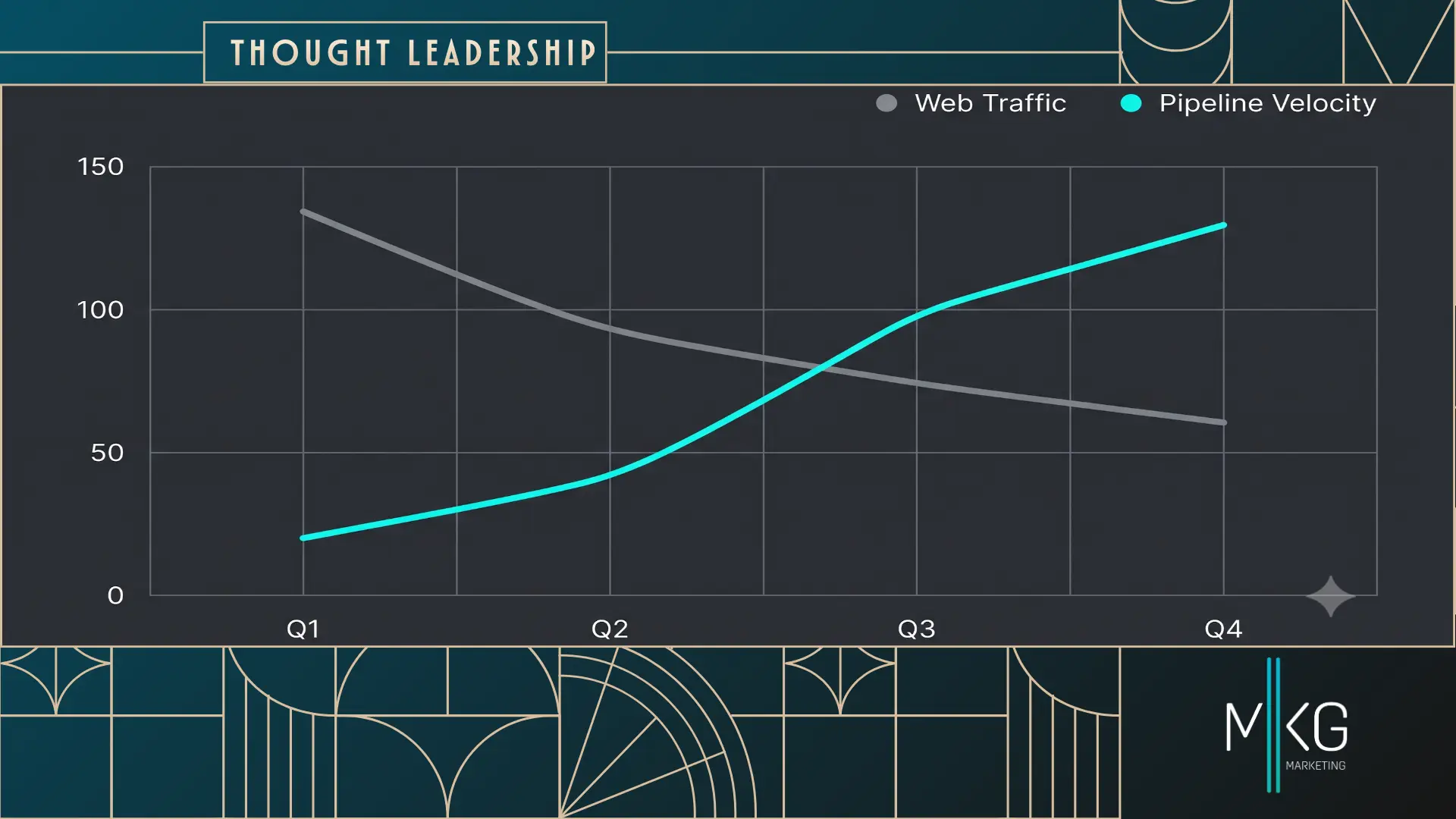
Every single week, you are losing 15 to 20 hours to pure marketing chaos. You are acting as the human router between a disjointed network of freelancers: a writer who doesn’t understand your technical product, an SEO specialist who just dumps keyword spreadsheets into your inbox, and a graphic designer who takes four days to fix a font color. You are trapped in an exhausting cycle of constant review, micro-management, and point-solution firefighting, all to combat a terrifying trend: your organic traffic is dropping, and your pipeline is flattening out.
You didn't build a high-growth SaaS company to become a stressed-out project manager for outsourced contractors. It’s time to stop committing random acts of marketing (RAM) at midnight and build a growth engine that runs entirely without you.

The Chaos Trap: Why Point-Solutions Are Killing Your Growth
When you first raised your Series B round, the mandate was simple: scale the pipeline. To achieve that, you likely followed the traditional digital marketing playbook. You hired a few niche freelancers, brought on a boutique agency for paid ads, and tasked yourself with overseeing the output.
It seemed efficient on paper. In practice, it created a highly fragmented system that demands your constant attention to survive. Niche agencies and freelancers operate in isolation; your SEO vendor doesn't talk to your content writer, and your content writer has no idea what your paid media team is testing.
Because there is no unified strategy or shared operational framework, the responsibility of connecting the dots falls entirely on your shoulders. You become the central node. Nothing moves unless you review it, approve it, or fix it.
This fragmentation results in three critical failure points for a Series B organization:
- The Velocity Crisis: Because you are managing independent contractors, a single piece of content takes three weeks to move from ideation to publication. By the time it goes live, the market window has shifted.
- Vanity Metric Overload: Your point-solution vendors will always defend their specific silo. The SEO agency points to rising impressions, the copywriter points to word count, but neither can tell you how many qualified opportunities entered your CRM this month.
- Strategic Disconnect: Freelancers write for search engine algorithms or generic audiences—they do not write for your buyers. Without deep product context, the content feels shallow, failing to capture the strategic narrative required to win enterprise deals.
This operational drag represents a massive hidden cost. When you spend 20 hours a week acting as a tactical traffic cop, you are not doing the high-leverage work that your board actually measured you on. You are sacrificing strategic growth to keep a broken execution model on life support.
Moving Beyond Chaos to a Systemized Pipeline
To break free from this operational quicksand, your organization must transition away from disjointed point-solutions and embrace a unified framework. You do not need more freelancers to manage; you need an integrated execution model that converts your strategic vision into a pipeline without demanding your personal time.
This is where the shift to a systemized pipeline occurs. Instead of treating marketing as a series of isolated creative projects, it must be run as an integrated product engine.
[Strategic Vision] ➔ [Integrated Execution Partner] ➔ [Systemized Pipeline]
A systemized growth engine relies on two foundational pillars: operational control and financial predictability. When these two elements are integrated into your growth strategy, the need for midnight editing vanishes.

The primary reason founders get pulled into tactical execution is a lack of visibility. When marketing operates inside a black box of messy email threads, scattered Slack channels, and fragmented Google Docs, you naturally micro-manage because you cannot see what is happening until it is either late or broken.
True operational control means replacing communication chaos with absolute transparency. By consolidating all marketing execution into a single, centralized platform—such as fully optimized Asana sprint boards—you gain immediate clarity.
At any moment, you can look at a single dashboard and see exactly:
- What strategic initiatives are currently in production.
- Who owns the next step of execution (design, copy, technical implementation).
- The precise launch date for every campaign, asset, and distribution channel.
When production workflows are systematized, you no longer need to check in on people. You don't have to send "Is this ready yet?" Slack messages at 10:00 PM. The system provides the visibility, allowing you to step out of the project manager role and step back into the visionary role.
The second major friction point in scaling a marketing engine is financial unpredictability. Traditional agency models are intentionally opaque. They hide behind complex retainers, unpredictable hourly billing, and sudden scope-change fees that require constant negotiation.
Every time you want to pivot strategy, launch a new experiment, or spin up an extra campaign, you are forced to review a new statement of work (SOW) or argue over out-of-scope costs. This introduces massive procurement delays and wastes precious executive energy.
A modern growth engine eliminates this friction through fully transparent, published pricing models. When your execution partner operates on flat, predictable rates with clearly defined monthly deliverables, budgeting becomes simple. You know exactly what you are spending, precisely what you are getting, and you never have to waste time auditing a confusing invoice from an agency partner.

The Execution Playbook: Shifting From Thinker to Reviewer
Building a self-running growth engine does not mean you abandon marketing entirely. Your strategic insights as a founder are incredibly valuable; you understand the market, the product, and the customer better than anyone else. The goal is to change how your insights are extracted and executed.
You must transition from being the primary creator to the strategic reviewer. Here is how an integrated execution model restructures your workflow to give you your time back:
| Workflow Phase | The Legacy Way (Founder as Creator) | The Systemized Way (Founder as Reviewer) |
|---|---|---|
| Ideation & Strategy | Founder spends hours researching keywords and drafting outlines from scratch. | Founder records a 10-minute Loom brief outlining core strategic concepts. |
| Production & Layout | Founder routes drafts between isolated freelance writers and graphic designers. | Integrated partner handles research, writing, design, and technical setup natively. |
| Quality Control | Founder spends midnights rewriting poor copy and fixing formatting errors. | Founder reviews a polished, near-final asset inside an Asana sprint board for approval. |
| Analytics & Reporting | Founder logs into multiple dashboards trying to connect traffic to revenue. | Integrated partner delivers a single dashboard showing direct pipeline velocity impact. |
By shifting your input to the very beginning of the loop (sharing your unique domain expertise) and the very end of the loop (final sign-off), you cut your time investment down from 20 hours a week to less than two. The entire middle phase, the heavy lifting of research, drafting, designing, and optimizing, is handled by an integrated execution system designed to scale.
Reclaiming Your Executive Leverage
Every hour you spend editing a blog post, tweaking a landing page headline, or tracking down an unresponsive freelancer is an hour stolen from the strategic growth of your company.
At the Series B stage, your board is not evaluating your performance based on how many articles you published or how many keyword metrics went up. They are looking at capital efficiency, scalable customer acquisition, and ARR growth.
When you break the founder bottleneck and replace random acts of marketing with a systematized pipeline, you aren't just cleaning up your marketing operations. You are reclaiming your executive leverage. You are giving yourself the operational freedom to focus on fundraising, culture, enterprise sales, and product innovation, the high-leverage work that actually moves the valuation needle.
Leave the midnight writing sessions behind. Build a systemized growth engine that operationalizes your marketing, gives you absolute visibility, and scales your pipeline predictably month after month.