Big launches are intoxicating.
They come with urgency, deadlines, and a clear finish line. Everyone rallies. The deck gets polished. The campaign goes live. The team feels momentum, because for a moment, everything moves at once.
Then… it fades.
The backlog fills up again. Priorities shift. The team goes quiet while they “catch up.” And the market stops hearing from you until the next big push.
That cycle—burst, silence, burst—has become the default operating mode for many Series A–C teams. It’s understandable. Resources are lean. Everyone wears five hats. The calendar is full. So marketing becomes a series of sprints toward a launch and long stretches of maintenance in between.
But here’s the problem: the market doesn’t reward bursts. It rewards presence. And in 2026, it’s not just humans paying attention. AI systems are constantly learning your category, absorbing patterns, sources, and repeated signals of authority.
When you disappear, you don’t just lose awareness. You lose momentum within the systems that shape recommendations.
This is the quiet cost of “big launch mentality”: you stall your own growth engine.
Because growth isn’t a one-time event. It’s a rhythm.

Bursts, Silence, and the New Cost of Going Quiet
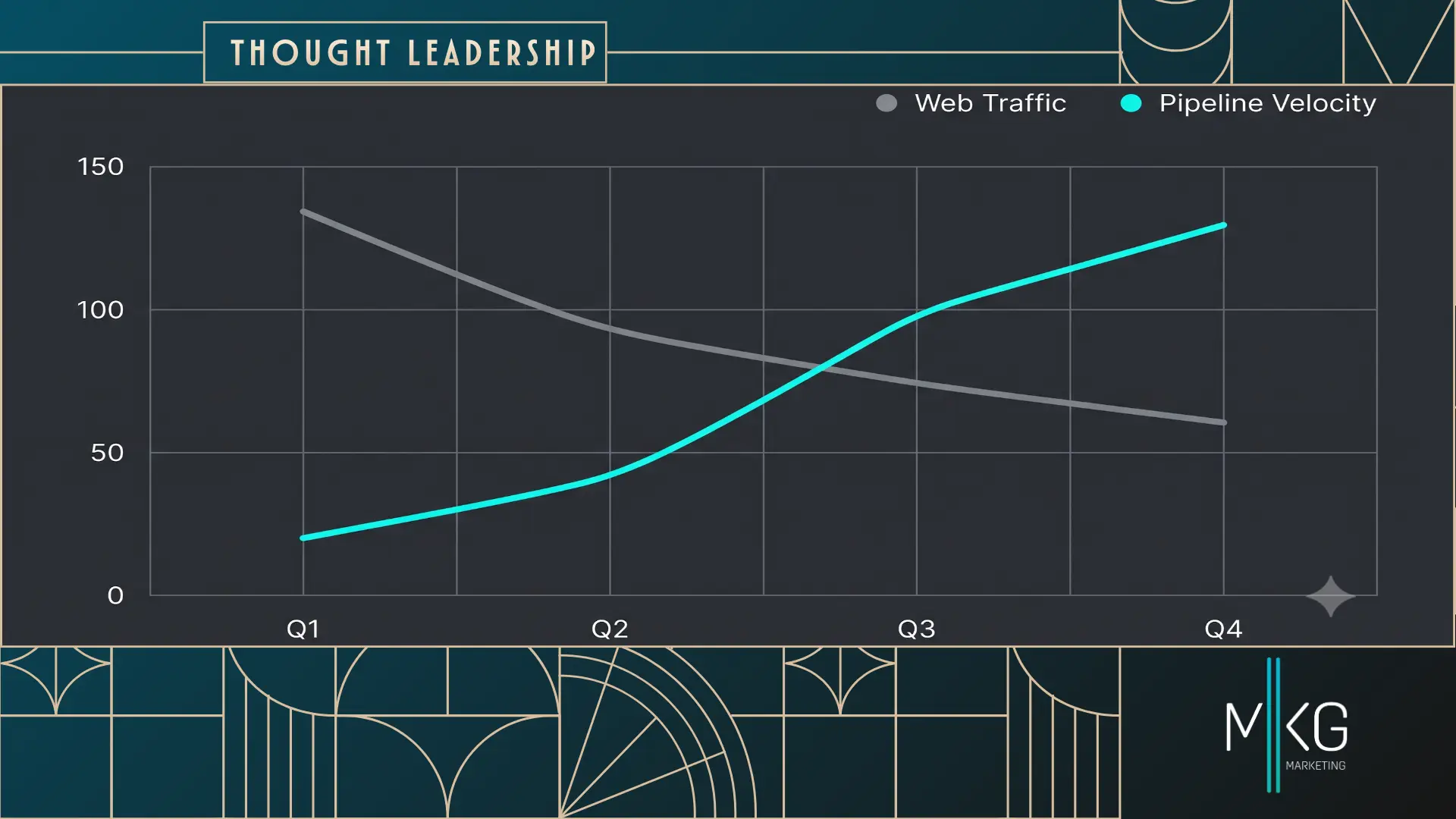
The chaos is subtle because bursts can still produce wins. You might see a spike in traffic. A jump in demos. A short-lived lift in the pipeline. The team celebrates. It worked.
But then you go quiet, and the compounding stops.
Here’s what that burst-and-silence pattern creates:
- Your messaging changes every launch, so the market never learns your true position
- Your channels never stabilize long enough to optimize properly
- Your reporting resets every quarter instead of building trend clarity
- Your content footprint looks inconsistent, even if each piece is good
- Your audience hears from you in waves, not in a steady cadence
And now there’s a newer problem: Share of Model.
AI systems learn from repeated, consistent signals across the web. They pick up on brands that appear frequently, say the same thing consistently, and earn citations over time. If your presence is episodic, you’re easier to forget and harder to recommend.
In other words: you’re not just competing for attention. You’re competing for memory.
A launch spike doesn’t build memory. Rhythm does.
That’s why “Random Acts” marketing is so expensive. Not because it never works, but because it can’t compound. It creates isolated moments instead of an engine.
If your team is constantly trying to recreate momentum from scratch, it’s not a creativity problem. It’s an operating problem.
Rhythm (TRACK) and the Systemic Always-On Model
At MKG, we anchor the fix to the Rhythm pillar of TRACK.
Rhythm is what turns marketing from a series of heroic pushes into a predictable engine. It’s the cadence that keeps your message, your channels, and your measurement moving forward—even when no “big launch” is happening.
When Rhythm is present, momentum becomes structural.
That’s what mkgOS is built to do: create a Systemic Always-On approach where progress is weekly, not occasional. It’s not “always-on” in the sense of running the same campaign forever. It’s always-on in the sense of maintaining a consistent operating heartbeat:
- Weekly priorities
- Weekly shipping
- Weekly learning
- Weekly refinement
This is how you stay top-of-mind for humans, and stay present in the training data patterns that shape AI recommendations.
And it’s how you stop treating growth like a series of events and start treating it like a system.

Why Rhythm Beats Launches (Even When Launches Are Good)
Launches have a place. But launches are peaks. And peaks only matter if there’s a base underneath them.
Rhythm builds the base.
Here’s what changes when you shift from “big launch” to “rhythmic engine”:
1) Your message becomes learnable
A market can’t remember what keeps changing. When you ship consistently, your core story repeats across multiple surfaces. That repetition isn’t boring—it’s what creates clarity. It’s how people (and AI systems) learn what you’re known for.
2) Your channels become optimizable
Bursts don’t allow iteration. Rhythm does.
Paid campaigns get smarter because learnings roll forward week after week. Content gets sharper because you’re building depth, not just volume. Landing pages improve because you’re refining based on patterns, not hunches.
3) Your measurement becomes trustworthy
When everything happens in spikes, measurement becomes emotional. A rhythm creates baselines. Baselines create honest decisions. Honest decisions create better outcomes.
4) Your team stops restarting
This is the hidden benefit. Rhythm reduces reinvention. When you run an operating cadence, you’re not rebuilding a plan every time. You’re adjusting a system that’s already moving.
This is the difference between pushing a stalled car and driving an engine that’s already running.
What “Systemic Always-On” Looks Like in Practice
Systemic always-on doesn’t mean doing everything, all the time. It means doing the right things consistently.
Here’s the mkgOS-style structure:
Weekly: Ship something that compounds
Not “post for posting’s sake.” Something that moves the system:
- A new insight published in an authoritative lane.
- A landing page refinement tied to performance data.
- A campaign iteration based on what the market responded to.
- A proof asset, case snippet, or use-case expansion.
- A distribution push that earns external mentions
The key is that each week builds on the last.
Monthly: Turn learning into next actions
Monthly shouldn’t be “reporting theater.” It should be:
- What worked
- What didn’t
- What we’re changing
- What we’re doubling down on
This is how marketing consistency becomes measurable, not just aspirational.
Quarterly: Use launches as accelerators, not lifeboats
Launches become strategic peaks atop a stable base. Instead of “we need a launch to create momentum,” it becomes “the launch amplifies the momentum we already have.”
That’s how launches become powerful again: because they’re not carrying the entire strategy.

The 2026 reality: Consistency is the growth strategy
In 2026, you don’t just need a strong message. You need a strong cadence.
Markets are noisy. Trust is scarce. AI tools are compressing categories into shortlists based on repeated, consistent signals. If you go quiet, you don’t just lose attention—you lose position.
This is why Marketing Consistency isn’t a nice-to-have. It’s a core lever in any modern B2B Growth Strategy (and yes, even if you avoid the acronym in your public-facing copy, the operational reality is the same). It’s also why teams focused on Scaling Series B Marketing hit a wall when they rely on launches: the business outgrows burst mode.
The brands that win aren’t the ones with the biggest moments. They’re the ones with the steadiest engine.
mkgOS exists for this exact shift: from random acts to rhythm, from spikes to systems, from launch mentality to compounding momentum.
Because the real unlock isn’t the next big launch.
It’s the rhythmic engine you build in between.