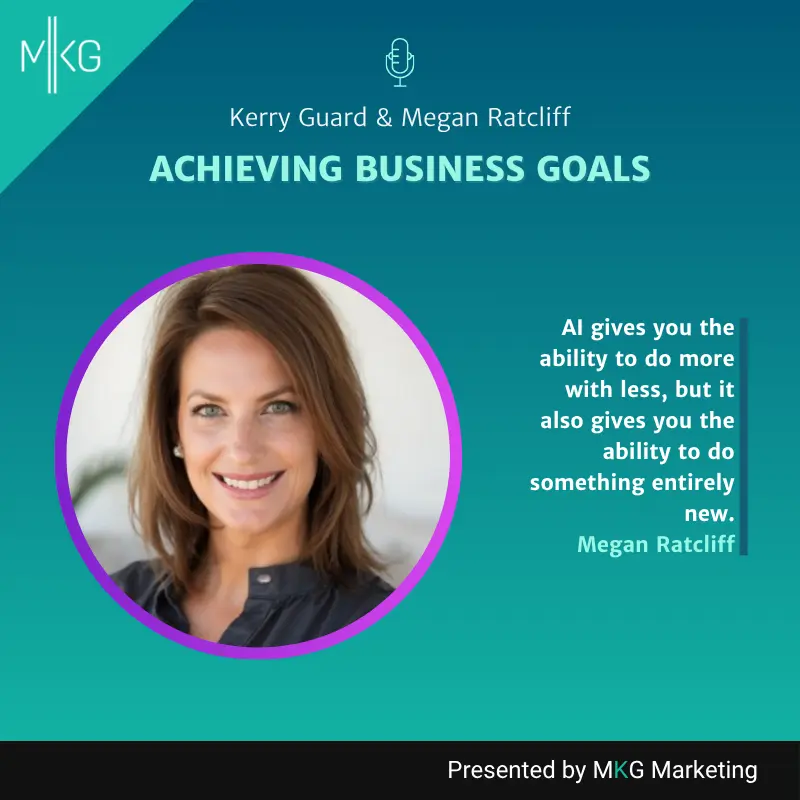
Megan Ratcliff
Megan Ratcliff helps organizations turn AI from a promising tool into a practical advantage by building AI fluency, redesigning workflows, and empowering teams to do their best work.
Overview
Megan explains why many organizations are approaching AI the wrong way by focusing on tools instead of transformation. She breaks down the foundational elements of successful AI adoption—including fluency, governance, context, data, and human judgment—and explores how companies can reorganize around outcomes rather than outdated workflows. The conversation reinforces a central theme: AI should amplify human potential, not replace it, and the organizations that thrive will be the ones that use technology to unlock new value rather than simply reduce headcount.
Transcript:
Kerry Guard 0:15
Hello, and welcome back to Back on Track. I'm Kerry Guard, your host and the CEO of MKG Marketing. Quick word on what we do, because visibility gets thrown around a lot. Getting found today takes three things working together: SEO, so Google ranks you, AEO, so you show up in Google's answer engine, and geo, so you get cited inside the LLMs like ChatGPT, Perplexity, Gemini, et cetera, where your buyers are not asking, where buyers are now asking their questions. You need all three. That's why we built our search visibility optimization framework. It lays the foundation, so your content actually gets cited where people are searching, not buried on page two. Welcome to the show. I'm so excited for this episode. This show is for the marketing and go-to marketing leaders, figuring out how to do more meaningful work, often with inner teams, more tools, and a whole lot of noise, mostly about AI. If that's you, you're not behind; you probably just jumped in the middle, and we're here to get you back to the beginning in the right order. And my guest today is thinking harder than just about anyone about what the beginning actually looks like. I'm so happy to introduce Megan Ratcliffe, partner at Clarity In Motion Collective. Megan has deep demand gen roots, and after leading an AI transformation inside a high-stakes GTM org, she and her partners, Keryn and Asma, set out to do something bigger: help revenue teams turn AI from an abstract promise into a real operational advantage with speed, with humanity, and without replacing the people who make a company worth buying from. She's not just teaching teams to use AI, she's helping them rethink the whole shape of how work gets done. Megan, welcome to the show.
Megan Ratcliff 2:02
Oh, thank you for having me. I'm excited to be here.
Kerry Guard 2:05
Oh, I've been looking forward to this. I am super excited as well. Let's get right into it. You, for folks meeting you for the first time, tell us about Clarity in Motion Collective. You and Carolyn did the AI transformation at your last company. People started asking you to come speak, and you basically went, 'Wait, this is the most fun we've ever had. Take us back to that moment. What made you jump in?
Megan Ratcliff 2:30
Yeah, for sure. So, Carolyn and I have worked together, like, for several years in different capacities. She was a client of mine to begin with, and then I called her one day, and I was like, "What are you doing? And she's like, "I'm doing this new thing over here, and I was like, 'Cool, I want to come. So she was the VP of marketing at like a B2B SaaS company, and I was like, "Cool, I've never like worked inside of an org before, I've always worked on the agency side. So I was like, "How hard can it be? So I jumped in, and like, at that time, is when Chat GPT became public, and so we were like, "What, there's an opportunity here? And so we were a tiny company going against like a Goliath of a competitor, and so we didn't have a lot of time, we didn't have a lot of resources, there wasn't a lot of money floating around like our budget compared to theirs was insane, and we didn't have any additional head count that we could add, so we were like, what can we do, and so that's where the idea of AI ecosystem was born, and it's about, you know, adding on skills that you don't have, so that you can like really fill out the role, and so we started to do that together, and from that, like, little seed, the entire marketing org transformed, and it took, it's not overnight, it like takes a while for people to get this figured out, and the work changes, and then other teams inside of that company were like, "not back, what are you guys doing? so then we started presenting to the other teams and helping them do this transformation, and then, like, other companies started to catch wind of this, and they were like, "What are you guys doing? And so we decided to just like jump off on our own and start doing this, and we brought along a partner, her name is Esma Stewart, who is brilliant, and she was leading the AI transformation at a very highly regulated agency, and we were like, we need you to come on board, because what we're doing isn't easy. A lot of the clients that we're talking to are in highly regulated industries, so we need to figure out how to do this safely and responsibly, so that teams get the most benefit out of it without exposing themselves to risk. So that's how it was born. It started just about a year ago. Oh
Kerry Guard 4:43
My gosh, I feel like in the age of building a company, a year ago is probably like, if you know, if we're talking, feels like forever.
Megan Ratcliff 4:51
Yes.
Kerry Guard 4:52
Yeah, like dog years, right, versus yes, cat years versus human years. So one year is probably five years. So what's. You know, Chat GPT comes on board, you know, comes out to be a thing, you guys jump on board with it, you figure out how to utilize it. What's changed since then? You know, we got new tools, new capabilities. What do you say has been the biggest shift in AI in the last year?
Megan Ratcliff 5:16
Oh my gosh, like, what hasn't changed? I feel like I feel like just have the ability to mature what you're able to do on your own, so I'm non-technical. Carolyn and Esma are more technical than I am. Carolyn ran off at one point, and Esma is just like a builder by nature. It's foreign to me to be a builder, so the fact that this, like, all clicked in my brain so easily was lovely, but the thing that I think has changed the most was, like, the onset of co-work when that came from Anthropic, because that opened doors for non-technical folks to get in and do actual work, and to create automations that they weren't able to do previously, before you would need to use a tool like Z Pier or Make or NADN, and coming from a non-technical background like I did, even getting into NAD and like trying to figure it out was very difficult, and so the unlock for me was co-work being accessible to me, and me being able to like figure out how that system worked, so when I first like started getting in there and using it, I was like cloud code curious, and I was like, I think I can do this also, but I want a tutorial from an actual like machine learning engineer first, and so we like get into this lesson, and he was like, okay, here's what we're going to do. He like started in the terminal, and I was like, "Oh no, but he was talking about file structure, and I was like, "This is boring. Why are we doing this? And he's like, "You will see why this becomes fundamentally important. And so we worked on, like, setting up file structure first. This is how it works. This is the hierarchy of the files. This is what belongs in here. And after that lesson, I was like, oh my gosh, you are so right. So now when I work with clients, it's less like what's the custom GPT we're going to build, and it's more like what is the outcome that we want to achieve. Let's set up our context and file structure to set us up for success, and then let's figure out what it is that we need to build, so it's been quite fascinating since the launch of Co-work. I will say, and then with Codex coming out, you have a couple of options on what you want to do.
Kerry Guard 7:34
I love Co-work,
Megan Ratcliff 7:37
It's so good, it's so fun.
Kerry Guard 7:39
My first experience with AI, like outside of just prompting, was when I started with Cursor about a year ago. Yeah, redid a client's website in a month using Cursor. It was wild because with Tailwind UI and Nux JS, and Cursor, I was just flying, but I wanted more. I was, but I was like, I want to do this with everything, like, why can't everything just where I could just go into a window, and I start asking things, and then things start happening behind the scenes, now I have to touch it, like.
Megan Ratcliff 8:14
Yeah.
Kerry Guard 8:14
When does that happen? Then, yeah, Claude Cohen came out, and I was like, " This is amazing.
Megan Ratcliff 8:18
It is the best I know. Well, and then when Cloud Design came out, I was like, tried
Kerry Guard 8:23
That yet?
Megan Ratcliff 8:24
Oh my gosh, it's like, it's like, so incredible. Like, literally, this morning I was on a call with somebody, and the point of the call was not to do the thing that we did. It's like we were squirrels, and we went off, but she was like, you know what I want to build is I want to build like this interactive game that I can bring to trade shows and events, and I was like, I love that, say more. And so she, as she was talking, I was in cloud design, I had built their design system already, so like everything was already in there, and so she was like, okay, I want it, I want to be able to like find the bugs that are in websites, so I want to create like a fictitious website, and like the user has to find the bugs in 60 seconds, and the faster they do it, the higher the score. And then, well, let's have a leaderboard, and I wanted to be lead gen, and this, and then that, and then the other thing, and I was like, cool. So I was like, I will build this over here, let's do your real work over here. And then by the end of the session, we had her functioning game built. I sent it to Climb Code, and it started building it, so I was like, there you go, there's your game. Her brain exploded. She was like, " This is magic, and I was like, it feels like magic, doesn't it?
Kerry Guard 9:31
It does feel like magic. Let's talk about the building blocks, because you mentioned them in terms of file structure, which I totally agree with getting your, getting your folder set up so that Claude knows sort of its boundaries. I think it is also a safety feature. Yeah, I haven't given it, I'm like scared to hook it up to my Google Drive.
Megan Ratcliff 9:54
Yeah,
Kerry Guard 9:56
yeah. Have you done it? Yeah, of course, of course, I. Of course, did you put guard rails or anything around it to like try, and
Megan Ratcliff 10:04
yeah, so like, yeah, so when you're in Claude, when you add a connector, there's like certain permissions that you can give it, like you're allowed to do this, you're not allowed to do this, or you need to ask me before you do this, and the way that I always like advise on this is, if you want to connect to a drive, create a sandbox and only connect to that sandbox, only use projects inside of that place, just to keep things in one little spot. If you're going to manipulate a file, make a copy of that file. So there are definite things that you can do to help safeguard, but I think that there's still a lot that we're learning about how these models work, what they can access, and what they can't. So it's always best to be a little bit cautious. I would err on the side of being more conservative with what you're willing to connect, watch what other people do first, learn from what happens to them before you like jump in and go crazy, but, but, yeah, the connectors do make things just like really streamlined and really wonderful, but we have a cloud sandbox set up in our business, so everything runs through OneDrive rather than the whole thing. Yeah.
Kerry Guard 11:16
Even on my computer, it jumped files. I had it in a folder, it's supposed to only stay in that folder, and it totally jumped folders like the project went outside of that project into another folder project and pulled from that one and added the folder to this project. I was like, no, no, that folder does not belong in this project. I don't know how you did that or knew to do that, but no, undo. Yay, put that back over there. yeah.
Megan Ratcliff 11:43
If that folder had been accessed previously, that's probably how that happened, but if it had never been accessed before, that is, that's a little fun. That
Kerry Guard 11:52
project, let's, yeah, what are some other foundational building blocks that we need to be taking? I know that we're all just plowing ahead, you know, figuring stuff out as we go, but what else should we, if we could start over, or at least take a huge step back?
Megan Ratcliff 12:15
Yeah,
Kerry Guard 12:16
What else should we be taking into consideration?
Megan Ratcliff 12:18
So, like, the biggest things that are foundationally important, and I think get skipped a lot, are like org-wide AI fluency, and fluency and literacy are different, you know. Anyone can, like, get into the cloud or get into Gemini and, like, click around and figure out how the tool works, but fluency is fundamentally different. It's about how you work with these, how you think about these tools, and fluency is tool agnostic, so thinking about, you know, how do I break down a problem into smaller pieces, so that's actually achievable. What belongs in AI versus what belongs with humans? What kind of context is helpful and structured correctly, versus what is noise? How do I detect drift? How do I restart a conversation when I've reached drift? How do I audit my work to make sure I'm not shipping something that's AI slop or not factual? So those are like the fundamental fluency skills that we teach that I think a lot of organizations like plow right over, and you might get like one or two trainings from HR or IT, that's like here's what our AI policy is, and here's how you use the tool that we gave you, but a lot of them miss the fluency piece, and for fluency to really stick, it has to be customized to the work that you actually do, so if you're a marketer and you are like specifically a PMM, and you're getting examples from somebody in sales, that the fluency doesn't necessarily click for you, because that's not your job, you have to like see it in your work for you to be able to be like got it, mindset has shifted. Now, the other thing that I'll say is really important is governance. So, you probably, most people watching, probably have an AI policy somewhere sitting on a server in their organization, which is like, these are the approved tools. Don't put PII in there, don't do this, don't do that, don't do the other thing, don't start using a tool with a personal account like that's great and fine, every company should have that, but governance is like the living movement of how do we work with this technology across teams, how do we navigate this responsibly, how do we navigate this safely, what are like the decisions that have been made that help protect us as a company, what are the decisions that we've made, like, how risky are we going to be? How do we automate things? What's connected, what's not? So that's more like the living movement of how this happens in an organization, rather than like a staple to the wall. Here's the policy, so fluency, governance, those are the foundational pieces that need to be in place. For people to start to do this transformation in a really safe, responsible, but curious way.
Kerry Guard 15:07
You mentioned the difference between what the robot should do and what the humans should do. Do you have.. I know it changes, like you mentioned, it kind of changes per role, but yeah, do you have sort of like guidelines, best practices around what that should be? Yeah.
Megan Ratcliff 15:26
It's like super curated for each individual person, the role they play, and why they're approaching AI in the first place. So, my number one rule is don't give AI the things that you like to do. If you are a creative, keep that - you're the creative, that's what you like to do. Give AI the stuff you don't like to do. If you don't want to, like, manage a spreadsheet, AI is wonderful at doing that. If you are a type of person, maybe you have like a more balanced brain, and you're like, there are some things I do like to write and some things I don't like to decide what you like versus what you don't. So that's my number one rule, is keep the stuff you like to do offload the stuff you don't, because of the way the AI is moving and changing, and like the sections that each of these AI companies are investing in, there's a lot of things it can do that it used to not be able to, so it's kind of like you get to choose what you offload versus what you don't, but when it comes to judgment, that should always be a human, AI can't practice judgment when it comes to like actual innovation and actual creativity, like AI cannot create something new or novel, only humans can do that. So those are the things that I like; those things stay human. Well, you can offload most other things to AI, but keep what you like to do, and offload the rest.
Kerry Guard 17:07
It's your expertise too.
Megan Ratcliff 17:10
Yeah,1,000%
Kerry Guard 17:11
Somebody said the other day on LinkedIn that they used AI - they're a writer, it's what they do. They write LinkedIn posts, it's literally their job, and they offloaded it to AI, and it took them a whole day to write something that would have taken them an hour.
Megan Ratcliff 17:23
Yeah, I've had like a very similar experience with this. Well, first of all, like LinkedIn is a little bit wild these days, I will say, and it's a lot of people using AI in ways that it probably shouldn't be used, and when people give up their authentic voice to a robot, like it's missing its soul, and it's easy to tell, right? There are certain language patterns AI picks up on that it's difficult to edit out with a prompt, it just is going to appear, and unless you're doing like really good line edits on it, it's going to be very visible that you use, you had an assist, right, which I don't think is like terrible all the time, but when I was first starting, I was using my pal Claude just to help me start to organize and frame what I was going to say, because when I first started like posting to LinkedIn, that felt like a very vulnerable moment for me, because I was like on my AI journey, like posting in real time about what I was learning and how I was progressing in my career. This was a couple of years ago, and I am not, by nature, a great writer. I have literal English majors in my family who are excellent writers, and it's not me; I can barely string a sentence together. So for me it was very vulnerable and scary to be posting about this, but also adding on that I'm not an eloquent, like, writer, those things together, so I was using it as an assist, but like, as I was doing that, and as I was progressing, I was like, you know what, this is missing is it's missing like my authenticity and my soul, so I stopped doing it, and so now everything that you read on my LinkedIn is that is a 100% me. I am writing that with my two fingers inside, usually in the LinkedIn box, and because of that, I think that builds more trust. So when we offload the writing that should come from an actual person to an AI, I think it becomes very visible and noticeable, and I think there's a breakdown in trust there.
Kerry Guard 19:27
I think there's a lot of breakdown and trust that's just happening across the board, even for, like, I know my daughter is calling, like, a 10-year-old looking at stuff on YouTube, like a slop, right? Like, yeah, she is just so in tune with it these days that I think these kids are going to be, they're going to tune it out, right?
Megan Ratcliff 19:49
Yeah, there's like, there's so much out there right now, like content is being generated, like there's more AI stuff on the internet than there is. Human created stuff at this point in time, which is crazy, but I think when people don't have the foundation of fluency and they don't have the foundation of governance, they're running wild and they're creating stuff that's not worthwhile any longer, and so you have to have those foundational pieces, like, I think AI is a wonderful assist to help with a lot of different things, but when you are just shipping straight AI-created material, first of all, that's like not defensible, like, you, it's not yours any longer, you can't claim it when there's no human intervention and there's no like polish on it that comes from a human, you can tell, and so that's where it starts to like be a breakdown in your audiences. They don't trust you any longer, because it's not you that's behind it, it's a robot.
Kerry Guard 20:53
From an SEO perspective, this is going to become - it's already is just so important in terms of the content that's being produced, because if it's not different to your point earlier about needing to make sure that as humans we're creating things that are net new and not just regurgitations of the World Wide Web.
Megan Ratcliff 21:14
Right.
Kerry Guard 21:14
That in order to get mentioned to show up in AI SEO, like we have to say something different, and it has to be in line with what the brand offers, and how the audience is thinking about the problem, and so I agree with you that AI is a great assist there in helping you figure out what the problem is, and how you're different in doing that deep research. Yeah, but man, I had tried to help me write the website, and I was like, you just, yeah.
Megan Ratcliff 21:51
Me, yeah, well, I'm like, the thing I think that it's easy for people to grasp, right, content is easy, I can use AI to write content, everyone's doing it everywhere, that's the, that's the shortcut. When you start working as, like, AI, as the, as a, like backup, as behind-the-scenes, that's where it becomes really valuable. So think about, as somebody who creates content, you have to, like, mine a lot of information, right? You need insights from different places where maybe you're not always at there's, you know, like Reddit, there's conversations going on all the time, or in like Trust Pilot, or whatever, like there's conversations happening all over the web, and what AI is really great at is like plucking those and bringing them back to you, so you can be like, oh, that is interesting, let me double tap on that a little bit. So, when you use it as your source of intelligence and helping you, like, kind of pull out this information, you, the human, are the one that's saying, this is the insight right here, I'm going to write about that. So, when you use it behind the scenes, that's what the time saver is. Yes, and that's what's going to make you more differentiated than somebody else, is because you're not just like rambling on because you can, you're talking about something that's important to somebody else, and that maybe they're not receiving an answer to, so you are answering their question, and that is the hard thing to do, and that's what the, like, best people are doing.
Kerry Guard 23:27
Yeah, allowing, freeing you up to focus on this, the things that really are what we need to be doing, versus moving data between sheets. Yes.
Kerry Guard 23:36
yeah.
Megan Ratcliff 23:36
Exactly.
Kerry Guard 23:38
You said the work you set out to do isn't the work you're actually doing now. It's become a change management moment, the chance to knock the whole structure down and rebuild it. What does that rebuild actually look like? So, we talked about fluency, we talked about governance, and we talked about the file structure. Is there any, like, what's the next step in that?
Megan Ratcliff 23:59
Yeah, so this is like where it starts to get hard and really uncomfortable for companies, and companies are not going to like cross the chasm without it, and it's you have to reorganize on outcomes, and so when we think about a marketing org, there are certain outcomes that you're signing up for each quarter or every year, and so when we put those like on the board, and then you look back at, okay, how do we actually achieve that? You have to start realigning the work that you're doing from the work that you've always done, and so to reach those outcomes, you can't do the work you've always done any longer, and you have to realign the people that do that, like actually works on that work, so it's about understanding everyone's skills, and then mapping out where we have gaps, mapping out the work to be done to achieve that outcome, which is it's not a new concept by any means. Microsoft wrote a really great paper on this last year, called the Frontier Firms, it. If you have an extra 25 minutes, I would read that front to back. I have read it probably 15 times. It's just an excellent case study on who's actually changing in this moment versus who is like cosplaying, and so just getting your team a Claude license without changing the way that work gets done is not actually changing anything. If you pulled the tool out, would the work have changed or not? If the answer is no, you're not doing this correctly. So, you fundamentally just have to change how work gets done in this time, because the work you used to do isn't the work that you're going to need to do moving forward. So, the vast majority of what I talk to leaders about now is, let's take a step back, what is the outcome you're actually trying to achieve? We need to rethink how work is getting done. Sometimes that involves an org structure change, like, oh, actually, we don't like these people are in the wrong roles, like they should be, we should have a marketing engineer now, or we should have, like, a go-to-market specialist that's pulling all these teams together, or we should have that, you know what I mean. And so we need to redeploy people in the roles that actually align with the skills that they have, rather than here's the traditional role that we used to be in, because that's how it's always been. So it's a big, big change management initiative. I would say it's like 80-20, 80% is change management, 20% is like learning the tooling, so that's something that absolutely cannot be ignored. And it's something that I'm working very closely with leaders on right now, is like figuring this out. How does it change? How does it shift? What does this look like in 612, 18 months?
Kerry Guard 26:44
GTM has been something that's been around for, I'd say, the last five years, maybe three, three to five years, but I feel like I'm now just understanding what it means, and I feel like AI is really making that role,
Megan Ratcliff 26:59
yeah.
Kerry Guard 27:00
solidified as like the thing you need, would it? What other roles has AI impacted in that way? Where it wasn't really a thing, or it was kind of sort of hovering in the background. You mentioned the, the, the marketing engineer - I've heard that term starting to sort of float now. What roles have changed, and what new roles are sort of coming up, thanks to this change management you're talking about?
Megan Ratcliff 27:27
Yeah, so a role that you're probably hearing a lot about is a go-to-market engineer, and previously, before AI, before AI, we had, you know, there would be sales, sales enablement, marketing, sometimes product marketing would sit outside of there. You would have customer success, so all of these teams were working independently of each other, right? Sometimes, like, marketing will call over to sales and be like, "What's the word on the street?" Or sales will call over to marketing and be like, " Hey, can I get a battle card? So, like, they were all functioning independently with the onset of AI, and honestly, just like with the shift of how companies need to work, you need a central like team called the go-to market that is really understanding how the customer is going to experience you as a company, and that go-to-market team is pulling on all of those levers: sales, marketing, sales enablement, product marketing, customer success. They have to pull it all together because a customer doesn't experience you in all of those separate silos. They experience you as one brand, and so that go to market is the one that's understanding the customer, creating the experiences that the customer wants to have with your brand, and making sure that they are, you know, having a good experience with you, understanding what services you have, helping them like expand inside of your company, while also making it seem like their idea, so like that go to market is, you know, sometimes it's one person called a go to market engineer. I think that that term was kind of popularized by Clay a couple of years ago, and now we're seeing, you know, tooling being built to support the go to market to support that go to market engineer. So it's kind of a wild time. So that is one thing that's happening for sure that we're seeing everywhere. Another one that I'm seeing is context engineers. So, when we think about how our brand, you know, shifts and changes, and how everybody talks about our company at the same time? So, say if you have a brand with several different products and a salesperson reaching for something over here to help sell the one product, that like that context could have shifted and changed in a different area of the business, and that salesperson would never have known about it, and so the context engineer is building this context layer that sits across the entire org that every. A single person can tap into so that they have the latest and greatest context. This is how we talk about the service; this is how we talk about the brand; this is what we say; this is how we say it. So that context layer is becoming very important, and you'll see context engineers starting to sprout up that structure, that context in a way that's usable.
Kerry Guard 30:18
Everything I'm shouting from the mountaintops in regards to how you have to really understand your customer and the problem that they're having that you solve better than anybody else, and how you communicate that, and it has to be consistent through your entire customer journey all the way out to your entire digital footprint, and so this seems like the solution, but when you're talking to companies that are more, maybe in that scale up phase, and their resources, like you've worked at, you've worked at a few of these, they're sort of their resources are a bit more limited. How do they justify, like, the amount of resources that this takes to be able to do this, or is it just a changing marketing team, where it's now all being sort of compressed more into the GTM team, and they're all working as a single entity, versus sales over here, marketing over here, GTM in the middle?
Megan Ratcliff 31:18
It depends on the size of the company, so like smaller companies, obviously, are a lot more agile, so they're able to like pull this all together, and also like their context layer is probably a lot smaller than a gigantic corporation that has several product lines, etc., etc. So I've seen it a couple of different ways. I am actually working with a client right now on building their context layer, and there are like phases to this, right? We're not just going to go and build this all out in one shot. We have to figure out how the company is going to use it first. So we're doing like a v version of it, and there's like three different outputs that are being deployed as the context layer, and then we're figuring out what v looks like, and the person I'm working with is like a content person on their team right now, and he's taken like a vested interest in this, because he's like, I know how fundamentally important it is for everybody to be speaking the same language, and to be like detailing out what we do the same way, and for each industry that we serve, there are certain ways that we talk about things that's really important, and as you know, people are using AI to help them write sales emails, or to help them, you know, pull together decks to present to clients, that all needs to look and sound the same, and so we're building this context layer in phases, so V is almost complete, and it's getting deployed in a couple of different ways, but it's centrally located as a markdown file in one place that can be pulled into the different AI tools that they use. It's also being deployed as like a few different skills that we're breaking it into, and it's being like pushed into one project where if you have questions about how to say it, what to do, who we serve, you can go get that information in one central location, but the marketing team is the team that is driving that context layer. There's a couple of other layers too, I don't know if you want to go into them, but like to do true AI transformation, it's more than context, so there's, there's like the data layer as well, so marketing should be, should be a layer, but that is much, much larger than a marketing team, because you're going to have customer success is getting information from the user on how they're using the product and what they're having trouble with, like that, is really valuable information. Sales are getting, you know, questions about. Here's the problem that I'm trying to solve. Here's what's going on. Valuable information. Marketers have a different lens that they're looking. Here's what's going on in the market. Here's what our competitors are doing. Here's what we're up against. Valuable information. And then everything is going into, like, a black hole inside of whatever CRM that they're using, that's probably not being updated very well, and so there's a lot of missing data, but when you give everyone access to all of the lenses, that makes it a much more complete data set, so that everybody can look at it and be like, oh, customer success is saying, like, users are having trouble with this feature, we need to do something about that, and so those are the things that used to get lost, but if you can create a full data layer where all of the information is accessible to the different teams that need it, that is like one huge thing that you're doing to really help move your business forward, and also like AI is an amplifier, so if your data layer is a mess, guess what's going to get amplified, that data layer, and it's going to be even messier. So folks need to get that sorted out like immediately, and then there's the context layer, then there's the orchestration layer, which is how do we. Pull these levers. How do we manipulate the context? How do we manipulate the data? What are the tools that we're building and using across teams? How do we compound the value of those tools? So that's another layer. So the orchestration layer is really about the ecosystem that you build to support it, and then there's the judgment layer.
Kerry Guard 35:19
With fields and agents.
Megan Ratcliff 35:20
yeah,
Kerry Guard 35:21
Sort of thing that happens in an orchestra.
Megan Ratcliff 35:22
Exactly, yeah, and then the last layer is the human judgment layer, and this is the skill that you build that's part of that foundation, you know, it's part of governance. How risky are we going to be? What do goods look like? What do we feel confident putting out into the market? How do we want people to experience us? Is this right or is this not right? So that judgment layer is a really critical component, and if you don't have that locked in with your team, it can get really messy. So those are the four layers, essentially, that you need for true AI transformation.
Kerry Guard 35:58
In terms of the data layer, what I loved about what you were saying, that I think is so interesting, is you know, when we think about data, we generally think about the numbers of it all, but everything you described is qualitative.
Megan Ratcliff 36:10
Yeah
Kerry Guard 36:11
that usually gets lost in the CRM and is hard to pull out. So, how are you when you're talking about the data layer? Where am I getting technical here, because I'm trying to understand the building? Where does it live? Going back to the folders, I imagine it's getting you to have agents that go out and get the data and pull it into a folder that then everybody has access to from the orchestra.
Megan Ratcliff 36:35
Yeah, the way that a lot of companies are doing this is they're building vector databases to house all this information, so what's great about a vector database is it creates meaning out of ones and zeros, and so if you are looking for something, but you don't have like the exact right query, it's going to still surface information that's related to that, so if you as a marketer, what's going on in customer success lately? You could query a vector database that's housing the conversations that are going on, the, you know, win-loss rates with customers, the expansion rates within customers, and you can help figure out what is what is actually happening, you know, you're looking through their lens, but everybody's data is stored in a place where it's accessible to all, and so at every company, depending on the size of the company, the data layer is going to look different, and I am not like a technical person, so there are people that are much more qualified to speak on this, but those that I have talked to, this is the way that they're setting it up, even if you think about, if you think about, like reporting, so I work with a lot of like marketing agencies, and we think about, you know, if you're a cross-channel marketing agency, you've got a lot of different teams that are contributing to one client, but the client doesn't want 15 different reports, they want one, and so you have to combine all of that data and normalize it in one place, so that you can create a report that is smart, cohesive, that tells like the full story of what's going on, because we know that it's not one channel that's going to do xyz, it's the combined effort of all of those channels, and so putting everything into one place is what helps you uncover those insights, so there's a, there's a lot of different ways to look at it, for sure. Hire an expert.
Kerry Guard 38:30
because we're an agency, and so we want to know, especially SEO, so much more qualitative than necessarily quantitative as well. So to be able to tell that story, and then delayer in digital ads to talk about how they impact one another, is going to be really cool. I also am really excited because we're going to be able to aggregate it across all of our clients and make it client agnostic to find trends, just like what's happening, so smart that is.
Megan Ratcliff 38:55
That's like an excellent example of how a data layer can work when you build it correctly, is you're able to like slice and dice it in ways that you weren't able to do before, so you could create like a trends report on here's what we're seeing in the industry based on real data that's happening, that's that's like so valuable.
Kerry Guard 39:16
I'm so excited.
Megan Ratcliff 39:17
That's amazing. You'll have to show me sometime. I am really interested.
Kerry Guard 39:22
Oh, well, we get set up. I'll call you. We will make that happen. This is amazing. Oh my gosh, I could talk to you all day. We have all right. I'm gonna ask another question, because I can't. You said when companies cut people, they're cutting their context, their nuance, their culture, and killing the chance to create new value streams. Make that case for the exec who's staring at AI as a way to do more with fewer people.
Megan Ratcliff 39:50
Yeah, for sure. I think that people have, like, such a misunderstanding. So, people in general, there's such bad marketing around AI. Now it's like, so bad, we have such a bad PR problem, but executives right now have a lot of pressure, right? What you need to do more with less money, and it's easiest to cut head count, but what they're giving up when they do that is that there's a lot of nuance that is carried with human beings, there's a lot of creativity that is carried with human beings, and there's a lot of curiosity that is carried with human beings. So, my favorite example of a company doing this right is the IKEA example, and if you haven't heard about this, I really encourage you to look it up, because what happened with IKEA is they introduced AI into their business. Obviously, they found efficiencies. We don't need as many customer service people, we don't need as many XYZ, but instead of letting them go, they redeployed them, and they opened up a new division, which is helping customers design their space using AI. So now they have re-skilled the employees that would have been displaced to drive that business forward, and it's like it's been like a billion-dollar business for Ikea, because they opened up a new value stream using human innovation, human ingenuity, and creativity. Think about all of the information that those customer service people hold in their brains to be able to help support their customers in this new endeavor, so that's where, like, I love to see it, because AI gives you the ability to do more with less. Yes, but it also gives you the ability to do something new, which is the best part of this whole thing, and that's what I want people to realize and understand, and it's not about cutting costs, it's about adding revenue, and the only way you add revenue is redeploying people, reskilling people in areas you haven't been before, so that's like my number one, like, come on,
Kerry Guard 42:00
Yes, I completely agree. I don't think the answer is to cut people. I think the answer is to give them the AI tools, the fluency, the governance, and the how to use this, and then maybe you'll find that you need to hire less people as you go, but you'll actually fuel your efforts now by not letting people go, you'll actually fall behind in the market by letting people go. Then, had you kept them getting the right skill set and seen what could happen, I had a great conversation with a friend of mine who's also a marketer, and we were talking about how even if AI helps us find some efficiencies, we're always going to have work to do.
Megan Ratcliff 42:49
There's always work to do, 100%
Kerry Guard 42:51
always work to do. So, yeah, I would. I just cannot agree more in terms of, please don't let your people go, give them the right skills and the right tool sets, and see where it'll take you, and I'll redeploy them. That's brilliant.
Megan Ratcliff 43:09
Yeah, I think I think one of my favorite things about people is their ability to surprise you in the best ways, and like, we ran a workshop a couple of years ago, Carolyn and I did, and it was like, let's grab like the most untethered thinkers in this organization, those that are not going to be boxed in by like what we've always done, and let's have like a revenue workshop with them to find new value streams for the company. We came up with like 15 new ideas. I think we deployed like five in a couple of months, because we could, and so that's what I want to see from companies, that's what I want to see from leaders, is like the people will surprise you in the best ways, if you get rid of them, you're losing your ability to innovate.
Kerry Guard 43:58
It's so true. Oh my gosh, Megan, this was amazing. There's so much more we can learn. I know it. And if you'd like to learn more from Megan, you can find her. I'm assuming on LinkedIn. That's how I find you. I found you. Is there anywhere else people can get in touch with you?
Megan Ratcliff 44:13
Yeah, you can find me on LinkedIn, LinkedIn slash Megan Ratcliffe, probably. Otherwise, my website is Clarity inmotion.com. You can find me there as well.
Kerry Guard 44:23
And we should all head there right now and go learn more, because this is where it's all I will link to the IKEA article, the Frontier paper, all of the things, so that we can dig deeper into what Megan is saying and get out ahead, because we have a, we have a lot of work to do, y'all.
Megan Ratcliff 44:41
Yes, yes.
Kerry Guard 44:42
Thank you so much, Megan. This was amazing.
Megan Ratcliff 44:45
Yes, thanks for having me. Happy to be here.
Kerry Guard 44:48
That was every bit the conversation I knew it would be. Thank you for being here, so generous with it. You can find Megan, as we mentioned, at Clarity In Motion Collective over on LinkedIn and at Clarity inmotion.com. Go connect. Especially if your team is staring down AI and trying to do it in a way that keeps your people at the center. If there's one thing to take with you, AI isn't the thing that makes your people expendable. Your people are the context, the nuance, the culture, the whole reason anyone wants to do work with you. The opportunity isn't to do the same work with fewer humans, it's to build the work around what your humans are actually best at, and let the technology carry the rest. This episode is brought to you by MKG Marketing. And when we say visibility, here's exactly what we mean: all three working together - SEO, AEO, GO - you need all three, and you need them to own their own pieces. They'll also overlap and ultimately help you be visible and not just be sighted, but we want to help you get mentioned, ultimately get mentioned. That's what needs to happen, and we're here to help you. Thanks for being here. We'll catch you next Thursday as you are.