Kelly O’Dwyer Manuel
Kelly O’Dwyer Manuel is a results-driven marketing leader known for scaling high-growth programs through sharp positioning, market insight, and impactful content.
Overview:
Kelly explains why category creation is often misunderstood and how most companies mistake a better solution for a new category. She highlights the importance of clearly defining the problem, understanding how it is currently being solved, and assessing whether the market is ready for something new. The conversation also emphasizes the need for alignment across the business, continuous market listening, and leveraging analysts and influencers to build credibility and momentum in a crowded cybersecurity landscape.
Transcript:
0:00
I think that's where a lot of folks that have this fantastic idea and really want to bring it to market, they think this is an this is a brand new way. It's the best way to do to solve whatever problem this is, or it's the best way to do whatever this does. This is just, this is so new. It's in it's an entirely new category, and as we sit in 2024 more often than not, that's actually not the case. It might be a better way of solving an existing problem, but it often doesn't address a net new problem or offer like just something that's not been seen before. Because for a category to be new, to create a category, you're selling the problem as much as you're selling the solution, to be quite honest.
Kerry Guard 0:54
Hello, I'm Kerry Guard. Welcome to Tea Time with tech marketing leaders. We are live on LinkedIn and YouTube. If you are here, say hello. Say hello. It's the beauty of being alive. Otherwise. Why bother? So make this worth it for both Kelly and I, say hello. Let us know you're here, and most importantly, we so look forward to your questions, because at the end of the day, what matters for me personally is that you walk away feeling like you can actually go do a thing, whatever it is we're talking about, you can say, Yes, I can apply this and I'm going to go do it, and it's going to be spectacular. So let's make sure you feel that way and chime in if we don't get to your questions live, because maybe there are too many that would be a great champagne problem to have. We will. We will come back to them post and make sure your questions are answered. So don't be shy. Don't be shy. This episode was brought to you by mkg marketing, the digital marketing see that helps cybersecurity and data management platforms get found via SEO and digital ads, and I'm so grateful for that. Sponsors, thank you. Mkg Kelly. Kelly O'Dwyer is our guest today. She's a highly experienced marketer and communications leader with expertise in creating full-service programs, including media and analyst relations, internal and executive community. Oh man, internal executive communication is like half the battle, right there, demand, generation, event and trade show planning, strategic campaign and product launch, communications, planner, and social media outreach. Man, she spans the gamut, and wow, do we need that today, because she is going to help us understand what category creation means as it relates to the cybersecurity industry, and when to and not to go there. Key, big time. Key, it's key. Kelly, this was a very quick sort of summary of your LinkedIn profile, but I want to hear from you about your journey and your story of how you got there. So bring us along.
Kelly O’Dwyer Manuel 3:11
Take a shot, let me paint you a word picture. I was telling Kerry earlier that my eight-year-old is doing his first public speaking performance, his first speech that he's written, and performing in front of his school today. So I told him to paint a word picture, so I'll do that too. So thank you for having me on. And I think my career has been kind of a neat one. So I started out very strong in media relations. Worked for an agency. It was great, you know, you get that kind of rigorous practice that you need in connecting the dots between what your clients offer and the actual problems in the marketplace, those bigger picture issues. So I was able to, as I grew and went in house then to parlay that those skills and that expertise into broader marketing pieces, including analyst relations, where then it becomes a matter of, okay, how does all of this align to what's going on in the marketplace, trends that are coming up, what competitors are doing, what those enterprises, or, you know, smaller companies, what they're seeing, the pain points that they're raising? So that really lends itself nicely to doing a whole bunch of things in marketing, and a tip of the hat to my fellow small company scale up startup peeps, you know that's, that's how we do it all you got to any function that you do, any hat that you wear, it's in your best interest to make sure that it, it certainly serves all of the other pieces that you're responsible for. So that's, that's really what I do at axiomatics, is whatever, whatever, whatever we need, wherever I can jump in, happy to figure it out. If it's not something I do already, I'll be there.
Kerry Guard 4:51
I'll be there for you. How can you just bridge the gap for us? Like, I feel like cybersecurity in particular has sort of. A moat around it, of like, cut you either happen to slip in behind the back door or, like, intentionally, I want to be part of this thing. Which one were you did? Did you happen to, like, have an interesting expertise that found your way into cyber, or were you, like, this is where I want to be?
Kelly O’Dwyer Manuel 5:22
That's such a great question. So I think in the very early pieces of my career, I got the opportunity, and this is going to show how old I am. I had a client where we went on a media tour, like an old, you know, oldie time press tour. And he was, they were a cyber company, and he was able to talk about perimeter defenses, and using the analogy of the Chicago fires back in the day, and looking at that, and I just, I was fascinated. I was hooked. So any opportunity I had to work on cyber campaigns, I absolutely did that. Then took a break, did some other areas in tech, and some B to C stuff as well, which was fascinating and illuminating, and I think prepared me pretty well, because B to C moves pretty fast, and so does cyber. And then just kind of fell back into more specific identity and then the data security spaces, which, again, now all of a sudden, you know, identity and access management has been around forever, but now it's the shiny Penny again. So you know, it's, it's, it's fast and furious, it's exciting. There's never a dull moment. And it's evolving. You know, not just the spaces, but how you market in cybersecurity is evolving at such a quick pace, I find that exhilarating to always have a new challenge to look at.
Kerry Guard 6:43
I like want to go on a tangent. Really hard. I'm debating. All right, we're gonna go on a mini tangent. The blessing of getting into cyber so early is that you have seen it all, and it is a shiny Penny right now. And you said it's an it's shiny again. So how has it been somewhat quickly, if you can, you know, paint us that word picture again that you're so good at. How has it evolved in that way since you've joined, to where it is now? What has that sort of evolution of cybersecurity been in your eyes, gosh.
Kelly O’Dwyer Manuel 7:25
That's such a good question. Kerry, I think, and this, in this, really aligns very well, actually, to category creation, because I think when I was first, when I was first starting out, and I wasn't thinking about things in those terms, obviously, right? You're just thinking about how I can grow my skills? It was just about, you know, the network, and logging on to the network and the messages were very much you should be secure and more more basic like that, because it was still trying to get those pieces up and up and running and get that that kind of mind frame, those that that high almost, that that corporate hygiene of you need to implement these pieces at every stage, just getting that down pat. And as people started to do that, what we're seeing now is cycling of some of those trends then, because I certainly remember back when I worked for Quest Software in its first iteration, the whole idea of the Internet of Things and digital transformation, these were newer topics, and now they're really coming around again. We talk about them, maybe in different ways, but it's about the same types of things, you know, people having workarounds so that it or security pieces don't, don't cause them friction or make their day-to-day activities more onerous or time-consuming, because none of us have that time. And you know, now, with the whole forcing function, I think of the pandemic that may have forced everybody to mature their digital transformation initiatives. Now everybody's playing catch-up with security. Whereas, you know, before it was just about getting it done and having it ready, not all companies were there from the security standpoint, and now they have to be, and now they're supporting a workforce that works everywhere all of the time. Sometimes it's an office, sometimes it's at home, sometimes it's both, sometimes it's it's solely one or the other, but you have to be able to ensure that all of those, all of those identities, humans, machines, endpoints, mobile devices, all of that, that all of them are having secure interactions with the with the data and the assets that are most critical.
Kerry Guard 9:41
I also feel like a lot of us sort of felt like in the early days that they were only after the big guns, because it was so much harder back then. So it was like it could never happen to me, and that's just not the case. Now we are all at risk, and you don't even know what the risks are until. Happened. So being at the forefront of it and being in the know feels like it. It's more of what people are searching for versus before, like, Ah, I'll be fine.
Kelly O’Dwyer Manuel 10:14
It'll never happen to me. It's so true, because even when you were talking, you know, back in the back in the day, even a few years ago, as five or six years ago, when we were talking about, you know, from a side, those of us doing cyber PR, the Target breach and the Marriott breach, those were kind of moments where you could build a reactive response program and go out and execute against that. Now, there are just so many breaches on a continuous basis that it's a lot harder. You can't build those kinds of standalone commentaries against one because there are just so many you can comment on all the time, and there's so much noise. So it really requires a different approach, a different a different take more than Well, this is what they should have done, because there's no it, it's, it's just, it's a whole, it's the wild, wild west and a whole new frontier, which is exciting, and also, I think anxiety driving for marketers.
Kerry Guard 11:10
It's bigger. It's so much bigger, and it's more on an individual level too, of not just trying to keep a company safe, but how to keep your individuals up to date and in the know and safe to then protect the bigger entity. It's never ending, all right. Before we get into the topic, which is really going to lend itself to how we message this and how we help folks think about their product and the challenges that their audiences face. Let's first start with a challenge you're currently facing. Kelly, your human life is hard, and you're a cybersecurity marketer, so for you in particular, right now, what? What's in your way? What's really, really hard right now?
Kelly O’Dwyer Manuel 11:54
Oh, my goodness. Well, other than ensuring that my children sleep through the night, which we have talked about, because that is, that is a, you know, it's like your brain is wearing a blanket that then, right the next day, it's, it's good times, good times. Um, I think the biggest thing Kerry is, you know, I work for a company that's, we're small but mighty, but that means we have to be very thoughtful and pragmatic, and all of our choices so that we can do the things that help us rise above all of the noise in in the marketplace right now, and look at, okay, what if we want to do these three things? What? What are the deliverables going to be? How do we measure success? What's the return on investment going to be? How is this going to drive revenue? How do we want to measure it? What does that mean for everything else that we want to do, and all of those things? Because I think for smaller companies, you and folks in bigger companies too, there's so much that you want to do, and you think, Gosh, this would be really great and really creative, that trying to pinpoint those things is really challenging. And coupling that with the fact that you want to look at those buyers that you're going to ask going after and reach that a really personal and meaningful way is a challenge. It's a massive challenge because they're just getting inundated with stuff from cybersecurity vendors, and some of it is great and pertinent, and some of it just isn't, and it becomes, I think, it's a massive challenge for them to have to dig through all of that.
Kerry Guard 13:33
Oh, I want to unpack all of that, but hopefully our topic today will weave some of this through between trying to connect personally with our audience, which is tough to do given the folks, CISO folks, and IT practitioners who don't really want to deal with marketing and deals, but know that at some point they have to. We are a necessary evil in their eyes. Right now, maybe we could change that. We're all working on it, but the end of the day, that is what the current struggle for all of us is, including you. It sounds like Kelly, and so that personalization layer of I see you and I hear you, and I'm with you, is so important, and doing that on a marketing level, that's a bit broader. And, you know, those broad strokes of intent versus personalization are an interesting topic that I look forward to coming back to in our conversation. Let's talk about building a category. Let's talk about categorization to begin with, like, what does it mean to even, what is it? What is it bring us like? We're gonna start way at the back, at the beginning, like what it even means to have a category. So start the beginning.
Kelly O’Dwyer Manuel 14:53
Of course, and that's such a great starting point, because I think this the what a category is has evolved. Evolved over the years, because the number of categories has really exploded, right? So when you I think probably the The easiest example, then the one that people will resonate with most, that will resonate most with people, would be Uber. So when you look at what they did, because Uber definitely created a category, they solved a problem that people didn't know that they had, and at the end of any conversation, really, when it comes down to it, that's the simplest explanation you can give for what is a category. It is a new awareness of a problem and an associated solution that's net new to the market. It's not better than because if something already exists, then it already exists. But this is something entirely new. So for Uber people, you know, if you think back to when you went to San Francisco pre Uber, you would just bake it into your day when you arrived. Is there really any big city that you have to stand in line and get a cab right at the gave them down? I remember exactly going to CES and standing in Las in line at the Las Vegas airport. That's going to be 45 minutes, an hour and a half. It just, it was it was frustrating, it was annoying. But you didn't think about, Gosh, was, would there be another way? You just thought, well, this stinks, but this is what it is. And then Uber came along and said, Hey, isn't that mad? And they do, do you understand how many other things you could be doing with that time? What if you could just call somebody and they'd come pick you up and take you where you needed to go, and you could call them as you were getting off the plane or as you were waiting for your luggage, and all of a sudden people like, hey, yeah, I didn't, I have this is a problem of wasted time. And that was a whole, it was completely re-engineering, the way people thought about things. And Salesforce is another great example, right? Software is dead.
Kerry Guard 16:51
I do want to pause there, Kelly, because it's interesting. It's a nuance, right? The taxi business already existed. I remember standing on the streets of New York City in the pouring down rain, praying to goodness that a taxi with a light on was gonna go by me and not 50 other people were gonna be around me trying to get the same damn taxi like I remember those days, but the taxi business existed, so how is This a category creation in that it's just another way of hailing a tax. I'm oversimplifying the malarkey out of it, but it's just like I'm hailing a taxi. You're just doing it on your phone, versus standing out in the cold, in the rain, trying to get it done.
Kelly O’Dwyer Manuel 17:35
It's an over so they, so that's an excellent point, Kerry. So they, they created the category of transportation, mobile transportation, you can track essentially. And I'm simplifying that, but that was kind of it. And probably a better example for cyber, where there have been Flippity Jillian new categories at least attempted, would be around the cloud access, security broker category, which was really pioneered a bit by Gartner, but really by sky-high security. And around that whole I talked earlier about the Internet of Things conversation, and it became, you know, where people really companies didn't know what was going on in their clouds, because people were bypassing it to just put stuff up in the cloud, to be able to share it better and do more with it, because they didn't want to be hassled with that friction. So it didn't have a good handle on that. And in the CASB market grew to give them a way to wrap their arms around that. So it really brought that like, Oh, this is a problem that you don't exactly know your ab, we're going to quantify this for you, it's much bigger than you think it is, and here's how you can solve it.
Kerry Guard 18:45
So it's taking a very big, broad problem, transportation. I need to get from point A to point B. Okay, I can take a car to get there, and then, okay, I can go on my phone and actually pick this thing up. And similar in cyber. Cybersecurity is huge, right? You have a password problem. You have all the devices' problems. I mean, the list goes on in terms of entry points, of how people can come in and access your information. At the end of the day, people are trying to get to your data and exploit it in some fashion, but how we go about doing that essentially creates the category.
Kelly O’Dwyer Manuel 19:29
Yeah, exactly. And I think where people tend to get tripped up is a category is not a product, because a lot of times, you know, a category can become, and often does become synonymous with a particular vendor, but it is not a product. And I think that's where a lot of folks that have this fantastic idea and really want to bring it to market, they think this is an this is a brand new way. It's. Is the best way to do to solve whatever problem this is, or it's the best way to do whatever this does? This is just, this is so new it's in it's an entirely new category, and as we sit in 2024 more often than not, that's actually not the case. It might be a better way of solving an existing problem, but it often doesn't address a net new problem or offer like just something that that's not been seen before. Because for a category to be new, to create a category, you're selling the problem as much as you're selling the solution. To be quite honest.
Kerry Guard 20:37
You are, you are, I think it is about the problem solution and the unique way that you are solving that problem. I'm going to go to the typical Apple approach, right? They have a VR headset. Let's all recognize that it's a VR headset, but they can't call it VR because that is not the Apple way, and they have to approach the problem differently. And so they're calling it spatial computing, which is technically a new category. Whether we all buy into it in the long run, I don't know, we'll see, but it's this idea, right? Of like taking a thing, it's a VR headset, and translating it into what some of the problems was, VR headsets, I don't know if you've worn them, but, man, they are claustrophobic. And if you're in a really scary game, they are terrifying. You can't see around you, so you don't know if you're, like, walking into your desk or, like, backing into something, and it's, like, not compatible with the real world. It's just something you do to escape it, right? And so Apple's trying to solve the problem of that by creating spatial computing where you are wearing a VR headset, but thanks to all of its sensors and fancy Ness, you can actually see your environment as you're walking through it, and it's using it technically as a computer versus an escapism through gaming. So that's another example. I love Apple, but I'm not sure about this one. We'll see that's category creation. That's what that's what it means to be in a category. And I love this, because I think it's an important topic, of really defining it, of coming back to like, I feel like Apple's sort of doing it for Apple's sake, because they're Apple, and they can so good for them, but we're not all Apple, certainly not no. So let's talk about the nuance of your product. You're in cyber, and you're trying to figure out where you fit. I mean, that's really what it is, right? It's, it's, how do you get in front of the right folks to say the thing that's going to help them understand how you solve their problem? What? When does category creation come into that? Is that, like, the first thing you define, you're going into a new category, you're going to find this thing, or is it more about what we're talking about? Like, help me, like, where do you begin on this journey of even knowing that you need to be in a new category or create one?
Kelly O’Dwyer Manuel 23:17
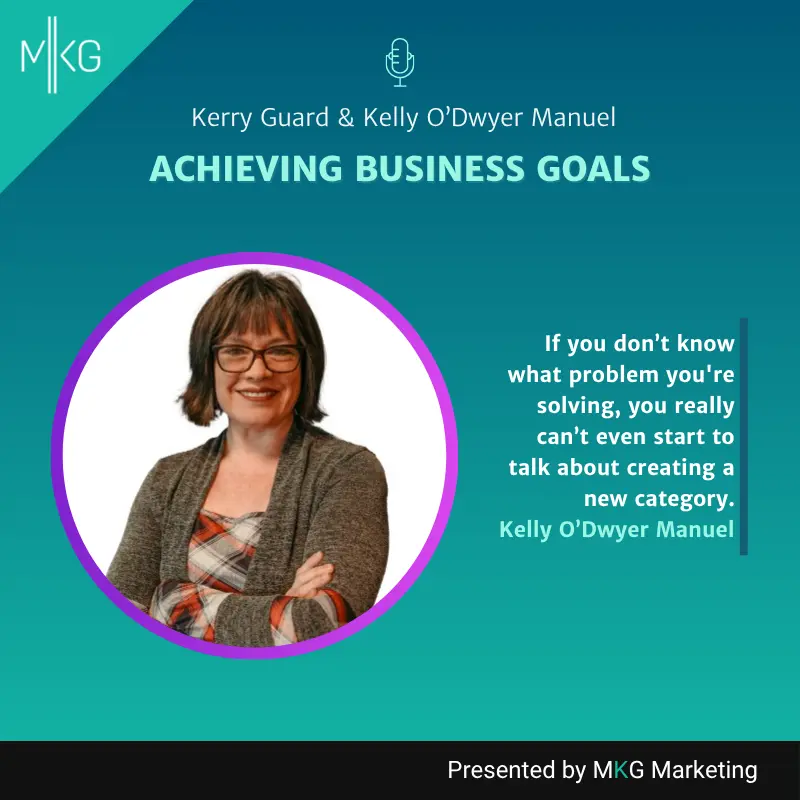
I think, and I think not enough people, to your point, pay enough attention to this part. So it's really about understanding what the problem is. What is the problem I solve? And it sounds so straightforward, like, right? You should be able to quickly and easily answer that, but it's surprising how many people can't do that, because we become wrapped up in technical benefits and feeds and speeds and price points and all of that kind of exactly feature the race for features, and it's great. All of those things are fantastic, but it's about the problem. And if you don't know what problem it is you're solving, you really can't even start to talk about whether you need to do, whether you need to create a new category, or drive a wedge in an existing, you know, unseat an existing category leader. So that's really where you need to start. What, what? What is the problem that you're going to solve? And there are so many places where you can look for that, for that insight. You know, if you're a larger company, and this is going to be a net new division, or a brand new foray into something that your current customers haven't seen before, but you're looking at some traction, maybe you have some friendly customers or partners you can talk to about these types of problems or pain points. Analysts are another great resource there, because you can talk to them about, okay, what, what are the, what are the what are the pain points that you're hearing, the challenges that you're hearing from your clients when they're having inquiry conversations with you? And how often do these come up? And are you seeing any tricks? Ends, is there a question that you're getting all the time or not? And that's often kind of a I find sometimes we think of analysts as okay, we're going to show the analysts our new product and tell them why this is a great thing, and then they'll write about us. And there are so many other ways in which you can use analysts and their insight to benefit what you're doing. You don't have to agree with everything they say. Everything they say, but you can take that as important information point. So those are just kind of two areas. You can also talk to influencers, generally speaking, and all of that kind of stuff. Do some surveying, and it depends on what you have available, but it will start to paint a picture for you as to what are the pain points out there, and what is the problem that really needs to be solved? So that, I would say that is kind of the first critical question that you need to answer before you even start down the category creation path.
Kerry Guard 25:53
It's so true to understand the pain, the problem you truly solve in the product. I always, I'm always curious about going back to the original founders. Why'd you build this thing?
Kelly O’Dwyer Manuel 26:05
Yeah, exactly right. Why did you
Kerry Guard 26:08
Why is here now? Because then everybody sort of piles on, they're like, we could do this with it, this with it, and that with it, this with it. But it's like, Yes, I'm sure that this thing could live on in so many ways. But like, why did you create? I had a wonderful podcast a few months ago. I was, I was dabbling with having a founder show. Maybe I'll come back to it. I hope to come back to it by these wonderful founders who started a product around that. The product is actually called credentials, because it's about both, you know, people who come and work on both, and being able to manage all of their documentation, and making sure it's up to date and easy. Yeah, it's wild. It's wild. But when they got it in the hands of a bunch of different people, everybody was like, Oh, well, this industry could use it for that. This industry could use it for that. And you know what? About payroll? And then they started piling on features that were like it, it got overblown, and then they came back to like, Well, why did we build this thing like? And how do we work with people who own boats, who have to hire people, and get back to like the heart of the thing? And, man, it's so easy to get caught up in like, but what could it be?
Kelly O’Dwyer Manuel 27:22
Yeah, yeah. And what did you see that other people don't? Where is that white space? That's such a that's such a great, great point, you know, because they're even thinking of the axiomatics founders, you know, they, they saw that this was going to become a thing, that authentication was going to need that next that next step, and they saw that a while ago. So that's a great point.
Kerry Guard 27:49
Stay on the cutting edge. Got this exercise? Let's talk about that next step so you truly understand the problem. Let's assume people have done their homework and their research, and they've sat down with the customer. Yes, you've called up the customer as a marketer, and you said, Tell me more. Please tell me you've all done that. I hope you have, and now you understand, like, the true pain of what's happening. So, how do you figure out whether this is something brand new or if it already exists?
Kelly O’Dwyer Manuel 28:23
So I think that's the next question that becomes, how is this currently solved? And you can go back to those same sources to ask those same questions, how are people solving this problem right now? And that's going to give you a couple of different pieces of information. The first is, obviously, how they're solving it now, and maybe the answer could be, they're not; this is just a pain, and people are, oh, we're just going to live with this. Or they're cobbling something together that's not perfect, but does the job okay? And that that is problematic, if that ends up being the answer or and how ready they are to accept a new a new solution, because that piece is is a really important one too, if they're okay with either living with it because it's not painful enough to warrant an urgent change, or they've Been able to kind of string together, you know, acceptable or satisfactory solution, they may not be. The market may not be motivated to do something different. They might be, but you're going to know that this is going to take a really dedicated push to really hammer home the pain of that problem and why it's it you need to solve it in a new way. So this is really where you kind of, you're peeling back the onion, and you're getting into the guts of what you need to do next.
Kerry Guard 29:49
And is that through community, like, how do you find that information? Is that, is that through customer research? Is that through? So yes, that seems quantitative, qualitative, qualitative versus quantitative.
Kelly O’Dwyer Manuel 30:07
It is, and it's different sources as well, right? So are there? Are there? You can reach out to partners and channel resellers to say, Okay, what were the gaps here? And again, analysts will let you know. Analysts will let you know, kind of what, well, people are kind of just accepting that what they're doing with X, Y, Z is probably good enough, and they haven't budgeted to do anything further. So it gives you a bit of another Okay. Hmm, this is going to be a bigger battle. If it's not something that I can attach to their priorities or their budget priorities in the in the future years, that's going to be a struggle. I need to make this I need to make this pain really real that people would want to action on it so it's looking out. I think the big key, Kerry, is at that point, once you've got the information about what the problem is, you need to look outside at the market as a whole and understand how big a pain is this problem and versus the way in which it is currently solved or not solved. And that'll give you a sense of timing. Is the market ready for a new category, for a new way of thinking about this? I love that.
Kerry Guard 31:22
Is this already in some aspect being self, maybe not quite right yet, and we're all figuring it out, but do but can I layer into something that exists, or do I have to go build it? We actually had a client that had this pain of they wanted to go out and build their own category around something called wire data. They were cybersecurity company, and they were thinking about, you know, they had this hardware that was connecting information from one end to another and across the wire. How was that information sort of trying to be interceded? It was, you know, a few years ago. And so it was this, this concept of wire data. And we were like, well, it's cybersecurity. Like you're trying to go off and create your own thing outside of cyber to, like, define it. But people are searching for this problem inside of cybersecurity, and so once they made that shift and acknowledged that this environment already existed. They were just solving it in a unique way. Everything changed their keyword mapping, changed their volume, changed the way that they could go after competitors, changed, and for the good, like they went off and got sold to a company for over $900 million, right? Like, right? So I think there are stories on both ends. Let's talk about the creation part that didn't work out for them. It made more sense for them to fold into the existing. And at the time, cyber, you know, XDR, and then they sort of, like, you know, fell into a subcategory of cyber once we helped them pivot, but help me understand within cyber, building out a brand new category, having done this, what the benefits are there and when it makes sense, because it feels like if You're the first to the game, there's pros and cons.
Kelly O’Dwyer Manuel 33:23
It is a big advantage to be first if you hit that timing right, which is no small thing. But let's assume that you've got that going, and you feel like the time is now more than ever, you kind of have to act really quickly, because anyone can stand up a digital property and say anything. So you've got to be able to have a, you know, be fierce, be fast, and be focused, to be able to get this across the line. You also have to make sure that everybody is all in this is not something that somebody can do as a side of desk project. This is not something that marketing can just go off and do. And I think that's another thing where a lot of times marketing is tasked with, go off and create me a category and make sure I get to, you know, that there ends up being all this, this that I'm, I'm the defined leader and whatever this is, and that's, that's not we marketers might be able to win with that as a mandate, you know, run far. So it has to start from the top down, that everybody is all in that you know that this is going to require dedicated resources and a dedicated budget, particularly right now, because the cybersecurity market as a whole is so crowded, you've got to be able to differentiate yourself, and you can't do that without some budget. It can't just be, you know, a line item where there's a whole bunch of other things that you're already doing, and it's a, it's a side of desk job for your Head of Product Marketing. That's not the way this is going to work. This has to be something where everybody is on the same page. Are wholly invested in getting this done, and you're able to have some kind of big, big bang pushes here. And that can look like a variety of different things, but really it's that, that kind of mindset and that understanding that that managing of expectations internally, that this requires in everybody signing on, it requires budget and resources, and then you can start to take those steps and plot what, what success is going to look like in 369, 1218, 24, months, because it's also not a short term thing if you're setting up, and I'm sure you've seen this, if you're looking to set up a new category, and you're saying, Okay, well, we're hoping to recognize revenue on this in three months or six months. That's not That's not realistic. That's not going to happen.
Kerry Guard 35:49
It's interesting because it feels like, it feels like a bigger mountain to climb, but it's, it's steeper and a little faster. So if you can get it right, if you get it right, right time, right budget, everybody on board, you can get there faster because lightning happened to strike. That's a big gamble, though. So how do you know it's the right gamble to make?
Kelly O’Dwyer Manuel 36:18
I think there's an always an element of art versus science with this, you know. And sometimes you'll hit it perfectly, if you've got all of that information and everybody's aligned. And sometimes it might just take a little bit longer, and as long as those expectations are clearly managed, that this is a long-term goal, that you have smaller milestones that you're going to hit, you ultimately will be successful in some way. You know, it just you have to be mindful of how you're measuring that that success, and understanding that for for every Uber or Salesforce out there, there's millions of companies that that aren't, and that if category, if your company doesn't, either isn't, this isn't the right fit to create a new category, or you don't have you're not sure you can get all of these pieces aligned. That doesn't mean the other option is to do nothing. There are still lots of other things that you can do that might make your point with a couple of the examples that you've given, be just as, if not more, impactful for what you're looking to do, because it's looking at what is that ultimate outcome? What is it I want to do here? Because category creation is an outcome, but what is the broader thing that you're looking to do that, taking these founders, your founders' vision, or your, you know, whoever came up with this, and bring it to the right audience in the right way at the right time.
Kerry Guard 37:52
It is a full pivot, too, when, yes, when this client, extra hop, decided to make this pivot into cyber security outside of what they thought was wire data. It was an all-hands-on-deck moment. They had a fork in the road, and it had to come from the top, and everyone had to get on board, and data was a big part of that, right? We were coming to them and saying, the problem people are searching for that you already solved is already a thing, and we could just slot so it's not that competitive yet, we could slot very nicely into it, and we can meet you where you are. So I love that we're talking about when it makes sense, the right data that you need, and that, like everyone, 's got to be on board, because if they're not, and you have a rogue salesperson who's using different messaging,
Kelly O’Dwyer Manuel 38:42
Rogue senior executive, which can also, unfortunately, sometimes be the case. It's problematic because you've got somebody kind of chipping away at that. So it's a it's difficult, and it's even more difficult now because there are so many more smaller vendors and larger vendors looking to get in, particularly into cybersecurity, that it's really difficult to differentiate yourself. So sometimes I think, sometimes people then think, well, if I can create this whole new category, I have a niche that's going to differentiate my company and my solution automatically. So I don't have to worry about that, because marketing can do that for me. And the difference is that you can actually go in and in seat, unseat a category leader that might be resting on their laurels or going through, you know, some churn with customers, or some other type of turn better together.
Kerry Guard 39:40
Right? Exactly,
Kelly O’Dwyer Manuel 39:41
You can do a whole bunch of other things to still get that end goal of creating mind share and revenue and getting a really strong and loyal customer base that grows and grows. I was just having
Kerry Guard 39:53
This conversation with my husband is about this. He was talking about a company he sat down with today, and they were talking about what they wanted to do. And he's like, this feels like a feature versus a product, but it's coming to that, right? Like people are seeing between the lines of, like, what the industry still needs, and isn't there yet, and so they're creating this one, very tiny. And I said to him, I was like, they should go do that, because then they could. It sounds like it's in an easy sell into something bigger, right? Which, for some people, could be a great exit strategy. So, it does feel like the industry as a whole is sort of moving in that direction of finding these holes. Of like, yes, you have this bigger product that does most of these things, but there's just this little thing missing, and if I could just fix that for you and plug it in, we're good.
Kelly O’Dwyer Manuel 40:46
Exactly, exactly.
Kerry Guard 40:48
Are you seeing that across? I mean, I'm only seeing this in, like, a, you know, in my little, my little frame that's over here. Are you have a bigger window? Are you seeing that? Or am I speaking crazy?
Kelly O’Dwyer Manuel 41:01
No, and I think that's everywhere, you know, and it's, it's, it's interesting, and particularly in cyber, where things are moving so quickly, you're seeing a lot of spots where people are thinking, Oh, no, well, well, should I, should I do this? And how should I, how should I buy, and what do I want to do? But I already made this massive investment in this one solution. So what, what can I What can I do this? What can I do about this? So, you know, how is buying this new thing going to help me when I just spent a million dollars over here? So it's all of these different types of messages and just kind of figuring out, okay, blocking out the noise, what is the problem that we're hearing here, and how are we uniquely positioned to solve that problem?
Kerry Guard 41:46
Sounds like buyers are having multiple problems?
Kelly O’Dwyer Manuel 41:49
Oh yeah, I think so. And you know, I'm not, I'm not a cybersecurity buyer. But you know, in looking at what, what they have to what they have to look at, even if you look at big, broad categories, like zero trust, like it is a behemoth of a thing to be able to do and to solve. And you've got vendors out there saying, I have a zero trust solution, but there's really no such thing. It's a broader philosophy and strategy, and it's going to take a number of solutions that ideally all work together. But then what does that look like? And does that mean you have to replace the things that you already have, or buy a whole bunch of new ones?
Kerry Guard 42:24
Things, and then the subscriptions and the things you're tied into.
Kelly O’Dwyer Manuel 42:28
All those legacy applications that you already have, and what do you do with those? So, you know, I worked ages ago for a company that had a legacy a legacy product, and it was still humming along, but they were always reticent to make any changes, because the people who had coded that years and years and years ago were no longer there, so they had no idea if they made a change to the code, whether the entire thing would fall down with a clunk and we'd never be able to fix it again. So it's there are a lot of those things that you know on a coder. I don't think about that stuff, but there are a lot of those kind of little problems out there that people are having to deal with as enterprises get more and more complex, that it's there's not just one like do this, and everything will be fine, type of scenario, which makes it it makes it challenging. It makes it challenging for us as marketers, too, because, you know, I just spent, what, two minutes talking that through. Nobody wants to hear a solution that's two minutes long.
Kerry Guard 43:24
No, it's true. It's true. Let's talk about, let's assume. Let's move into solution mode. Talk a lot about the problems, the problem, the problem is clear and real, and it's true. And it's like, which path do you got a fork in the road here? And it's a matter of, do you do you disrupt an existing category, or do you co-create your own? And it is definitely an all-or-nothing sort of moment when you're faced with this. And so, you know, making the right decision is imperative. Let's assume you've decided to create a new category, because I feel like we all can join an existing category and mostly figured. There's nuance, and another podcast can help us navigate it. But for time's sake, let's talk about creating a brand new category and saying, Okay, we're doing something different that nobody else is doing. What? Where do you start with that? I'm imagining. It's messaging, but nobody's searching for this thing. So how do you create? I'm going to use that word that not everybody agrees with, but awareness, brand affinity for this thing that nobody knows about when you're not Apple, right?
Kelly O’Dwyer Manuel 44:36
Yeah, I think it's ultimately looking at who are the people who can help you make this quicker, make this faster, who already have good followings and talk to the people that you ultimately want to be purchasing. Who are they talking to? Who are they listening to? There are influencers, analysts, media, and all sorts. Of people like that. That's who you really want to sell the problem to, because if you get those influencers to buy into that problem, they'll be more inclined to say, and you know what? Here's a potential solution that you should look at, even if they're not naming you by name, although hopefully they do. If they say you need to look for something that does X, Y, and Z, and you do X, Y, and Z, it's validating what you're able to solve for. So those are the folks. Because if you're trying to push this rock up the hill all by yourself, it's going to be very difficult to do. So if you're not Apple, or, you know, another massive exactly, because I already know Apple. So I'm going to there's already a level of trust there with whatever they are going to show me that's new. I'm probably going to pay attention to it. I don't buy it, maybe not, but I'm going to pay attention to it for smaller companies or net new companies, they don't have that kind of buffer. So if you can leverage that, that kind of community of influencers and analysts, and bring them in early and walk that, have them walk with you on this journey, and have them buy into that, that problem and why this is the solution. You're going to have much more runway and be more successful because they have the audiences that it's going to take you a heck of a lot longer to build.
Kerry Guard 46:20
You enjoy another audiences? Yeah, it's what I remember the company right now. Who is I'm gonna I'm working the company right now. Who is building fusion microreactors? I know. So it was this. It was this moment of, do we go rogue and talk about this new energy thing that we're creating, or do we join the fusion community that's starting to get some traction, and talk about a different way of doing fusion? I feel like fusion isn't quite big enough to start carving out our own category just yet. So I'm saying, let's jump on the fusion train and talk about why we're different at the same time, because the PR momentum that people are already getting around that we don't have to cultivate, because it's just naturally happening. And there's only so many companies within that category currently that while we're a name among a couple, it's still less than many, so it's still making a splash that we can cultivate and ride sort of the tails on before we will have to go off and say, but we're micro and we're mobile, and we don't have to be a big power plant, and we're doing something different, right? Like that moment will come, but in the meantime, we're not there yet, and so, sort of jumping on the existing fusion train has done wonders in that. And I think that's what you're saying around, like, choosing your moment and those existing influencers, I think that's key. Like, you need people to trust Kelly. Like, correct me if I'm wrong. I feel like I've been on my high horse a little bit and preached in the choir somewhat, to maybe I feel the people who follow me on LinkedIn or maybe sick of me saying this, but like, we have lost, we have lost our buyers as marketers because they don't want to deal with us. We are a necessary evil that they like will have to come to at some point, because they have a problem and they need a solution, and we happen to like be there at the right time in the right place. I think we need to change that. And I love what you're saying, of like, finding these folks who we can bring along and help cultivate those case studies and those stories. Of like, No, we're not just vaporware, and we really are trying to do something good here in the world, and you can trust us, which I know was really hard as a cybersecurity person.
Kelly O’Dwyer Manuel 48:58
But you know what, Kerry you the example you just gave is so perfect. Because the other part of this is that you also have to understand not only where the market is right now, but your vision for the future, because it gives you an important validation that, hey, we not only understand the problem that everybody's dealing with right now, but we see that this is how this is going to evolve as we go forward. Because that's the other critical piece of that. You'll see, there's lots of examples of people who've created categories and have kind of sat there on the category, and they really haven't had a vision for where this market is going to go, and another competitor comes up and eats their lunch, because they're saying, Look, these are the problems that are going to arise, and this is how this is going to roll out in the future. And we've, we've got to solve for that. This is how we're going to align ourselves to solve for that in the future. So it's like, this is a that's why it's a long game, and it's you're going to come up against, you know, the three-month mark, or the five-month mark, or whatever it is, and you're gonna think, this just feels. Was like, I don't feel like we're moving forward fast enough. Or maybe it's just me, because I always want to be going faster and doing more and having you know, let's get it done. And this just isn't that you know, you've got to be all in for the long haul and see where things are going. So even if people are saying, "I don't, I don't know where you're talking about in the future," this is my problem right now. And you can say, absolutely, totally get that. Here's how your problem in the future is going to, you know, spin up to where this vision is going. That's something we're actively doing at axiomatics right now. Is saying, Look, we see how this is going. Here's how authorization is going to kind of evolve in the next 510, 1520 years. And it's, it's tough to be able to sell people on that when they're living in the day-to-day. But I think you have to have kind of both, both those sides.
Kerry Guard 50:51
I feel like you need to see into the future of what's coming as the marketer and the brand, and you need to create. I call them lily pads. Of like, what jumps are we going to need to make towards that? Your audience isn't there yet, but we see it. And how do we ensure that they're going to be safe on the other side, by building them this roadmap that it's sort of like a plg motion, almost, of like, let's focus on the existing problem they have right now and then, let's be ready for them, because we know that that's the next thing to come. And that is what, to me, building a category is: seeing into the future of, like, we're not there yet. We're not gonna, we're not, you know, we're talking about Lynn, you know, we planted somebody on the moon, and we're talking moon, and we're talking about going to space, but like to have colonies on the moon, yeah, how are we gonna power that? Right? Nobody's there yet, but they are trying to think about how they're going to power that cruise ship that's sitting out in their Harbor, blowing that black smoke, right? And one is going to lead to the other. So, yes, to seeing into the future and being, you know, helping people along the way, in that if you jump to the end, yeah, you will. Yeah, you will lose them. Give us a last nugget here. Kelly, for folks who are building a category, let's assume that they figured out the problem. They've dialed in their messaging. They say the lily pads are starting here, now, and then they're going to build up to that. You know, how do you do it's the long game, but also there needs to be momentum. So how do you create, what are sort of the activation pieces that you put in place to create some of that initial momentum? I know it's going to depend on the brand, but for your experience as always, but from your experience of the brands you worked on, or maybe for, you know, the brand you're working on right now, what are sort of, some of those activation pieces that you're immediately putting in place to staying a seed into the future? And these are the things we need to do right now to start building up to it.
Kelly O’Dwyer Manuel 52:58
Always be listening. Always be listening. So listen to your listen to your customers, but understand too that if they're current customers, you've already solved their problems. So it's one proof point. Listen to prospects. Understand if there's a gap, listen to analysts. Just keep listening and refining, but stay focused. Don't let anything unseat you. If somebody else comes along that's talking about something, something over here, let them do their thing and stay focused on what it is you want to do and what your outcome is meant to be. So, you know, stay focused. Have regular touch points with all of your key stakeholders to ensure everybody is crystal clear on what the goals are, short-term and long-term, and the progress you're making against those goals. So I think Kerry, if I were to distill it down, it's constant communication, and keep listening, those would be the two things
Kerry Guard 53:57
I think that's so crucial, because we can't make decisions in the dark. Kelly, we need the data, and you're only gonna get the data through those two touch points: listening and then understanding what other people are seeing while they're listening. So exactly yes to that. Oh, so good. Kelly, where can people find you if they wanna learn more about category creation, your history, and the clients you've worked with and continue to work with?
Kelly O’Dwyer Manuel 54:22
Where are you? I'm on LinkedIn. I think I'm dash in Dash, Kelly L as in, Lama M as in, you know me, so feel free to connect with me. I love how LinkedIn is evolving. I know that's probably like a whole other episode, but it's super cool and super fun. I learned so much from following on LinkedIn, and I'd love to engage and have good conversations. And also, I'm a member of the cybersecurity marketing society, and it is such a fantastic group of folks I've learned. So much from all of them, and continue to learn, share, and grow. And I can't recommend it enough. If you're in cybersecurity marketing, you absolutely have to be a member of the society. So go there and do that.
Kerry Guard 55:11
And if you're going to be there, if you're going to be at the cybercon marketing event in Philadelphia in December, hit us up, because Kelly and I will be there with Bella's on, and we look forward to meeting you in person. I can't wait to meet Kelly in person. It's gonna
Kelly O’Dwyer Manuel 55:24
Be right? We've already got an entirely new offshoot of conversations to do over cheese sticks. I love this cheese steak.
Kerry Guard 55:31
Cheese stick chat. We're gonna make it happen. And if you like to join us at pats, not chinos, we welcome you right hot take right there. I'm from Philly. I get to say that so many gyms. Gyms should be open now on South Street, so one of those, we will let you know where we will be, and you can come join us for our cheese steak chat. We look forward to it. Kelly, before we go, you are more than a marketer. You're human, and life is hard and different and a new these days, yay, covid or not, however you want to paint that picture, but I feel like we figured out how to live with this thing, to however much we can live with this thing, and we are looking forward to the future, at least trying to, At least trying to so for you right now, as things have settled down and we figured out how to live with this, what are you most looking forward to in 2024 other than your kids sleeping through the night, which we are all struggling about.
Kelly O’Dwyer Manuel 56:30
Can't happen fast enough. You know, 2023 in particular, Kerry was a challenging year for my family. My husband was diagnosed with leukemia. He's now in remission. Yeah, he's, he's a, he's a force of nature, certainly. But it really taught me that you need to life isn't short. You never know what's going to happen, so you need to just take advantage of those moments. So to that end, I'm super excited that next week I have time off. I'm taking my 70-something-year-old mother to Las Vegas, which is her city of choice. And you know, I'm looking forward to 2024 to continuing to learn and grow professionally, but also to taking advantage of those moments personally, being present, being there, and just enjoying the ride.
Kerry Guard 57:21
I just want to, like, cheer you on to all of those things. I just saw an amazing post. Oh, it was a cybersecurity marketer who actually was one of the original founders of the cybersecurity marketing con. She just posted about being present. It's not always about hard to do, but, yeah, it's so hard, but just to show up, like, Yep, and sometimes you'll show up messy, and we'll figure it out, but the more often we show up, the more good moments that we have to remember, versus, you know, only showing up in key moments and hoping it's the best. I just so hit home for me today, and what you're saying is resonating. So, ah, Alicia, it's Alicia and Kelly. Thank you so much. Yeah, I know.
Kelly O’Dwyer Manuel 58:07
Thank you, Kerry. This was so much fun. I feel like we could do this often, and I learned so much. I love it. So I look forward to cheese steak. Cheese Steak chat. We may need to rethink this now, but I very much thank you for the opportunity.
Kerry Guard 58:21
I'm so grateful for the conversation and for you and to our listeners, thank you for joining this episode of Tea Time with tech marketing leaders. If you liked this episode, please like, subscribe, and share. This episode is brought to you by MKG Marketing, the digital marketing agency that helps cybersecurity and data management platforms get found via SEO and digital ads. We've helped companies like Extract, as I mentioned, grow to $900 million to get bought by Bain. And we're here to help you out. If you like to be a guest on Tea Time. I'd love to have you DM me. Let's hang out, have you on the show, and until next time. Thank you all so much.