Charlie Sells
Charlie Sells is a Brand Architect and founder of Clarity Over Everything who helps growing businesses eliminate confusion, align their strategy, and move forward with clear, focused direction.
Overview:
Charlie Sells joins the show to break down what clarity actually looks like inside a growing business. They cover the hidden cost of random acts of marketing, why leaders often mistake certainty for clarity, and how inconsistent messaging quietly erodes trust over time. Charlie also shares his seven-part framework for helping teams align around what matters, how to think about brand consistency beyond just logos and design, and why simplicity is often the hardest—but most important—part of marketing. If your company is drowning in tactics, unclear priorities, or disconnected messaging, this episode offers a more grounded way forward.
Transcript:
Charlie Sells 0:00
I think the biggest thing I hear just at the top of the list is most of the business owners and the leaders that I interact with and that I talk to wind up committing random acts of marketing, and it's really not their fault, like they want to focus so much on what they do, and marketing becomes an afterthought, or brand a brand strategy just becomes something that we sort of think about doing, and over time, a bunch of tactics will just pile on in the name of trial and error, and we forget to just stop and think about what we've learned from all of these. Should we be continuing some of these, or do we have to stop or pull over, or build something new?
Kerry Guard 0:51
And we're live. Welcome back to Back on Track. I'm Kerry Guard. If your B2B, SAS company is stuck in the growth Valley somewhere between 2 million and 10 million. Arr, and what you got here has stopped working. It's time to stop guessing. We install the marketing system. You need to regain visibility and drive real pipeline, not just activity, see everything, hide nothing. Today, we're talking to Charlie Sells, the man behind clarity over everything, and Charlie helps businesses cut through the noise by focusing on what actually matters. Charlie, welcome to the show. Hey Kerry, thank you so much for having me today. So excited to have you today. And impromptu. I was like, Hey, Charlie, what are you doing on Thursday? This was Monday. He was like, I'm free.
Charlie Sells 1:34
Let's ride, so here we are. Let's go. Here we are. Let's go in the week, in the week, on a high note.
Kerry Guard 1:40
Before we get right into it, Charlie, I'm going to, we're going to do a little quick word association game to get our motors humming to let people come in. And it's just fun. So I'm going to say a phrase, and you're going to have a gut reaction to it. Okay, just a simple first thing that comes to mind. Don't know. Great, okay, all right, ready. Let's go. Let's go. Brand awareness is important, very important. We're gonna come back to that growth hacking, underrated. Omni-channel.
Charlie Sells 2:26
Overrated, pivot. Ross, hardly when you hear the word "pivot".
Kerry Guard 2:40
I know, I know, unlike sofas, how does what about in marketing terms?
Charlie Sells 2:45
Oh, in marketing terms, necessary synergy. I'm trying not to overthink it. I think it's still a good buzzword.
Kerry Guard 3:01
Oh, oh, man, I think it's great. We're gonna, we're gonna unpack all those folks, bring it into it. Charlie, you talk about clarity over everything. What are the first three indicators you see in businesses in the 5 million ARR that tell you they've lost their clarity?
Charlie Sells 3:21
I think the biggest thing I hear just at the top of the list is most of the business owners and the leaders that I interact with and that I talk to wind up committing random acts of marketing, and it's really not their fault, like they want to focus so much on what they do, and marketing becomes an afterthought, or brand a brand strategy just becomes something that we sort of think about doing, and over time, a bunch of tactics will just pile on in the name of trial and error, and we forget to just stop and think about what we've learned from all of these. Should we be continuing some of these, or do we have to stop, pull over, or build something new? And I think that's where a lot of business owners find themselves, is they don't want to focus on marketing, and they don't want to think about how is my brand actually performing and being perceived out in the marketplace and with my customers. I think that's the first place I find a lot of business owners get stuck, and where things start to get unclear. Some of the dead giveaway phrases are like "I'm not sure," "I don't know," or "I have so many ideas, and I have no idea what to do with them." I think Part B to that, and it's directly connected to it, is that there's just, like, an unclear direction of you know, again, we're just trying a bunch of stuff. We're throwing dry spaghetti on the wall and hoping that something will stick. And most business owners just don't know where they're going, and by default, any path is going to get them there. I think Third, if you have a big enough team, there's. Just some misalignment going on where stuff is not translating from the top or from the vision down to the people who are actually making the things and doing the stuff for you, and eventually, over time, that's going to lead to some very confusing marketing assets, and over time, some brand erosion and loss of trust with your customers. So those are the top three things that I hear the most from business owners.
Kerry Guard 5:28
Yeah, can't help it. I'm a founder as much as I am a marketer. I'm also a founder. And I have lived all three of those. I might be living one of them right now, but what I think I find this too, though, in talking to founders as well and working with a few the random acts of marketing is interesting because it's really, I think where they get stuck is that they think marketing is just going to put advertising On a thing, or doing some social posts, or it's channel specific, right? Yeah, they're thinking in terms of channels. What channel can I activate? But what you're saying, I think, is so important, and what I've been double down on, doubling down on lately, is that messaging piece, especially now with AI and how you're getting picked up in the llms, in those in the chat gpts and the claws of the world, right? Having that messaging has become more than fundamental.
Charlie Sells 6:34
Oh, 100% it's, I would say it's foundational. And a lot of brands cast that off to the side, or they just assume it's going to be a byproduct of what's happening. And in reality, a lot of lot of businesses will drift into random acts marketing because they have no cohesive strategy, because they have no brand awareness or consistency or solid messaging, or they're positioning what they thought worked, you know, at one point, or maybe for one ICP is not translating to a bigger ICP or a bigger customer base too.
Kerry Guard 7:05
Yeah, yeah. I lost stop, start for sure. Like, they're not giving things enough time as well. So that creates that, that randomness, feeling of not knowing, to your point, where they're like, I don't know, I don't know what's working well, that's because, yeah, actually, you kind of need all these channels. You need them to run for a long time, and you need the right positioning and messaging. And messaging to make sure that people know what problem you solve. You have a list of 20 things leaders get wrong with clarity. Give us the number one mistake that is actually costing them the most money right now.
Charlie Sells 7:37
Every single leader that I talk to, if they don't have their head around their marketing functions or some kind of cohesive strategy, they mistake clarity for certainty. This is the key I think a lot of leaders get stuck in, is yes, the buck stops with you. At some point, you're the one who's going to make the decisions and make the calls. But there comes a point in time where it becomes too rigid and too narrow, and it chokes out all creativity, all strategy, all pretty much anything. It just becomes status quo, and it becomes rinse and repeat. And that's a very dangerous place to be in as a business and as a brand. And I'll give you a great example, several of the business owners that I know, and we've kind of danced around this already, they'll come to me, and they'll say, the one thing I need to do is blank, and that's going to move the needle. That is certainty on steroids. And I'll often go, Okay, well, let's look at your entire ecosystem. And over time, we figure out, oh, I don't want to send people to my website because I don't like how it looks, and I really don't have an offer dialed in. And this part isn't clear, and I said I was going to do a blog, and also, where does my video go? And snowball effect all over again, right? And certainty is the choke point for a lot of leaders in becoming so rigid and so dead set on. This is the path we have to have, and clarity, by contrast, I think, is more of a direction and a vision and a North Star, because that's what creates alignment on now that we have a filter through which we can look at everything that we do from a marketing or branding standpoint, decisions are easier. Creative flows and momentum become very natural.
Kerry Guard 9:27
I can't even tell you. So, as a marketing agency, the cobbler has no shoes, and of course, we don't actually do our own marketing. Until recently, I said that all the time.
Charlie Sells 9:39
That's exactly the phrase I use, the cobbler's kids go without shoes like that's my brand for a lot of Yeah, for a lot of career, right?
Kerry Guard 9:49
Do not. Yeah. There are so many phrases, some that are good and some are that are not so good. But anyway, the point is that we, just last year, really doubled down on our position. And messaging, you know, as going through being a marketing leader myself for other companies. I've sort of figured out that it's because I'm a channel marketer. I've been since my days at as a media planning days with TV and GRPs, good times. So now, so I just have that channel brain, you know, I'm kind of like that founder who's like, we just need to do these channels and these things. And I finally figured out that actually, we need to figure out what makes us different than other agencies and why you should work with us. And I did that work last year, and this year, I'm starting to step into the CLC to start saying those things. And it makes just such a difference to have something to say in relation to a real problem that people have, that you can solve, that nobody else is doing it in the way that you're doing it is just such a game, such a game changer. But so freeing, isn't it? Freeing is a great word, yes, yes. I couldn't agree more. That is exactly how I feel. I know exactly how to show up, and now I know how to say why you want to work with us versus them. I'm still dying. I'm still getting used to the words, like you could hear me start a fumble on it in the in the intro, a little bit. I'm working on it, but it's just very. I know the problem. I know the solution, and I'm here for you, right? It's so helpful. I love what you said about how that and that everything stems from that. Everything like all the decisions, all the positions, all of them, the creative, everything is just coming from that. It's great.
Charlie Sells 11:37
You'd be amazed at how many business owners like experience that for the first time, even if they've been doing something for five or more years. I'm working with a local business right now. And yeah, exactly, but I'm working with a local business here in Tennessee. And man, everything is just so much faster now that we have a plan, we have a strategy, we have tactics that make sense. And it's not just all over the place. We have easy rhythms where it's not taxing on anybody. And, man, you can just feel the synergy, like the business owner is now excited to talk about this kind of stuff, rather than just feeling like, oh my gosh, I got to think about what's on the menu this week and how to do XYZ and blah, blah, blah, blah, blah. It's, it's, it's this catalytic aha moment for a lot of these business owners. And it's invaluable when you can do that too, because now you've created value beyond an ROI too for for these business owners, where it's not necessarily about the numbers, although numbers are important now it's about the trust that I have built with and the relationships that I have with these business owners, and how we can turn that into something really special for your brand.
Kerry Guard 12:53
I could talk about this all day. Yes, yes to all of that. Most marketing teams are piecemealing. They're tech stacks. When you look at a tech stack, what is the one tool that is usually an absolute waste of budget? Ooh.
Charlie Sells 13:10
I mean, I don't want to disparage anybody by name. I have a lot of I have a lot of platforms that I'm like. When I see them, I know the bill of goods they were sold, and thinking that this is the most magical all-in-one tool that you'll ever need. And it just falls dangerously short of anything. And again, I think this is, this goes back to the silver bullet thing, where a lot of entrepreneurs just grab stuff in like, do you remember that that show back in the 90s, the Supermarket Sweep, where they go and they just, like, they throw stuff in a cart and, you know, try to try to check out before the other person and all of that. Yeah, that might be the most obscure pop culture reference I've made in a long time. I love it. But that, I think, is how we approach business ownership at first: thinking, "I have to have all of these things," right as a marketer.
Kerry Guard 14:02
And the top of the line?
Charlie Sells 14:04
Oh, absolutely. As a marketer, I got into that place where I was like, Good grief, I would love to have a SIM rush, you know, license, but I don't have 200 bucks a month to put towards something like that. And it's very expensive. It's a great tool. It's very expensive. But we get into that mode where we think, if I have all six of these things, then that's going to be that's going to lead to success, that's going to lead to progress, and sales and all of those things. It often does not. Because now, even though you have six different systems that all do different things, if they don't talk to one another, you got a bigger problem, because now you have, now you have a visibility issue where you're having to go to six different things and check all of the things. An author that I worked with a couple of years ago had the exact same problem: four very broken systems that we're not talking to one another, and this had to export to that, and the tags were wrong. And all I was like, put it on one. Systems like you only need one, one of these things, and are very hesitant, which I understand, having been on one of these platforms for 10 plus years. And I said, it's just not intuitive. It's not it's not going to help you do what you want to go and post a blog every single week, and you're having to get somebody who understands code to go do it, or you're just copying and pasting and hoping that it formats correctly. And showed them this, this builder, all of a sudden, within Squarespace, and they're like, this is what I've been missing. And all of a sudden, that, again, that eye-opening thing. Now I can go do more of this, because I know my website's going to work for me. I know I can post stuff on the fly. I know that I can track analytics and do all of the things that I wanted to do, but I just wasn't able to. So, man, I wish I had a solid answer where I could be like, the dead giveaway is if they are on this platform, but more often than not, you're exactly right. It's just this, like, we grabbed a bunch of stuff and put it together in this weird, you know, Play-Doh looking multicolored ball, and went, This is what we're going to play with now. Going to play with now, and that usually leads to a whole lot more heartache and destruction.
Kerry Guard 16:07
We've all tried the Rubik's Cube. It's not easy. No, I also find that when you buy these tools, you then need an expert to drive the tool. And so now you're looking at the head count. If there's no owner of the platform, then there's no use of the platform, is really what it comes down to. So I, oh, I totally agree. It really is, the conglomerate. And really thinking about what I love, how you said that it's like, what's the roadblock in my way of helping me, allowing me to move at the speed that I want to, and how do I get the thing that's going to help me fix that thing right? Exactly. Sometimes there is no thing like, like, with LinkedIn, you just have to comment, you just have to show up and write the thing and do it every day, like, right? You know, like exercise and all the other things that we really just don't want to do. So unfortunately, there are tools to unblock you in some cases, and sometimes you just gotta do the thing that's right by hand, manually.
Charlie Sells 17:19
Well, and honestly, we may touch on this at some point, but like in the age of AI, there's nothing wrong with doing things manually, too, so long as it's not burdensome and taxing on you. Like, if you hate to write, please use AI to help you outline stuff and then use that as the foundation or the bones to put flesh on whatever you want to say after that. I mean, it's amazing how many tools are at our disposal today, and yet how paralyzing it can be for folks who are terrified to step into a space like that.
Kerry Guard 17:48
Let's talk about that for a second. We started to get into this before, before, and I halted us. I said, because, of course, we're going to have a wonderful conversation that I'm not recording, but I stopped us because we're going to have it now. You said you're using AI a lot. Yeah. What are you? You know, as a writer who believes in clarity above all else in the entire world, I find that AI actually for writing isn't great. I it is absolutely a thought starter. You can outline things for sure. It's a great thought partner. The research I find, depending on which tool you're using, is awesome. So you know, as somebody who What are you using it for?
Charlie Sells 18:28
I use it for a lot of stuff. I primarily use it for idea generation. If I'm learning a new industry or trying to wrap my head around it, what does this client need? Oftentimes, I'll plug in their website, their socials, or whatever I can find, and say, you know, what are the gaps that exist? Especially because clarity is one of the big things that I obviously, you know, preach on and talk about. I'll ask for consistency. I'll look for, you know, competitor analysis. Some of that I will do manually, where I'll go into another tool and say, "These are the top three competitors." What are they ranking for? What are the trends showing? Etc. So I primarily use it for idea generation. I don't use it for images and all that kind of stuff. Like just a whole different animal, right? Number two, just on the personal side, it has become a really great, like, almost an executive assistant, but not in the way you would think, like, I have so many ideas, like, like, a lot of the business owners that I'm sure you you have on this show and and probably for yourself, like, there comes a point where, if it doesn't make it out of your head, there's no point in, You know, giving it any kind of credence. And so I have, you know, a mile-long chat with everything that I've done over the last couple of years in saying, like, what about this idea? What about this idea? Does this make sense? What if I wrote a book about it? Or, you know, did all that and the recall that that has provided me at different phases to be like, Hey, I think six months. A while ago, I said something about this. Does that still make sense, given my current client mix, and it'll be like, Nope, we actually need to make a big old pivot for that. So, like using it kind of as a historical record for what I do specifically has been unbelievably beneficial, because I can't remember everything, and I'm not going to remember everything, but I have a history with it, so I think you're right too. I had a conversation with a business owner about this on Monday of this week, and they were like, " Are you using AI? Is it going to replace writers, etc? I was like, No, it's not going to replace writers. Writers are going to use it. Writers are going to find it as a very valuable tool, but the key differentiator, and at least what I have experienced with in the marketing world, is humans are still going to have to discern and decide what makes the most sense and what is usable and what is not the businesses that are just copy and pasting from the robot out into the world. I am very cautious and very, very leery of how that is going to play out, because at some point it's going to catch up with you, and you're going to be like, Oh, I didn't mean to say it that way, but I just kind of glanced over it and trusted that that was the right thing that goes out, and therefore I posted it. So I don't know, I don't know about that. Yeah, um, on the flip side, by the way, Kerry, I haven't run into a lot of business owners that are so scared off by it that they just want nothing to do with it. In fact, I'll be very upfront with them and say, Hey, I'm going to use AI for some of this. I want to make sure you understand what that doesn't mean. It doesn't mean that that is the ultimate source of truth and that it's going to replace everything, anything that we do. It does mean that it is a helpful resource and a tool, because as a solopreneur and as a one-man shop, I gotta have an extra set of hands too. It's an extra set of hands, and not a single one of them has been like, no, please don't use that. I'm so terrified of the no takeovers and, you know, Terminator-style, apocalyptic, whatever. I'm like, we're not, yeah, exactly, yeah, yeah. So it's been, it's been a good conversation starter, and honestly, they don't ever ask, like, Did this come from AI? Because I'll be like, Hey, here's the thing that we're gonna post today. You know, tell me if it sounds like you or not.
Kerry Guard 22:17
Yeah, I would say founders are definitely on the forefront of it and not scared of it, and using it maybe to a fault. I also know folks who are using it so much, there's been a lot of comments and chatter on LinkedIn, and I know my husband's experienced this, and I did a little bit as well, where it's actually because it's so fast and your ideas can happen so much more quickly. We're actually taking on more problems at one time, that's causing kind of a creative like a cognitive overload. I know you just switched systems. I know you're dabbling a lot. I know you're using it a lot. You talked about this week being really just exhausting because you've just been so busy, which is a great problem to have a solopreneur, but it's just so time, as much as AI is being helpful, are you finding that in some ways, it's getting in the way, or causing that that overload, because we're we're so able to it's just so much faster than we've ever been used to before? It's a great question.
Charlie Sells 23:19
I have not found that it is overwhelming to me yet. I do know some people in my circle and in my sphere that have probably erred on the side of relying on it too much, where I'll get handed an SOP or something is like, " Hey, take a look at this and tell me if it makes sense. And I'm going, we've already done half of this. I don't, I don't think that was taken into account where this was concerned, necessarily. And so I think there can be an over-reliance on it, or thinking that that is the only way to create XYZ. Now, data synthesis and everything, 100% use it all the time. Honestly, sometimes I forget it's there, and sometimes I'll be like, Why am I trying to do this manually? When I have a I have a record again, like, I can go back and say, Hey, remember this thing we did a couple of months ago? We need another three-month strategy, but don't repeat content. That's my biggest struggle, honestly, is like, I'll have an idea, and all of a sudden, I'll go back and look at what we posted in January, and I'll be like, oh, shoot, we already did this. So, you know, again, there's a great idea consistency is, is one of the things that brands miss a lot in thinking like, you know, again, we're just grasping at straws. We're just doing XYZ, you know, it looks like something. In essence, it's becoming a gatekeeper or brand guardian for a lot of a lot of what I do, especially in the content space, like that's invaluable to a brand.
Kerry Guard 24:50
I am using AI as a second brain in terms of memory, as I find the same thing, like I'm not really good at. Journaling. I've never been good. My business partner is a prolific journaler. Or he wakes up in the morning and sits. He journals, cannot, cannot, cannot. But I find that because AI is so data driven that, and if I think about it from a data perspective, I can wake up and say, like, okay, woke up at this time. Here's how I'm feeling. This is what the watch is telling me in terms of how much sleep I got. I weighed myself today. Here's where I'm at, just sort of those data points of like, and then I can say it, then helps me sort of gather my thoughts around. Well, why am I feeling this way, and what happened yesterday that would make me feel this way? Do I have a lot of energy? Do I not where could that be coming from? And I sort of journal, and then it remembers it, and then I could actually ask it back, like, are you seeing any trends? Like, I've been so tired this week, I don't know what's going on. Like, is there anything going on over here? And then it can, I feel like it's not just journaling and then going into a book that then goes over there and, like, disappears into the ether, but it's something I can, like, talk with and understand how I work in a way that journaling was just never that interesting to me in that regard. So, yeah, I love that.
Charlie Sells 26:14
Yes, second memory, yeah, almost like your external hard drives of the of old, right? Like it just, it just exists out there. I gotta have it all the time, but only when I need it, and only when I need a reference.
Kerry Guard 26:25
True story, seven step framework, you mentioned this in our in our pre call, let what is the specific question a CEO should ask their head of marketing in their Monday morning one on one, to establish context as you know, you talk about context in your seven one of your as one of your seven steps. Why is context so important, and where does that fall in the process?
Charlie Sells 26:47
Oh my gosh, context is one of those, one of those missing pieces, I think in a lot of what we do, where, and I would have mentioned this had we, had we gone through all 20 of the you know, what people get wrong about clarity pieces, right? But we get into these we get into these rhythms, and we get into these modes, and we just become very comfortable. And there's nothing wrong with that, except we think that saying it once means that it will happen or that people will remember it, and when you can constantly put context in front at the beginning of a conversation. Now we have a North Star again, more or less to say, Oh yeah, we meant to do this. We meant to do all of that. Well, if that's where we want to go, then what are the things happening now? What are the things coming later? How do we prioritize? Etc. I think for marketing leaders specifically, you know, we live in these we live in these places where, my goodness, it can just get so overwhelming and so like we want to do the next thing, we want to be creative, we want to move the needle, but we've also got to stop and pull over and go, let's set the stage for a second. So, in this framework that you mentioned, it always starts with curiosity, and this is where a lot of leaders have to start. When you get comfortable, when you forget that there are customers on the other side of things, and when you try to become the ultimate source of truth, you get stuck. That's where certainty becomes the opposite of certainty, which is curiosity. Can I put myself in the shoes of my customers again? Can I ask better questions before prescribing solutions? I tell leaders all the time, look at four places. Number one, look at the data. What is the data actually telling us? Not what I want it to tell me, and certainly not going from the top line to the bottom line and forgetting what's in between, right? What do our numbers actually tell us? Where are we winning? Where are we falling short? Digging really deep to see where are those gaps and where those opportunities are, number two is some of the doubts, and again, I think this is something that we shy away from, especially in the marketing world, like it's not just like, I doubt that's going to work, or, you know, having some skepticism. I think that's that's healthy, and that's important. But I think doubts are really those things, like, we launched this thing, but I don't even know if it's working anymore. Like, where is that uncertainty coming into play? And how can you lean into it again? It's not to go on an investigation to try to find all the stuff that's broken. It's really just to lean in and go, What am I missing? How can I widen my gaze a little bit? Is discomfort the same? Is the same thing? If somebody comes to you and says, We've got to do this brand new initiative thing, the first answer should not be, " No. The first answer should be, all right, let's talk that through. Does this make sense in our strategy? Is this going to make us uncomfortable? Are we going to have to translate what we do into a new channel and figure that out? And the fourth one, I think this is the most important one and overlooked one from a leadership perspective, who are the voices that are consistently and healthily disagreeing with me, and what are they actually trying to say? So is a copywriter saying, hey, this. Doesn't really make sense for our brand. We should probably say this differently, or we should revisit our brand standards from a design standpoint, because things have changed, and we have no consistent language. So curiosity is the place that everybody has to start. Context is the next place, by the way, this framework you can use in a one-on-one. You can use it in a team meeting. You can use it in quarterly planning, you can use it in annual planning. You can use it in any place. Most of the creatives and Kerry will understand when I go through all of these at the end and say, like, this is this is how we do it. Most creatives and marketers can do all of these things like that, because they live it every single day. Leadership gets doing it, probably already doing it right. And until I kind of wrote it down and figured out this is what I do in every single meeting, and I have for years, I just didn't have language around it, right? So we start with curiosity, then we've got to have context. All right. Now that we have all of these questions, let's look at what our priorities are, what are our goals, what are, and who are the people that have to be involved? What are some of the constraints that we have? In other words, what game are we playing and how do we win? And if that is not a central part of every conversation, well, now we're just shooting the breeze and brainstorming with no parameters around it, no boundaries.
Kerry Guard 31:13
Okay!
Charlie Sells 31:15
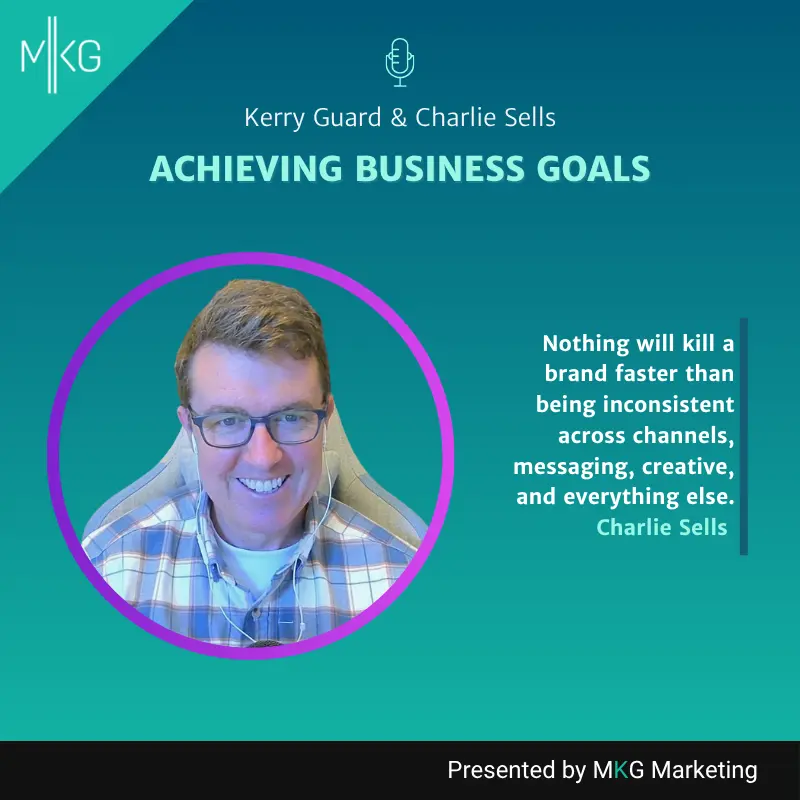
So after the end goal has to always and that can be as simple as I don't want this to sound robotic either because, because if you're leading a meeting and you're like, what questions do we have about this particular campaign? Let's now go to the context part. It doesn't have to be robotic, and it doesn't have to be clinical. It can be as simple as, hey, just as a reminder, this is the goal we are working towards this week, or this is why this campaign matters, tying the tying somebody's work back to a why actually creates momentum and boosts morale and makes people go create better stuff. So after you go through those things, I think there are three filters that you have to look at every single problem through. The first is, are we being competitive? Not? Are we spending more, or are we doing better than our competitors, but are we clarifying what makes us different, not what makes us louder? And that's where a lot of brands get real lost, is they think we got to do more. We've got to say more. It's got to be flashy, it's got to be produced. It's got to be X, Y, and Z. It goes back to being as simple as product first position, that's as simple as we can make it right. So we have to make sure we're leaning into our competitive advantage rather than trying to copy our competitors. Number two is, are we being consistent? And this is the thing I hope. I preach till the day I die, nothing will kill a brand faster than being inconsistent across channels, across messaging, across creative, across everything else. Because if they see a commercial and then have a very different experience on your website, or they read an email, that's totally different than your social stuff, you are losing, you don't know it. That's really important.
Kerry Guard 32:55
Yeah, I want to. I think people get as I think for me, I kind of get hung up on the word consistency, because I think consistency means that I need to be everywhere all the time. What you're saying is so much more important: your message throughout the customer journey, wherever it is, has to be 100% consistent. Absolutely.
Charlie Sells 33:16
And it's not just your message. It's everything to do with your brand. This is where I think branding gets relegated to a logo or design, and those are important, and they matter. It is so much more than that, and that's where brand consistency can build trust over time. I had a brand leader, one of my leaders, when I was at a very large company. He just said, he said, How did he say it? Man, it obviously stuck with me, but it had to do with meaning and trust fueled by experience like, that's how you that's how you build a brand that lasts, if there's meaning behind what you do, if you're building trust with your with your customers, and if they are experiencing that consistency, everywhere, all the time, trust on repeat is one of the ways that I say it. The last one is the hardest one. And you know this just from working with clients, being concise, simplifying to multiply, having fewer priorities, having a clear message. It makes yeses easier over time. And I can't tell you how many times I've had to work with business owners who are like, I want to do all of this stuff. I'm like, pick two, and they're like, but we could do all of them. I'm like, and you will burn out, and I will burn out, and nobody will be happy, and the brand will not win. That's part one of it, too. I think part two of it is like, we want to say more. We want to do more. One of my favorite examples is when I was working with a business owner when I first launched out. They don't know that they were a guinea pig, but they were a guinea pig, and it was great. I combed their website and looked for all of the things. That could be a headline, that could be an H1, that could be, you know, the thing that encapsulates this brand. And it was just like, 10 words here, 20 words here, three paragraphs, nine bullet points, and the whole nine. And so when I was going through all of their other stuff, and really just kind of auditing everything that they had out in the world, I found five words just kind of tucked away in a presentation. I said, Why is this not your H1? " and they were like, well, we used it for a presentation once, and it sounded really good. I was like, it doesn't just sound good. It summarizes your brand and what you want these people to do in five words. Like, it's the most clear picture in representation. They were like, Yeah, but we want to say this, this, and this, I'm like, Cool. Put it on a landing page, put it in an email, put it somewhere else, let them go through your course and discover it for themselves. Those are not intriguing. That's just information. This is compelling. This is the thing that is going to push your brand over the edge. And they're like, Huh, okay, five words versus 20. I mean, most brands are not do that work? And that's true. It is the hardest part of this, this entire framework, to cut and then cut again, and then cut the last 10% until it doesn't make sense and doesn't feel like vaporware.
Kerry Guard 36:09
Like, that's what's so hard, is like, I remember we were doing this with ours last year, and I'm still trying to find it, because it just feels empty, like, one of the taglines we used was we, it was something around the details, like, we manage the details, you capture the market. I'm like, that doesn't mean anything. Like, yeah, that could be any agency in any of the land doing anything. We do these two things to help your brand found like that, that's what we do. Like, I don't that, but that doesn't found that doesn't feel compelling. To say, yeah, right. So it's like, how do you sound compelling? And do you, how do you simplify what it is that you do in a way that nobody else does it?
Charlie Sells 36:58
I have, like, three or four that I go through on a regular basis. My favorite one that I I can't really commit to it, because I like saying a lot of a lot of things, you know, in a lot of different places, but it's the one that I keep coming back to, is that your brand deserves better than guesswork, because a lot of times again, it is just kind of throwing stuff out there and seeing what happens, or trial and error for the sake of trial and error. And at the end of the day, if you don't have a strategy, if you don't have something that is consistent, then you're just going to lose, and so my commitment to business owners is, number one, I want to make sure that you get to do more of what you love. And number two, I want to make sure you have a strategy that you actually understand, and that you can implement, that's not just guessing, right? Okay, three filters. Step six, by the way, is clarity. It's not step seven, and that's important. We're going to align on what matters. We're going to decide who owns what, and we're going to determine what happens next. It's almost a read back to make sure that everybody understands we're not looking for consensus and we're not looking for total agreement. You're very rarely, if ever, going to have that. And I think there are points in time where those are important, but everybody just needs to know what that what they do ties back to something and how to go and execute on it, which is why Step seven is go and create the stuff, ship the work. Build momentum, you know, get everybody excited. Have a three to 12-week plan. Have a three to 12-month roadmap that people can see what is going on and what happens. So, in order, it looks like this: curiosity, context, competitive, consistent, concise, clarity, and then creativity. That's the framework. I think. There it is, all of us go through at in the marketing and especially the creative world at some point.
Kerry Guard 38:50
Naturally, yeah, but it's so nice to actually have it spelled out for us in a way that we can, like, double down on it. The competitive filters, what are the three columns you use to compare a client's messaging against our top two competitors?
Charlie Sells 39:05
Some of that I do in real time with a business owner. I think the first thing is that Donald Miller says it in just a beautiful way. There's your website past the grunt test. That's always the first line that I look at, is like, does your H1 make sense? Does your overall messaging, you know, permeate throughout your entire site? That's that's the first place that I do. In fact, I do. I do this every now and then. We're all, I'll throw something out on LinkedIn and be like, hey, send me your website. I'll tell you what's unclear in 10 minutes or less. And it is one really, really fun and two really eye-opening for a business owner to get an objective look at, oh shoot. I have been using insider language. I've been using tech words. I haven't been using the words that solve my customers' problems before, and, oh man, I did one for a big, growing company that's in like, 12 states, soon to be. 50, you know, over the next couple of years. And I was talking to the to the marketing lead on it, I was like, Do you know that? I couldn't figure out what this thing was until halfway down the page, right? And they're like, Huh? And when I pointed out to them that they were using this word here, and this word there, and this word there, and then all of a sudden there was a summary statement about a third of the way down, and then they started to make sense. They were like, " Oh, shoot, yeah, we have missed that, yeah, because two reasons, and I found this out later. Number one, a lot of people had a lot of opinions about what needed to go on this homepage. Number two, nobody, yo. I know nobody did a consistency check on all of this. Nobody thought to go back through it and be like, yeah, all of this makes sense, or we're going to be consistent. And I mean, I've worked with enough UX designers to, in my mind, and when I'm writing copy and doing all those things, I'm also thinking about where they go next. And so I'm thinking about like, this is an overview page, which is what it should have been. Now we send them to these other Hub Pages where they can learn more about this, or do a deep dive, or do this and this and this, right? That I think was, I mean, that was, that was super eye-opening. And when I show, when I show, like a business owner, this is what your next three competitors are doing. It's always amazing how little work that they have done in that side-by-side comparison. One owner that I worked with during the event space, I was like, I can tell immediately who this website is for and who they're targeting. Do you have any idea? And they'll go, oh yeah, we're not, we're not going after those people. I'm like, great. What about these guys? There's a little bit of overlap. Great. Okay, now we know who we are, who we're really competing against, and I think that's important to put in front of business owners, is for them to actually look at what is going on.
Kerry Guard 41:56
I love that. I think actually having them see that and be able to pull it apart, because the nuance founders have just this amazing amount of nuance that never really comes through, and taking the time to really sit down with them, to pull that out is just so, so critical. Speaking of founders, how do you handle, you know, they get emotionally attached? It's our business. It's our baby. We've done this for a long time. Oh yeah. How do you handle a founder who's emotionally attached to a cool tagline that you know is failing the clarity test? And what's the data point that helps change their mind?
Charlie Sells 42:33
Oh man, this is my favorite long-term problem to solve, and I say long-term, because it does not happen overnight. Kerry, and I know you know this, and a lot of people who are in the marketing world know that when a business owner is beholden to a logo or a color or a catchphrase or something, as soon as they say, Well, I have always liked this, or that's the one we've always had. You better buckle in, and you better be, you better be putting premium gas in the in the tank, because it's going to take a while in order to get them from where they are today to where they want to be. It's sort of that player-coach mentality, right? Where, okay, we can play the game, and we can go down this and all of that. Honestly, I have found that one of the more compelling ways to guide and to lead a business owner to the next place, if you will, is just to show them options. I've gone through this exercise with a with a client very recently, where they had an idea for a logo in their head. I showed them, I don't know, probably six to eight different options that had almost nothing to do with their brand. It was just like, here's a way to get the juices flowing. And from there, they saw, Oh, yeah, I think I like two of these. And so we developed two of them in a more fleshed out, fleshed out way. And they were like, Okay, now we got to beat up on these. Sometimes it's just showing them what they don't know, or what the possibilities are, right? The same can be true for an H1; the same can be true in copy. I do that in some of my like, agency style work, where you know, if we're working with a brand on a refresh, I'll show them, like, this is what you have currently. And that is like, neutral. This is what it would look like if it were more clinical, more technical, just very straightforward. This is what it would look like with a little bit of personality. And this is what it would look like with a whole heck of a lot of personality. Like, if Ryan Reynolds was going to endorse your brand and be talking about it like, this is how it would sound. And you would be amazed at how many people are like, Oh man, I really love that. Voiced up personality. Version of it tone down just a smidge. I'm like, great that we can work with. But again, like it's so easy, I'll just, I'm working with a couple of clients right now that are in the copier business. Right? There is nothing fun about the copier business. People have to have them. They have to work. And if they jam, then work comes. To a halt, and, you know, toner has to be refilled, and all that kind of stuff. It's not easy talking about that entire world, right? But we're pushing really hard to say, rather than focusing on features, you know, kind of the Apple and the iPod thing, let's talk about the benefits. What? How much time are they saving? How many? How quickly can you solve their service and efficiency problems? How, you know, how are you actually providing value to them beyond just, like, here's a piece of hardware, and we're going to service it for you, and then at the end of the lease agreement, you can buy it from us. And, you know, like, it's, that's, that's the kind of stuff that you get to draw out of a business owner over time, and honestly, that's why I love to do more of like, interview style calls with business owners, because I learn a heck of a lot just by asking questions and saying, like, tell me about your biggest client success story, and they'll do a deep dive. Or, you know, my other favorite question is, like, if you have a sales team, what are the number one what's the number one question that you get about what you do? And then I'll then I'll kind of challenge them on the spot and be like, Why is that not an FAQ on your website? If that's the number one question, go ahead and answer it. Go ahead and get ahead of the game.
Kerry Guard 46:17
And I know it feels weird. I had, I was talking to somebody last week, a friend of mine who we were, he we were talking through a search visibility, you know how SEO is changing. And he was like, never in a million years did I think having FAQs at the bottom of a page was a thing. I thought it looked so weird. I felt like it was really chunky coming out of left field, and now it just needs to be completely standard. I'm like, Yes, it really does. It's your point of not just being able to easily answer the question for the user, but it also allows for the llms and for the answer engine, for Google to pick you up so much faster, because it doesn't have to search so hard for the answer. It's right there. So I know it feels weird. Why would this? This doesn't look pretty. It's at the bottom of your website. It feels out of place, but it is so crucial these days, 100% agree, get those especially.
Charlie Sells 47:13
Well, especially if you have so many different verticals that you're trying to keep track of. I mean, sometimes, and I think this is where you're going with that point as well. I mean, eventually nobody's going to search for information in the traditional way. They're just going to type it into Google or ChatGPT or caught or wherever, and they're going to ask a question, just like your FAQ sounds. And imagine what's going to happen when those actually pop up as the answer, and there's a link reference, and they can go to your site, and, you know, do all the things, right? And if you have so many verticals that you would hope to land with a customer, FAQs are going to become a vital import, a vital part of your website, because you shouldn't just be answering questions. We should say this too, right? You shouldn't just be answering questions about your brand, your product, and your services, answer general questions like, Why does a multifunction printer matter? Do I need a multifunction printer or a laser printer? You know, some of those industry-specific questions that aren't just about your brand. They're just thought leadership repackaged and put at the bottom.
Kerry Guard 48:18
Definitely, yes, definitely a balancing act, as the way we're thinking about this, the search visibility optimization, right? So adding to the acronym soup, I know, but we needed it. I just got so tired of writing SEO, AEO, and GEO, because you need all three folks. And you know, as this shifts, it is going to be you're going to want to be the answer and make sure that your structure, your page, does. So FAQs are a big part of that, but it's balancing the key. It took me three hours. I'm an SEO agency. You think I'd be able to do this faster, but it literally took me three hours to write a pillar page the other day, because it's this now, this marrying of not just writing about the difference between laser printer and a multi printer, but your brand identity of why you're different needs to also be baked in there in a way that doesn't feel like you're trying to sell something, but you're being to your point that thought leader in the space of why you everything you do now has to come back to why you, even if you're just doing a simple definition of what is a printer like? What is a like? What does a printer mean to you? Is it your brand of what you're trying to accomplish these days? It's so much more complicated than just simply pumping out these definitions and these high-level pages around information, because that information exists all over the internet, and the AI can get that from anywhere, but why should they be getting it from you? Yeah, it's a whole new world.
Charlie Sells 49:47
It is, it is. And props to the clients out there who are thinking about that, even if you're not implementing it yet, because we're still trying to figure it out, right, like it is, man, someone's like, what about. What about this? Like, how can I do that? I'm like, I have no idea. Like, I'm guessing at it too, and we're all learning it in real time. And as the pros, like, as the professionals who are supposed to be able to recommend and prescribe and do all of that, you know, we have no idea how it's gonna change. It's gonna change tomorrow. There's, like, there's no rhyme or reason to it, which, in my opinion, is kind of fun, because, like, it's a new adventure, right? It's a new side quest. We that we get to go on, yeah, love good side quest.
Kerry Guard 50:32
I totally agree, Charlie. I thank you so much for this conversation. I could talk to you all day. I love your framework. I love that we use it. I love that we can use it anywhere in terms of creating clarity in everything that we do. Where can people find you? You can
Charlie Sells 50:47
always find me on LinkedIn. It's Charlie sells, and yes, that is my real last name. It's not just a not just a pseudonym for anything, or a pin, a pin name. You can always find me on LinkedIn. Or you can go to clarity over everything, calm, and find some of the ways that we could work together. If you just need a strategic advisor in your back pocket to ask questions and, you know, help reprioritize, or if you want a full brand audit and clarity and alignment sprint, we can, we can arrange that as well.
Kerry Guard 51:15
Amazing, amazing. Thank you so much. I loved this conversation. I can't wait. We're going to clip it. It's going to be everywhere. If you want to join in on the conversation, feel free to comment below. We'll come back to you. And yeah, looking forward to getting this back out there and keeping, keeping the party happening. Love it. Yeah. Thank you so much for having me. Kerry, absolutely. And thank you to our listeners for joining us. If you're ready to stop the guessing game and start building a marketing engine that actually scales. Visit us at MKG Marketing. This episode was brought to you by MKG Marketing, and we'll see you next time on Back on Track. You.