Marlena Sarunac
Marlena Sarunac is an award-winning entrepreneur who blends engineering rigor with sharp storytelling to build scalable go-to-market strategies for early-stage startups.
Overview:
Marlena Sarunac joins the show to break down what founders get wrong when they rush marketing before the fundamentals are in place. They cover why brand awareness needs a real system behind it, how to create messaging that attracts the right buyers and repels the wrong ones, and why creative debt can be just as dangerous as technical debt. Marlena also shares her data-first approach to building messaging frameworks, the importance of recording and analyzing sales calls, and what startup teams should look for before hiring a senior marketing leader. If your company is trying to grow without wasting time on disconnected campaigns and half-built systems, this episode offers a more deliberate way forward.
Transcript:
Marlena Sarunac 0:00
Yeah, so I'm very data-focused. I like to start on a quantitative level and then build on the qualitative level. So I think that that's kind of an interesting approach in that I don't come in there like guns firing with hot, crazy, cool, sexy ideas. I like to look at all the data. I like to really listen to the team. Everybody on the team has a unique perspective that they're able to bring to the product, the service, the company. And I take all of that, I synthesize it, and then we kind of lay down, like I said, that messaging framework, like, what are the ground rules about? Like, what are we who? Are we for whom, etc? And then that, for me, is like, when the magic really happens, where, like, that creative level comes in, and that's when, you know, I can start to create the spicy kind of, you know, headlines, taglines, whatever.
Kerry Guard 1:08
Hello, I'm Kerry Guard, and welcome back to Back on Track. We are here today to talk about so many things. I can't wait to unpack all that has to do with AI and for founders of growing your marketing, and from somebody who has who really understands the engineering side of what you all put into your product to then get it out into the world. I'm so excited. Marlena, welcome to the show. Hello. Thank you. So pumped to have you here before we get into the weeds of creative jet and other topics that we're going to unpack, we're going to start with a little word association to clear the air and give people time to join us. If you are here, say hello and feel free to join on in. We'd love to hear your input as well. I am paying attention to the comments. All right. Marlene, are you ready?
Marlena Sarunac 2:00
I am always
Kerry Guard 2:03
All right. I'm going to throw out three common, three common terms, and I just want your immediate unfiltered reaction, okay, okay,
Marlena Sarunac 2:16
I'm a little nervous, but let's do it
Kerry Guard 2:21
all right, turning chaos into clarity.
Marlena Sarunac 2:24
Oh, such an AI trope. Chat, GPT, all the way, someone just put in like, what? Give me a headline for my website. Boo, two thumbs down. Is my reaction.
Kerry Guard 2:41
I'm with you. I'm with you, fractional Head of Sales and Marketing.
Marlena Sarunac 2:45
Oh, that's a great role to hire for if you don't actually know what you need and you are looking for this person to fail because they can't possibly do both. No disrespect to anyone who is, who is tackling both, but there are such distinct areas of expertise, both executional and strategic, I think it's really difficult to get both in one person very well. It's tough. I also think that, you know, one of the things I always kind of laugh about is that you can get a degree in marketing, as you can actually go to college. Like, there's a whole discipline around it. So, like, why do people think they can mash it into just sales and expect one human being to get it all done? It's beyond me. I think that's really difficult, really distinct skill sets, complementary, but distinct.
Kerry Guard 3:41
Absolutely, as a marketer myself, and also the founder of a company, stepping into a sales seat. It's just a different ball game in it. And I gotta say, as a as a marketing mindset is stepping into a sales mindset, it's not the struggle is real.
Marlena Sarunac 4:02
Yeah, I just want to be clear that I have immense respect for sales, and that's why I don't think that you can match both and do well. I think you can hobble along. But yeah, they're distinct for a reason.
Kerry Guard 4:17
Absolutely, I couldn't agree more. Last one, brand awareness.
Marlena Sarunac 4:22
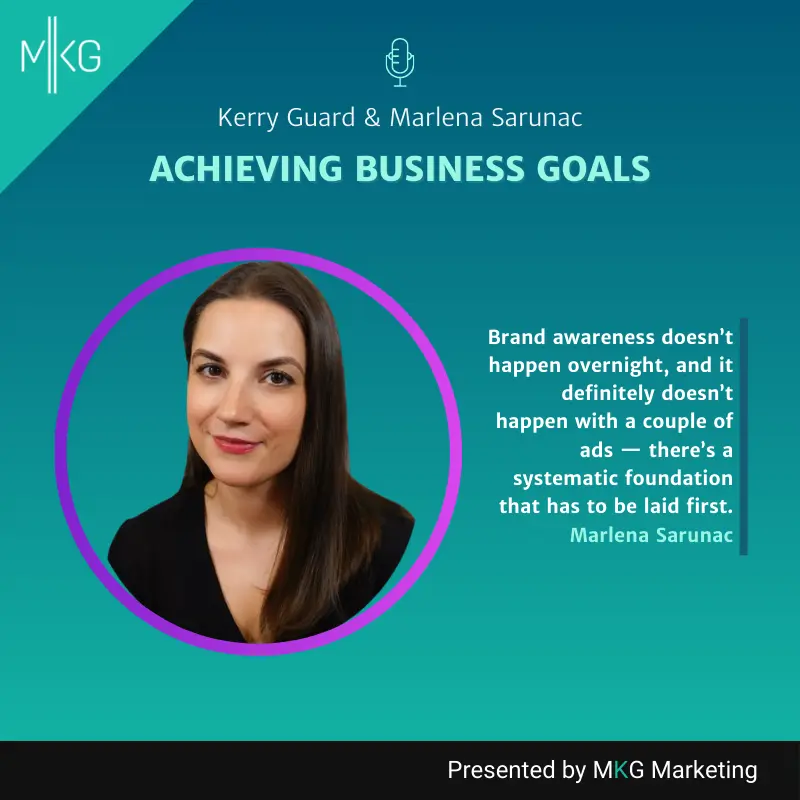
Brand awareness is a critical step when you are emerging into the market with a new product or solution, and there are specific steps and fundamentals that you should have in place in order to establish brand awareness. It doesn't happen overnight. It doesn't happen with a couple of ads. There's a systematic foundation that needs to be laid down in order to start to chip away at that, that top of the funnel.
Kerry Guard 4:55
Let's start there, while we're here, right? Right? Yeah, let's go. Because I think the landscape is shifting under our feet, like as we speak, and AI answers, AEO answer engines, and the like are really taking over, and search in general is getting disrupted in a big way. And more people are building categories as well. I feel like brand awareness is about to have a heyday.
Marlena Sarunac 5:26
Yes, there's definitely a resurgence in the way we think about it, talk about it, and measure it.
Kerry Guard 5:34
Yeah, tell me more about the measurement piece, because I feel like marketers get it, but founders are scared of it.
Marlena Sarunac 5:41
Yeah, definitely. I think that there needs to be some grace in this area with how quickly the landscape is changing and the way people are discovering brands, now and solutions and products, and companies. Typically, when someone is Googling, they already know about your solution, and they're probably looking you up, or they're looking up similar solutions. When they're accessing something like an LLM, like ChatGPT, they're exploring a category and looking at how ChatGPT has defined that category. So there's a lot of different tactics, complementary tactics, but important, fundamental tactics that you really need to think about like, like how are you presenting yourself online everywhere, from your website to every single source that cites you? Are you talking about yourself in a consistent and a consistent way that LLMs can understand what you do and then categorize you correctly, and then actually present that information to someone who's in that buying mindset? So you have that going on. And then in terms of the actual measurement piece that you asked about, you know, I think that there are a lot of things that there are a lot of metrics that work together. So are you actually driving traffic to your website? That is important. But also, we're seeing that the AI overviews that you're seeing, like at the top of Google search results, are getting eyeballs, but not clicks. So you might be appearing there, but no one's actually clicking through, so it kind of behooves you to be in a lot of different channels, testing a lot of different strategies, and appearing multiple times. Because, you know, a bunch of studies show that someone needs to see your brand at least seven times before they actually click through and engage with you. So think about all of those places that someone needs to see you, see the logos, see the brand, see some messaging from you before they actually decide to engage. And there's a lot of work that needs to go into that, which might not have a clean attribution. You might not be able to cleanly say, " Oh, this person typed in this, click, this, they came into the funnel. They requested a sales demo. It's not like that anymore. It's a much more disparate type of buyer journey, unless you have really honed in on your machine and you're showing up in geo the way you need to. Your website is fully optimized, like everything has been optimized, and you're just ticking away. Great, you're in a great place. But most companies aren't there.
Kerry Guard 8:24
Yeah, I feel like even if you start to get there, then the ground shifts again, yeah, it's always something you're going to be attribution is always something we are all chasing. I would say, for the way that I look at attribution and how I think about visibility and the impact on that of the brand from a pipeline perspective, my favorite thing has always been keyword volume in terms of brand. Your brand terms are more people searching and trying to understand your brand terms, and you can visit visually, see that in the llms through Google, Google Search calendar, and your impressions are going whoop. And if you have SEMrush, we just upgraded our SEMrush to the AI aspect of it. It's actually really magical. You can see the exact prompts that you're searching for. And so if you're seeing your name come up, where people are starting with you, wanting to know reviews and things like that, that's a great way to know, okay, I'm showing up, and all enough places getting residents.
Marlena Sarunac 9:25
Yeah, definitely. And there's a lot of there's some interesting companies out there that can do audits for you. So you can kind of, like, hone in on, like, what is appearing, who else is appearing. What are those long tail, you know, keyword-like, search terms and keywords that people are utilizing? And then, how can you leverage that in your content, and how you how you present that.
Kerry Guard 9:48
Absolutely, and we are one of those companies. So you know, if you want to know what your search visibility looks like, give me a call anyway. Back to you, Marlena, I could talk about brand awareness all day, because I do think you know you. Not quite the 1960s Mad Men style of like big blasts in terms of commercials, that is, that's not happening, but the visibility that we're talking about in terms of consistency and being everywhere. Talk to me, you mentioned it a little bit, but I want to sort of, you know, dig in and press on the button and be annoying about it, because it's just so important, and I don't think it's sunk in yet. The the point of your messaging, and that your messaging not only has to be it has to be consistent and everywhere, but how do you know that you have the right messaging? Because I feel like you have to have that dialed in so much more definitively before you place it everywhere.
Marlena Sarunac 10:45
Yeah, you know, it all starts with a process around forming a hypothesis, an informed hypothesis. And that's part of the work that I do. I sit down with my clients, and we really go through, what problem are they solving? What's the backstory? Who is it for? Is there a difference between the buyer and the user? Often there is, especially in the B to B space, yeah. And so we basically go through multiple steps to, kind of like, define all of this, and then we come up with a messaging framework. And the messaging framework is basically based on, like, what are your value propositions, what are your key differentiators? What are your competitors saying? How do you differentiate from them, and who are we talking to? What makes you special to them? And what do we like? What are the pain points that we're really solving for? And once we put together all of that, then we kind of put on, like, a creative layer to it. So we come up with, like, the snazzy tag lines, headlines, copy, the storytelling part, like the stuff that you know, like the script, right? And then you start running some controlled initial tests to get some market signal. And you want to see, you know, some, some key things that you know that this is working is, Are people are when you're on sales calls, are the prospects repeating back to you the same kind of language that you use to talk about yourself? That means that they're getting it, and they're, you know, they're regurgitating back to you, that's an excellent sign. Another thing is, you know, I think a lot of the founders I work with, they their aspirations for what they're building, and I'm really talking about, like, early stage companies who are still kind of like figuring it out. Their aspirations for what they're building are usually so is much further into the future than the current reality of what the state of the product is and where they are in terms of brand awareness and all the things that they've built in the marketing end. And I think you need someone to connect the dots between, like, where are you going with the company, but where you are right now and what you're actually able to offer, and who's actually going to be interested in this in this moment in time. And so what I often see is, you know, there's like a hesitancy to maybe get too specific in messaging, because you don't want to turn away a potential prospect. And I say as good, you know, Hero headline on your website, the first thing that you see when you land on your website, if a good number of people say no, this isn't for me, and they close out. That's a good thing. That means that the right people are saying no, and what you want are the right people to say yes and actually enter your funnel so that you're not wasting your time and precious resources chasing down leads that are never going to convert. So that's another exercise that I kind of force the founders to go through, which is, can you write a headline that alienates or, you know, makes it clear to a significant portion of potential visitors that this solution is not for them? And so all of these things can be measured, obviously, through, you know, web analytics. And then ultimately, what conversations your sales team does end up having.
Kerry Guard 14:02
Yeah, yeah, you mentioned that you would do some structured tests to understand to start getting those signals. Is that through paid, or is that through organic? How are you getting that message out there in a way that you can actually measure its impact?
Marlena Sarunac 14:18
Yeah, every company is different in terms of, like, what their sales motion looks like. So, you know, I think, like an optimal situation is you're running paid, targeted advertising. So at this stage, after we're done with this, you know, messaging framework, like, we know who you are, we know who we want to go after. It's not just, let's just blast a couple of things out into the universe and see who comes in. No, we know we've made an educated hypothesis, and so we can target them really easily. It's their tools at your dispense all over the place. So you can start targeting with paid; you can start doing organic, but you know, that takes a lot of nurturing. And you need someone who's really dedicated to those organic channels, because it takes a lot of work. It takes engagement. Need to build community. You need to hype up current users, get them to tell their stories, and see if you can create brand evangelists on your behalf. That requires a lot of effort. It's not just going to happen on its own and then in your sales motion, you know, if you do happen to have, like, maybe you have great investor relations and you're they're setting you up with incredible sales calls, you better be recording exactly how those calls are going and sitting down with all of the takeaways, objections, reasons that people say yes, reasons people say no, and start to aggregate that information so that we can go back and iterate on the messaging and see, like, Okay, this move the needle. This is not so much. That's what you need to start doing. Like, that's the signal that you need to start collecting so that we know where to iterate and how, and just keep optimizing. Sales calls are gold. Yeah. And now everyone's Now, everyone's actually recording and transcribing them. So there's absolutely no reason not to have that software in place so you can collect that absolutely critical data so that we can analyze it and see something interesting. They hesitated here. They asked a lot of questions about this or this other thing, which was a light bulb, like an aha moment on the call. Let's capitalize on that. Let's turn that thing and put that into the market-facing messaging.
Kerry Guard 16:27
I have to say, I haven't been in the sales seat very long, but it has been the absolute best part, it's like really hearing where people are and what their struggles are, and in relation to, you know, what it is we're trying to do and how we can help them. It's the amount of content that comes out of that that is just so great. I totally agree. Let's talk about creative debt. You mentioned this in our prep call, and it's just such a great term, yeah, for a founder who's just doing what we like to call random acts of marketing. What are the first three symptoms that they are overleveraged on that creative debt?
Marlena Sarunac 17:07
So, you know, this is a term that I use because I do work with a lot of technical founders. I'm kind of an unusual marketer and that I have an engineering degree, so I definitely like, you know, I can, I think I get what a lot of these founders are trying to do and trying to stay, and I'm pretty good at translating that into market speak and so creative debt is, you know, a term that I started using to help illustrate to founders that just like you don't like to accrue technical debt, where you take shortcuts, you don't fully code something correctly, like You know that you're gonna have to come back and patch something up, or fix it, or rewrite it, or whatever the thing is. The same thing happens with on the marketing side and on your brand side. So when you skip ahead a couple of steps, or you cut corners, inevitably, you are going to have to come back and revisit that. And when you do just like with technical debt, it's going to set you back time wise, and it's going to be expensive, and you're going to start to you're going to create potentially a broken experience too. So a lot of folks, you know, rightly so I'm not saying that you need to have $100,000 brand marketing project that is not I would never advise that to an early stage company doesn't make any sense, because you're still iterating. You're still collecting market signals. You could be pivoting, changing stuff in six months. Most companies do. What you need is a playbook that prepares you so that you have something out there that looks good and sounds good, is cohesive, is differentiated, but you can keep building on it and iterating on it. And I think that that is a really special type of mindset and playbook, and you need someone with this particular eye. And that is exactly what the company advises, which is the company that I'm the co-founder of; that's exactly what we do. We sit there, we sit with our clients, and we make sure that they have an iterative plan that they can build upon, so that they're not starting from scratch when they do finally reach some kind of market traction. And now they're like, Oh, great. Our logo is looks like it's from 1998, and our website is crappy. You know, all of these things need to be fixed and completely overhauled. You know, a full rebrand is very expensive. You're losing out on that brand awareness that you have just been building on, like you're just throwing away your creating throwaway work, and that is not in this current time and age. In the startup world and startup mindsets, you cannot be creating throwaway work. Everything should be iterated upon. So there are ways of doing all of these things, like I said, from brand to marketing, where you just do like, just enough to like, look like. I said, look good. Sound good. Look credible. Have someone in an enterprise seat actually take you seriously. Without over-investing, over-indexing, freaking out your investors that you just, like, signed on this, like, huge agency to do something nonsensical and unnecessary at such an early stage. So, yeah, those are some, like, the things like, you know that. And when we talk about, like, where you show up in that way, it's, you know, what are your decks look like, your one-pagers? What does your website look like? You know, you want all of these things to look polished and professional, because the table stakes are at this point. I mean, that's all it is. Table stakes just to look polished. And, you know, we can get into this even some more. And I am totally going on a tangent now, but like, the goal posts are just being moved up and up and up. And what, what used to pass, what used to be able to pass? To be able to Series B, you now have to start showing when you're a Series A company. And now I'm seeing seed companies that look like Series B companies. You know, that's all intentional, and it's just the reality of the market that we're operating in. It's very different from 5-10-20 years ago.
Kerry Guard 21:06
So much more competitive, so much more competitive, and that polished, and the help with, you know, AI and things becoming less expensive and getting being able to do those things sooner is getting easier. So that's helpful, not helpful in so many ways, because founders really have so much more important things to be focused on than whether they have a pretty pitch deck.
Marlena Sarunac 21:34
Definitely, and there is all this tooling is really helping commoditize and create access to things that strapped companies didn't have access to. At the same time, you do need to keep a human in the loop, because now what we're saying is it's become so commoditized that now everyone's starting to sound the same. And that first prompt that you gave me that just really made me laugh about, you know, turning clarity into chaos. That is such an AI trope. And I think a lot of companies and founders don't see it yet, because it is so new. But those of us on the other end, like we are on that other end of the bell curve, then then a lot of then a lot of the you know, these founders are, and we see it, we recognize it, we can sniff it out, and your buyers and the consumers are following. They're right behind us, and they're going to be able to sniff it out, and they're going to be able to tell that there's something artificial going on here. And like, I don't know if this brand is really totally trustworthy.
Kerry Guard 22:37
Yeah, it's interesting, because even I had, I'm not, you know, my background is in channel marketing, right? So SEO, digital ads are primarily where I like to play, and so I step out of that for our own positioning and messaging last year, to figure out how, okay, who are we, and what do we do differently, and why? Why mkg marketing, and I had help with AI because I'd never done it before. I was like, All right, AI can help walk me through this. But now I have to say, so much of what I uncovered about us, I'm now seeing, like, out in the world, yeah, like, oh, we were all doing that, right? So, yeah, I figured out how to, like, you know, pull it back and hone it. I worked with a partner of mine who does positioning messaging on time. And she was like, here's what we were like, here's what we need to do. And so she really helped me. But like, yeah, it's once you it's like, when you buy a new car, and you, like, didn't see the car on the road at all, and then you buy the car, and now all of a sudden, everybody has the car. Yeah, that's true. That's what it felt like. I was like, okay, yeah. Words were dropping, and yeah, things were saying, and we this is what we're sticking to.
Marlena Sarunac 23:45
I think definitely I'm careful of, yeah, I see a lot of chatter now about, you know, people are kind of, like, ragging on, like, the cringy LinkedIn posts. And you can just tell, like, when something's been fully generated by ChatGPT, and it just like, has there's like this formula to it that's like kind of coaching. And you know, if you're able to pick up on that on LinkedIn, I'm telling you, people are gonna pick it up on your website.
Kerry Guard 24:12
Yep, 100% 100% you mentioned you have an engineering degree. And so how does a systems thinking approach change the way you build a messaging framework compared to a traditional creative agency, yeah.
Marlena Sarunac 24:25
So I'm very data-focused. I like to start on a quantitative level and then build on the qualitative level. So I think that that's kind of an interesting approach, in that I don't come in there like guns firing with hot, crazy, cool, sexy ideas. I like to look at all the data. I like to really listen to the team. Everybody on the team has a unique perspective that they're able to bring about the product, the service, and the company. And I take all of that, I synthesize it, and then we. Kind of lay down, like I said, that messaging framework, like, what are the ground rules about? Like, what are we? Who are we for, who, etc? And then that, for me, is like, when the magic really happens, where, like, that creative level comes in, and that's when, you know, I can start to create this spicy kind of, you know, headlines, taglines, whatever, and make you like, look and sound really sexy. But I think having, you know, having one senior person, look at this from top to bottom, someone who's done this multiple times, someone who has, like, just like, like, just like a musician has, like, a fine-tuned ear for certain notes, like that is what I am to this space. I have the ear, and I, all I have to do is just like, go through the notes a couple of times, and then we're going to be able to create, like, a really great, you know, Masterpiece together. I have been on the agency side. I loved working in an agency. I am not knocking agencies whatsoever. But, you know, typically senior sales people come in, they sell the deal gets handed off to junior exec, you know people to execute on it and and I think sometimes you know you are, you become a you become a client of a machine that's that that has tight, really tight margins and is trying to produce, whereas if you work with like, you know, maybe like a fractional executive, you're Getting more dedicated, more bespoke, more white glove and custom solutions, because I'm right there. I'm sitting there at the table with you, listening and embedded in your team throughout this entire engagement. And I'm not only embedded, but I'm also able to sit there as an objective, new person who can kind of maybe challenge some assumptions or help the team come to a consensus, because oftentimes you start to all kind of evolve in your own ways. And now the CTO has a different idea than the CEO, and the product head of product has a different idea than the head of sales. And I can, kind of, I can be that forcing function that forces all of everybody to sit down and be like, All right, let's focus on this thing. Let's try it out. Let's test it out, and then we'll iterate.
Kerry Guard 27:08
I love that. I couldn't agree more. As an agency, I have been fighting that since day one in terms of who we hire and making sure that they have 10 years plus of experience and that it's not handed off to a junior team. But I also found that the marketing leader is so crucial, and we actually like to refuse to work directly with founders, because having that marketing lead is just it's just a different it is that bridge between the agency and the founder in a way that you can speak founder, totally, you have to have that skill set. It is a whole different shift of, like, how you explain, and I love how you've adopted it with your engineering background. Like, I think that's and the creative debt that's absolutely brilliant. And I couldn't agree more, like, the importance of having that marketing insight in the room and being able to communicate back and forth between these two functions to make sure everybody's aligned in a way that are that both sides understand.
Marlena Sarunac 28:08
So definitely, yeah. And you know, even, like, back to that engineering mindset too. You know, the other thing that we offer is a lot of laying down the groundwork for go-to-market systems. So what does that mean? Okay, you can run all these campaigns. You can, you can, you can announce a raise. You can announce a new launch, a new product. How are you collecting that data? Do you have a CRM in place? Is the CRM connected correctly to your website? Are you like, there's so much technical stuff that actually goes on that folks also never think about. And you know, if you get a HubSpot account, did you negotiate the right deal, the right package? It's going to take you probably a month to fully get it all set up. There's a lot in there. There are a lot of bells and whistles. You need someone, you need someone in there setting that up. And it's not just about, you know, pumping out pretty ads or website copy. It's really getting those fundamental systems up and running. Because otherwise, if you're just collecting all of your data in a spreadsheet like you are, in for a world of pain in a couple of months when you need to start figuring out, okay, what actually worked, how do we replicate this, and how do I hire someone to take this over? Because a credible marketing person is going to look at this, you know, half-assed system. Be like, No, thank you. I would rather step into a company that was doing this correctly, you know, a long time ago. I don't want to sit here and clean up for three months. Absolutely. HubSpot is a beast, a beast. And everyone's like, oh, let's just go get HubSpot. I'm like, you realize that there's a lot more involved than just getting HubSpot.
Kerry Guard 29:50
Yeah, yeah. Where, at least, go to die if you don't do it correctly, yeah? Well, let's talk about this a little bit, because you're one of my questions. The question here is about building a lightweight website to test marketing signals. Obviously, you need to have a CRM to know what those signals even are. What are the five must-have pages that provide actual data, and what can and can't we ignore in that?
Marlena Sarunac 30:19
yeah. I mean, back to the startup playbook that we work with. We tell folks we are not building, we're building between five and seven pages, and they're like, What? No way. We need 18. No, you don't. That's where you know you talked about leads going to die in HubSpot. If you have 18 pages on your website, that's where the lead is; that's where traffic goes to die, too. You need a compelling homepage. First of all, sorry, let me back up. We start with the site map, and we show you a site map so that you can see exactly like, navigationally, like, what is the information hierarchy going to look like, and what pages connect to what, and what sections talk to which section, so that there's a cohesive path for someone to go through your website. This is not an online brochure. This is an informational gateway so that folks can gather what it is that you do be, and find it compelling enough that they actually submit the contact us form. So we start with a compelling homepage with sections that link to the rest of the pages. Definitely a page like about how it works. Like, how does what is this thing, and how does it work? Then, who is it for? Here's, you know, this is an area that we also have to exercise restraint, where you are targeting one to two, maybe three. Buyer personas, not five, not 10, not endless. Really, get really specific, because again, remember what I said at the top of the hour, which is like, you want the right people to say yes and the right people to say no. So we so we have the homepage. We have how it works. We have who it's for. We have an about us page so you know who are you as a company, your mission, your vision, your team, investments, etc, whatever it is that you want to share often. This is like, where your career is, a link to your career page also exists. And then a blog somewhere, some kind of repository for information that you need to have a really great strategy around the schema, how it's laid out, what information is in there, how often it's being updated, all of it, all of it, which is critically, critically important for geo now. Now we have started building a separate FAQs page. We have FAQs on every page, but we also started building separate FAQ pages if it's right for the right company, because we're learning that LLMs really love FAQs. This is like they do, very scannable content, and then a good contact us page. So that's by my account, I think seven pages right there, and that's really all you need. There is no reason to have a page per feature, a page per product; that is not necessary when you're at an early stage. That said, when you are running your tests, and you do have launches spin out landing pages, like those are great testing and learning environments that don't require heavy resources to update your whole website. That's not necessary unless you like, are radically pivoting, in which case, all of it should be done cohesively, all in one go, not just overhauling one page. I'm a big proponent of spinning out landing pages, very easy to do in HubSpot or on Webflow, which my agency is a certified Webflow partner. And so you can leverage Webflow, whatever platform, really, but spin out those landing pages to run tests and glean some very specific learnings.
Kerry Guard 33:41
Yeah, I love that, testing and learning all the time. And I agree. Dude, I have one client that only has a single landing page, and nice because that many leads, and sometimes that's all you need. And we're like, that's that's all we need right now. Please don't give me more than two. This is great. This is all great. It's gonna do its thing, build landing pages, you know, once we get more into the blog and all of that and the resources stuff when it comes, but yeah, for right now, this is great. Yeah, let's talk about AI. I mean, we've been dancing around it a bit here, but let's just get into it. You said it's a silent partner, but commoditized and creative. What is one of the what's one aspect of marketing you don't think AI should touch well? Or do you think it's helpful everywhere?
Marlena Sarunac 34:37
I think it's generally pretty helpful, if you know, and I'm not the first person to say this, a lot of people say this, like treating it as like a very entry-level employee. You know, would you allow an entry-level employee to write your whole website? No, so why are you letting AI do it? It's beyond me. Okay, other than, like, saving costs, but I don't know if you're actually going to net the results that you need. Hmm, I think it's good as a jumping-off point. But again, you need that human in the loop, someone with the tuned ear, that can take and really synthesize all the information that they gathered from your team to turn into something really compelling. At this stage, humans are still selling to humans. I know that we're going toward a future where agents are going to be selling to agents. And, you know, I think we've all seen like, the different like the robocalls, where you just have agents talking to each other, and they're all AI, and they're all like, they're like, scheduling and stuff. It's wild. And I know that that is coming. You can, let's, let's do this interview. You know, in a couple of years, when that's the case, because I'm sure I'll have a completely different take. But at this point, you know, human, a human being is making the purchase decision, even if you, even if Chat GPT, LLMs, AI are part of the process and are part of, you know, aiding the human being, you still need to keep a human in the loop. But, yeah, silent partner all the way in terms of creating frameworks, outlines, ideas. But I really think that when it comes down to putting pen to paper, you should have a human being doing it.
Kerry Guard 36:16
Yeah, I think AI is actually, I feel like I'm fighting with it right now in terms of writing, because it does. It's doing all this really weird stuff, like, yeah, putting words in quotes and jargon. Oh my gosh. It's worse than a marketer from the early 2000s when it comes to making up words for things like it just stop, please.
Marlena Sarunac 36:39
I know. I feel like we all thought it was sweet to just write it. There was something about it that felt so magical, like two years ago. And now I agree with you, I'm getting more and more frustrated with it, where I'm like, No, this is crazy. And also, where did you come up with this? And you know, you really have to yell at it. And I'm like, I don't want, I don't want to yell at an intern, but sometimes I feel like I have to yell it. I feel you, and be like, Wait, where did you come up with this? So I think you really need to be really good at prompt writing and really good at knowing the guard rails, otherwise it's just gonna free-fall. And I think that's part of like bringing in a mark. That's why I don't think marketing people are going to be replaced, because you still need someone who can tell the machine what to do. And I don't think that they it knows right now.
Kerry Guard 37:27
It does not, yeah, no, it's bad. I could talk about this all day. I'm gonna keep moving when founders hire a big brand enterprise marketer, and it fails. What are two nitty-gritty skills a marketing leader must have if they're going to survive the startup mindset?
Marlena Sarunac 37:51
Yeah, I think, I think sometimes what I see is, look, you want to hire people who are successful and are going to bring a playbook that is going to bring success to your company, of course. However, I think that there needs to be a balance between having, you know, Star heart eyes for like a sexy big brand, and actually knowing, can this person, can this person, and will this person and those this person want to roll up their sleeves and really execute. And I think someone who has not executed in a long time and has had the benefit of relying on a very well-resourced team will often struggle starting from scratch again. And I, you know, I've interviewed a lot of people like this who, you know, they become disenchanted with corporate, they want to go back to something scrappy. They're excited about that. They want to build something, but at the end of the day, they don't want to build HubSpot from scratch. They don't want to build a lot of these, like, really fundamental, non sexy things from scratch. They want to launch that into space, and they want to, you know, see what the results are, and be excited about the, you know, campaign success. But I don't think a lot of, I don't think a lot of those folks have been able to flex that muscle of actually getting down the nitty gritty, into the weeds. I am really speaking in broad strokes, and again, I'm not trying to offend anyone at all. This is just from my experience. I'm also ex corporate, but I was corporate during the economic downturn of 2008, so even though I was corporate, I was pretty much in the weeds, because one, like, I walked in two days after my start date, and, like, my entire cubicle city was decimated and empty. I was the only person there, you know, freshly out of college, so I had to learn how to do a lot of stuff. I wasn't just like a cog. I was like the like, we still had client work, and we still, like, needed people's bodies to do it, but I was just like this little 22-year-old was being. Like, I figure out again, I'm not trying to say I'm like, you know, special by any means, and everyone has their own experiences. And there was a lot that I was able to learn in this corporate environment that I was able to bring effectively to a startup, but I had to build a different playbook completely. And I think that that's something that you just kind of like, have to hone in on when you're interviewing folks like this. And also, as a marketer, you really have to ask yourself, like, the real soul-searching questions of like, do I really want to start from scratch here again? Do I really want to do something that an entry-level person would be doing? If the answer is yes, all right, go for it. Go start up. But if the answer is like, then maybe, maybe step into a later-stage company, a later-stage startup. Maybe, you know, make sure that there's a real PMF, a real product market fit with this company that you're interviewing with, you're just going to be up against a lot of challenges that maybe you're not used to. And I don't think it's going to be fully enjoyable if you're rewriting your own playbook that you've been that you've mastered, you know, over the course of your deck, of your career.
Kerry Guard 41:09
Yeah, I would say it's a difference between, you know, being that early market hire who has to do a lot of things in terms of being in the weeds and in contact with the CRM, in contact with the campaigns, and contact with the website, versus the enterprise level of building the team who's going to go do all that? Right? So that's really the big shift. Oh my gosh, Marlena, I could talk to you all day. I still have, so I've skipped over questions. I was like, " Oh, but that's a good one. Oh, but that's going to be gone. But before we go for our founders, one last piece of advice in terms of helping them. You know, we've covered the danger of creative debt and AI slap. What's one single actionable step a founder in the gross Valley can do today to get their marketing back on track? Yeah?
Marlena Sarunac 41:56
I mean, I think at the risk of sounding overly promotional, one thing that you can do that is free right now is you can go to our website, which is the company advice.com we have a tool on there called the friction finder, and you just fill out a couple of questions on there like a little Quizlet, and it'll help show you, know, shine A light on points of friction that you have in your marketing and product experience. And if you notice these moments of friction emerge, and you're like, oh, man, yeah, you're right. I need to hone in on this, like, call us up and we'll do a little diagnostic for you, and we can figure out if there's something that we can work on together. If that feels like too tall of an ask, then I recommend doing the exercise that I talked about a few minutes ago, which is, can you sit down and rewrite your company's website headline and make it some make it a headline that intentionally excludes someone, and see if you can run with that and just see, like, what happened to do that? Yeah, exclude someone on purpose. It's a little bit of a backwards way of thinking about it when you're trying to generate revenue. And you know, counterintuitively, you are decreasing your funnel by doing that, but hopefully you're increasing the quality, and that's what we want. So I think that could be another exercise that everyone can do. You can go do that with your team right now, once you hang up from this call, and see what happens. And in that case, also reach out to me at the company for advice, because I'd love to hear what happened. You know, I love these kinds of experiments and the stories that come along with them. So, in any way, get in touch. Absolutely.
Kerry Guard 43:43
Marlena's contact details are in the invite on LinkedIn or in the show notes of YouTube. Be sure to check that out, Marlena. I thank you so much. I am a firm believer in our marketing leaders, and the fractional world is alive, and I am here for it. So thank you so much for joining me and for sharing so much wisdom with us. Thanks for having me. Kerry, thank you, and thank you to our listeners. If you'd like this episode, please like, subscribe, and share. This episode was brought to you by MKG Marketing, the digital marketing agency that helps you get visible across all those lovely channels that Marlena mentioned. Visibility is a big thing now, and we're here to help you. Can DM me, and we will get you back on track next week. See you all then.