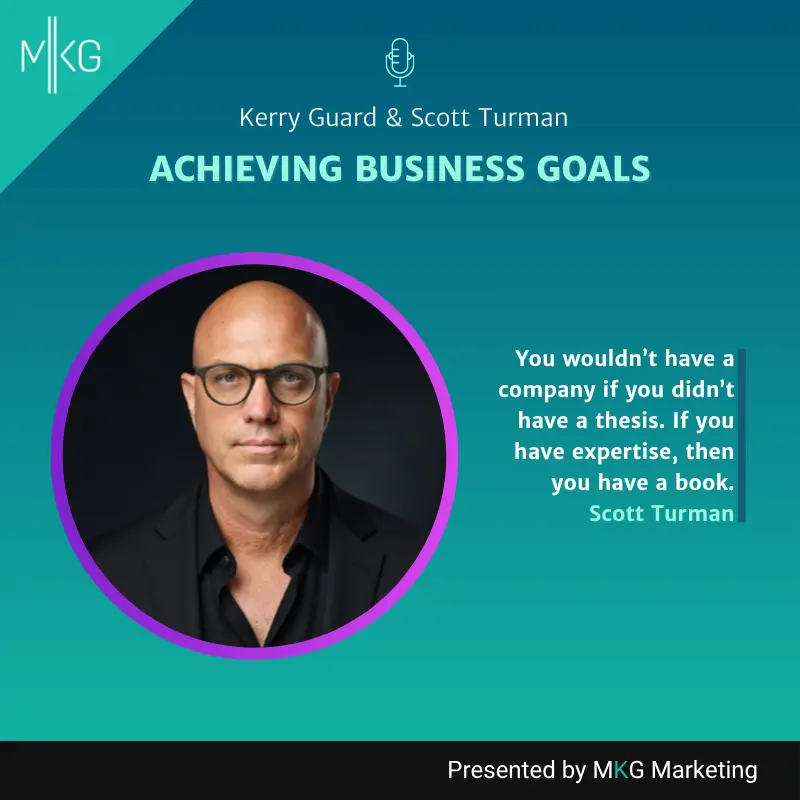
Scott Turman
Scott Turman is a technologist-turned-entrepreneur who helps leaders turn their expertise into authority through books, podcasts, and scalable publishing strategies.
Overview:
Scott explains how writing a book forces founders to clarify their thinking, refine their thesis, and articulate the value they bring to the market. He highlights how most founders already have the expertise needed to write a book—they just struggle to recognize and structure it. The conversation also explores how a book can act as a high-leverage marketing asset, helping founders build trust, reach the right audience, and create meaningful conversations at scale. From leveraging books for direct outreach to using podcasts to sharpen messaging, the focus remains on turning knowledge into authority that drives growth.
Transcript:
Scott Turman 0:00
Is your brain telling you, you know, what are you doing? Man, you don't deserve to be here. Why would they possibly want to read what you know, what you know you're, whatever you're, you're kind of writing about, you know? And I guess my answer to that is, you wouldn't have a company if you didn't have a thesis. If you don't have expertise, right? Then you don't have a book. Oh, you have expertise, then you have a book. It's, can someone at the end of the book, take away and go, Okay, gee, I now understand that topic. Then you have a book.
Kerry Guard 0:42
And we're live. Welcome back to Back on Track. I know, I know, I took a bit of a hiatus. Sorry, not sorry. I actually took a vacation, something that I rarely do. Went off to the wonderful land of Ireland and saw all of the things with me and my family. And then, of course, we came back and caught the sickness of all sicknesses. But we are all recovered, and I am back, and I am so excited for this episode. A little bit about the show before we dive in. We talk a lot about shiny object syndrome on the show, and for many founders, nothing shines brighter than the idea of writing a book or launching a podcast. But if you don't have a strategy to back it up, you're just making noise, lovely random acts of Marketing. Today, we have Scott Turman, the founder of Bright Ray Publishing. He's a former NASA software engineer who realized that authority is a technical challenge, and he's here to help us get our marketing back on track through this lovely concept of publishing. Scott, welcome to the show.
Scott Turman 1:45
Hello there. Thank you.
Kerry Guard 1:49
I gotta know. I gotta get it out of the way. How, how did you go from NASA and the Department of Defense to book publishing?
Scott Turman 2:01
So, I'm named after Scott Carpenter, who's the second American in space. My dad was an engineer on Mercury. I was destined to work at NASA my entire life. You know, I really had pointed everything in that direction, you know, moved to Orlando, the whole nine yards. Started working there, and it was, it was awesome for a minute, right? And then it wasn't. And as much as the mission and all the things that go on out there are just absolutely incredible. It was an hour and 15-minute drive every day, so two hours and 30 minutes for, you know, just in the car, you know, it was, that was tough. And some of the buildings were like, people like, got sent to the moon in this building, but they can't keep water out of the ceiling, like they are all right, right? Next to my desk, I had, like, Do not hit with a hammer. Asbestos. Was like, right. It was literally right next to me. So it got up a bit much. And, I mean, I would go back there in a heartbeat, to be honest with you, just to have the experience again. But so I decided, like, okay, you know, we have a baby in the way. We need to go get stable, more stable, right? Need to be home more often. So I decided I want to work at Disney, or at least that was the second biggest employer as an example in town. And I couldn't, I couldn't get them to bite, for whatever reason, reasons. So what I did was I FedExed my pitch to Michael Eisner at the time, who was the CEO of Disney at the time, you know, like a complete psycho. I didn't know any I was, like, 28 years old. I didn't know any better. I didn't know what I was not supposed to do. I didn't know how far I was supposed to go. But I ended up getting a contract, and I just never kind of looked back. Fast forward bazillions of years. You know, during COVID, I was trying to hire 20 software engineers for a project I just gotten with with a Fortune 500, and I'm like, You know what? I've always thought writing a book would allow me to get make this easier, maybe, you know, and the book was specifically about how to, how to, how to negotiate your salary or contract. But for nerds, specifically, good night. I'm a terrible writer, by the way, but I've always dreamed of doing it. I knew it was a good branding exercise, all this stuff, right? And then a close friend of mine's daughter, who had published a ton of books to the age of, you know, 23, we worked it out remotely over COVID. She this kind of process where she had an interview. I thought it was a ghostwriting process. Is what I had eventually thought ended up being this guy writer, like, almost like a writing group process, back and forth, back and forth. Wrote the book. And I had a close friend, Craig Sacanti, who's a Professor of Entrepreneurship at Rice University. Like, how the hell did you do this? And I go, Well, I told him, and he goes, Hey, would you do that for me? And I'm like, Yeah, sure. $12,000 because, okay, my it was, it was this kind of thing that was born. And, you know, fast forward a couple of years, and, you know, we've got a ton of writers and did a ton of books, and here we are.
Kerry Guard 4:48
Oh my gosh, I mean, that you just never know where things are going to take you, right? I mean, I went to school for photography, and now I'm running an agency from. The middle of the Channel Islands, like you just, you just never know. So to hear your story specifically, I just, I know I've cut this out, folks, and it sort of is like something we that doesn't make it into clips very well. But I had to know. I had to know. So thank you for taking the ride with us. Ken Marshall, always good to see you. Thanks for joining us, buddy. I appreciate you. All right, let's get right into it, because I think so many of us want to write books, but we just don't think we have anything to say. I'm gonna be transparent here, folks. I actually am signing up with Scott momentarily here, because I, you know, as an agency owner, or somebody who's done this for 13 years as a brand-building exercise, purely because brand is just the antithesis of what we need to do this. You know, today, in terms of marketing, we've always needed it, but I think we skirted by for a while of like to just going after lead gen, for so long that we forgot about the beautiful moat that is brand, and now it's coming back in full force because, because how AI operates, and the need to make sure that your footprint is consistent across your entire, entire digital footprint. And so I'm going to try and do this thing, and I got to say I'm having some serious imposter syndrome of Do I have something interesting say? We're gonna find out through the process, but help me understand, Scott, you do this day in and day out. I mean, do you run into this a lot? It says you, you said it that you even sort of had that, like, do I have anything interesting to say? So how do you help founders through that?
Scott Turman 6:38
I mean, if you look at it as purely a branding exercise that'll get you through it, right? But if it's also, if you look at it as a condensed thesis, right? It's hundreds of pages of what you know, right? Now, if you do it the way we do it, we actually have a TLDR too long. Didn't read in front of every chapter. So if someone's in a hurry, they could actually get the essence of your book in like 30 minutes, just by reading the thing very quickly. In terms of imposter syndrome, that's that. I think that's real for any high-functioning autistic for the most part. And a lot of us business owners are right. So that it's a real it's a real problem. It's the imposter syndrome, is your brain telling you, you know, what are you doing? Man, you don't deserve to be here. Why would they possibly want to read what you know, what you know you're, whatever you're, you're kind of writing about, you know? And I guess my answer to that is, you wouldn't have a company if you didn't have a thesis, if you don't have expertise, right? Then you don't have a book. Oh, you have expertise, then you have a book. Can someone at the end of the book take away and go, "Okay, gee, I now understand that topic"? Then you have a book. But I, but no, we have had, I have been in the early days of Brightway. We were talked into doing book projects, and we're, like, three weeks into it, and my writers came to be like, This guy has nothing, absolutely nothing. He is just the he is, he is, he is wealthy beyond his wildest dreams because his dad made all the money, and he's got absolutely nothing to say. That guy has no business writing a book, and we caught it too late, right? So yes, there are, there are. There are times when people shouldn't write books, but you're not one of them. If you have a thesis that works, then you have a book.
Kerry Guard 8:19
Well, we're gonna we're gonna uncover it together, and I'm excited to go through the process with your team. I've been wanting to write a book for a long time, but I really don't have the time to do the actual writing.
Scott Turman 8:32
It's a nightmare. Actually, writing your own book is an absolute nightmare. If you've never done it before, it's gonna be just okay if you can't tell a story, right? Or if you're an ADHD mess, like I am, right? There's no world where that translates into a coherent rise and fall of, you know, of, you know, turning a phrase and, you know, and now, like, oh, you know, with AI, we can just do with AI. AI is dog shit. It does not create anything of value. It just doesn't pure text with a, thematically speaking, that's that's correct, that someone would want to read right? You still need to know what you're doing, and, and, but writing a book on your own is just not fun. It's just, it's,
Kerry Guard 9:16
maybe
Kerry Guard 9:16
That's how people it's birthing a baby. Yeah,
Scott Turman 9:20
I don't know about that. I haven't done that.
Kerry Guard 9:27
With not having to do that again. Most founders want book credibility, but that's kind of vague. What the top three specific business goals a book should solve before a founder even writes the first word?
Scott Turman 9:43
I mean, if we write books specifically for business lead gen, but right? But does it mean that, if you have a title and a subtitle, that the person you're trying to endear to them a little bit, right, they need to see themselves. To the title and their problem at subtitle or vice versa. Start there, right? If you can't even, and that's if we can't even start there, you can't even kind of work your way backward from the thesis that can be what title and cover are like, 90% of the problem in a bookstore, right? So ultimately, you're trying to, you have to find the thematically speaking, they see the problem themselves in that title, right, and ultimately, the ultimate goal is for them to read the book. See that you have the expertise, realize that whatever you do is impossible for them to do themselves, or that they could do it, but it's a giant pain in the butt to do. Like writing a book, be an example. Producing a podcast, I'll hire this person who I just learned how it's done, that's 90% of it.
Kerry Guard 10:44
Just go do it right. Yeah,
Scott Turman 10:46
Yeah, exactly, I loved.
Kerry Guard 10:47
I know it's one of the first questions you asked me. Which I really loved is, like, what your writers actually asked me, and they said, What? What would it look like at the end of this? Like, what does the outcome for you personally look like? And I was like, I want Mark. I want, you know, there's so much trust that has to be built these days in marketing, and so to really kick that up and write something that has some authority to it in a way that allows marketing to do so much more heavy lifting for me, as I just don't feel like a salesperson. And so to do that one to one outreach all the time, and to then get people to, you know, to press on their pain and to nurture them over time, to then, I'd rather build a marketing engine that can do so much more of that initial heavy lifting for me, because I'm, at heart, a marketer, and so I'm very curious to use this, you know, the book, to do that for me, so that I can get back to being the CEO, being a CMO, and being with my family. And I just really loved it, really made I had to, like, sit back and really think through that. But I just love that question. And my point is, the writer asked me that such a thoughtful question. And I just really loved that I could sit there for a minute and think through it and really figure out what it was going to do, not just from lead generation, but what it was going to do for me as a person.
Scott Turman 12:07
So yeah, here's the diabolical part, right? If you, if you, if they, you take that book, right? And if you can mentally go, if I can hand this book to someone, a Rando that's definitely in my that is may have a need for the thing that I sell, right? And if you could just hand that book to them and walk away, and if you feel at the end of the at the end of that book, they would be interested in maybe talking to you about what you do. That's the ultimate goal. Now let's scale that sales engine, marketing engine. Let's go send that book to 1000 people via the mail, because no one gets mail anymore. Nobody gets mail, right? So it's the Twitter is a cesspool. LinkedIn is an AI nightmare. It's all generated, all auto-generated. Everything is so difficult to even get through, to look at anything there. It's very difficult to know if it's humor or not, right? AdWords used to cost $2, now for $100 for a single lead, right? Everything, everything is clogged. But you know what's not clogged? The mail? Open rate now, imagine this. If you have a handful of people you want to get that book to, send it to them from Amazon, because everybody opens an Amazon package with their name on it right now, you have a wave, and just follow up with an email right with the Hey, did you get my book? And you're gone? We some of some of the initial success that we had. We sent out 200 and something books, and then I had, I had, I did an AI dossier on the person and a dossier on the company. That way, the messaging would be factually about them, right?
Kerry Guard 13:35
Yeah
Scott Turman 13:35
Of an email. Did you get my book? Three sentences about their organization and why this book will help them, right? And then I sent that in a three, a three sequence on HubSpot, we had a between 17 and 33 0% response rate to the email.
Kerry Guard 13:53
Response rate, not open rate
Scott Turman 13:55
Not open rate. Was no open rate. I get above 90%. Yeah, you can't really tell, but I got a very high open rate. I'll show how to do that later on if you want to know, but our open rates pretty high. But did you get my package or book? Or like, hey, Kerry, did you get my package book? You're gonna open the email, right? So, with that said, the response was like, " Hey, yeah, I did. What's this all about? And boom, you have a conversation now. Hybrid that with, Hey, I'm just inviting you to my podcast, and now you're getting you're punching above your weight. You're getting a hold of people that can't be gotten a hold of. I'm getting a hold of Fortune 500 CEOs that have so many layers. But guess what floats right to their front desk? A package from Amazon.
Kerry Guard 14:41
Yep, yep, they're naming it. I have to know, because now that we're in COVID, you know, post covid And so much so many people are remote. There is some hybrid action. But, I mean, no. Nobody could send me a package if they tried, because I am also overseas. But with everything being so, with everybody being so, just, you know, all over the place, how, how on earth do you find they're at I mean, that feels a little creepy. If I was, if somebody sent me a package they knew where I lived, I'd be a little surprised that would raise an eyebrow.
Scott Turman 15:22
There are a couple of ways, right? So the big aha moment for us a couple of years ago was, huh, have you noticed that people actually put the town they live in on their LinkedIn profile, not where they work? Typically, 99% of people actually do their where they live, not where they work, right? Now you do a long longitude, latitude, distance, right? Cosine, sine, cosine. How far is that office? If it's 30 minutes away, they go to that office, there's a 97% chance they go to that office, right? So, find that the address is typically an office address. That's not totally hard. There are a million services to do that now, scale. Automate that with AI, right? And you're gonna, you're gonna get about a 95% delivery rate. Now, the great thing about that is, if it's wrong, you'll get the package back, and you won't cost you any money.
Kerry Guard 16:11
That's true.
Scott Turman 16:12
Right? So, and here's the other thing, if it's a founder, guess who's gonna walk that book right to the boss's desk or make sure they get it.
Kerry Guard 16:21
yeah
Scott Turman 16:21
A package with their name on it. They're not going to open their name; they'll make sure the boss gets it, and she will be very thankful that someone got her mail.
Kerry Guard 16:30
Yeah, and who doesn't love getting a present in the mail?
Scott Turman 16:34
I mean, it's diabolical. It's so diabolical, right? When you think about what you're doing, you're getting right around the front door, you're going through a side door, you're getting you're getting to people you're not supposed to. We sent this out. I want to say it was like 20 or 30 people in the House of Representatives are different. Bearing House represents representatives in the United States with 100% delivery rate because they thought that the Senator or the Congressman ordered a book, it was right to them.
Kerry Guard 17:02
So, and then what? That's crazy, and then 100%, and then what, what happened from there? So they got the book. You sent them an email to get my package.
Scott Turman 17:12
No, so in the Senator's case or the Congressman's case, we actually said, Hey, text me. I'm an expert in dot, dot, dot. I want to talk. I want to be on your committee for this, this law coming up, or whatever, whatever thing we were trying to do, really talk about from the middle.
Kerry Guard 17:27
I had tried.
Scott Turman 17:27
We were trying to, we were trying to sway this one committee, specifically in drug rehabilitation, right? So we that the book was literally the thesis of why that was a good or bad idea, send that out to people, and then guess who got texts from Congressman we did, so we got it from their assistants, and then we ultimately got in front of them. But it's a thing, right? So, yeah, yeah.
Kerry Guard 17:56
There is something about a book that carries weight in and of itself, that it's a physical book. I mean, you've been doing this for a while, so why help me understand the psychology of that? Of like, if you this must be important because it's in a book. Like,
is that still true to this day? Is that losing its luster because so many more people are writing its book, or is that still holding?
Scott Turman 18:19
So there's this guy named Kevin Mollen Cap. He's the guy who came up with America runs on Duncan. It's not TV, it's HBO via. It's everywhere, right? He's like the great-grandfather of branding. He's a total badass. And he said, What asshole throws away a book? No, no one throws away a book, even if it's like, you know, Windows or work groups or like, you know, Excel 2.0, you're like, a little hesitant to even throw away that zero value you're still not throwing away. And that's, I think that's gonna be true, at least for the next couple of years.
Kerry Guard 18:49
Oh my god, I accidentally, because we're cleaning houses, we might be moving. And I threw one of my kids' books away, and I was like, What am I doing? I mean, I know it's recyclable, but I'll just, I just need to put it the goodwill pile. It'll go to Goodwill, and somebody will enjoy this book, somewhere down the road. I just couldn't bring myself to recycle it. I Yeah, it's, it's so true. It's so true. You've worked with NASA and the DOD, as we mentioned, what's one logic-based framework from the engineering world that you apply to position, to positioning, and personal brand?
Scott Turman 19:26
So it really is execution, right? So, you know, for years, and this is maybe it's less true with AI nowadays, right before the idea meant nothing, your your your your Twitter for accountants or grinder for cats or whatever bullshit idea. Someone would pitch me like, Hey, would you sign an NDA? No, my funding and NDA for your Facebook, for accountants, or whatever stupid idea you got, right? But now execution can be, is, what's the hard part, right? Because any idea, and you're like, I want to go to the moon, well, good luck with that, right? What's the How are you gonna get there? So with that said. Agile methodology. Development methodology is the software development used to be. It used to be where you would plan for nine months or a year, like, Let's go do it. Like, I don't know, let's go make the payload package this, and the explosive is going to be this. And, you know, we're going to figure out long lap from, you know, doing this way and whatever. And in the meantime, they invented GPS, so now all your plans are horse crowd, they're not going to work, right? With agile, you make those decisions every single day. You can turn the ship every day, as opposed to having, you know, a flash of understanding every six months, right? So waterfall used to be the old way, which is a plan, and they execute. Now Agile makes that decision every single day, what you should be working on, because it may be different from day to day. You know, what are you doing? What did you do yesterday? What are you doing today? And your team, and you'll find that things just get done.
Scott Turman 20:51
They get done. So that was a lot. So our writing team does a an agile stand up every day.
Kerry Guard 20:59
We're agile too. It's absolutely, we've been, yeah, I read, I read that book. Oh gosh, it was before it was 2014, so ever since we just because I married an engineer, and so he was talking all about agile and how they work. And I was like, how? Tell me more, and that I just, you know, picked it up and implemented it because it just felt it does allow you that that pivoting, that everyday iteration and flight tweaking is so much more effective than having to completely turn the Titanic absolutely.
Scott Turman 21:33
Yeah, it's a, it's a, it's definitely the way it should have been, right? Because your sample size is daily, whereas before, the sample size is, like, every couple of months, right? No, I don't know that. I don't remember the numbers specifically, but it goes something like this. The Department of Defense used, so if you were going to go create a missile, right, and you're going to go have a payload, you're going to have a, you know, coordinates, you're going to have fire control, all the stuff that goes with it, right? You would go plan that out. And they were having, like, for certain software projects, they were having a 90% failure rate, 90% it was, it was bonkers, always over budget. Never got it delivered on time. Is never what we asked for. The contracts were always wrong. You're always missing this and whatever. So they started doing Agile with the original, the original that founder of Agile, but one of the guys, the big proponents, whose name completely escapes me right now. And they started, like creeping down to 70% 50% 40% failure rate. They start going down, down, right so now, if you go pitch DOD, if Agile is not part of the plan, you're not getting the contract. Interesting.
Kerry Guard 22:35
Yeah, it's it's game changing. Founders are busy. Walk us through the no type workflow, what specific tools are, or meeting cadences do you set up so the book actually gets finished without the founder losing 20 hours a week or their patients or their sanity.
Scott Turman 22:56
So typically, it's you would be meeting with two people, two writers a week, and there's about an hour as an hour interview, and then at the end of that, they have base material. Now they've, we've worked up a thesis outline, a general outline, you know. And they're really just, you know, they're kind of poking around a little bit. Oh, that's great. Why do you feel that way? Like, oh, oh, I guess I feel this way because of this. And it ends up being a therapy session, right?
Scott Turman 23:21
One hour it Jen's about 20 hours' worth of work. On our side, we'll be typing and working about 20 hours for every one hour that our customer actually does the interview right. And then this goes on for a couple of months, and at the end of it, you have something distilled and valuable. And many times, people that we do this for change their business model a little bit, because they ended up this therapy session, ended up uncovering some stuff like, that's right, the original reason I started this was dot, dot, dot. And you, it's just until you kind of hug it out, for lack of a better word, you don't really maybe know some of the basis of your thesis, of your business as well as you maybe thought, or maybe, maybe sort it out one way, and you went to the other way, and maybe you forgot the reasons you did it, etc.
Kerry Guard 24:07
It's so true of founders. We talk, I talk a lot about this over the show, because normally when fractional marketing leaders or in-house marketing leaders sort of show up for the first time to an organization, the first thing they'll do is sort of a round robin to everybody and have interviews and want people to sit down with. Is the founder, and it's always sort of that aha moment of like, Oh, that's right, that's why I started this thing. And getting back to that problem solution, of what you're trying to actually do for your customers, we just so easily lose sight of that from the bright shininess of the things. But yeah, that's getting back to her core. Is important.
Scott Turman 24:45
There's a guy named Mike Maples Jr. He is the private equity of all private equity phrases. I'm like a fan boy of his, for sure. And he, he was, like, one of the original, you know, I don't know, investors in Twitter and Instagram and whatever, right? He is fascinating because he keeps data on everything, and he's had hundreds and possibly 1000s of investments in the last 2030 years, right? So he noticed that the one of the companies that went on to do great things, pivoted three years in for the most part. So it's like you started off as a messaging app, but you turn to 120 characters. They didn't figure that thesis out until they were three years in, and they pivoted. Pivoting companies make all the money. Is what is ultimately, if you could survive long enough for three years to basically pay the bills and not go bankrupt, you had time to go figure out your product market fit, right? So what this is, this is a, this is a three or four-month investment in understanding product market fit better than you could ever have done in either way, because we're going to force you every week to tell us why this matters. We're going to force you every week to tell us the reasons and the things you know and why you think they're valuable every week, and at the end of it, you will have instilled value.
Kerry Guard 26:00
I got that in the first week I was there. I was being so pushed in terms of, like, what that value is, and what we bring to companies, and why us, like, oh, man, I feel like we only scratched the surface. Like I have. I did a lot of work last year on trying to figure out product market fit, and I think we're in a good spot right now, but I know that, like, we're gonna really on, like, I'm gonna, we're gonna really put that to the test. It's gonna be, it's gonna be a fun ride.
Scott Turman 26:29
Product placement, price, right? The piece, right? What's the what is the thing I sell? What do I sell it for? And how do I deliver it? And what is the perceived value? And do they believe that that price is worth the thing they're getting out? Right? If it's too high, you'll make their sales. If it's too low, you'll make too many. You'll die of your company will die of indigestion, and not starvation. We rarely die of starvation in this business. We can figure out there's money and blood the water, right? We could smell it a mile away. But at what price, right? What are we willing to sell that service for, and how much? And on and
Kerry Guard 27:00
on? True. So true before the book is even published. What are the three assets needed to what three assets do we need to build to ensure the launch isn't just a one-day spike on Amazon?
Scott Turman 27:14
So the there's a couple of things you're going to want to do, right? I found years ago that the one, the one, the one of the most successful things I could do was as a text messaging campaign to people I know. So let's say the book goes like, book goes live at eight o'clock at night. Because you don't really, Amazon just kind of chooses an hour, by the way, they don't, don't really know sometimes, like, well, there's someone there, physically, I think, clicking a button, believe it or not, on the other side in Bangalore, or wherever the hell they're at, right? So, so what, you're trying to get the people who love and respect you, they're going to buy that book day one, right? Let's go. Let's go. Try to make five or 600 people well, the way you do that is you make sure that a weeks of before that they know you're going to publish, they're going to buy anyway, right? These are not your prospects. These are people who already love and respect and just want you to do well, well-wishers, if you will. So if you text message that, Okay, today's the day, here's the link. All they got to do is click the link and hit the buy button. There's like, Okay, move over here. Move it there for a second, right? You have, like, you'll have, like, an 80% conversion rate, just for the people who already said they would buy the book, right? And now you've got two or 300 sales. You're typically number one in your category, with 50, and depending on the category, right? And that's a matter of how many days in a row can you do that to become an actual, like, number one bestseller is, it's horseshits lost its meaning, right? Oh, wow, you're in, you're in, I don't know, you're in the albino studies category, with like three other books. Congratulations. You sold one book, and you're number one. Nobody cares about that. That means absolutely nothing. Now, are you number one in marketing? Because that's bonkers, right?
Kerry Guard 28:52
right?
Scott Turman 28:53
And that's basically the difference. So there are a couple of ways to get there. Obviously, you know, you can kind of Marshal your forces of the people that you know already, respect, and love. You also manage social media, right? Maybe do a little bit of light advertising. If you have I love on LinkedIn, the one thing I do use LinkedIn for is is you can take 10,000 of email addresses of the people that you've dealt with, and you kind of know you and, and go make them into their own category and then advertise just to those people.
Kerry Guard 29:22
yep, yep.
Scott Turman 29:23
So go advertise that book to just those people for five
Kerry Guard 29:27
days. Maybe they already have it in there. Maybe it's already been shipped to them. And then this is just a reminder that they have it. Should go read
Scott Turman 29:35
it. But that's the thing, is that the book sales are less important than sending, like, would you rather have 10,000 book sales or make a million dollars in your services?
Kerry Guard 29:45
yeah
Scott Turman 29:46
Because I'm just saying, when you rather send that book to 1000 people and go make 50 sales? Because I would. I don't really care what it how well it does. I personally don't care how well it does on Amazon. I care that I converted people into my service. Says, and they got something valuable at the end of it.
Kerry Guard 30:03
Yeah, it's, I think it depends on how, you know, we're not authors who are going to write multiple books and, you know, do book signings and all of these things to essentially sell more books and get the next, the next. You know how publishers will give you, like that feed to get you going, a book, right? We're not, we're not those kinds of writers. This is a total marketing strategy in regards to building authority and getting in front of the right people and saying the right thing, speaking of building authority. There this book in terms as an SEO agency, one of the key things I'm most interested in, in regards to this, is actually uploading the book to Google Books and having that impact the SERPs, right? I mean, can you talk to us about about that you've seen that happen?
Scott Turman 30:56
So, yeah, it's the, it's the, it's a shortcut for a knowledge panel, right? If you go as an author and you know, but if your name is Barack Obama, you're never getting a knowledge panel, or you have to have a semi-unique name, John Smith, not getting a knowledge panel, but Kerry Guard, you're getting a knowledge panel. There's not a lot of Kerry guards out there. There was a Black Power Ranger from a 90s TV show. His name was Scott Terman, and I crushed him because I had to, because he was coming up before I was right. So I wrote a book. And now you enter the, not the kind of consciousness of Google, through the books categories that you know, the way you know, kind of Google's like, Okay, well, what is that? It's a noun, and that's a dude, and always an author, and he's this and that and the other. And then typically happens that triggers that knowledge panel, which is kind of a shortcut. If you type in Bill Gates as an example, you're going to see his giant head. Type in Scott, termin entrepreneur, you'll see my giant head there with all the information on it. I entered that consciousness through Google Books. That was the shortcut. It's either that or the Wikipedia page, right? And you've got to, there's, there's notoriety requirements. Wikipedia it's a little bit
Kerry Guard 32:02
harder, right, right? I had to get married to get my name because I was originally Kerry Ellis, and there's already a famous Kerry Ellis. So I met my husband and I typed up Kerry guard. It's like there are no other Kerry guards. I was very excited. Absolutely take your name. That sounds crazy.
Scott Turman 32:16
Let's pretend that wasn't gonna work, though. What's your middle name? Like? Maybe you have to rebrand yourself in order to show up better, right? I mean, you, of all people, understand that the Knowledge Graph is called everything, right? And the more the stronger the scent, the more sure Google is about something, the more likely it is they are to show you, as opposed to another Black Power Ranger named Scott. Scott Turman.
Kerry Guard 32:44
Oh gosh, Scott, I could talk to you all day, and I have so many questions. I'm trying to pick one last. I'll ask two last questions here. Here, a lot of people track downloads or book sales. We talked about revenue and ROI. It sounds like you've had good success in helping companies actually produce an ROI. First part of the question is, do you have an app? Do you know what? Do you have any averages in terms of stories or examples of what return people have come to expect from doing this?
Scott Turman 33:18
So it's okay, like all things, it depends, right? There's a if you're an NFL football player, we wrote your book, they're looking to change. They're looking to kind of take control the narrative. They're not selling a service. They're trying to build that brand like, that's a different ROI for them. But if you have a service that costs 50 to $100,000, that is a service that requires trust, and trust is, is an agreement by, in my opinion, it's an agreement of your customer that you have the knowledge and the in the history you know, to go do the thing they want you to do or need you to do, right? So, if you can, you know, if you were selling 10 of those things a year, you know, for a million dollars, for 100 grand a pop, right? And trust is the barrier. You're just going to make more money. Just are right? The more complicated the thing it is that you do, the more that your customer needs to understand in order to actually find you valuable. Right? The more valuable a book is, because it's a book is that compressed understanding of your thesis and your knowledge right now, in terms of numbers, no? Because the guy who has a, you know, who has a green hydrogen company out of Canada, like, that's, it's that the value for him, as he gets on CNN and talks about green hydrogen, right? That has different value than someone like Kevin Mullen camp, you know, who sends his book to dying food brands like Hardee's or whatever, because he wants to go rebrand them. Well, that's a million half bucks. Boom, right there now, but now he can scale it. Now he can send 1000 of them. And if he gets two sales a year, he's making a fortune. So it all depends on, yeah, it all depends on how that widget you're selling.
Kerry Guard 34:59
what. Of that, yeah. What value you're all you're ultimately looking for? Okay, well, outside of ROI, what are some other metrics that we should be paying attention to when we write a book, other than downloads and book sales? Are there any other things we could be to feel like this was a success?
Scott Turman 35:18
I mean, if, if, yeah. So, in terms of actual hard numbers, yeah, you probably want a couple of a bunch of reviews from your people, which is fine, right? But ultimately, I kind of bypass all that, because I sent out 1000 copies of the book, right? You're getting the phone to ring, and if your top of funnel gets filled up, then you win.
Kerry Guard 35:35
You're good, right?
Scott Turman 35:37
Period, it's a full stop. If you don't sell a single book, who cares if you have you fill the top of your bottle up. That's what matters in this case, right? And the thing that you're doing here.
Kerry Guard 35:48
Totally, all right. Last question for you, Scott, because, again, we could talk all day if a founder is stuck in the growth Valley, right in that awful like two to 10 million place and they need to they need to out their revenue needs to outpace their expenses. Right? The struggle is real. What's one single actionable step they can do in the next 24 hours to start building real authority in your training experience?
Scott Turman 36:17
minus a book. Go appear on podcasts. Start getting on podcasts immediately. So the great thing about podcasts is you actually get your thesis down by the do the third or fourth one. You have all these ideas of what you're going to talk about, but you don't really know, especially if you're kind of new to it. By the time you do your fourth one, you have a samurai sword. You are. You are now a blade. Your understanding of how you're going to pitch your thesis gets very, very fine because you're on the spot, right?
Kerry Guard 36:43
Yes, yeah,
Scott Turman 36:44
It's the first thing I would do: go get on five podcasts immediately. Immediately. I don't care how. I don't care that three people watch these podcasts. Go do three or five immediately, just so you can get your story straight, get your bullshit together before you go. You're gonna get better and better, better at sixth 1/7, one, you've already got all the stories loaded in your head. You've already got all the examples. You've got all the you know, all the there's nothing they can tell you or ask is you won't know, right? And at the very minimum, you'll get coverage. At the very maximum, maybe you'll get some sales out of it. Maybe people will call you because they heard you on the podcast. But it's the lowest bar in terms of how you can do something tomorrow. Go get a podcast immediately, get on the podcast.
Kerry Guard 37:28
Yep, yep. Totally agree. It is. I love being a host. I prefer it. But there is power in being in the hot seat. And it is. It is finding your message, for sure. Scott, this was amazing. Where can people find you?
Scott Turman 37:43
Bright Ray, calm, b, r, I, G, H, E, R, A, y.com, or just look me up on Google.
Kerry Guard 37:49
Yes, you're right there. I have you up. I can see you.
Scott Turman 37:52
There we go.
Kerry Guard 37:53
That's awesome. Thank you all to our listeners. Ken, so good to see you. Heidi, thank you for jumping in if you were watching this after hours. No worries. Drop us the questions. We'll get back to you if you are ready to write that book, to get over your imposter syndrome, and to say something thoughtful out into the world, while also scoring some building that brand and bringing in some revenue. Give Scott a call. This episode was brought to you by mkg marketing. We help B to B. Tech companies get found in search and everywhere your buyers are looking, so you're winning deals before the demo even happens. I'm Kerry Guard, and as we say here in Guernsey, À la perchôine.
 (7).png)