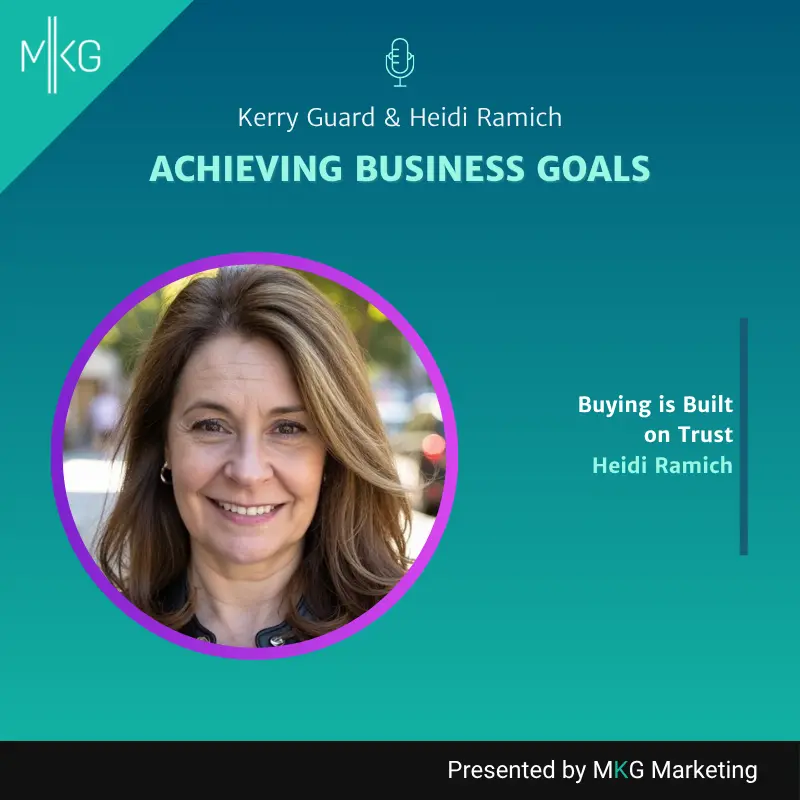
Heidi Ramich
Heidi Ramich is an executive B2B marketing strategist and former Director of Marketing Operations & Analytics at VMware Tanzu. With over two decades of experience spanning product marketing, solution consulting, and marketing operations at companies like Marketo, Carbon Black, and Cloudflare, she specializes in building revenue-accountable marketing engines. Known for her data-driven approach, she excels at integrating complex software tool stacks, orchestrating account-based marketing (ABM) strategies, and aligning marketing and sales teams around long-term business growth.
Overview:
In this episode, host Kerry Guard sits down with marketing expert Heidi Ramich, who uses real-world company data to show why traditional sales funnels no longer work for modern business purchases. Drawing from her experience handling complex software tools, Heidi explains that buyers rarely make decisions alone or follow a straight path; instead, large teams evaluate products together, jumping back and forth before making a choice. She demonstrates that focusing solely on getting individual sales leads hides the bigger picture, whereas tracking group interest and staying in touch throughout the entire decision-making process leads to far higher sales over time. Ultimately, the discussion highlights that businesses need to move away from quick-fix sales tactics and focus on building long-term trust, educating potential buyers, and getting their marketing and sales teams working toward the exact same goals.
Transcript:
Kerry Guard 0:12
Hello, I'm Kerry Guard, and welcome back to Tea Time with Tech Marketing Leaders. I took a break, y'all. Thank you for thank you for giving me some space. Thank you for letting me take some me time. I went to London. I hung out with my girls. We went to see Six. It was epic. It was so good. Oh, Heidi, it was so good. I totally encourage people to go see this musical, which is debatable whether it's musical, but it's hype and it's awesome, and I'm here for it. And I loved it, I loved seeing it with my girls, and it was the time, it was the self care I needed to come back to you all. If you're here with us on LinkedIn or YouTube, say hello. We want to hear from you. This is going to be a bit different. I'm gonna treat this. I'm gonna. I'm gonna go off script, and I'm gonna treat this more like a webinar because Heidi has the data to back it all up, and we're all visual learners. We just are, take it or leave it. But I believe that it's easier to see and understand it than it is to just talk about it. And we're gonna walk you through a deck, a presentation, if you will. It's gonna be a little bit more like a webinar session. And so, if you are here and you are watching, you're going to have questions, and Heidi is going to have the answers. So please let us know that you are here in the comments. I am paying attention to those, and I'm going to make sure that your questions get answered. If you are watching this after it's already been recorded, that's okay too. Comment below, ask us your questions, and Heidi and I will follow up and make sure that they get answered asynchronously. It's a beautiful world we live in, where we don't have to be on any sort of anyone else's timeline but our own, and we're here to support you. We are here to support you. I have been waiting for this conversation. I feel like I've been talking about elements around this, and Heidi is going to bring it to life for us in a way that I haven't been able to clearly communicate it the way that I wanted to, and so thank you, Heidi, for making it possible. I can't wait to unleash this on the world. It's going to be glorious. Before we get there, a little bit about Heidi. She is an executive B 2b marketing strategist. She believes in measuring business metrics and campaign results. That is going to come through crystal clear for y'all. It's going to be amazing. She's an experienced marketing ops and technology consultant, and she has the experience back that up with having constructed a marketing ops web, if you will, of 17 plus products to get to the data she's about to show you. She's been around the block, y'all, and buckle up because she's gonna she's gonna school us today. It's going to be awesome. She has expertise including defining business goals, creating demand generation strategies, and defining digital marketing best practices and streamlining operations processes across the marketing technology tool stack. As I just said, she's experienced in marketing, technical sales, and finance. She's a Swiss Army knife. It's going to be epic. A team player and with expertise in creating campaigns, orchestrating data, using and optimizing marketing automation platforms, Salesforce CRM, and web content management systems, experience launching products, improving user journeys, developing personas, and evaluating software, optimized sales and marketing efforts. She's developed, executed, and measured marketing campaigns using SEO, SEM, social media, email and nurture campaigns, webinars, trade shows, seminars, video content, blogs, and direct mail. I mean, if you want the ultimate go-to-market strategy, you're going to need Heidi, y'all. And if you can't get a Heidi, you're going to listen to this webinar to figure out what this all means, I will say, in full disclosure, on april 18, 2024, Heidi is open to work. So, perk up, y'all. She, she just may be the person you've been looking for. It's going to be awesome, Heidi. Welcome to the show. So grateful to have you.
Heidi Ramich 4:45
Thank you so much. I'm so grateful to be here, and you made me sound even like better than I think I am. So thank you for that.
Kerry Guard 4:54
The beauty of marketing, and I say this to any entry level marketers. Is that the journey is yours for the taking, and the path is yours to define, and you're going to end up with this beautiful resume of these intersectionalities that no one else has, and you, Heidi, are a prime example of that. And I think between the marketing ops with the finance background and understanding how go-to-market and demand gen works is a skill so many of us wish we could lean into, and it's beautiful and awesome. And somebody out there is good. It needs you, and this is the time for them to figure it out, and if they don't, that's okay because somebody else will. And you're going to impact so many people today in this information you're about to share with us all. I mean, I am so privileged, and I recognize that. And what an honor to have you with me today. So thank you for reaching out, and thank you for being on the show.
Heidi Ramich 6:01
Again, thank you for the opportunity, and I'm just thrilled to be here and to be talking about this because it's just something that I just really very much believe in, and I just see this is where all of our futures are going in this direction in marketing.
Kerry Guard 6:17
I feel like we're we should be there, but we're not, and you're gonna and and we're gonna figure out why in a second. Before we get there, though, Heidi, tell us your story. Why I sort of said all the things that you do, but we need to understand how you got there. So whether marketing found us or you found marketing, what's that story?
Heidi Ramich 6:34
Umm, Sort of marketing. I would say marketing found me. I did not start out to be a marketer at all. I actually started out in finance. I worked for an investment company, Harvard Management Company, that manages the endowment fund for Harvard University. They taught me how to use a database, Oracle database. I learned how to write SQL statements, and that actually started off my what became my career in technology, and I had a knack for being able to automate things, and so I fell into product management, and then into product marketing, and then as you could start to measure things more, that's marketing got more interesting to me, so when I could measure what was happening with email and I could measure what was happening on the website, I was like, "Ooh, this is cool, and that's how I made my way over into what I'm doing now. And then in 2012, you know, things really changed big for me. I got laid off from a job. It's kind of like what's happened here for me recently, and I I saw that marketing automation, and I thought, and it was Marketo at the time that I had seen a little bit more of, and I was like, this is going to be big, and I want to be a part of it, and I want to understand how this works. So I became a sales engineer, and I'm.. Marketo hired me, and that's how I got into a lot more of being a lot more data driven. And I think what it did is it really combined my two loves of solving problems with technology and being able to measure stuff with data. And so now here I am, many years later, and really taking a look at or relooking at all the things that we've learned about how how to use marketing automation, that foundation that we've been taught in how the MQLs, and how this is changing in our daily lives, and that what was introduced 18 years ago, what we've been using for a really long time, we're coming up to this really important change that's happening in the market. And even if you look at it, like John Miller, who is one of the people that just really helped to put this entire funnel model out there that we all know, love, hate, use, and and that, but technology, so many things, it's changing and it's changing the way that we use those things. And I think this is really a story about change and how do we embrace change and use these technologies better than we're using them today.
Kerry Guard 9:25
I'm hanging on to the words you just said about using it better than we have been in terms of all the technology at our fingertips, and I think it's gotten a bit over. I don't want to say overblown, but like there's a lot going on there between all the tools that we have access to, and all the data that we can cut in so many ways, and tying it all together, I don't know. This is where my mind got blown with your presentation, my Heidi, because I don't know that anybody's really cracked the code. On understanding the customer journey, I feel like I've been talking about it a lot through anecdotal evidence of what people are generally saying, and my own experience in the way the marketing landscape has shifted with the buyers being very clear from a Qualitative standpoint, qualitative standpoint of what they want ahead clearly do not want. We haven't been able to really see it in the data, and I think for what you're talking about and about to show us, and what John Miller's been saying around how the landscape has Changed. We're behind. I believe little hot take here. Probably can get a little heat for it. That's what they're all about. I feel like we're behind. I had somebody on my podcast back in 2000. Was during the pandemic 2000. She is from Sixth Sense, and she was talking about how we need to un-gate, and at the time it felt like, what un-gate all of our content? What planet are you on, lady? And we're still not there, and we're and we should have been. We should have been in 2020, and it's four years later. So I think we're behind, and I hope that today's conversation helps speed things up a little bit because it's all in the data, and you can't. The data is the data, folks. No matter how much you want to ignore it or pretend it's not happening, or leadership is telling you it is what it is, but we're about to get into it, and it's going to be awesome, Heidi. Before we get to the presentation, where are you today? What's hard for you right now in whether it's in the work you're doing or personally? Like, what you know, we're life is hard. It's a whole new world, like we're talking about. So, what is it for you? What's the challenge you're facing?
Heidi Ramich 12:01
I I think a lot of it is the challenge for me and what I'm facing is that in my last role I was at VMware and I worked at Tanzu. I'm no longer there any longer, and it is trying to find that kind of environment that is open and willing to think differently and embrace change. I know even right now in my job search, there have been some things where you know just building an MQL funnel is not what I want to do because I don't believe it's going to help 90% of companies because there are so many other things that really come into play that we're going to talk about. It's not that you still don't score it. It's not that you still don't look at it, but it's not the primary metric. I think that that's one of the bigger differences, and hopefully, I'm not going to get too much heat for that. But I think there is just something around. We need to also remember that the buying process is not a logical. It's not a logical process. It's not a purely logical process in B 2b. Logic is absolutely involved in it, but it's also very much an emotional process. It's a process that's built on trust, and just pushing more and more and more people that are not ready or not even close to that consideration phase. We really, really need to rethink that because I think a lot of companies waste a lot of money, a lot, a lot of money, with that going. Oh, if we just nurture everyone, they're going to buy. But there's more to the equation than that. So much more, so much more, right? And I really getting. Oh, I'm sorry, and it really is getting in and looking a little bit differently about how we're investing and how we're investing over time.
Kerry Guard 14:16
I feel like there's going to be so many aha moments in this, which I hope for. I know for myself after talking to you and looking at my clients and some of the challenges they're currently facing, we're starting to test this, and I hope to share results with it. But just to give everybody a little bit of a taste of like how Heidi's changed my line of Thinking is with LinkedIn in particular and LinkedIn ads. So the beauty of LinkedIn is you already know who. If you know your ICP based off of who actually buys your product, assuming then on LinkedIn you know you can build those lists and. Can target those people really intentionally, whether using Six Sense or whether using you know LinkedIn's platform natively. You can build those lists and target those people, and driving leads. We have seen over 50% cost per lead drop off, like a cliff in terms of people downloading. It's unreal, just quarter over quarter, and so we're shifting our thinking thanks to Heidi's work and her work. You know, presenting this presentation to me privately, of well, what if we know that these are the right people, and they're just not ready, and that's okay. But we do need to build our brand, so we're going to use LinkedIn as a brand builder, driving them to the website and letting them discover it on their own or not. Maybe it's just a visual element for the time being until they're ready. And just shifting to that aspect is going to immensely widen our net in visibility and getting people thinking about how this brand can help them. So it's so it feels so small, but it's a huge it's a huge jump in being like we're going to a band lead generation and we're just gonna look at visits and we're gonna build retargeting pools and look at lead and MQL lift way down fun hole over time. Buckle up! It's hard. It's hard to make that shift. It's hard to get leadership to buy in, and we're gonna test it. And I'm gonna let you all see how it goes. But just as a little, a little seed that Heidi planted with me that we're already looking at, and I I hope that you all take the leap too because we're behind, and we should have been doing this years ago, and Heidi's got the day to prove it. So I'm ready to get into it if you are.
Heidi Ramich 16:56
Yep, absolutely. Let's get started.
Kerry Guard 16:58
Let's do it. I'm gonna drive here, Heidi, but you tell me when you need to switch up slides. Do you want to just give us a little prefix of like, tell us the backstory of where this data comes from in terms of oh, you know, you painted the picture for me in a really compelling way of how you got here and how the how you had to prove whether the MQL was still viable or not.
Heidi Ramich 17:24
So a lot of this comes out of a lot of the work that I-I mean, it's kind of a lot of work leading up to this over the course of time, and I feel like I had this opportunity where this all really came together at VMware and and the Tanzu business unit, and a little bit of this is my own story in terms of what I've been doing and I've been sharing as I'm out here looking for my next role. But it's also something that I I've always believed in, and this is where I made it work 100, and I can show it, and I can prove it because up to this, I had accomplished a lot of different pieces of it, but I never accomplished the whole thing end to end, and that's what this story is here. So first and foremost, it kind of goes back to that you know this is not just about this is not about a lead funnel. In all honesty, it is really looking at things based on a a cycle and how you're looking at your solutions or your services, and you're really setting this up to build trust over the course of time. This is something that starts at the beginning, creating some awareness, moving people more into the middle of the funnel, the bottom of the funnel, winning your opportunity. But it doesn't stop there. It is now how do you make sure you're onboarding them, making them successful in getting that renewal, and then starting that over again with being able to do the cross cell motions, so when you start to really look at this as a circle, and that you can jump into any of these things in a little bit more of a nonlinear way, I think this is what really changes everything from what we know today. And I think -
Kerry Guard 19:17
So it's not a funnel.
Heidi Ramich 19:21
I, yeah, I don't want to say that it's not a funnel. I want to say that it's not linear. But I think is what you get is you get a lot of different smaller funnels off of this, and when we only look at it as this one linear funnel, I think that's what kind of sends us in the wrong direction, and I think that that is what has changed and has changed a lot probably in the last five or six years.
Kerry Guard 19:53
One of the ways we've been talking about this at MKG is more of less of a funnel.
*Phone Call*
Heidi Ramich 20:00
Sorry,
Kerry Guard 20:02
that's what life's all about. Less is a funnel and more of a cyclone, where you just have like this constant, like spinning around your audience, depending on where they are, moving them through, and they might go back up, and they might come back down of like wherever it's still spherical, but it's but it's to your point, not linear.
Heidi Ramich 20:24
Yes, I think that's the perfect analogy because it really is more of that moving up and moving down. Like I really think of the buyer journey to be a whole lot more like a Jackson Pollock painting than I think of it to be as like this linear funnel that you're going to move through.
Kerry Guard 20:43
Oh, I love that, Jackson Pollock, art for y'all, amazing. We don't have any questions yet, but maybe we will in the aftermath. But I, I think this is just so helpful in setting the stage of how to think about the customer journey, how to think about your ICP, and to a recognize it's not linear, and b recognize it doesn't end, and that the customer success piece needs to continue, and we don't all do that. So yes.
Heidi Ramich 21:19
And this is also taking this look at because you know in B2B, yes we like to get our foot in the door with a particular person, i.e. a lead, but we're selling to accounts and we're selling to teams, and whether that team is only three people, or if it's 40 people, it is not the decision of only one person. You're not like this is not e-commerce, right? It's a different model, and it has us needing to think a bit differently. And anytime you're trying to get a group of people to be able to move in a particular direction. You have to build trust with those people.
Kerry Guard 22:05
Such an important point to bring up the fact that is no longer a single decision maker, but you're looking at a committee, and that's where account-based marketing or ABX or whatever you want to call these days comes into play. Of trying to work, trying to support not just a single decision maker, like at at the top of a in terms of a CxO, but really looking at the full breadth of everyone who's going to touch this, whether it's actually using it day to day to approving it, to making sure it fits into the budget, it's it's a lot more lot more cooks in that kitchen than we realize, and it's helpful to think of it this way,
Heidi Ramich 22:43
and only more and more people are getting into that process. It's not we're not going backwards, you know. I think it used to be a much smaller thing, which is why at one point in time, MQL a long time ago worked a lot better. But the bigger that buying team gets, the more complex that buying team is, and again, this is where for some people MQL may work really great, and if it's working great for you, awesome. But I think for 85 to 90% of the people out there, it's not working as well as it once did.
Kerry Guard 23:22
I think that's a really important point around. I feel like, from what I've heard, from a qualitative data standpoint, that buyers, especially the ultimate decision maker, the person who brought the tool in, the person that vouched for this thing, is more worried and scared than ever of making a wrong decision. So they have to get, for their own safety, buy-in from so many different parties, so that they can say we were all in agreement that this was the right path, and it doesn't just all follow me. Especially when it's an Expensive long term purchase, like like we all have. So I agree. It's not. It's not going to get better, and it's not going backwards for sure.
Heidi Ramich 24:14
This is one of the things that is one of my more favorite slides because I think this is something as marketers that we so often forget. I have spent more than 15 years of my career looking at evaluating and buying software. I've been doing this for a long time, and what I can tell you about this is we love to do all this stuff to say these are our personas, and this is what we're doing. But I think a lot of times, what we forget as marketers is that people that are doing this-they're domain experts. I'm a domain expert in marketing automation and a number of other tools. When we, when domain experts come into this buying process, they already. I will tell you at a minimum three vendors that are already at the top of their list, and I think one of the really important things you need to ask yourself is: Are you in those three vendors or not? And if you're great, if you're not, then this is also where I guess in both of those scenarios, honestly, this is where brand and making sure you're educating about what you're offering is so important. Not just trying to go, are you ready to buy yet? Are you ready to buy yet? Because this really is coming into is you have this group of people that are coming together. Each of the people that may be involved in this, whether that's three people or 25 people, they are all coming in with their top three or four vendors into this. And there's this whole process that happens before anybody starts researching, where you all sit around a table and you honestly debate what are they going to be the six or eight that we're going to do, and then teams will go out. and I think a lot of this is, I look at it. I know for myself, a lot more of it tends to be around validation than really doing research, and I think that is one of those things. And so this is where getting into this building, this relationship of trust. This is not just about pushing out a lot of content, and everyone's going to go, "Oh yeah, I need that. I'm going to go buy it now. Because in a lot of cases, your budgets for the year are already locked. You can't necessarily do some of these things. So it really is being able to look at this process a little bit differently, and then as we're going through this, is recognizing you're working with a buying team, and they all have to align on one solution and one vendor, and it does really come down to who do you like, who do you like best in this? Who do you think is really going to help to make you successful? And that's where it starts getting into customer success. Winning the deal is only part of it. You have to make sure you can successfully implement it and renew. Because today, today it is all about: Are we getting the renewal? Are we getting these other pieces? Is not just selling the deal. So that is where this is kind of bringing this all together in and around that, because it's like if you go through all of this, you sell, you try to implement, and then you don't renew. Like that's rough on the organization,
Kerry Guard 27:42
it's a lot of effort to then not get the deal second round. I want to go back to one of the things you said around validation. I think that's really key in terms of the buying committee, right? And how people made you feel at the end day, and whether you like them. That's like a hard pill to swallow. Of like, well, we're the best in the business, and this is we're gonna do better than But are you gonna take care of them? Which I feel is like what you're saying, Heidi, from a customer success standpoint. Like that piece of feeling like you've been taken care of and you've been heard and validated from not from both the vendor side and internally of like everybody feeling like this is the best way to go because they all have their own experiences they've all been burned in one way or another and they want to make sure that this is the right decision as a collective, and that's
Heidi Ramich 28:44
100% And this is why all the time you see new companies come up, these startups that come out of nowhere, and are like flying to the top of things around this. And so often, what the case is in that this is not like if it was just logical, the best product would always win. But that doesn't happen. We know that all the time. And why is this? It is because of emotion. And it's like maybe you don't have every feature that I want, but I like your vision. I like where this is going. I like some of these other. There are so many different elements to this that is so much about is tapping into that trust and that emotion and creating that connection. It's not just about processing people to find out if you're ready, but really spending more time to create those connections. That even if it takes another 12, even possibly 18 months before they're going to buy you, that you're constantly being able to do that, which goes to one of my earlier points of we. Need to look at a little bit differently on how we measure, because it's not just about running a campaign and how much did it bring in. What did you do with these ads in this quarter? This gets into that conversation around brand and building your brand and educating audiences. This is where that investment at the top of the funnel. We measured it in one year, and what I was able to do is go and say, "Hey, but when I expand this out two years or three years, this is what it looked like, and it looked so so different. And everyone was like, "Wow! I mean, and it really is getting into when you look at some things out there, investing in your brand, investing in educating your market, and not just looking at it as a one quarter, two quarter, or a one year fix on something. It builds on itself over time. B 2b is multi touch. It's never one campaign that is making it all come together. It's not one ad. It's not one event. It's not one webinar. You know, it's not one thing ever. And feel like too often we get really caught up in going, "What did the campaign do well. I mean, you know what? There were probably 12 campaigns involved, maybe 17, maybe 20 that got you to that outcome. I think we just need to look at that differently than we are. I think that's a little bit of where we're going wrong.
Kerry Guard 31:40
I think it's also looking at, to your point, the multi-touch. It's not. You might need to have multiple campaigns running in different aspects of that cyclone and that funnel, depending on where people are. And I feel like if you're putting all your eggs in that one campaign basket, whether it's top of funnel or bottom of funnel, then you're basically leaving a gaping hole or not filling the top, right? So either you're at the bottom of the funnel and you're going to run out of folks, or you're filling at the top and then it's just bleeding, you know, sort of out into the side.
Heidi Ramich 32:16
Yeah, and you get you get that you get that traditional leaky leaky funnel
Kerry Guard 32:19
Leaky funnel! Yes, yes. We have a client right now we're talking to, and it's very clear they ran a campaign in August of last year against one of the cybersecurity events. I think it was Black Hat, and there was a clear difference when you looked over multiple quarters. Right, you didn't just look at that quarter, but you looked at the whole landscape of the year and beyond on both sides. That when they ran that campaign, the whole funnel was impacted in a beautiful way, right? And it's hard to replicate when you can't, when you need space, be able to see that kind of impact. And so now we can be like, okay, how are we going to figure? You know, now how are we going to recreate this, knowing that that's and see if we we can make it happen again? But when you when you're so focused on the day to day, the month to month, or even the quarter to quarter, to your point, Heidi, it's like you really can't see the trending of and the impact in in which all of your marketing efforts are making on all the touch points, and you need a lot of touch points. You need a lot of touch points. Let me keep us moving.
Heidi Ramich 33:36
So this is one of the things like on on the MQL funnel, and this is getting a little bit in terms of how do you look at everything that is happening? When you're only looking at leads, you're only looking at part of the activity that's happening in the account, and I think this is what is becoming so powerful around what Six Sense is telling us, what DemandBase is telling us because an MQL is you're really measuring activity. Just because somebody's done a lot of activities does not necessarily equate to being ready to buy. We can move to the next slide. But when you start looking at this as an entirely from an account centric view. What's happening with my leads plus what is happening with my existing contacts? What we saw around this. So here you can see there are two MQLs. One's a lead, one's a contact. But what is also going on here, what demand base was showing me at the time when I could see clusters of people like this in the account, the cluster was a far more, a much better indicator of the possibility of something happening in that account, because again, I'm going. Go back to what I was saying before. You have a lot of domain experts. They already have a lot of knowledge around this. We're continuing to educate them over the course of time, and that's where I think these pieces come together of looking at that on that longer term view.
Kerry Guard 35:20
What do you mean, clusters? You mean multiple people within a single account doing lots of things?
Heidi Ramich 35:27
Yep. In terms of like you know, and and again, even if you're in in a big company like VMware, was, I mean, I could look at this, but I could actually be able to narrow this down to be able to say, oh, I can see that this is being is happening more around this product, or it's happening more around that product. It wasn't just like here's everything that is happening across all of this. But when we saw this type of activity, this would start to be like, hey, looks like there might be something going on in that organization, where people may be forming a buying team to be able to do something, because when you can see that type of clustering of activity, and again, this does get into being able to trend your data over time, which is what we were doing, and that was the piece that was just really making this really powerful, I think this is what everyone has been saying about ABM and ABX for a long time. But it's when you can really sort of put it a little bit more analytically into this kind of thing, where you can really see there's a very big difference between six people engaging versus only one blue MQL lead or two MQLs overall.
Kerry Guard 36:49
I love how you're differentiating them between leads and contacts too, because I feel like what you're telling us and the way that ABM works and something I mentioned earlier is like the beauty of ABM is you already know these contacts. You already know who they are. You don't need to necessarily capture their information or have them download a thing. You know they're the right people. So, just taking them on that journey of helping them through that decision-making process on their own accord is really what needs to happen. And it's really scary. Not gonna lie, trying not being able to see the downloads and the lead data and depending on that very bottom demo and trial and opportunities is really hard for those first six to 12 months. Hang in there, hang in there,
Heidi Ramich 37:41
But again, the more that you know who those people are and you see that, the less reliance you have to have on the form, and this is really just my way of really kind of helping to outline. Here is where it really helps you to be able to see that leads are about processing activity, right? Oftentimes, we score people based on how many times they've been doing something. What are or some of those things that they're doing? Whereas when you start to really move more into an account-based framework, not just ABM, but it really has you focusing more in on who are the accounts that I care about, how do I want to tear out those accounts, how can I deliver the right content? Might be around industry messaging, might be around size of company. You're really being able to set this up in a very different way because I don't, I know for myself when it comes to and evaluate a solution, I don't start at the beginning and go through this nice, clean, linear process. I'm almost always jumping in somewhere in the middle, and then I might go back to the beginning and I might jump to something at the end. But I think this is how all software is evaluated. In all honesty,
Kerry Guard 39:06
yeah, it's definitely more. I love the word activity. I think that's really key. I'm gonna keep us moving, but I that word really stuck with me in thinking about it from an MQL standpoint and the activity that's happening around the account and multiple people who are involved.
Heidi Ramich 39:21
And this is really just being able to to give you a view of here is what a demand based one or a six sense can deliver for you. It can really help you to be able to understand what is working and where in the stages of the funnel. Here we can see that in the marketing portions of the funnel, our engagement is very good. Everything is trending upward. Everything was going really well. Where what we were honestly surprised by, but it was we were seeing it in other places as well, is that we were getting a little bit. Were stuck in being able to have the same kind of velocity happening in the pipeline, and this just gave us an opportunity to really come in and actually spend a bit more time with our sales teams, with what we were doing with marketing and what we were doing around our content. Some of how we corrected a number of things here was actually setting up some campaigns that right after somebody became a sales qualified lead, they still continued to receive marketing from that to help to advance them to help to give sales that air cover. There are a lot of different ways. This is just one example, but when you can look at this, and again, it it doesn't it this is you are look you're you're kind of creating a funnel. But I think what you're really being able to do here is you're really being able to see the ups and downs, and you are always going to have ups and downs. This is not about making all of these things always being up green arrows, right? You're going to come through something through an end of the year, and you're going to have a drop off potentially in what's happening in marketing. You're going to have a drop off, and what's going to be happening in some of your pipeline. A lot of businesses they do a lot of business in Q4. That's going to be an area that you may see some of that drop off happening. But again, I think this is what helps you to be able to smooth this out and balance this out better over time. When you can have this more holistic view, not just how many MQLs are we processing and and how many SQ SQAs did we get out of this. I know this was really powerful for us.
Kerry Guard 41:43
I think that's really helpful, especially when you talk about the seasonality of it. I'm going to keep us moving because there. I know what I know. There's some money slide in here, and I think that's going to really help bring this to life in a way, in a very linear timeline fashion. So we're going to circle back on this, folks, hang in there. But this is really helpful to start to see where to decouple these things and not look at this linearly and see where things are moving up and down, and details of seasonality.
Heidi Ramich 42:13
And I think the other portion around this is-is this also helps you to improve your alignment? It's not about pointing fingers. Let me start with that. This is not like yay. Look at marketing. Marketing is doing great, and oh, like sales isn't doing their thing. No, if you're looking at it that way, you're looking at it wrong. You're a team. It's like a football team, a soccer team. It's not an individual sport. Let me just put that out there, and I-that's probably the most important thing that I want everyone to take away from this. This is about helping to improve alignment so that we win as a team, not to go, "Hey, we're doing our part; you're not doing it theirs. Because, as I kind of said, what we were doing here is we said, "Here's how we can help to provide some air cover. That was because you know we're a team. It's not just about throwing something over the wall.
Kerry Guard 43:09
And one of the hardest parts, sales, is those in between and those quiet moments. Like I said, and we're going to come to that. And so marketing being will step in and say, let's provide you that air cover is so huge, not just in being able to. It's everything you're saying, Heidi. Not just in being able to actually surround the prospect and help the sales process, but just lending a helping hand to the sales team of like, hey, I understand this is really hard in this in these moments of quiet. So let me see if I can provide you a little bit of support in driving a bit more ads, knowing that they're not going to drive leads, but it's just going to be visual reminders. Maybe I'll throw them an email here and there as provide them value along the way. I know they're making a really tough decision. You know, again, I think it's it's both in helping the prospect, but building that bridge with your sales team to say we got you, and we're here. We're all in this together. I love that, Heidi.
Heidi Ramich 44:07
Exactly. It's it's about being in it together and working as a team together.
Kerry Guard 44:12
Yes. Yes.
Heidi Ramich 44:13
So this is being able to take a look at a little bit, like over the course of time. Here is what we were looking at over four years, and when we were just measuring the MQLs, and this was looking at three quarters in one year, where we were dreaming more than 23,000 people engaging in accounts, and it was all part of our transition and really being able to look at those accounts better and what was happening in them, and so this is where this really started to have a huge impact with our sales teams, and not just being myopic and going where are the leads, but really going back to that account centric view and really. Helping them to be able to see and understand what is happening in their accounts, who is doing more in their accounts, and it just kind of ended up becoming just this really wonderful way of of helping to get everyone more on the same page, and that we we really ended up changing the dialog around what do we do to help to create more engagement in the accounts, not just we need more leads.
Kerry Guard 45:30
Can you just help us understand the time frame FY 20? So these are full quarters, right? They're just like where does FY? Oh, these are full years. These
Heidi Ramich 45:38
are full years on the left, and then on the right-hand side, that's just really looking at three quarters in one given year. So, like we were far exceeding even our our best our our best year. I mean, this is also the interesting for this. Tanzu was a very new brand. Tanzu was just newly established, so FY20 is really 2020. So there was there was always forward looking. So it's that's really 2020, 2021, 2022, and 2023. But this is where we we going back to that first slide when we were doing more to look at engagement in the entire account. We were seeing so much more activity than when we were only looking for leads.
Kerry Guard 46:34
I mean, it's a different mindset.
Heidi Ramich 46:37
It was just a huge piece.
Kerry Guard 46:39
Yeah,
Heidi Ramich 46:40
This is probably the the piece that is is my favorite, and this really gets into what is your deal size and what is happening around this and what is the behavior. So for us, we were really trying to target more at a higher deal level because what we saw in our data was that when we sold at a higher level, those things, those accounts renewed. When we were selling at lower deal levels, there was a much higher churn rate, and part of that had to do a little bit more with some commitment. This varies for every organization, but what I think you'll find, and I think most people will agree on in B2B, is that when you're selling something at 30k or less, there's a lot more discretion around the budgets that can be used for that. But as you start moving up and in getting into larger deal sizes. There's a lot less discretion, and so here in this example of looking at opportunities for 75k or more, what we saw in this, and again, this goes to this impact of looking at this over time. We could see this very clear uptick earlier on of a few different key people, and then oftentimes we'd see this period of quiet. This one just aligns very nicely to their budget cycle, and then we would start to see these spikes. Because in a lot of cases, it was this piece in here, which is where either they were internally looking to create the business case, when in some cases we were even helping to create the business case. But I think this is something that's really, really super powerful in terms of being able to understand. I think also as you look at this, you can see that this isn't linear. It's very choppy. It's very up and down, and the part that I found most surprising, and what I kind of loved about this was we do all this and to say this is all the stuff we want to get to creating the opportunity, and then like forget about it. Marketing marketing's job is done, but what we saw was so much more activity happened right after the opportunity was created, and I think this is where for marketers, and I've shared this with a few different people and few different colleagues, and they're like, "Oh my God, we see the same thing. This is really, really common. Why? Because that that buying team is engaged, and so actually making sure that your marketing is continuing, and maybe even up taking a little bit right after that op is created, whether that's in advertising, social media, other things like that. There's just a really, really powerful piece to this, and you know, this is this.
Kerry Guard 49:49
I think this is an important piece too, Heidi. That really hit me when we first talked was this idea of a short list, and so when people are showing up, they have. Three companies that they have said that these are the three we're vetting, right? And they've already done their research and they know what they want and they're just trying to figure out whether you're the going to be the best fit for what they need.
Heidi Ramich 50:13
And I think that that's really the important piece here because when you look at this, like a lot of this, like from identify vendors to creating the opportunity, right? This is where we're doing our piece around this, but the short list really brings in the customer's perspective, and you really do need to know, and you should be tracking within your organization whether or not you're making the short list, because if you're not making the short list where they whittled that down to two the the final two or three vendors that they're going to put that that gives you a lot of information a lot of really useful information that can really be folded into how can you better compete in the future and so I would say to everyone out there I think the metric that we're missing so often, and part of our funnel measurement is: Did we make the short list?
Kerry Guard 51:09
Such a great question to ask.
Heidi Ramich 51:13
This is just being really where everybody needs to have the same goal, which means we all need to have the same, the same goal, the sales goal, and these are not real numbers, by the way. They've been doctored up, but it really is being able to help you to be able to understand whether or not what are you winning, what are you losing? And we're all taking a look at what is our coverage model, right? What does this coverage model start to take a look at? And I would tell you on some of these things, if you're only paying attention to what you're winning, and you're not doing more investigation around why you're losing, i.e. why you didn't make that short list, you're going to have a really really hard time with your coverage model as well as hitting your goals if you're not taking a look at that. The reason that you lost, it's not because you're bad. It's not because of necessarily the product. It's an opportunity to really be able to do that and then take a look at when you're winning, understanding exactly what are you doing right there. What so you can keep repeating those different things around that, but it really starts getting into showing them more about how you're going to help them to succeed, not just what your solution is doing.
Kerry Guard 52:41
And I and I have to say, from people I've talked to, from my own sales efforts to working with my coach, to people I've had on the podcast, if you're losing because of cost, then you're not selling the value of why you very well. It's not about the cost because if you're there to solve their problems and you're doing a good job of communicating that, then money wouldn't be an issue. So don't just feel like you got to cut. You know, start striking deals and start giving things away. Go back to your messaging. Sit with it. Figure out why you aren't hitting their pain in the right way to to be the best solution. I would as I move slides. Heidi, any thoughts on that?
Heidi Ramich 53:37
No, I really 100% agree with that, and it really is getting into really being able to understand what is making a difference around that. And again, this is this slide here is how we help to prove this out, and it goes to that being able to make to find within the organization some support around this because you we didn't have the top down luxury of somebody going yes Heidi you're brilliant and let's go ahead and do this it was we worked across the organization we found a few different teams we found actually a lot of support for a lot of thinking around this with our MEA team, and the reason for that is because they they have all the the GDR rules, they have so many other things, so they just didn't have nearly as much on leads, and so they loved this thinking, and they were a lot more open to trying it and seeing what happened. I mean, you know, great. And so and there was a bunch of really important people that were supporting this. But the piece of this here is again, it didn't happen overnight. But when we look at, you can see the lift in 2020. 2021 to 2022, but look at the explosion in 2023. Why that goes to what my previous slide was showing, and that they we were doing more to develop trust. We were developing a healthier pipeline because it wasn't just about what can we close this quarter. It was actually doing a lot more to focus on the relationship, helping with business cases. Yes, there are a couple of really good deals within that, but I think that's all of what happens is that when you're really looking at the more the account level, not just one person, not just one persona, not just one lead. This is what comes out of that, and you see so many companies that start to adopt ABM, and and this is what they see. But it typically is almost two years before you see that really big jump. But it's 100% worth it.
Kerry Guard 56:01
And I love what you're saying too. Of just sort of doubling down on the aspect of just because they're an MQL doesn't mean that deals close, and so staying on top of being top of mind is really key, and I'm sure a big component of why you're able to make that leap as well.
Heidi Ramich 56:21
Yeah, and that's where this again we put more focus of really what was happening right after. So this is just one of my my my tech slides that I I really kind of love. But when I when I joined, and this is what our tech stack looked like. It doesn't look like this anymore because we've been acquired, and everything I'm showing you here is either gone or about to go away. But I'm still super super proud of this, and that it was this nice simple thing. Certain things were working, but other things were not, and then as we became Tanzu and became part of VMware, as we move to the next slide, this is what we expanded into, and this is where it was like this was a labor of love. Like the the teams that I worked with, everyone that I worked with, this is not what Heidi did. This is what we did as a team, and we put all these different things together, and we added 16 pieces of software in 18 months. All of this fully integrated. I can't claim responsibility for Gainsight or the customer portals; those are some pieces that were already there. But there were so many different pieces that we added in here, and I will tell you the one thing that made this possible. And I would tell to every single marketer, VP of marketing, CMO, marketing ops, even sales ops person. Part of what made this work is I had the support of my director and the CMO to be able to invest in a resource that sat with our Salesforce team. They sat on the sales. We funded them. They were dedicated to us, and this is what enabled us to be able to do this because we didn't have to sit behind all these different projects. We didn't have to be able to to do that, but we funded this and it was 100% worth it. It was a wild ride. It was kind of absolutely crazy, but as we put this foundation in place, this is what really fueled everything else that you're seeing beyond this, and this is where we had two really big implementations. One of which was demand-based, and the other piece in I still call it the old name, Marquetteo measure or visible. It's still always going to be visible to me, just for some reason, these were some of the things that really provided so much more of the insights of what was working at the top of the funnel, the middle funnel, and the bottom of the funnel.
Kerry Guard 59:13
All right, let's jump into that just to close out. I'm going to go a bit quick here, but and and we'll send and we'll share this out, folks. But I want to be cognizant of time, and you talked about the funnel, so I sort of skipped a slide. Is that okay, or do I time this?
Heidi Ramich 59:30
Yeah, we'll do this really quick. This is just looking at custom attribution, and one of the things, my key takeaway on this, everybody is going to argue about attribution, but really, what we did here is we made attribution almost equal across every touch, so there was no way of overweighting anything. So you could see what was happening more at the top, what was happening more at the middle, and what was happening more at the bottom. So my advice around attribution. Try to weight everything almost equally. That way, there's no bias.
Kerry Guard 1:00:04
I love that. All right, we got a panel here,
Heidi Ramich 1:00:08
and then this is where this attribution really helps you to see and understand what's working at the top. What are bringing in the people? What is happening with your lead capture, your acquisition and are you doing this at a cost effective basis? But as you start moving into the middle of the funnel and then to the bottom of the funnel, it gets into that 95 and five rule. Only about 5% of your ICP are in market. So even as you start to look at your mid funnel, there's probably only going to be a smaller percentage of this that's actually going to buy this year, but you're still constantly moving your top of funnel and mid funnel and your mid funnel to bottom of funnel. For those people that I like to use the word considering change, right? Is that if we just look at this of we're going to nurture them and they're going to be ready to buy? No, guys, this is just not how it works. You need to be able to hone in with AI and predictive data and other things like that to really help you to understand your mid funnel and those people that are considering change.
Kerry Guard 1:01:17
I think that's that's really important word that you harped on a lot with me, considering change. They already have a thing, or they need a thing, and now they're in the consideration phase. And you gotta hop to,
Heidi Ramich 1:01:34
yeah.
Kerry Guard 1:01:34
And you gotta know when to hop to. I think is where when we look at that slide of the timeline, right? And then all of a sudden that flurry of activity happens. How do you help your sales team acknowledge that flurry of activity and that change is upon us? And now is the time to get in there and build that.
Heidi Ramich 1:01:54
And that’s what clustering does, right? Clustering does that, and then you can use intent signals. You can use lots of other pieces around that, and if we go to the next slide, and this is again one of the things that I just was really able loved was being able to measure exactly by your channel what is being most productive at the top of the funnel, at the middle of the funnel, and at the bottom of the funnel. This tells you so much around where, how you want to invest, how you want to be able to put some different things. It also helps you to be able to look at your campaigns and your assets to really know what messaging was working at the top of the funnel versus at the middle of the funnel, bless you. And some of the things that we found in this is our mid funnel stuff. It wasn't about the product. It was much more about here's how it's going to help you to succeed. Here's how it's going to help you to transform. Here's how it's going to be able to help you to do some of these things, and that just really helped us across all the teams to optimize our assets, investments, and to prioritize what we were doing.
Kerry Guard 1:03:15
Not every brand and company is the same, but I think it's helpful to take note if y'all are watching this to pause and look at the different channels across the funnel. This is fascinating, and I could sit here all day and talk about it and pick it apart. But y'all should do that on your own time. This is look at how many different channels are in action at every stage. It does not get less, and in some cases it gets more.
Heidi Ramich 1:03:51
And and that goes to that point that instead at the top of this is that you're running all sorts of different things. These are intermingled over the over the course of time, it it's not a linear process, right? But when you can understand better what is working for you, so you can optimize your investments, so that you can try different things, so that you can be able to do that, and in a lot of cases, it's not about doing more campaigns, but it's doing more of what you know is working well.
Kerry Guard 1:04:34
And maybe there's something on here you haven't given a shot, and now this is going to inspire you to try something new, to line your funnel, and try a new tactic. And I think,
Heidi Ramich 1:04:42
and we would, yeah, exactly. And we would use this because we would go, well, why isn't that working? And then we like like spend some time when we talk about it, and we dig into it, and you know, and there would be things where we were doing a lot to also improve how some of the channels were working, like some. The data in here was surprising. The the fact that content syndication did so much in the mid funnel, I went back and I I redid this. I looked at this over and over every single quarter for 18 months because it was like, are we sure that's right. Are we sure that's right? And again, I think this is some of the stuff about being data driven. Is it's sometimes letting the data tell you a story, and then you can use a number of things. Because as we looked at that, and we're like, oh, well, that's a really cool asset, and we could do this at an event, and we could do this in a webinar, and we could do this here. So there's a lot of different ways this information can be used across the organization. It's not just oh that team did that really well.
Kerry Guard 1:05:58
No, it's wild. It's wild. All right, bring us home, Heidi. Bring us home.
Heidi Ramich 1:06:03
This is just really like we're always we're always all being asked, what does it look like? Can you take a look at and and to do this and you know this was just one of the things like you know at the end of the day, as we were looking at this, this is not what was one, but it was really helping us to see email costs us next to nothing, but look at the return that we're getting on this trade shows, nurtures, webinars, like these were the things that were really driving revenue for us, and it like and it was aligning in other ways. And then as we started to take a look at some of this, but as you start moving down on some of these, these channels down here honestly have a lot more to do with that top of funnel brand awareness that are leading into all of these others. So even though the dollar amounts are lower here from a quote unquote ROI perspective, when you zoom out on this, and you take a longer-term view. You can really see in your data how this is fueling these other pieces here. And I think that that's probably one of the most important takeaways. It's not just about put all your money in trade shows or put it all in nurture. It's I think you really can't just do it on the hex, right?
Kerry Guard 1:07:26
I think this is so key. A couple things I take away from the slide is again that multi-touch, right? You need all of these things in some degree. That the things that have the less money are definitely the more top of funnel stuff. I guarantee you take those. You know, you you take the the paid social the tech target the content send out and you're going to see the rest of those things fall right
Heidi Ramich 1:07:52
and I think one of the things one of the really important things is though all of these channels tech target content syndication paid social, the sponsored ads, these are all things I can't measure the value of the awareness. I can only show you here what was coming through that I could attribute. But if you were to be able to put a value on top of the awareness from that, I'm going to guess that it's going to surpass anything that I'm showing you here with my biggest bar in email, and I think these are some of the things that, if you're only if you if you become too myopic an ROI, you can really hurt yourself by not investing in your brand by not putting some of that other awareness, because this is not something that takes place in one quarter or two quarters. This is something of building this over time. And then this was an analysis model that I got some help with the BI team to put together, and we were trying to figure out some problems here because some of the products were not selling the way that we wanted. But that's how you can kind of take a lot of this data by being data driven and put it into something like this, so that you really can start to tell an internal story, and the internal story here was we really started to understand that there was more of a maturity curve that we had to pay attention to, and it takes me back to the days of when I worked at Marketo, and I was a sales engineer or yeah doing sales engineering and doing sales is that in I spent a lot of time. I spent a lot of time doing this when I worked at Blue Wealth as well. Is really talking about the maturity curve because when you're adopting something new that you haven't used before, or you're going through a big. Information. There's almost always this sort of moving up the maturity curve, and this just helped us to be able to outline this with data for our teams. It provided a tremendous amount of insight. It got teams talking. It got teams collaborating. And again, the piece here is just being able to pull and use and to show something like this to facilitate that conversation because there really wasn't any arguing with it. If anything, we spent a lot of time theorizing about like, well, why are they buying this and not buying that? And you know, it actually created, in all honesty, some really fun conversations. But I think what it also did is it went back across the teams and helping to build trust in marketing. I think so often this is some of the stuff that you know sometimes was like, well, is marketing adding value? When you can really start to do more to measure your data, it really helps you to be able to see that and to operate as that one team. I know we've gone over here. I just want to thank you so much for this and and helping me to tell a little bit more of this story, but I think this is something that everyone out there has the the the option to do. You guys all have many of these tools. I think some of it is really looking at how are we using them? What are we doing with some of our strategies? Because I don't think the strategy is just push more and more and more at people that are not completing those call to actions. And I'll leave this as one last thing: an email open email opens are great, but if somebody isn't clicking through and not completing your call to action, it's not that good of a metric.
Heidi Ramich 1:12:05
You know, it's it's it's some of these things is like we really need to remember to be like: Are people following through on those call to actions that we're asking them to do, not just paying attention to some vanity metrics, because I don't know some report out there says your open rate should be 20% Well, what if my open rate's 10% but my click through rate is you know way above that? Honestly, guys, I would take a higher click through rate on that any day of the week, as long as I know that they're completing that call to action. It's just my two cents on that topic.
Kerry Guard 1:12:48
You need it all. You need the leading indicators to say that the that they are opening it, and at the end of the day, you need the quality metrics to say and they're taking action on the things that matter and moving through the funnel, and it might take, it might take two years, and that's okay because that right the customer journey, and it's a it's an investment. And I just love how you said all that, Heidi. Thank you for this presentation. Eyes wide open. We know more today than we did yesterday. We had to make more informed decisions, and I'm excited for everybody who's heard this message. I'm going to scream it from the mountaintops. I am so grateful for you and your team for having taken the time putting presentations together of this magnitude takes a Herculean effort on so many accounts across teams, and what a beautiful job you all have done! And I'm so grateful that I got to share it with my audience. So thank you for the opportunity. Before we go, Heidi, you're more than a marketer. You clearly have, you know, have a breadth of experience. It's 2024. COVID is neither here nor there. What are you most looking forward to now that spring has sprung and the weather's getting better? What do you got going on for the rest of the year? Do you have any travel plans? Are you doing anything exciting? Any new big changes coming your way?
Heidi Ramich 1:14:15
Well, I'm hoping for some big changes coming my way around that. So you know I'm I don't know I'm just very optimistic of the future I'm I'm happy to be out here doing this you know I'm looking at trying to make some summer travel plans I spend time up on a lake up in Maine so that's part of some of the plans and getting out and doing some boating with my family my my brother and his family. I'm just really looking forward to just being able to get out there and enjoy the nice weather. I'm based up here in the Boston area. I don't like the cold, and so I feel like it's just time. I'm just excited about not being housebound, and I'm looking out the window and I see the flowers are blooming. And the grass is coming up, and these are just the things I'm just happy and excited to be getting out there more, and just just spending more time outside, and just really being able to enjoy life. I mean, because I I think a lot of this is I really love what I do and being able to help to bring some stuff like this together, and to show people stuff with data, and go, hey, what do you think of this? Right, it's not about trying to be right. It's not about, oh, you're not doing your piece. I think a lot more of this is. I like to think of myself more as a problem solver, as somebody that likes to be able to put together puzzles and actually doing a puzzle with somebody else is actually a lot more fun than just doing it by yourself. And so, I guess that is one of the things I would just sort of leave everyone with is everything I've shown you here is more about how to help to facilitate collaboration, and how we use data in terms of doing that because what led to that success was exactly that.
Kerry Guard 1:16:12
Oh, so good, so good, Heidi. Thank you again for the opportunity. Thank you for sharing this with us. I'm so grateful. Where can people find you?
Heidi Ramich 1:16:21
You can find me on LinkedIn, and like and and that and yeah. I would tell you LinkedIn is really the best place to find me at this point in time.
Kerry Guard 1:16:32
Where I found her. Yeah, I can vouch that that's the best way.
Heidi Ramich 1:16:36
I'm out there. I'm posting more. You can you can hear me talk a little bit more about this, but I think there is just so much around really being able to look more at your data flow and how information is flowing across your systems, because it was that data flow that allowed me to get all of these, all these cool things that I put into that presentation. And again, I just had the support of a lot of different people helping me along the way. And you know, sometimes it was my idea. Sometimes they came to the table with great ideas. It was just never just about any one person's point of view. I think so much of everything here was just all about working together in collaboration.
Kerry Guard 1:17:27
I love it, Heidi. I'm so grateful. If you like this episode, please reach out to Heidi. Please learn more. We'll she'll be happy to share the presentation with you. I'm going to tell you to reach out to her first because I don't want to give away her work. So if you want to learn more about the presentation, please DM and reach out to Heidi. This episode was brought to you by MKG Marketing, the digital marketing agency that helps brands get found via SEO and digital ads. We're those top of the funnel folks. We're help to build your brand, sell your message, tell you why you're different and why you can help customers do their jobs better, and then we'll leave it to the email and to the bottom of the funnel, nurturing to get it done while supporting your sales team in the surrounding of your customer. We're here for you. If you want to be on the show, I'd love to have you. If you're B2B marketer in SaaS and tech, DM me. Let's hang out. That's how Heidi got on the show. She reached out to me. We made it happen. It can happen for you too. I'm here for it. And this episode was done by my beautiful team over at MKG, who made it all happen. Are continue to share Heidi's beautiful message. And thank you again to our listeners. We're so grateful for your patronage, and we look forward to next week, and I'll see you out there. Thank you again, Heidi.
Heidi Ramich 1:18:44
Thank you so much, everyone. Have a good day.