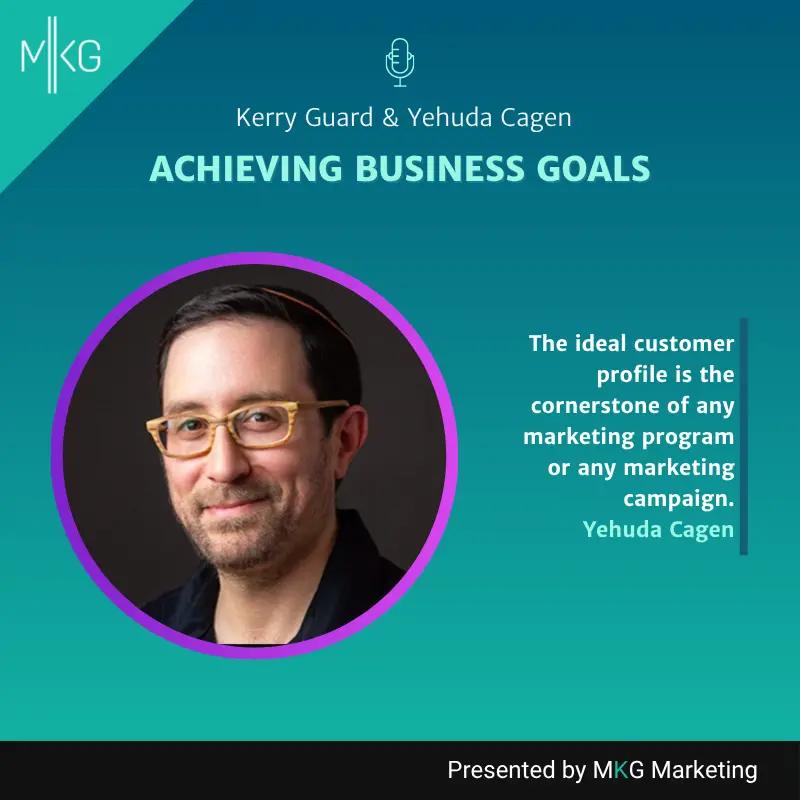
Yehuda Cagen
Yehuda Cagen is a results-driven marketing leader who builds high-impact campaigns that drive growth, efficiency, and brand value.
Overview:
Yehuda explains why marketers need to move beyond broad targeting and focus on the accounts that truly align with their product. He also highlights the importance of understanding the full buying committee—from champions to economic buyers to internal blockers—and tailoring messaging for each. The conversation reinforces a key idea: when you know who you’re speaking to, and just as importantly, who you’re not, your marketing becomes more focused, more effective, and far more trusted.
Transcript:
0:00
But at the same time, you can't work in fear, right? And I mean that that doesn't necessarily help either. Now, it's good to match, you know, mesh in a little bit of fear with some of the passion, but at the same time, if you understand your audience well, and you know that certain messages resonate with that audience, then I don't think you have much to be fearful of. Now, obviously, there's going to be people that have a bad day, and they'll lash out at you, and you just have to kind of take it for what it is, right? They probably had a bad day, and then it you're going to, no matter what discipline you're in, you're going to come across challenges and problems.
Kerry Guard 0:48
Kerry, hello, I'm Kerry Guard, and welcome to Tea Time with Tech Marketing Leaders. This episode is brought to you by mkg marketing, the digital marketing agency that helps complex brands build trust with complex audiences via SEO and digital ads. We are live on LinkedIn and YouTube. If you are here, say hello. I'm hanging out in the comments. I want to know. I can't see you unless you say hello. Say something. Tell me where you're from, tell us what's going on, what's hard for you. We're here for it, and we, most importantly, look forward to all of your questions, because that's the beauty of being live here on LinkedIn and YouTube, is we get to hear from you and make sure you feel like you can walk away with something, you can go do something, lean into something, and ensure your marketing is better in terms of building trust with your end user, which is the ultimate goal of all of the things in terms of how marketing should roll. So we are here for it. We look forward to hearing from you. Let's go. Let's go. With me today is Yehuda Kagan, an experienced and results-oriented marketer with the ability to develop, implement, and manage forward-driven marketing campaigns that drive lead gen, increase revenue, and elevate brand value. He's a dedicated marketing innovator with experience in motivating teams to deliver peak performance, enhancing the efficiency of processes and spend, to positively impact revenue and brand equity. The dream. You are the dream, Yahuda, we are here for it, and we're excited to dive into today's conversation around the ICP. We're going to get into what that acronym soup means in a second. But welcome. You had a thank you for joining me. Thank you. Thank you for having me excited about this discussion. It should be good. We have a lot to dig into before we get there. Though I gave a brief, very brief, very high-level synopsis of where you are today and what you're looking to do. But what's your story like? You know, what are you doing now, and how, and how did you get there?
Yehuda Cagen 2:56
So I work, I've worked almost exclusively in B to B Tech. Starting in the mid 2000s and MSP, and then I've kind of worked my way towards supply chain integration software, and now I'm working for Stendio, which is cybersecurity software, GRC, cybersecurity software. So I've spent the majority of my career in B-to-P TECH. It happened because I was, I lived in, I'm, I still do, and I live, I live in Houston, and at the time, there wasn't a huge I was really into advertising, that kind of thing. And I like its creativity and the humor in and around it. The problem was, is that, or the challenge was, for me at the time, is that there weren't a whole lot of B to C kind of opportunities here in Houston, and so my career path just, you know, the trajectory went in the way of B to B Tech, and I've been in it ever since. It's been fun.
Kerry Guard 4:04
I feel like B to B Tech and cyber security in particular have sort of like a moat around it. Either you, you know, trip over a rock and, like, skip over the moat and land in cyber, or you go after it really, really hard. It's not something it's not generally something people find themselves in. It's an interesting it's an interesting niche. It's an interesting industry that not many people are in are familiar with. So can you tell us your story in particular, of how you found yourself in cyber in particular, sure.
Yehuda Cagen 4:44
Well, when I worked for the MSP, I was, you know, we talked a lot about cybersecurity in general, right? Because, as things were starting to gravitate towards the cloud, it became very apparent that cybersecurity had to be taken very seriously. And so as the cloud. Became more commonplace. I would give seminars and webinars in and around the subject of cloud and internet security. And I took about a 767-year break when I moved to supply chain integration software. And then when I was asked to join Astenio, I had a good idea, a really good idea, of, kind of, some of the implications of cybersecurity. I didn't quite have the compliance side knowledge of it, which I later learned when I when I came on board, but that's kind of how I stumbled into it. I knew the components of a security program, you know, whether it is, you know, endpoint security or disaster recovery or business continuity, I would actually give, we live here in Houston, and so business continuity and disaster recovery are a really big topic down here due to the storms and hurricanes, things of that nature. So I had a familiarity with it, and so it seemed like a pretty natural fit for me. So that's kind of how I, if you will, stumbled into cyber security.
Kerry Guard 6:11
It's interesting because you mentioned Houston a couple of times, and being in a remote world these days, location doesn't always come up that often, but it sounds like location for you has actually played an important role. So you've always grown up in Houston, or I grew up and moved to you there.
Yehuda Cagen 6:30
No, no. Actually, my dad worked work, moved us here. And so my grandparents are all born in the Milwaukee, Wisconsin area, and to the chagrin of my extended family, I'm a Houston Texans, Astros, and Rockets fan, and I have no allegiance, or little allegiance, I should say, to the end of the Milwaukee area sports teams. So for the most part, I grew up here in Houston, with warmer weather.
Kerry Guard 6:58
I don't blame them.
Yehuda Cagen 7:02
It's, it's, it's very warm, much warmer weather, right? There. There are two, two. They say there are two seasons here in Houston: there's hot, and then there's hell, right? So those are the two seasons here. But, you know, it's a good place. It's kind of heck. It's got a big city, but it's kind of a small-town mentality. People are very friendly here, so you know? So I stuck around, and I'm now raising my family here.
Kerry Guard 7:33
I love that, and it sounds, you know, when you talk about B to B and tech, Houston isn't generally a city that pops up. It's usually San Francisco, Seattle, and New York. It's not Texas. It's not any cities in Texas. So I find it really fascinating that not only is Houston sort of a booming area for B to B, but in particular cybersecurity, and the fact that you mentioned storms around that, too, I think is an interesting parallel and dichotomy as well.
Kerry Guard 8:11
I'm sorry, go ahead. No, no, no, I want to hear, I want to hear what we've got going.
Yehuda Cagen 8:14
Austin has a nice tech scene. Now, Austin, Texas, has a pretty nice tech scene. And actually, I, you know, the company I work for is based out of Virginia, and I actually work remotely. When they asked me, and this was towards the end of COVID, they asked me, Do you think you'd be able to manage a team remotely? And I told them, Look, honestly, before COVID, I know I probably thought I could, I was, but I couldn't give you any real answer whether as to whether I can actually do it. But, you know, since COVID happened and we had to go through it, so that's, that's, it actually gave rise to an opportunity based out of Virginia, which was great remote work.
Kerry Guard 8:54
I am so excited is here to stay. We've been remote since 2011, when we started. So we've been remote since the beginning. COVID hit, and we were like, just another day at the office, apart from kids and pets and all the other things that are our feet. But the other day, we knew how to work remotely. And I'm so grateful that the world has caught up, because it is a wonderful there's pros and cons to both, for sure, but now that we can actually play in both spaces officially, I worked on a Microsoft campaign, like, I don't know, 2010 and it was, it was this idea of, it was something about without windows or without walls, and to be able to work from anywhere. And it was like this novel idea of, like, working from a park, like, What are you talking about? And it's here. It's finally here. And I'm, I'm grateful it's here for so many people who have made, you, know, made work more accessible, yeah, and flexible, yeah.
Yehuda Cagen 9:58
I've spoken to a few people. Who actually are being mandated to go back in the office? And my thoughts, what are you on an assembly line? Like? What? Like? Why is it so necessary? But, you know, I know that, you know, different industries require different things, and I think also it has to do with, you know, the accountability that is set by management as well, of course, as the accountability of the individuals, right? So that's that's a huge component of it. But if you have someone, if you have a culture, if you have built a culture in your organization around accountability, and you hire people who are accountable, I don't see any reason why you wouldn't allow them to work remotely.
Kerry Guard 10:38
Yehuda, we could have a whole conversation just about, yes, we totally could, because I do think that there's a ton to unpack in terms of how you set it up for success. You can't just, like, take what you did in person and then move it to re-vote, or vice versa. I don't recommend either of those things.
Yehuda Cagen 10:56
Yep, yeah, I agree. Agree. Part that'll leave that to for part two.
Kerry Guard 11:01
Part two, I am here for it. Well, let's switch gears, or get back on track, or both. And I'd love to know for where you are now. You're in Houston, you're working for this company that's in Virginia. But what's hard for you right now, what's the challenge you're currently facing we've got going on over there?
Yehuda Cagen 11:20
Well, I mean, I think the one challenge that you face, ultimately, particularly when you're with you're in cyber security, is understanding your audience, right? I mean, and the audience in cyber security, I mean, people have become a lot more skeptical, especially as the marketplace becomes cluttered with messages and promises. But I think you can take that to the nth degree in the cybersecurity market people, I mean, those people, cybersecurity experts, are, I mean, they're trained to be skeptical. So if you, if you, if you can't bring your A game and your a message to that, that cybersecurity buyer or influencer, you're going to be in trouble.
Kerry Guard 12:09
I feel like it's gotten worse in the sense that they are, they're, they're always skeptics, but they're even more skeptical as it relates to marketing and sales in particular.
Yehuda Cagen 12:25
Is that fair? Yes, I like I said, I think, I think they have to be, you know, for their for the work that they do, they have to be very skeptical. And I think anything that they bring into their environment, half of it has to kind of, it has to be seen with a very skeptical eye, because, you know, one miss misstep or a series of can can lead to another series of missteps, which can have catastrophic consequences, unfortunately, and so, but I agree, right? So anything that they bring into their, you know, their inner influence, and that includes any tools or platforms or services that they take advantage of, they're going to be skeptical of it right off the bat. And so you really have to build that trust. You discussed building trust as part of the process, and I think that is key in any market, but in particular to cybersecurity.
Kerry Guard 13:30
I'm gonna get on my pedestal, high horse, whatever you wanna call it, for a hot second to sort of lay the stage for this, because I think this is such an important topic, and something I'm pushing pretty hard, to the point where I actually was on another podcast, and then he quoted me directly. And I was like, Wow, that sounds that sounds really harsh when you, like, isolate it as a thing. But I think this is really true, especially for this audience of as marketing and sales, we are a collective who do outreach to have people buy our products and end up using them at the core of what it is that we do have used scaling tactics in a way that has burned bridges and made it worse, took a skeptical audience and made them extra skeptical.
Yehuda Cagen 14:27
Yes, yes, and like they say, you know, it takes a long time to build trust, and it doesn't take much at all to lose that trust. So yeah, you got to be really careful. Yeah, we're there, yeah, but exactly, but at the same times, you can't work in fear, right? I mean that that doesn't necessarily help either. Now it's good to match, you know, mesh in a little bit of fear with some of the passion, but at the same time, if you understand your audience well, and you know that. Yes, certain messages resonate with that audience, then I don't think you have much to be fearful of. Now, obviously, there's going to be people that have a bad day, and they'll lash out on you, and you just have to kind of take it for what it is, right? They probably had a bad day, and then it you're going to, no matter what discipline you're in, you're going to come across challenges and problems and difficult people or people reacting, you know, negatively to what you're doing. And so it's not just a matter of avoiding those challenges, it's how you deal with those challenges. And so you deal with it the way you would any other challenge, right? If someone gets upset, then you own it, and you move on.
Kerry Guard 15:43
And if it's only one or two people, like, if it's only a handful of people, yeah, you know, you take that with a grain of salt, you know, take that as you will, good to learn from it, but also, like, you don't need to react to it, versus an upheaval. We are not Netflix, trying to, you know, break into two parts and DVD versus I think that's really important. Let's talk about the ICP, because that's really what we're here talk about today. And let's start from the beginning of ideal customer profile. We love talking and acronyms for marketers. We make them up all day. Ideal customer profile. Let's talk. Let's break this into two parts. You have your ideal customer, and then what a profile is. So let's talk about what it means to be an ideal customer. What is an ideal customer? And how do you know that you're talking to an ideal customer?
Yehuda Cagen 16:42
Well, I mean the ideal customer profile, and I see it as the cornerstone of any marketing program, right, or any marketing campaign or plan. It's essentially understanding a specific segment within the market, and you know, and your message is basically based on that segment, and you're essentially telling your ideal client profile, or your ideal client, I should say, that you have a specific widget or platform or service that was created specifically just for you, right? And so that's why it's so critical. And I mean, I could take, I think we could take lessons from other industries, right? So we're typically B to B Tech, SAS, cyber security, but let's just, you know, I like to kind of blend a lot of what I do in B to B with some of other experiences and some of what I've read in terms of good marketing and companies that have really perfected the identification and the messaging to their ICP. So, in the case of a B, a good B to C example would be, here's kind of what I mean by the cornerstone of a marketing program. Imagine, imagine if Harley Davidson didn't have an ICP right, and then say, Oh, we just want to build a good mode of transportation for everyone. I mean, they wouldn't look anything near what they look like now. I mean, they kind of honed in on a segment of the population that was very passionate about the open road, very passionate about, you know, kind of their, their, you know, the way the machine has to work, and how they go about it, not just not an A to B. It's not just getting from A to B, right? I mean, if they just market it to the largest, largest segment of the population, they would be a totally different company. So that's what I'm saying. Like it has to be identifying that, that profile or that ideal client has to be the cornerstone of your marketing plan. Because if you don't, it's, you know, you just go into you keep a lot of self-doubt. You'll keep, keep going in many different directions. And then back to what we spoke about earlier, you might just take off some people, because it just doesn't resonate with them.
Kerry Guard 19:01
Yes, to the ticking off piece for sure. Let's talk about the brand. Because I love, excuse me, I was holding my tongue because I had, like, a million brands on, you know, that I was ready to, like, launch into space of, you know, who I, who identified their ideal customer, and, like, really, you know, leaned into that. But the fact that you came up with Harley Davidson is just so magical. Because one, it's not one that came to mind for me. And two, when you think of Harley Davidson, you think of you, I have to imagine the rest of the audience did what I did, where they painted a picture of the person who's probably a bit rough and tumble, got a beard, bandanna on his head, some awesome leather jacket, maybe with an eagle on the back, and like they are riding this hog down the highway and cruising like it's all they want to do. All. Day, every day, you're to your point. There's no destination. They just love on this bike, right? Like, we all painted that a similar picture.
Yehuda Cagen 20:15
And yes, like, yeah, you don't, you don't drive around in a Harley Davidson if you just want to, you know, skip traffic in Amsterdam or something, right? It just doesn't. It's just not, it's just not the persona. It's not the ITP.
Kerry Guard 20:26
No, it's New Hampshire folks of live free or die, right? Like that, and in a good like, in the most, in the best way, I like, in the best, in the best way.
Yehuda Cagen 20:41
And they can tell you. They can tell you what it is, right, every one of their customers, right, their clients.
Kerry Guard 20:47
I have to believe, and I don't know, the story of Harley-Davidson. Now I want to go on this fact-finding mission, because I can't help myself, and I will, and it'll be magical. But I have to believe that it started with the person who built the company, where they probably had a similar persona themselves, where they saw themselves wanting to live this life, and they couldn't find it, and so they went out and built it.
Yehuda Cagen 21:12
Yeah, I mean, it's like, like I said before, right? It's finding that segment of the market, you know, that in you telling that individual this service platform, widget, you know, bike with it was created specifically for you, right? This is who we created for, and this is why, and again, you just lean into their sensibilities, their philosophical viewpoints. I'm not, I don't know. I mean, there's a lot of talk these days around creating demand. Kind of hard to create demand, and we thought a huge budget, but you can certainly channel that demand, and kind of, like I said, lean into their sensibilities and what they're they're into, and what they believe.
Kerry Guard 21:56
I think there's this element that's been lost in the world, and I'd love to, I'd love your opinion on this, Yoda, because you've worked with some smaller companies. Smaller companies and startups, as well as bigger companies. Is that, and I love using the Harley Davidson scenario, because I feel like when you build a thing, you start to think about all the possibilities of what this thing could do, and you lose sight of why you built the thing to begin with. And I feel like, going back to the founder, is a lost piece in that a lost piece to that puzzle of like, well, why did you build it? What did you want from this? Yes, why does this thing exist? Right? You're the ICP once, tell me more.
Yehuda Cagen 22:43
That's right, that's right. Well, I mean, also bear in mind, I mean, the ICP is not something that you just said on the front end of your of your marketing plan and that, and that just stays static for perpetuity. I mean, this something that's all you know, understand that a it has to be realistic, right? You can't just say, Well, I'm just going to, I'm going to start, I'm going to start trying to, let's say, pry customers away from the Harley Davidson. I'm going to create my own bike, right? Be realistic, obviously, and then understand that it can be fluid, right? It can be, and at times, it needs to be fluid, because there's going to be a lot, a little bit of trial and error, though. Again, you should probably do a little bit more market research beforehand, but there's you have to understand kind of where your customers are, and sometimes you'll learn things along the way that you didn't realize, and you might, and that might open the door for other customers, or other segments of it, of the population as well, like look at Arm And HAMMER Baking Soda right now, they found a niche in keeping their freezers fresh, like, Who would have thought, right, right? I mean, so it's now become a fresh baking soda has become a freshness, you know, it's kind of like it's competing with Febreze, or Febreze competing with it, right, in terms of keeping things fresh. So you have to be open to the you know, you can't just be very static. You have to be open to that, the idea that the ICP can be fluid, but, you know, stick with it. And then give yourself, I don't know, 12-18 months, whatever you think is required. And then build, build off of that, right? And set the pivoting, set goals for yourself, and kind of how you want, how long you want to stick with this, and how long you plan to stick with it, and then realize that, and then reassess and see whether you've you've really hit the mark to what extent, and whether you have to pivot a little bit. But I think there is something about, you know, being the ICP, and representing the ICP, and kind of what you would like to see in the market. And there's definitely some validity in that. But you also have to, you know, there are some people like, for example, I mentioned that I'm a Houston Astros fan, or Houston, you know, Texans fan. And, you know, we have, there are certain things that I that I believe that the Astros should. Do, and, you know, that kind of thing. But there are differences in opinion on that. And so you have to, even though you're fonder and you're very passionate about and you understand, at least what you feel is the target persona, you have to also be open to open to a different perspectives, or at least very, you know, varying perspectives at the same time without again, going too far out of that the confines of the ICP.
Kerry Guard 25:28
Let's talk about so I mentioned one way to sort of identify your ICP, about going back to the founder, depending on how big or small you are. But let's talk about how you really uncover. You mentioned so many great examples of how things might accidentally pivot, like Arm and Hammer is a wonderful air fresher for your freezer and so but, but they didn't know that. That's not why they created it, right? So, in thinking about the ICP and the problems we solve for cybersecurity in particular, where do we start in really knowing who we should be marketing to?
Yehuda Cagen 26:09
Well, I think when you build the Yeah, so when you're building the company, or if Lisa, you're building the marketing program, or sales and marketing program, you have to understand, well, who is this for, right? I mean, everyone has to understand who their audience is, right? They say that you, if you try to market to everyone, you're marketing to no one. So you really have to understand, and you can't, you can't, when you look at this, and you do this analysis, you have, you obviously can't be in a vacuum. You have to recognize if there are others in this space, and there are others in this space, and particularly if they're established in this space, you gotta again that goes back to being realistic, right? If you want to go back to, let's say, the Harley Davidson analogy, it's gonna be hard. It'd be really tough to supplant Harley Davidson, right? So you say, well, well, then what other segment do I have, some motorbikes? You know, whatever what our segments could be, maybe it's off-road, right? Maybe it's, maybe it's just trying to get weave in and out of high traffic and high congested traffic areas, you know, whatever it is that you have to, sure, yeah, you're trying to, have to, you're trying to find the the area, or the segment of the population, or the second of the target audience, that that makes most sense to you and to what your platform strengths are, presuming that you've already built the platform, or you've built.
Kerry Guard 27:30
Sure, you have a thing service, right? Sorry, you have a thing you're ready to market.
Yehuda Cagen 27:37
Yeah, yeah, right. So you already have in place, then say, Okay, well, where do I? Where would I resonate most within this market? And obviously you can't be, you know, five people, unless you sell very high ticket items, right? It has to be a nice segment of the population, but also it has to kind of serve a need that is unserved. Otherwise, you get into high commoditization, and you don't want to be in that place, because it's hard to compete, you know, it's a race to the bottom if you want to just, you know, be the Walmart, or whatever your niche is, right? Because there's always going to be another knockoff, another Walmart, someone in China, building something else that's a lot cheaper. So it's just finding that area and then building on it. I, you know, what I like to do in particular. And this kind of speaks, maybe more of an Account Based Marketing, as opposed to, you know, ICP, protect in particular. But it is. It does introduce us to another acronym. So that's fun. ABM, right. You kind of start with, like a dream, a dream, let's say each, let's say sales rep. Because typically, the way I've seen it. Sales reps have always kind of sometimes predated marketing teams. I don't know why that is. Maybe they just, you know, typically, a lot of these cyber security or any kind of SaaS programs.
Kerry Guard 28:51
Early, higher, yeah.
Yehuda Cagen 28:52
Yeah, right. So they're an early hire. So maybe you just take a dream 200 or 100 200 and then go deep and wide on those that list in that particular segment, so you can, again, truly understand what their needs and wants are, and then you build off of that, so that you know that's what I would make recommend as a as a good start. And, just as important, when you're talking about the ICP, you also have to know which segment of the market not to market to and that will not appreciate what you have to offer. I mean, they may appreciate it, but you know, if you get to a point where it is, you've kind of charted into, you know, very cluttered waters, if you will, ever highly saturated markets, then again, you run the rest of become either commoditized or becoming, maybe perhaps a company or an organization or a vision that doesn't align with with a certain audience, and then you end up wasting sales reps time, you might even create a false sense of success, you know. Oh, look, look, all these opportunities. But it can ultimately lead to, you know. Again, wasting sales reps' time, poor sales forecasting, and then, you know, overall bad morale. Because then you start, you start questioning everything. So just as important of understanding who you are segmenting, you also want to understand and appreciate who you're not targeting.
Kerry Guard 30:19
Let's double-click on that for a second, because there are two. Yeah, there are a couple of elements to that. It used to be a numbers game, right? Where it was like, We need CISOs. Let's market to all of them, and then we'll whittle down, and we'll get a handful of the ones who are the right ones. And to your point, Account-Based Marketing has absolutely flipped that on its head. It's like, well, let's stop trying to talk to everyone, and let's talk to the people who are really going to need this thing. There are a couple of challenges with that, though; there are challenges with both. One is you burn a lot of bridges on one side, which is going after every CISO, and then willing down to this will take a lot of time. You've got to muddle through a lot of crap. You definitely burn a lot of money that way. On the flip side, from the ABM perspective, you are honing in on your exact audience. What if it's very small, like there are pros and cons, right? Like, you're talking to the exact right people? Mm, hmm. What if they're not ready to buy right now?
Yehuda Cagen 31:27
Like, well, well, I mean, statistics suggest that most accounts, or most organizations, are not ready to buy right between three to 10% of the time, depending on, you know, the sales cycles, right? So that's when you have to start, you know, building. And we're going a little bit out of ICP, but, yeah, ICP, but yeah, I mean, sometimes if, again, you have to recognize, if it's a market of 150 you know, accounts or companies, it better be a high ticket item. And again, it has to align with sales goals, sales revenue goals, and growth goals, and everything like that. So you have to recognize at on front, the front end, you know, if you bake in at least some conservative close ratios, right, and say, like, we can get 10% of the market, or 10 we can close 30% of those that we speak to, right? And then you kind of work backward from that, from there. But you have to obviously be cognizant of it. And you said something interesting in terms of every CISO, right? So you have to also recognize, you know, who is the economic buyer, right? Who's signing off the deal, and who are the champ, who are the champions of the deal? Who is going to drive it, or who is going to ultimately be the champion of whatever service or software widget that you sell, right? So, you know, again, everyone likes to go straight to the CISO or straight to the CFO, right? Because they're economic buyer, but it's really critical to also, you know, not just segment the accounts or the companies, but also identifying the champion, a champion, not a championship. See, I'm talking about the Astros, and I'm thinking championship, but you have to identify the champion, and in also create messaging that appeals to those individuals that represent your ICP, because if you don't identify the champion, well, then you can't even make it to the CF the CISO, or the CFO or the the you're not going to make the shortlist to the economic buyer.
Kerry Guard 33:21
It's true, and it makes sure it too, like if you're talking about, we're getting into Account Based Marketing here, but I think it's really critical. When you're talking about your ideal customer profile, it's not necessarily when you're talking. I know when we say, ICP, it sounds singular, ideal customer, singular profile, but the end dates what you're saying, Yehuda, it's actually profiles, and that each part of the organization is going is part of the buying process. It's no longer a single buyer. I don't know if I've ever was, but it definitely is not. Now. It's a committee that is harder. X exponentially harder. And so, really thinking about the different folks that touch this product, whether it's deeply like a practitioner versus a CFO who's just got to sign on the dotted line, you still need to think through the messaging of that and, oh yeah, try to negotiate with CFOs.
Yehuda Cagen 34:25
Man, yeah, it's not easy. And, but you have to, like, not every persona. Let's say you have the champion, you have the Econ. That champion is, might be, let's say, in our space, might be a GRC, the head of compliance, head of security, head of it in some cases. And maybe the CISO or the CFO, in some instances, would be the economic buyer. And then there's the end user, right? And then there's everyone else. So not every persona is created equal, right? You got to focus on those championships, the champion. Here I go again. You got to focus. The champion, right? The champion is, it's, we're getting into baseball season, but you got to focus on the Champion. Just know what everyone else's role is, right? I mean, you can't ignore everyone else, but it's not the same message as everyone else. So if you have the champion, let's say, then who else is there? Right? There's, you have to know what their roles and capabilities are. And typically, if they're not the champion and they're in the decision-making process, then their role often, and their capability is often what is, maybe how to kill the deal. Like, you know, their role is almost like some like a sounding board and saying, what? Tell me why this is a bad idea, so that I don't take this risk. And you know, with this software, this platform, right? So if you know who the champion is, and then who are the potential deal killers, then you got to arm the champion with those you know ways to circumvent those objections, right? So again, different messaging, different materials, different approaches to different constituents within the organization.
Kerry Guard 36:10
Okay, so here's what I heard you say: we have the champion, which is the ultimate person who's going to use this thing and has to figure out how to convince other people that they need it. Yes, you have the economic buyer who is going to sign on the dotted line and approve the thing. And then you have the naysayer, which wasn't your word, but I couldn't remember exactly your exact word, but the person who's coming in to figure out all the reasons why this thing is probably not a good idea. And so you have these three audiences that you have to help your champion, yes, navigate through the right?
Yehuda Cagen 36:49
Exactly, yeah, exactly. I love right. So you're not trying to give the same set of benefits and say, and like you're talking to the champion, and you give them a set of benefits that you know resonate with them. You're not going to take that same set of benefits and speak to other constituents that whose role is essentially to potentially kill the deal. Right? You're going to, you're going to start talking about objections and why you wouldn't, and then responses for why you would, right?
Kerry Guard 37:14
So, objections. Man, talk about objections enough.
Yehuda Cagen 37:20
I don't think, especially in a B-to-B sale, there's always, I mean, because not every audience falls into the same category, right? I mean, even like you just take it in generalities. Forget about cybersecurity, necessarily. C-suite, they're typically looking towards the future. They're looking okay, new way versus old way, right? That kind of thing, you know, those that are maybe in the mid level, you know, mid level managers, mid level management, they want things that are easy to implement, right? They want ways to know that it actually works, right? Because they're, you know, this is typically the champion in many cases, but not always. And so they want to make sure that, you know, since they put, you know, it's their it's their job on the line in many cases, and then there's the end users, right there. They're making the salami or the donuts or whatever, right analogy you're trying to use, right? So for them, you know, sometimes they're not, they may not be decision makers, but those days, those may be how to work it, right? They know, right? They have, they have to know how to work it, because then, then you get into customer attrition or client attrition, and you know, definitely don't want that.
Kerry Guard 38:26
Anyway, I actually went to battle. No, this is important. This is this is critical, because I actually went to battle. We were working with a company, and they wanted to keep working with us. And I was like, the only way we can keep working with you at this point, because it is if you give us somebody, a person who can literally train up my new people, because we've had turnover, and learning your product has been really tricky. So unless you can give me a person who can train them, I cannot redo with your product like that's and that's an end user, and then, like my end users, the people who were coming on board to use this thing had no say in this being the thing that they were going to use, but they had to know how to use it. I think that's so important. And something we're absolutely like, once the once the sale happens, it's like, we're good to go. And it's like, in a fast product, you are not good to go,
Yehuda Cagen 39:23
No more than anything, sales, marketing, and now CS, right, customer success have to all kinds of work in unison, and they all have to work off of each other, and they'll have to feed off of each other. So again, many different constituencies, constituents within the buying committee, if you will. And so you have to recognize who they are and what messages to send to those individuals, or to present to those individuals, or to present to the champion, to present to those individuals.
Kerry Guard 39:53
And I think this is really helpful, because if you're narrowing it down to this, this helps you want to narrow it down. Right? Like, if you're just going after one segment, and that's you're just gonna go after all of them and blast them, that's one way to play it. Or even better, this makes it this makes a play at why Account Based Marketing is so critical to those higher price ticket items. Because if you really identify who is going to buy from you based off who's bought from you in the past. Know who your champions are of who's pushing the product through. So for us as a marketing agency, right? It's the VP. The VP is ultimately saying, I need, I need a good agency that's going to help my team do better, and then I can get across to the CMO, ultimately, like they're the champion. But we got to work with their managers to make sure that they want to work with us, that like, at the end of the day, they're the end user who's got to like, like us, and the CMOS got to feel like we're going to deliver on our promises, right? But it's the VP that's ultimately our champion in that, and we got to help them, you know, feel like they're making a good decision because it's their neck on the line. I think that's critical. And what gets lost is like it's not just having a champion to give them the right messaging to push this thing through. It's like they're putting themselves on the line to say, this is the product we should use. And here's why. Because if it doesn't work out, or something goes horribly wrong, it's them on the line for IT and security.
Yehuda Cagen 41:23
That's right. You have to recognize their concerns and worries right now, then arm them right, so that's particularly the champions, I mean, in talking about those messages, I remember once, I think it was the beginning of COVID. Yeah, it definitely wasn't COVID. We ran a kind of cold email campaign. This is what background is in the supply chain integration software. And we didn't just target like our key ICP accounts, right? And we didn't just target different personas within the organization, but we also identified those types of companies that who may be suffering as a result of the pandemic, and those who may be succeeding as a result of the pandemic. And so, I think, all in all, we had like 14 different messages, right? So we have like different types of accounts, right to different segments within the within the population. So in the same supply chain, you often have, you know, buyers slash retailers, and then suppliers slash manufacturers. Then you have, then you have those within those areas that who are succeeding versus those that were, you know, probably suffering as a result of the like succeeding may have been, let's say, grocery or pharmaceuticals, or, you know, very, very essential. So those who may have been suffering may have been, you know, suits, right, right, formal wear, right? No one was buying foreign wear when the first, you know, six months of COVID, probably longer, so and so we identified different messaging that would where we hope would resonate with them. And I think it, like I said, 14 different messages. And yes, it takes a lot more time, or considerably more time on the front end, but it can, it can wait. It can save a lot on the back end, in terms of bang your head. Why aren't people, why message messaging resonating? Why are sales cycles so long? Why is it taking so much time to get a return on my investment? I think, I think I, if I recall correctly, you know that that campaign added I quarter million dollars of close revenue. So it's really important. It's really critical to kind of look at it and be as specific as possible. But again, you know, you don't have to say, Okay, we don't have to go that broad, right? 14 different messages, right? Because, again, some individuals within your, you know, within the corporate hierarchy, if you will, they don't really, necessarily hear it. They may need to overcome obstacles. So that's, you know, that's that's later on in the sales cycle, but just recognize kind of who you're talking to and what resonates most with them.
Kerry Guard 43:50
Let's talk about that for a second, because it is a huge lift when you start slicing and dicing, and you're also taking a budget that you're slicing and dicing, right? So the more you divvy up this, these resources, the more you feel like you need. Is that true? Or because you're being so thoughtful and specific, it actually a smaller budget can go a longer way.
Yehuda Cagen 44:19
I think you could be pretty creative with the budget, right? And let's take, you know, like, for example, if you're, if you have, like a, like a LinkedIn, like a LinkedIn type of campaign or paid LinkedIn, right? You're paying for people to, you know, to get in front of people, right? So that can, that's budget can get away from you really quickly. So you want to say maybe, all right, let's focus on the champions first, and then once we get later in the sales cycle, we can provide certain materials where that can satisfy some of the other constituents in the hiring committee, sorry, the buying committee, right? Whereas email, like I said, I mean, there wasn't really a whole lot in terms of, I mean, there was a little bit more time. But, like. I said, I think it turned out to be worthwhile in terms of the time commitment, but yeah, I mean, definitely there, you have to recognize what you what you feel that you can, you know, in terms of return on investment, whether it's a personnel investment or ad spend, you know, hiring consultancies or hiring different coaches or whomever right to kind of get you on the right track. But again, understand who you're talking understanding who you're marketing to, or who you're speaking to. I don't think you can. You don't want to skimp on that.
Kerry Guard 45:43
You just don't know, especially if it's small, and like, you only have so many people shocked you. So if you only so many champions, you don't want to burn those bridges. So being really intentional and understanding about what their
Yehuda Cagen 45:55
Needs are, and ultimately, it makes it easier. Because, let's say I, you know, there's, I've seen a lot of, like, copywriters and those that, you know, a much, much of their messaging, and they kind of get cutesy phrased on their websites. It's a lot of crossing out, and kind of, you know, working with the messaging, how well it works, how well it doesn't work, what what is extraneous, what is what do we absolutely need? And that becomes so much easier when you have that. Let's say you have that. You know that Harley Davidson person in mind, right? Because you're not gonna, you might be able to weave in and out of traffic. You might be able to take it off-road. But you're not talking to those people, right? You're talking to people just want to hit the open road and, you know, miss the days of Route 66, right? Or whatever it is, right? So, right? You know, think about the days, yeah, so you have a method, and it makes that process a lot easier. Yeah, Nothing's easy, but it simplifies it.
Kerry Guard 46:53
When you really can talk, when you really can talk to people who want to live the dream of whatever it is you're promising? Yeah, oh my gosh. I know we're using a B to C example, but I think we there's so much we can learn from from B to B, from B to C, of how to do a better job of storytelling, connecting with our audience, and helping them feel like there's a light at the end of the tunnel of whatever problem they have that we're there to solve. How many times do we do things the hard way, not knowing that there's an easier way in a tool out, right? Like, yeah, so many things. How many, be honest? Yehuda, how many tabs you have open right now of Excel sheets and data?
Yehuda Cagen 47:37
Too many likes, I actually have. I actually have, like, not just tabs on my, on my Chrome, but like, different sets of tabs based on whatever, whatever I'm working on, right? So there's, you know, ICP tabs, right? So that that includes, you know, notes on ICP notes, ICP documentation, right? And then there's competitor tabs, right? We're looking at the competitors, and there are all these different types, and there's paid, paid ads, and organic, right? So that can go straight to it. So yes, too, too many tabs, for sure.
Kerry Guard 48:16
We have to believe that there's maybe a better way, but maybe there's not, and that's just the world we're in right now. But that's how our audience feels, right, like so painting that picture for them of less tabs and less headaches and less, you know, what the B to C community definitely has unlocked. And we're we're behind what we're catching up.
Yehuda Cagen 48:34
Ultimately, you're just talking, yeah, exactly. Ultimately, you're talking to people. Still, I don't think AI is advanced enough for people to make those that's for to have aI make those decisions for you, though, might get there, but by the same time, you got to you got to be able to train the AI, but in any way. But when it comes down to it, I think a mistake that some B to B marketers might make is they ultimately in they're saying, Well, that's what, that's better for B to C, right? And that's better for this. But, you know, a lot of the B to C practices gave rise to some of the B to B marketing practices. And what happened is we became, so we became maybe, maybe that's an instance where we came too focused on, well, we're on B to B. So therefore, I have to speak in a matter that that has acronyms and jargon and everything like that, and that's where you and it just that doesn't work either, right? So just because 1b's to C and one's 1b's to B, you're ultimately talking to humans that are making these decisions, and you have to, again, lean into those, those them and their sensibilities and their philosophical viewpoints and everything that matters to them.
Kerry Guard 49:44
Everything that matters to them so much. Yes, that's what I heard you say in a recap, and then giving you a chance to double down, Kerry, if I'm wrong or say something that maybe I missed. But really, what I'm hearing you say is, when you're trying to identify your ideal customer, start very high level. What are the accounts? Companies that are going to make the most sense of who's buying your product. And you can look at your existing customers, you can go back to the founder to understand what it was they were trying to do, but really understanding, like from a B to B perspective, who are the accounts, and then from there, identifying your champion, who is going to ultimately be able to make the decision on this thing, knowing that they are going to need a committee around them, but like, who's going to who's going to be the voice inside the company to say this is a product for me, and here is why. And then from there, identifying your end users who you're going to need to make friends with, because they need to love this thing once they're once they're making it happen to the C suite, who has to sign off, and you know, whether that's both the CISO and the CFO to the naysayers are going to come in and poke those holes and poke the bear and say, Do we really, though, but do we and really dialing in your messaging for all those audiences, but starting from the top, from those accounts, and then digging into your champion, and then beyond. In terms of who your ideal customer profiles are. Did I miss anything there, or hear anything you want to double down on? Help us. You're muted. Unmute yourself. Let's go. You're muted. You're muted.
Yehuda Cagen 51:19
Sorry. There we go. Though I think you got it right. And the only thing that I would add to that is you've got to arm your champion, right, with the right materials, with the right objection handling, make sure that you make them the hero, right? That's critical. That's a critical component. You can't just recognize what those others are. You know that there are other constituents in the buying committee, but you have to arm them as well. So I think that's something that should be noted, as well. When you're building that ICP, you have to be on record. You have to recognize the competition, right? Again, you're not living it. You're not working in a vacuum, and if they've got strangleholds on it, then you've got to find a way. You know, either you can try to reposition, reposition the competition, like, okay, so I'll take, I'll show you an example of that repositioning up the competition. The competition would again be B to C, but I'll give another B to b1. Seven Up became the Un-Cola, whatever that means, right? But it was successful, right? And then, but it was successful because, you know, people that don't like the, maybe the heaviness of cola, it's a little lighter, right? It's, you know, so that's seven up. And then go back to, you know, one of the key kinds of cloud companies? One of the original Salesforce.com, they, you know, they used to have a software with an X through it, where they unsoft for a company, because you don't need to install software. You don't need to have experts that understand how to install and, you know, and implement the software. It's very intuitive. It's based, it's, it's, it's hosted in the cloud, right? So you can also reposition the competition. But what the thing I would add is that you have to make sure to take the the understand the competitive landscape as well as you're finding your ICP, and, you know, positioning your company within that ICP, and nothing else should matter after you've done that.
Kerry Guard 53:20
Those are things. Yeah, yeah. I love that. I think that's a wonderful triangulation of the of really understanding what your customers up against. You need. You need those competitive you need the competitive landscape. You don't understand the negative space in which you play. And you need to understand what problems you solve for your customer, and then arming that champion to bring that all into the company. Yeah, yeah. Messaging is you got it is key. Your differentiation is key. It's so hard. We are not trying to show up and say you this is easy. You got this. We are here to say. We are here to help. So, Yehuda, if people want to understand more, and they have questions, and they want to say, yes, I want to do this, tell me more. Where can they find you? To do that?
Yehuda Cagen 54:09
Oh, they can find me on LinkedIn. It's yeah, they can find me on LinkedIn. I also work for a Sten do right now. So they can, they can find me through astenio At, y, C, A, G, E N, at astenio, s, o, s, t, e n, d, I, o.com, but you know, LinkedIn is, you know, if it's just generic types of questions, then, you know, feel free to hit me up on on LinkedIn, and I'd be happy to provide any any guidance that I could I really enjoy this conversation, and I I enjoy doing this, doing this kind of thing, and talking marketing Absolutely.
Kerry Guard 54:49
So we're here for Yes, yes. We need to, you know, that's one of the things that I really loved about the cybersecurity community, in particular, is that we are all in this together. From a marketing standpoint, we're all trying to figure it out. We're all trying to learn together. There is no secret sauce, or, I'm afraid, to give things away. It's here it is. Let me know. Here it is.
Yehuda Cagen 55:12
Exactly, exactly. And again, if you're dealing, if you're talking to cybersecurity, above everything else, know. If you know your ICP, you know that you cannot, Bs, then you cannot fluff your way into a conversation, right? Be real with them. You have to be real with them. Absolutely, that real, human, genuine, truthful, right? Because there's no other way to build trust, particularly with them, but in general, of course, as well, right? People are too skeptical these days.
Kerry Guard 55:44
Yeah, the true thing. We could unpack that all day long. Well, Yehuda, before we close out, thank you for letting people know where to find you. But you're more than a marketer. You, too, are a human, and I love to know that, for 2024, we're still in the first half of the year. It's still early enough, COVID-19. We figured out how to live with it, but we are through the worst of it, and now we're on the horizon. So what are you most looking forward to in the year to come?
Yehuda Cagen 56:18
Are you saying beyond marketing or
Kerry Guard 56:21
yeah, life,
Yehuda Cagen 56:23
life, okay. I mean, sorry,
Kerry Guard 56:27
yeah. Life,
Yehuda Cagen 56:28
Yeah. I mean, I think, I think there's, there's, we talked a little bit about, you know, some of the positive outcomes of COVID and working remotely and Zoom and things like that. I think one of the things that I really like about what you've done and reached out to me, and like you said, everyone kind of helping out each other. I'm looking forward to kind of continuing conversations, not necessarily just with like-minded individuals, though that is a good marketing approach, but even those that may not agree with you. I think sometimes some of the negative ramifications of remote and remote working or remote communication is that you don't get really to kind of see different perspectives, particularly with social media, with the algorithms to keep you on there. You know, things polarized. So I'm looking forward to ways to connect with other people, whether or not they agree with me, and how things are going, and getting other perspectives. I mean that that is something I mean beyond sports, beyond watching the rest of Kerry's enthusiasm and last season, those are a few things. But just as a general rule, I'm really looking forward. I think it's really critical, and particularly as we kind of, so to speak, hide behind screens, right? And, you know, we can feel like we have a little bit of bravado, and we can kind of dig our heels in; again, that's that can be good for marketing. But you know, beyond that, and on a human level, and you mentioned a human level, I think we have to sometimes understand the diversity of thoughts, right? And what people come from different perspectives, and understand where they're coming from. Because I think the you know, when you stop having that conversation, everyone's, everyone's going to be tribal anyway, right? But if you can, if you can get those tribes to kind of understand where the other is coming from, I'm looking forward to, forward to a year that that people finally get to understand, you know, and come to understand each other, as opposed to just, you know, digging their heels in and feeling that their their way is the best, right? I That's kind of what I'm looking forward to again, beyond my sports teams, you know, Kerry's enthusiasm, all those cool things, and everything. With regard to my family, I mean, I'm looking forward to a good, happy, healthy, successful 2024, but I would like to see a little bit more of that, to be honest.
Kerry Guard 58:51
Yes, oh my gosh, less polarization and more seeking to understand, absolutely yes, I am so here for that. If you are going to be at the Cybersecurity Marketing Con, I will be there in person. And if you are there, you had a love; I would love to have some more in-person conversations to unpack that. And if you're going to be there in person, those who are listening, come find me if you want to have honest conversations, like you just talked about. I am here for it. Yes, that. And having them in person, I think, just really opens up the space to not hide behind those screens, not hide behind texting and words, but to actually, like, really sit with our human and unpack, unpack it.
Yehuda Cagen 59:35
Ah, exactly, exactly, and help each other out. Yeah, help each other out.
Kerry Guard 59:41
We're all in this same LinkedIn, cybersecurity, B2B marketing space together, and the only way out is to build each other up. Yes to that.
Unknown Speaker 59:50
Yes, yes, absolutely. I'm on board.
Kerry Guard 59:56
I love it. I love it. Well, we are gonna have a part two, because. There are definitely some topics here that we have left unfinished, and I recognize that, but thank you all for hanging in there with us. Yehuda, I'm so grateful for this conversation. Thank you.
Yehuda Cagen 1:00:09
Thank you. Thank you for inviting me. This was a lot of fun.
Kerry Guard 1:00:12
This episode was brought to you by mkg marketing, the digital marketing agency that helps complex brands build trust with complex audiences via SEO and digital ads, complex brands like Extra Hub Networks, a cybersecurity marketing company who mkg went on a seven-year journey that culminated in a $900 million exit in Bain Capital and Crosspoint Ventures. It's hosted by me, Kerry Guard, CEO of MKG Marketing. And if you're a B2B digital marketing leader in tech and you like to be a guest, to unpack great topics like we had today, I would love to have you come find me. Let's hang out. Yehuda, thank you again.
Yehuda Cagen 1:00:50
Thank you. Thanks so much for having me.