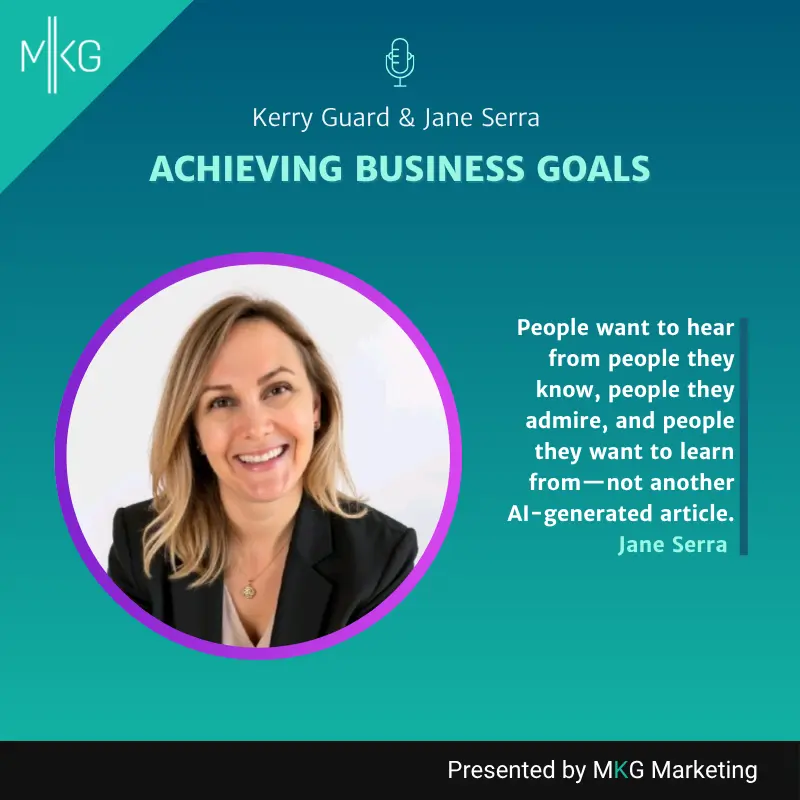
Jane Serra
Jane Serra is a growth marketing leader who helps B2B companies scale revenue through demand generation, strategic positioning, and customer-first marketing.
Overview
Jane explains why today's highest-performing marketing teams are redefining success by focusing on pipeline quality instead of lead quantity. She explores how paid media, first-party content, AI search optimization, and stronger alignment with sales are helping marketers build trust with buyers earlier in their journey. Throughout the conversation, she emphasizes that sustainable growth comes from understanding your audience, creating genuine value, and measuring the metrics that truly matter.
Transcript:
Kerry Guard 0:12
And we're live. Welcome back to Back on Track. I'm Kerry Guard, and when I'm not hosting this, I run MKG Marketing, where we help B2B tech teams get found in search and AI answers, the Google results, and the ChatGPT Plus paid to fill the gaps. So I spend most of my days in the exact stuff we're about to get into. My guest today is someone a lot of you already know, Jane Sarah, with 17-plus years in B2B marketing across SaaS agencies and international outsourcing. She leads growth marketing at her company, and she's the creator and host of Women in B2B Marketing. So, she runs the mic as well as runs the strategy. Jane, I'm so glad we finally made this happen. Welcome to the show.
Jane Serra 0:53
Thank you so much. I'm so excited to chat with you on and off the mic.
Kerry Guard 0:58
On and off. Yes, I love behind-the-scenes conversations, which we're going to get into. I know that the LinkedIn profile has a bit of what we will touch on, but actually, Jane and I had a really awesome conversation before this that we need to, we just need to unpack live for y'all. So, we're going to get into it. Before we do that, though, a little word association game. Fun fact: I looked at our YouTube today, and our shorts are the best-performing shorts, and it's these little games that I play at the beginning of the show that are actually the top performers.
Jane Serra 1:34
So I was like, people just want to have fun.
Kerry Guard 1:36
I know, and I haven't done it in a while, and I was like, well, guess who's bringing those back, so we're going to do a little word association, so you say the first thing that pops into your head, not overthinking it. Okay, okay, I'm just going to do a single word, and you're going to tell me what it means to you, not necessarily a definition, just what it means to you and the work that you do.
Jane Serra 2:00
Okay, okay, paid ads. Surprisingly, love again.
Kerry Guard 2:07
Yeah, AI slop.
Jane Serra 2:10
oh noise. And we will get into that later, too. Yeah, I just love AI. I'm actually pumped about a bunch of things we're building at Memory Blue with AI, but there are ways to use it that help you and help your audience, and there are ways to use it that feel manipulative to try to get an audience that doesn't really help anyone.
Kerry Guard 2:30
So, true. Stay tuned, folks. WordPress.
Jane Serra 2:34
And I still love WordPress. I think it has a lot of evolving to do, similar to Salesforce, right? Like we're all just in it and use it. I have not made the conversion over to Webflow yet, though I hear great things. It's just such a headache to switch platforms. So mixed is my response.
Kerry Guard 2:56
first-party data
Jane Serra 3:00
love, and I think there's a lot that can be used to focus on this. I think we'll talk a little about this too, but first party data and first-party, just general creating of things, and collecting and sharing results of things, all of that is what helps you stand out amongst the AI slop, and helps you, of course, collect data that helps you make decisions, so true attribution is a necessary evil. We can attribute everything, but we have to directionally show things, and then explain ourselves. So necessary evil that we will never really figure out in marketing.
Kerry Guard 3:40
Oh, except that LinkedIn.
Jane Serra 3:41
LinkedIn, I love LinkedIn. We were just talking about this before we turned on the mics, because I just posted about us hiring at Memory Blue, a few positions, but when you, as soon as you say you're hiring on LinkedIn, you get flooded with DMs and comments and stuff, which is, you know, great for reach, but not great for noise, similar to AI slop, where, like, I'm getting a ton of people coming in, but they're not actually fits for the role. So this is one thing that I'm not a fan of on LinkedIn.
Kerry Guard 4:13
Best practice.
Jane Serra 4:15
Best practice, overused term, but also really important, like when you're even like it's kind of the thing we hate creating as marketers for content, but you kind of have to, and when we search for things, you still kind of look it up if you're looking for a starting starting point, but I am a big fan of marketing owning pipeline, so the kind of a shift, a mindset shift of what pipeline is to me. Pipeline doesn't begin with opportunity. Pipeline begins with proper MQLs, not downloads, but actual hand raisers, and then everything passes there. And marketing should own the whole journey, of course, with sales. As it comes to the bottom.
Kerry Guard 5:01
They should merge and then mix exactly.
Jane Serra 5:04
Yeah, yes.
Kerry Guard 5:06
All right. Let's get to it, let's get into it, because we have a lot to get through, as you can see from that teaser.
Jane Serra 5:14
Yeah.
Kerry Guard 5:16
Let's talk about paid, because that was one of the first words you were launching pay for the first time ever, right? As everyone on LinkedIn was declaring paid dead, why did you zig when everybody else zagged?
Jane Serra 5:30
Oh, because that's exactly what we have to do to stay relevant. That's in general, but the reason I went and am now investing in paid media, particularly search and LinkedIn, because that's where audiences, so again, not a best practice here, because you need to look where your audience is, and that's where you should invest in paid and test the waters, but I'll say a few things, like one, I see it works when you have somebody running it who knows what they're doing, it cannot be like me. I am not an ads expert, I'm not a paid media expert, or any of these channels. I know enough, but knowing enough sometimes can hinder you even more, because you get it started, you launch it, you're like, why isn't anything happening? Oh, it's because you didn't put all of these filters on, you're not targeting your audience, you're not excluding these countries, you're not adding these negative keywords, like there's so many tiny little details that make the biggest impact on ROI, where you're just wasting money, you're throwing money away if you're doing it, versus if you bring somebody in who knows what they're doing, and we are working with, like, the king of paid media, I'm not even gonna say his name, but he's the best, if you want to DM me, but so he knows everything, and we're just learning a ton from him ourselves, and we instantly saw ROI. So, where I love to bring in paid media is when you're building all of your channels, so at Memory Blue Marketing is relatively new, only about a year or so, we've been marketing, even though it's - we've been around for 20 plus years, but marketing is new, so we're setting up a ton of new channels right now, and while we're setting that up, because it takes time, we could turn on ads a lot faster, and so that was able to close a gap to help us hit our pipeline targets while we're building all of these other channels, so big advocate when done right.
Kerry Guard 7:25
When done right. Let's talk about paid search for a minute, because that's shifting underneath us drastically. Are you seeing a change in terms of since you - I know you just launched not too long ago, but I mean, yeah, there's been - I feel like every month there's new data around: is this going to be a thing?
Jane Serra 7:46
Yeah, it's interesting. For now, it still is, and I wonder if we still have a lot of competition because we're in a competitive market, but I wonder if competition will start to dwindle because people are thinking this, and they might reallocate their budget, which hopefully they do, and then we take over. Yeah, but I think right now I need to.. I don't know how we would look into this, but I love to see more research on this versus my one singular example, but we're still seeing it thrive on our side. Yes, branded, and also for our key high-intent campaigns, so we're seeing it work really well. My hypothesis, without data backing this up, is that people kind of came full circle with Google, so searching things, everyone started going to Claude, ChatGPT, et cetera, but now the Google results are still so like they're good and they give you AI results and your answers now, not just the links that I think people are back to searching on Google and Claude and Chat GPT, but I think the habit of Google is so entrenched in us for decades, like a decade or so, that people kind of came back to it, so we're still seeing it perform really well. Caveat to that, we still very much have to invest in LLMs and AEO, and make sure that we're optimizing for search there. So, it's for us; I see it working. We'll see if it stops at one point. We keep an eye on it, but for now, it's still doing well for us, despite the, I mean, we do have less organic traffic, right? Like everyone's seeing the dip in organic traffic, and I think that's because answers are right there. So you want to make sure your answer shows up, and ads are another way to get your answer right below the AI answer that Google shares.
Kerry Guard 9:37
Yeah, it's true. We are seeing, depending on the client in the situation, but we are seeing that the cost per acquisition is definitely climbing slowly but surely as impression volumes start to shrink, so I do think, for you know, for one of my clients, so I'm a fractional CMO, but then my team on the MPG side runs the paid ads. Yes, and says are all of our SEO, AEO geo, and for one of our clients, we are seeing that while we've moved a bulk of the budget into performance facts by keeping on brand and just the very bottom of the funnel targeted keywords that are going to convert, right, people who are like, okay, I do need this thing. Let me go, let me go find the websites that will give it to me that we're seeing success on. So very much have I narrowed the field down to.
Jane Serra 10:33
yes.
Kerry Guard 10:33
More of the transactional keywords for search than those broader terms, which is where we're going to address.
Jane Serra 10:41
Address, yeah, we're seeing the same thing, because you're right, like a decade ago when I was running paid search, it was mostly- not mostly, but we had it mixed up from top of funnel, middle of funnel, bottom of funnel, right? We would do- let's get them to read this blog post and point them to this webinar recording. We don't do that anymore. I don't think the value is there, but high intent and brand are the go-tos. Brand, yes, competitor as well.
Kerry Guard 11:08
Competitors, interesting. Yeah, yeah, I have seen competitors do really well when you can, when you have some really good messaging of, like, why you, yeah.
Jane Serra 11:21
And to look into, so something that's great, because we noticed that a couple of our competitors were bidding on our firm and bidding on our actual brand name, which, fun fact, you're not technically allowed to do, there's trademarks, and you can argue and dispute this, but you know, Google's fun, and it takes a while to get that taken down, but something to keep in mind is you can argue that your competitors can't use your actual term in their ads, but you can also do the play dirty too, so it depends where you stand in the market, and I mean, I'm very much of the mindset of, okay, we want to have competitor campaigns, but we're not going to trash our competitors, so we just have fun with the ads there. Yeah, exactly, that's awesome. Yeah, I do love a good.. I think there's definitely going to be more competitors, so brand competitors, and then your transactional keywords are definitely still places to hang when it comes to paid search, couldn't agree more. I think you just answered my second question, but I'm going to ask it just in case we missed anything. You're four months in. What's actually happening, and what has surprised you from a paid perspective? Oh, I think from a paid perspective, so what I'm.. I was surprised that we were seeing so much traction right away. I knew that I wanted this to be a plug, but as soon as we turned this on, we started to see quality coming in, and being able to fine-tune it was just mind-blowing. Like, the power - this is why I'm such an advocate of bringing in an expert and somebody who knows these ins and outs and new things that are released and what not to do, because what he's been able to do for us, and the layers he's been able to add on, so that we're very targeted in our ads, has just been beautiful, because I've had bad experiences too, right, with where I've worked with with people, and it's been hard to bring in more than top of funnel, like really just bringing in a bunch of noise, but this is just bringing in really good quality again. When you know what you're doing, so pleasantly surprised.
Kerry Guard 13:27
Amazing, amazing. What do you say to the paid is dead crowd now that you've read?
Jane Serra 13:35
Okay, watch me eat my words in the future, but I feel like nothing is ever really dead, and everything depends on the world of marketing, right? Everything depends on who your audience is. It depends on how you're using it, and everything, in my opinion, comes down to, at the end of the day, are you providing value, are you helping people? Like super simple basic human connection, right? Like, are you helping people, and how are you getting in front of them? That's really, at the end of the day, what works. So, if you're using your paid media and you have someone who knows what they're doing to get in front of those right people, and you're helping them at the end of the day, the magic combination - nothing will ever be dead.
Kerry Guard 14:18
Sure. Where is your audience? What do they need? How do you show up for them? It, yeah, it feels.. it sounds so stupid simple, but this actually leads, leads into the next topic really beautifully. In terms of first-party content, you're interviewing your own target accounts and turning that into content.
Jane Serra 14:41
Yes, and when we first spoke about this, I think it was like pre-launch, like we hadn't even launched yet. Now it's like a couple of months out there. So we created a media arm of Memory Blue, and so far we have a media site, a publication that is called The Revenue Wire, and the whole goal is just like. My own champagne here, like I'm practicing what I'm preaching, is creating value, right? Like we're interviewing our target audience and all of their peers, so our clients, our partners, prospects, we're interviewing them and getting their thoughts on things, sort of like, like we're doing here, right? Like, where you talk to somebody and you get their actual insight, their stories, and you share that, and that is great for SEO, for AEO, for building connections with these people, and at the end of the day, providing value instead of AI slop, and just create an article that's all about xyz, that's just regurgitating what everybody already knows in your target audience, people want to hear from people they know, people they admire, people they want to know, and hear what they're saying, and what's actually working in various different facets, and covering the topics that are top of mind for them. So we're creating that content on our media site, and it's great for building content, sales enablement, ABX plays, and it's great for SEO. So, yeah, I'm so excited for this. We're actually going to launch a podcast, an extension of our media arm, which is also called The Revenue Wire, so we'll be launching that really soon too.
Kerry Guard 16:16
That's awesome. How are you tying this to the brand? Because even I struggle with it. Right, as soon as I open up the show, the first thing I mention is MKG, and I try and, like, make sure people understand that Back on Track is tied to the brand, but I don't ever bring - I don't generally bring clients on, although I'm starting to consider it. So, how are you tying it back to the brand, so that you do show up in helping from an organic standpoint, and from like, and if you are doing it in a VM standpoint, like, it's got to talk about you as the brand, right, from your customer's perspective, but I feel like that's such a, that's such a hurdle to, like, really jump over, yeah, and yes, and get.
Jane Serra 16:59
Because I don't want to be salesy, right, yeah, it's a fine line, because you're at the end of the day, you want to, you want to sell your services, right, but you also don't want to feel pushy, and you want to help people, so the balance is real. I would say what we do with the revenue wire is, we, the revenue wire is its own thing, it's a separate domain, and it's its own site. It's hosted, and we have a team that helps us create this content, like real journalists who build this out and do the interviews. So, at the very bottom in the footer, we have Memory Blue linked, like hosted by Memory Blue, and then we have some links throughout that that post, where relevant, and where it makes sense, we'll link back, and during outreach, or when I'll introduce people to be interviewed, or if our editorial team reaches out, they'll say this is on behalf of Memory Blue, and we're doing more sharing on LinkedIn of the articles themselves, so there's a light balance here of okay, this is from memory, but we're not trying to pitch it, we're more so trying to establish this tie into it, but what's most important is that we're starting this connection with you and building this relationship, and then we can always work with our team internally to identify, okay, like this person talked about xyz, is there something we can help them with, and our sales team can can reach out from there too, so there's a loose tie, we have it to build content awareness, it's a big awareness play for members, yeah, exactly, and then where they're where it's relevant, we establish the relationship and build from there. So basically, the same as the big principle in marketing: they think of Memory Blue when and if they ever need our services.
Kerry Guard 18:54
That's the name of the game. Yes, you gotta build a brand, you know, first-party data is the unlock for AI answers. Why do you think people are struggling to get it? And how are you getting it?
Jane Serra 19:09
Yeah, so first party, it's interesting, like the content play here is one that we just discussed, and then first party data, because there's all of these terms that we come up with in marketing that are so funny, there's the zero party data, first party data, second party data, yeah, there's so much.
Kerry Guard 19:30
Oh, I've only heard first-party data, so I didn't even.
Jane Serra 19:34
I'll try to correct me if I'm wrong, audience here, because it's been a while since I talked about this, but zero party, if I remember correctly. Zero party data is when somebody actually submits to you, so they're submitting this is my information, entering a survey, filling out a form that goes to you, so they are giving it to you. You have their information, and then first-party data is what you are seeing on your website. So the activity that they take and what actions they take on their website- call me out if I have these two reversed- but the first part, so both super super valuable, right? You need to be able to see both, because you can get signals based on what pages somebody is on, if they're an existing client, a prospect, and you can see what company they're at, or now with tools like User Gems and Vector RB to B, you can sometimes see the person, so you gather that information where they are, and that's beautiful for marketing and for so helpful.
Jane Serra 20:31
But when for marketers, when you can gather survey data or insight, like what are their current challenges, or if they're signing up for a webinar and you ask one of the questions, what are you looking forward to most in this to learning in this session, or what is your question for the host, and you get that information, muse it to our ears, because we can then answer that live, make sure we address that, and then you have that for the future, like what you can in aggregate look at this and identify what content you should be creating, so when you can get anything directly from your audience, it's just beautiful for direction.
Kerry Guard 21:08
Yes, especially the qualitative data. I'm, I'm having this conversation with Fright and Center, especially now into your, to our attribution sort of point earlier of like the necessary evil that it is, of probably never going to fix it, but also still need to have it, kind of a conundrum, but I do believe that, and I had it with Ann Gotte, I had it with Scott Wasserman last week, that that field on any form, or even when even if sales can ask them, right, How did you find us, and let them like tell you their journey, right? Like that qualitative data, so that would be considered third-party data.
Jane Serra 21:50
Then, well, if they're no, that would be first party, or sorry, that would be zero party, because they're.. If they're telling you to perform.
Kerry Guard 21:58
Sure.
Jane Serra 21:59
Yes.
Kerry Guard 22:00
okay.
Jane Serra 22:00
Through a form, but a whole other layer here with AI that I'm so excited about is being able to pull that information from sales conversations, because hopefully the sales team is asking that in the call. It's a great way to start a conversation, hear their path, or if they know somebody, or what sites they pay attention to, or influencers they listen to and respect, so gathering that, which I don't know if that would be first party or second party, because you're collecting it from a phone call, that one gets hairy, but that can fill in, because fill in a lot of gaps, because when you have that as a field, I personally don't have it as mandatory, I don't want to block people from submitting if they don't feel like sharing that, so we get probably 35% of people actually submitting. How did you hear about us? And it has to be an I will die on this hill, has to be an open text field, not a drop down, whereas a drop down, people will select the first thing nine out of 10 times, and it gives you zero data, and you'll miss out on things that are off of your drop down that you weren't even aware of, and you still won't be if there's a drop down, so open box, but still you get like 35% so if you're scraping phone calls and filling that in from there, you can get so much more data and information, so I, that's a huge way to use AI in a positive way, in my opinion.
Kerry Guard 23:24
Yeah, and goatee actually said that she people would literally write in their prompts, like, "Oh, yeah, I went to ChatGPT, and here's looking for, like, oh, but, like, the information they give is so powerful that you would never get, you'd know that they came from ChatGPT, but, like, you don't know what they ask for, unless you try and corroborate across platforms, which don't get me started on that.
Jane Serra 23:48
Yeah, still a minefield. Yeah, I love that, though. You're so right. Like, be especially if you market to marketers, we give so much information. Oh, well, I talked to this person about this, and then I looked at this prompt, and yeah, copy-paste, it's, it's awesome, it's great to market to marketers.
Kerry Guard 24:05
Oh, see, I, I wondered if it was going to be because we were primarily in B to B, more on the tech side with like security buyers and CTOs and developers, which is a whole different beast, and not necessarily an easy one, but I always thought that marketers would be the hardest to market to, because we just know too much.
Jane Serra 24:26
Yeah, but it sounds like it probably depends, right, on what kind of day they're having. But I feel like marketing to marketers, because we know we're like, " Oh, let me help you, like this is where I found you, this is who you should be.
Kerry Guard 24:40
I love that. I'm gonna keep a more open mind towards that. That's amazing.
Speaker 1 24:43
Yeah.
Kerry Guard 24:44
So you're building all this content; you have this wonderful media outlet. Are you doing any sort of research or understanding in terms of how that might be showing up in answer engines or LLMs, or is it still kind of early for that?
Jane Serra 25:00
Yeah, in between, we are seeing this is not fully connected yet, right? The team that we're working with for the editorial is going to be using one of these tools. I think they're actually building their own version of, like, an AI analysis, LLM, AEO analysis, and they're pulling that in, so they'll be able to track this much more granularly once that's live. I think this week, but on the not direct side, what we're seeing is since we launched this program, we are seeing an uptick month over month for the AEO that we're getting from the how did you hear about us field, we're seeing a lot more people just continuously say Claude or Gemini, Chat JPT, so that's been really great to see, but we don't have a specific tie. The only thing we're really doing, or the two main things we're doing for AEO, is this media arm and the G2 reviews, so that's what I'm attributing it to, the uptick, but I do need more analytics, so if anyone has ways to actually check, yes, Brittany.
Kerry Guard 26:10
I would, I would look at your branded terms as well to see if you're getting some uptick of more people searching for you, because you're also doing paid and paid contributions as well, so I wonder if you're just getting a little bit of more brand recognition, and if your branded terms are on the rise.
Jane Serra 26:26
Yeah, great call.
Kerry Guard 26:29
Check that out. So, you've got 20 years, you've got a 20-year-old site with a ton of inbound, and you want to rebuild it. How are you? How are you thinking about it?
Jane Serra 26:43
So, when we chose an agency, and if you go to Memoryblue.com, you'll see why we want to redo the site. It's just not.. It's not great. It doesn't look like we are very modern, very fun. Like, we have a great group of people who are passionate and really smart and care about our clients and each other, and that doesn't come across on the site. So, if you go to the site, it's okay. If you have any feedback, let me know before it's not mine. We're blowing it up. It's also a pain in the back end for us to change anything, so if we want to add a new page or change something on a page, we have to go through our agency right now to do that. We can't just go in and build, which is just a personal nightmare for me, because I'll want to build something, and usually I'd be able to build it the same day, and it'd be live. So we are blowing up the site. It is terrifying because, despite appearances, our website is our biggest pipeline driver. We have a ton, like everybody's coming in inbound and filling out our horrific form, so we're still getting a ton of traffic, a ton of conversions, most likely because we have built a brand. So again, those recommendations of word of mouth, people come to us, they trust us, they convert, despite the crazy long form and horrible site, but I'm terrified of that changing. So, when we chose an agency to redo our website, we made sure we got somebody who is focused on SEO and AEO through the process, so we're doing it very, very carefully, mapping everything, and how are we moving this over? We debated if we were going to go with Webflow and move off of WordPress, so there were a lot of questions, and we did it really strategically. So, hopefully everything goes out and goes well, because we're doing it so carefully. But yeah, talk to me in a month, because it'll, it'll go live at the end of July, so we'll see how this goes.
Kerry Guard 28:44
Most of the time, I'm finding a lot of people are hitting that sort of- I'm calling it WordPress. I don't know if it is WordPress that you're using, but it is sort of that WordPress wall where the plug, the plugins haven't been updated, or it's through an agency, and they don't have access, or so slow, or it's using like one of those WYSIWYG engines that isn't actually intuitive, and so there's just like a lot of, they're all hitting sort of this this wall of needing to do it, but it is really scary. I have to say, I on one of my own clients over a year and a half ago, I had the same problem, I was so scared to like rip off the band aid, because they were, they were doing okay until they worked, like I was like I hit that wall of I can't update the website anymore because it WordPress is so slow, and the agency I was using weren't, it's not that they weren't moving fast enough, it's just that they needed so much hand holding, and we were starting to, like, it was starting to not become intuitive, and I really needed to redo the architecture, and I didn't do it fast enough, and so everything went off a cliff in, like, February of last year, and then I basically, like, in a month, like, had I built a website, you know, I got, like, an MVP up, and. And like everything tanked and then but I rebuilt and now like it's doing as of August of last year so like I had a rough like, four or five months of like powering through to get those new pages up and to get the architecture settled in and then they had their best month ever we're getting absolutely strategic to that, so I feel scary. You will have a moment where everything will be okay, because you'll be able to move so much faster to get out in front of it, and it'll pay off.
Jane Serra 30:33
That, thank you. Thank you for the therapy session, because that I.. It's exactly.. you read my mind, like I'm expecting a dip, I understand it will happen, although I did once launch a site and we didn't have a dip, I don't know the miracle of what happened there, but it instantly started going up, but we had a, it was a really shitty situation to begin with, like the site was not performing well, so maybe only, yeah.
Kerry Guard 31:01
I was too.
Jane Serra 31:02
Yeah, but ours- we're seeing like organic is coming down, right? So, but I don't know, like that's a trend everybody is reporting right now with LLM, so organic is going down now is the time, like I want to be able to add more pages regularly, and again, value high-value pages and change, we have so many. The architecture of how the site was built is just really hard for us to navigate, let alone any kind of crawlers. They're just blocked, and the page load is horrible. So I'm hopeful it'll be similar to your experience, hopefully a dip or downtime, but good to prep for. Yeah, but yeah, and you're being so much more careful.
Kerry Guard 31:42
Like I was in panic mode, right, like, like, the it went off a cliff, and then I was like, I should have done this months ago, and then I went into like single developer mode activation, and I just sort of like did it with the help of cursor and AI, which was still kind of new at the time, it wasn't really asintuitive and great as it is now, but I knew I did websites enough that I could, I, with the help of AI, could make it happen in a month, so I felt a bigger dip, because I literally ripped off a band aid, versus what you're doing, which is so smart, of like being really intentional behind the scenes, making sure that you're mapping anything that you can't map, you're going to have a lovely redirect plan for, like, your, yeah, you got this, it's going to be awesome.
Jane Serra 32:27
Thank you. Speak it into being.
Kerry Guard 32:31
Let's talk about the echo chamber that we do find ourselves in. We love LinkedIn; however, I don't know about you, but I'm finding that I'm seeing the same stuff over and over and over again.
Jane Serra 32:52
Yeah.
Kerry Guard 32:53
You know, we're all nodding along. There's no silver bullet. Positioning is everything, but the founders who control the budget and the timelines aren't in that echo chamber and room with us, so how do you bridge the gap between everything we're saying as marketers and the founders who are still not quite there yet?
Jane Serra 33:11
Yeah, it's actually a great transition from talking about the website, because one example, right, is we know as marketers when you launch a new site, there is going to be a dip, so we expect that, but guaranteed it's not like everybody on the board is not going to anticipate that, so we have to share that that will happen, and why. Hopefully, a part of it is just trusting your experience, right? And be data, so data solves everything, just like revenue. When you're doing it properly, you can showcase how you're doing it, how you're pulling it, and how you're analyzing it. But if you show something, I quote, this is a research report from this reputable brand, or this is these are three examples from reputable brands, or this is what we are seeing, like your own data, of course, where possible, makes sense, but if you don't have it yet, and it's something you want to push, or like, this is why we need to invest in brand. If you have external, reputable sources for data that you can showcase, like research that is very recent and relevant, that speaks volumes, because it's like, okay, I'm making this decision, and this is why. So, it's a combination of hopefully you have the trust of the board and the exec team, hopefully that's why they hired you, but also supporting with data and giving your reasoning in a very succinct way.
Kerry Guard 34:35
Straight to the point. Skip the end, as my husband likes to save me.
Jane Serra 34:39
Yes, because that's another AI slop thing, right? That, that I talk about this all the time, and I'm sure this is another nodding heads around in our echo chamber, but I love Claude. I love Claude so much, and I was guilty of this myself, so I'll be the first to admit that, but because it's so fun to use for research and an. Analysis people go in and create 50 page 60 page decks and share it with you, and instead, what I would love for people to do, instead of sharing that 40, 5060, page deck, how about you give me, as I put in the prompt, okay, now make this one page, give me the TLDR, and make a page that has action items like from this. Here are the key points, and this is what we're doing about it, because nobody is going to read through a 60-page deck, and most of the time you just had fun researching it, and you didn't take the time to analyze and create an action plan. So, important thing.
Kerry Guard 35:41
It feels interesting when, when you're pitching to the executive level or to the board, because there has to be this balancing act between showing the strategic side from a very high level of like what you're trying to accomplish, but also making it tactical and like something you can tangible at the same same time, that's how do you stay sort of in the, in the executive summary, so to speak, but bring it to life. Sounds like data is a big part of that. Is there anything else that contributes to making it feel tangible in a way without getting too into the weeds?
Jane Serra 36:22
Yeah, I think I'm a very big visual person, so I tend to use visuals as well in presenting. So I like to have, like, one again, keep it as simple and clean and limited as possible, succinct. Like, let's say one visual, one chart that shows, okay, this is what we're, this is where we are now. This is where we want to go, hopefully up to the right, and then this is how we're getting there. This is what to expect, or we expect this dip in traffic, but we should be coming up here, like if we have one visual, and then the actual takeaways, that's key, but another layer again to earn and maintain, hopefully, that that respect and trust is not everything is going to go right and going to go exactly according to your plan all the time. Life doesn't work that way. So, if you own up to it, like, look, we are behind in this channel right now, we recognize that this is why we think that could be. These are the possible reasons. This is what we're doing to address that, so like, if we're expecting a dip in our traffic when we launch the new site, how are we going to make up for that in the pipeline? Like, what are we going to launch? Are we going to invest more in our paid media for two months to make up for that? Like, just as long as you have the plan and you share the visual, the action items, the plan, and admit when something doesn't go as planned, and a plan to go around it, and what you're doing because of that. You have the trust, you're just, you're sharing exactly what they need to hear, because it can't all be roses all the time. Then no one's going to believe you or trust you.
Kerry Guard 38:01
That slides perfectly into my final round of questioning here about the Slinky Detangler.
Jane Serra 38:08
Ah, yes.
Kerry Guard 38:10
Tell us, what, where did the name come from? What does it mean?
Jane Serra 38:14
So I am the mom of a six-year-old right now, and I added this. I'm a big fan of, like, making your LinkedIn very much you and speaking to your personality. You can tell from this convo I'm very casual; I tell it like it is, but hopefully kindly. I like to have transparent conversations. Like all of this, I try to share on my LinkedIn, and one of the things I added, I was literally detangling slinkies for my son when he was probably four or five when I added this to my LinkedIn profile, because I was like, this took me a long time to figure out. Sinkies, if you don't know, like those toys that kids play with that, like, stretch out. I don't know how, but they constantly get knotted. I don't know what kids do with them, but they get crazy knotted, and sometimes they get bent out of place. It's horrible, but if you're really careful with it, the key to detangling a slinky is slowly, methodically, and one ring at a time, like you're literally doing this twisting motion, and then yes. So once I realized that, I was like, okay, I am an expert slinky detangler, and somebody pointed out to me I meant it legit, like I can detangle slinkys because I am a mom of a toddler, a five year old, but then somebody DM'd me, and like, I love the slinky detangler analogy, like that's exactly what marketing is like, I was like, oh, that is so true. I love that. I wasn't even intending for it to be that, but yes, that works both ways. But it is like marketing, you just have to be really thoughtful, right? Like, take the time to look at it, and one step at a time, iterate. Like, it's exactly like marketing, untangling the chaos of the go-to-market journey.
Kerry Guard 40:00
Yeah, it's usually coming in after founders throw spaghetti up against the wall, and you've got to figure out what on earth they just did, and why they're doing that, and
Jane Serra 40:08
The founders at the toddlers, they totally.
Kerry Guard 40:11
Are they totally making the yes, we love you founders, but yeah, yeah, I mean, parenting as a whole, yeah, I am parenting as a whole, in terms of like how you manage people and how you manage your toddler, are not always that similar. Oh gosh, Jade, I can talk to you all day. I'm gonna ask my last question, maybe two. Yeah, what? Okay, they tie together. What's one vanity metric you've personally killed, and what did you replace it with?
Jane Serra 40:47
Okay, there's probably a bunch. I, so this will be interesting to see what people think about this. I, the opposite of killed, brought back MQLs. I love MQLs, but what I killed was the really shitty definition of an MQL. Like, to me, an MQL is not a webinar attendee, is not somebody who downloaded something, and so an MQL for me is a hand raiser. They are asking to talk to sales; that's where MQL starts for me, and then.
Kerry Guard 41:23
SQL.
Jane Serra 41:24
Not an SQL, so for me it's a hand-raiser MQL, SAL is a meeting is booked, SQL is an opportunity is opened, and having this clean definition aligns marketing with sales so much better, because we're not handing them crap, right? Like, here's somebody who attended a webinar, but didn't even know it was from Memory Blue, and has no idea who we are. So, it's or didn't even attend. Those are still great, but to me, that's an MQL. That's a contact for somebody who attended our webinar. I don't need to bug them. I don't need to have sales hound them; they just have this signal. If they come back to our website, that's what we want to try to drive them to do, right? More awareness ads, things like that. But that's not something we would hand to sales. So I think I killed the definition of MQL, but I made MQLs like matter.
Kerry Guard 42:19
Yeah, because MQLs to me meant that you had people who were throwing signals around showing up for your brand, but they weren't sales-ready yet. Where you've moved them down, yeah, where you've now moved them down the funnel, because it just, it just so happens that that's how it is these days, right? People, it used to be that by the time they showed up to sales, they had made up their minds. They had three brands; they knew which one they kind of wanted to go with, but they were sort of vetting it to make sure, or procurement told them that they had to have for the web person, they had to go vet other companies. But now that's happening before they even hit the website, like I've moved all of my conversions up on every single page, like the conversion, the form is now the second thing you see, like you have the hero of here we are and what we do, and then the form, yeah, convert, because that's really why you're here, you already know this stuff, get to it, yeah.
Jane Serra 43:17
A lot of PLG brands, right, like they all PLG brands should have, like, the email capture, and in the header, right? Because it's instantly you can sign in and check out the platform. So, yeah, fully with you there. I think this- I'm realizing, talking through this out loud- is that I think I did this so that, like, everybody was moving away from MQLs, and, like, MQLs are dead, another dead thing, but that's killing marketing, like the what's called a marketing-qualified lead, you're then saying is shit. How about you keep the term and make it high value? Like, then you see marketing is high value. I'm aligned with you, sales. We want pipeline, we want revenue. I'm not focused on the I am focused on the downloads and whatever we have for signals, but that's what it is. It's signals. It is not the start of our pipeline. So there, yeah, make it so you as marketing.
Kerry Guard 44:14
From a marketing standpoint, you're saying this is a qualified lead because they filled out a form indicating they want to talk to sales.
Jane Serra 44:23
Exactly, and then sales get
Kerry Guard 44:26
To decide, and then sales gets to decide whether what's the have you seen when you talk about conversion rates between, you know, from the website to that form, obviously there's going to be a bit of a there, I don't know, maybe not, because downloads are not really a thing anymore, but from the MQL to the to the SAL, is there, and I know you, you've been only at Memory Blue for a few months, but even before your other job, like, are you seeing a better conversion rate between those two now?
Jane Serra 44:55
Oh, for sure, yes, because if you're there, it's always going. Be some junk that comes in right, and we just won't consider that. We'll remove that from the MQL account, but that's inevitable. But if you're driving your awareness and your brand properly, and people are coming to your site, then the right people are coming to your site, and you're automatically going to have a higher volume of people that are hand raisers, I call them, coming in asking to talk to sales that are in your market, in your ICP. So we definitely see a high conversion from that to SALS, like our meetings booked, for sure, way higher than if we, we did previously call MQLs before I came on, were downloads or webinar attendees, and we had huge top of funnel, but then there was nothing really converting, and nothing, so it's kind of two disconnected systems, where MQLs, and this is why there was the death that, like, MQLs are dead because of how it was labeled, and this is outside of memory, like I see this often, so if marketing is saying, oh, we have this great type of funnel, we have tons of MQLs, but nothing's closing over here, like nothing's becoming an SAL and SQL, nothing's closing, they're two separate systems. So, by redefining MQLs as hand raisers, I connected it again, so we're all looking at the same key data.
Kerry Guard 46:16
Amazing, I never thought to do that. I'll be doing it; we should all be doing it.
Jane Serra 46:22
The very, very tough still matters. Like, we need to drive more of this. Everybody is labeled as marketing.
Kerry Guard 46:28
Is saying that this is somebody we qualified. They- this is not spam, this is not junk, this is somebody saying they're using the right words in terms of what they're looking for, in terms of the problem we solve. This is a good lead. Let's go get, let's go book that beating.
Jane Serra 46:42
Yeah, I mean.
Kerry Guard 46:42
I'm doing that right now with one of my own clients, but I'm not calling it MP. Well, when technically it is. We're just calling it a qualified lead, but it is from marketing. We did a thing, yeah.
Speaker 1 46:52
Credit, so funny. Yeah.
Kerry Guard 46:56
This was awesome. I could talk to you all day, and selfishly, I'm walking away with a list of things to go try. I can't, I'm, I'm bringing back the MQL, y'all. There was a show I went on about a year and a half ago where I was one of those people, where I was like, oh my gosh, please stop sending these leads to sales; they are not ready, the MQL is dead, and I have converted over. We are going to bring back the MQL in a much more intentional way.
Jane Serra 47:22
Don't kill the only thing with our name on it.
Kerry Guard 47:27
So true for everyone listening, go follow Jane and subscribe to Women in B2B marketing. She's having the conversations the rest of us need to hear, so go over there and make it happen. Subscribe, subscribe, subscribe. This will go out in clips over the next couple of weeks, so you'll be able to relive the conversation on LinkedIn and YouTube, and get to hang out with Jane once again. But if you'd like to connect with her, Jay and LinkedIn, best place to..
Jane Serra 47:50
Yes, I live on LinkedIn, so it's actually even better to DM me on LinkedIn than to email me, because my inbox is a jungle. So, yes, see you on LinkedIn, and so good to chat with you, Kerry. Thank you.
Kerry Guard 48:02
Oh my gosh, so good to talk with you. Thank you so much. This episode is brought to you by MKG Marketing, where we help you to be tech brands. Get found in answer engines and LLMs, and use paid to build that brand. We are here for you. Give us a shout. Thank you all so much. We'll be here next week.


 (2).png)
 (7).png)