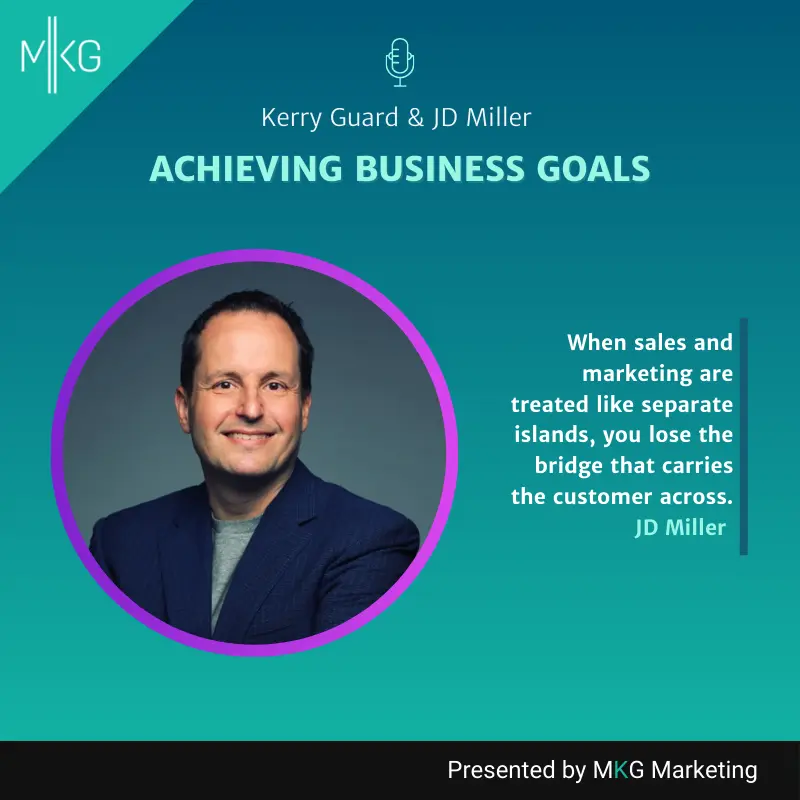
JD Miller
JD Miller is a seasoned CRO and operating advisor who helps PE-backed and pre-IPO SaaS companies scale revenue by unifying sales and marketing under one high-performing system.
Overview:
In this episode of Back on T-R-A-C-K, JD Miller shares lessons from decades of transforming go-to-market engines inside PE-backed and high-growth SaaS companies. He explores how to create alignment across sales, marketing, and customer success teams under a unified value-creation plan—especially when the pressure to perform is high. From designing operating rhythms to simplifying KPIs, JD challenges the myth that more people equals more growth. If you're leading in a complex, high-stakes environment, JD offers a clear framework for scaling with focus, trust, and speed.
Transcript:
JD Miller 0:00
You know, it's a mindset of abundance instead of scarcity. And we see this in so many contexts, not just sales. You know, we see this in how we interact in our communities, too. But you know, regardless of where you are as a seller, you know, if against your quota, if you can approach your territory and think I have this solution that meets a really important need that people out there have, you know, I can go to every call and be really confident, like, I know about you, I know about the problems you have, and I'm gonna solve this if I go to every customer saying, Oh, I'm way behind my quota, and I'm so desperate for you to just buy anything because I need to pay that bill. You know, it shows up in a way, and it shows up in a way that your prospect doesn't really, you know, it doesn't resonate with them, and so you may be talking to the same person, but it's all about mindset. And am I solving your problem, or am I desperate for you to solve my problem?
Kerry Guard 1:02
Hello, I'm Kerry Guard, and welcome back to the show. Back on Track here Thursday at four o'clock, my time, and 11 Eastern. If you are with us today, comment away. We want to know that you're here and where you're calling in from, and all the questions and all the land that you're going to have for JD Miller. It's going to be great before we dive on in a little bit about JD. JD has been on the show before, so if this is a repeat for you, sorry, not sorry, he's too good to not give all the deets about.
JD Miller 1:34
Thanks for having me back. Kerry. I always love talking with you, and learn so much about marketing, and have such interesting conversations whenever we talk.
Kerry Guard 1:41
So good, and I learned so much from you, and we're going to get into that in one second, a little bit about JD, CRO, CEO, and regional CEO. And led teams across mergers, integrations, and PE-backed transformations, and he's known for creating one of the most effective frameworks in modern GTM marketing: the unified revenue motion, which breaks down silos and brings people together around a clear goal. We're going to dive into how to actually align sales and marketing, the realities of scaling inside private equity, what leaders get wrong about culture during rapid growth, and why humanity has to sit at the center of every GTM team again. JD, you just launched your second book.
JD Miller 2:30
We're just finishing the second book. Yep. So the first book, the CROs guide to winning in private equity, has been out for about a year, and the publisher actually just signed me for the next book, which is the AI handbook for sales and marketing professionals. So that'll be out in the first half of 2026.
Kerry Guard 2:51
So exciting. What did you get? Did you just get the bug like you had the first book? So you need to, you need to keep going. Now, I heard that's a thing.
JD Miller 2:58
Well, you know, that's definitely part of it. But I realized, as a sales and marketing professional myself, we're at this moment of transformation where everyone is talking about AI. I don't think we know exactly what it's going to be like, but I'm confident that in three or four years, organizations that haven't included AI in their sales and marketing motions are going to be loved in the dust. And so for my own education, I said, what better way than to write a book about it? So I've been doing a ton of research. I've explored over 180 different AI companies that say they have solutions for sales and marketing. And the book is helping people cut through the clutter. You know, what's going to work, what's not going to work, and things to watch out for.
Kerry Guard 3:38
Oh, man. I mean, I keep hearing in the LinkedIn grapevine, the echo chamber that I've trapped myself in, that there's this there's this conversation happening, and I'd love your take, your hot take on it, in regards to whether AI is going to basically swell up most of our jobs and then, and if they do, what jobs are those going to be? I'm of the sense that I don't think it's going to make any jobs necessarily go away. I think it's just going to make the current jobs smarter, faster, work better, and so we'll need less of them, but I don't think it's going to replace any one thing. What's your POV on that?
JD Miller 4:23
Well, of course, I have a PhD in communication, and so the communication scholar in me says all of the jobs about what it means to be actually a human are not going to be automated way by AI. The thing that's really important for us to remember about AI is it's just a pattern recognition tool, and so although sometimes it feels like you're talking to a real person, it's just doing kind of call and response. It's learned that if I say please, it says thank you. It's learned that if I say I'm having a bad day, it should say, I'm sorry, I hope you feel better tomorrow. But it really doesn't understand the context and. So those native human things like empathy, trust building, all that interpersonal communication that sales and marketers do all the time, I don't think AI can replace. I also think this discussion about replacing jobs reminds me a lot about the.com boom. You know, I started selling in the late 90s, and everyone back then was talking about this new thing called the internet, and, oh my gosh, the web is going to put us out of business or completely change, you know, the way things work, and people were worried about losing their jobs to websites. And, you know, some of that happened. I had a big customer who was an airline who used to, you know, to order plane tickets; you had to dial one 800, you know, that airline, and someone on the other end would help you pick your seat. You know, we replaced a lot of that work with websites, but at the same time, the internet boom meant that more people started traveling than ever before. And so all of those customer service agents, you know, maybe aren't helping you buy a plane ticket anymore. They have three times as many passengers. They all have some sort of customer service work to do. And so, you know, I think with AI, something's going to change. I don't think we know what it's going to be yet. I think probably 95, just like the.com boom. I think 95% of the things that we say are going to happen aren't, but the two or three that stick, we're going to look back on and say, how did we ever survive without, you know, this particular thing going on in our businesses, so I can't wait to see what it's going to be.
Kerry Guard 6:23
Yeah, I totally agree. I have to say, like, I've already feel a little bit of that of, how did I ever not have this thing? But I don't, I don't think it's replacing anything that I was doing before. I think it's giving me capability to do things I haven't been able to do previously. So yeah, I think it is going to be an interesting few years as sort of everything shakes out. I do agree that if you haven't looked into integrating AI into your organization and gotten people used to it and comfortable with it, that there is going to be you are going to be left behind. Essentially, I agree with you that that I agree with.
JD Miller 7:05
And I think, just like the internet, it's a new skill set we're all going to have to get good at. You know, I work now as an operating advisor in private equity, and we just had, you know, 35 of our CMOS come together to talk about what AI means for them. And, you know, one of the core changes is all about, how do you attract leads, you know? So it used to be, we get really good at SEO, and we wrote really great websites that had the right keywords that get, you know, Google to pay attention. Now, all of a sudden, people are doing Google searches, but it's an AI result that's saying, you know, here's the best product in the market. And so, as marketers, there's a whole other skill set we need to learn about. Not just what do we do it on our website, but how do we really curate a presence that the AI bot is going to consume so that we're the thing that AI starts recommending as the best product or the category leader, which is a whole different kind of skill set that you know, I think professionals will need to master.
Kerry Guard 8:00
It is, and it isn't. So from an SEO perspective, it's actually the AI, the way that SEO has shifted in the last five to 10 years, with how Google has been doing its algorithm anyway, has shifted how we do SEO, which is actually lending itself to the way that the llms absorbs information. So as long as long as you're sticking to the fundamentals of how you do SEO, that shouldn't be an issue. You should be showing up. However, I will say the skill set that's going to become more important if you're not already leaning into it is, is the mentions the PR piece. You know, we always believed in PR from a link-building perspective. We were never about buying links. We're still not, don't do that Bad Juju. But in terms, it's not so much more. It's not it can help with link building, for sure, but there's not as much emphasis on that. What the emphasis is on now is how often you're being mentioned across the whole of the internet, right? And so that's why Reddit helps. That's why LinkedIn helps. That's why Yelp and all these other channels help in regards to your social footprint, and then the PR aspect of that of the better the website, the in terms of its trust, the better chance you have of being mentioned. So Rand Fishkin talks about all this stuff on with his new tool of Sparktoro, and has educated us silicones come home in regards to this. But I would say that is SEO fundamentals need to stick around, and you need to do SEO by the book and the new skill set to what you're talking about that I do think we need to start thinking about leaning into and working with social media experts and PR experts is okay now, how do we expand that SEO presence through for the llms, through that that digital footprint elsewhere is where it's going to get fun.
JD Miller 9:53
It's why we have professionals. Right? Your jobs to AI, yeah, don't worry about it. Okay, you're gonna have more work.
Kerry Guard 10:01
Yeah, no, we definitely like it's this is why the silos piece of what you do is so important. Because not just in marketing, not just siloing marketing and sales, but as a marketing department, we cannot be siloed. We have to be working together. Because it all has to compound in terms of how we create that footprint across the board that then leads into the organic results and the paid results and all of that. So, you know, we talk about attribution, that's going to be really everything's going to come down to that last touch that's going to end up on those Google results, because people are going to do all the research through llms and then go to Google to search for that brand term of your name, get to your website to verify, okay, you are real. The AI is giving me a real company to look at. It's saying everything's lining up in terms of what it's saying. And you do seem like the best or the best. I'm going to now quick click that demo result. But we're not going to have any visibility into how you ended up actually searching for us before that, right? So that's all going to end down, you know, the black social hole that that it is, and so, yeah, it's going to be, oh, we got to just be everywhere, which sounds awful and hard, but real. Um, good times. Good times. Let's talk about the silos of things you've held roles from CRO to CMO to regional CEO. How has wearing all those hats shaped the way you lead GTM today?
JD Miller 11:34
Well, I think it's exactly what you just talked about, which is to get a deal done and to get a customer to sign up with you. It really is a whole lot of touches and a whole lot of conversations from a whole lot of different places. And so, you know, we each have different skill sets. And you know, sales people, you know, negotiations, sales engineers, great at demoing products. You know, marketers are great at, you know, SEO and, you know, social media and all of this sort of stuff. But every single part of that has a role to play. And so the best companies are the ones that are constantly looking at, are we as a team, advancing our goals together? I was working with a small startup who had actually outsourced most of their marketing function to an agency, and the agency was doing lead gen for them, and was saying, Well, we delivered you 200 MQLs. So I did my piece. And now, you know, off you go, and you know. And we see that though, in real or in in regular organizations too, where, you know, marketing says I'm delivering my MQLs, or sales says, you know, I'm not converting very much. I need more MQLs. And we've got all of this kind of back and forth. The best organizations say it's a dance that all of us are involved in. And so how do we collectively look at not what piece have I done, but is it advancing our goal collectively? And so in my board work, I spend a lot of time with my sales people, sales leaders, you know, don't just come to the board and say, here's what we closed. I really like to look at all of the deal velocity, you know, kind of inputs. So, you know, how many leads did we generate? What was our conversion rate? How long did it take for us to close? And how did that add up to our result? Because if we're not getting the result, we want all of those, any one of those inputs could be tweaked. Yes, marketing could provide more leads. Sales could be better and convert better. We could be more efficient in our sales cycles. And so how do we get all of those voices to the table and talk about which of those is easiest for us to do, most likely to get done in the short term? And then, you know, sign up. And sometimes that means, you know, sometimes that does mean marketing says, you know, we've all agreed the sales team needs to get completely turned over, and their close rates are going to be terrible, and so we need a lot more leads. Sometimes it means, hey, marketing is doing really, really well. They're delivering great quality stuff, and they don't have any more budget or sellers; you've just got to get better. And maybe we need to rethink how we demo or how we talk about something, and usually it's a mix of both of them.
Kerry Guard 14:06
Yes, I think quality over quantity. Anyway, I have to stop for a second, because Ken Marshall is in the comments blowing us up over here. Ken, thanks for popping by. And yes, I have to agree. JD's blazer is on fire.
JD Miller 14:19
It's brand new. You're the first one to see today. So Nordstrom, you go find it.
Kerry Guard 14:25
So snazzy, so snazzy. And yes, Otis, my cat, decided to come hang out with us. But very good to see you. Ken, we just talked about SEO. Feel free to drop some knowledge over there in the comments, as you are definitely an expert in space and are all about AI and geo and all that fun jazz. We'd love to hear from you. JD, back to what you were saying in terms of alignment and KPIs. I have a client where, in terms of sales and marketing alignment, one of the things we figured out, and I haven't figured out how to do this in B to B, is I don't have as much sway. I. I'm not yet familiar with working with clients in that space, from a marketing leadership standpoint, but I think that there could be a way. But what's happening? What we found is that it wasn't so much that it was bad data. So we were bringing in leads, they were booking meetings, and then they weren't showing, or they were so not the right customer at all. And so by putting a qualifier in the process, which was $100 it's $100 for the meeting when you show up, you either decide to put that $100 towards working with us, or we'll just refund you the $100 if you feel like there's no value here, it's just to make sure that you save the spot on the calendar and that you show up. And the minute we did that, all the data changed, and it just gave us so much better data to work from. Obviously, it was smaller data at first, instead of this sort of spray and pray motion. Like, well, let's just throw everything against the wall, and then the good data will shake out, and then we will take that it's like, well, we just hone into the good data first, and then compound that over time, the sales, like, our lease volumes are down and our meetings booked are down, but the sales conversion rate is like, way up, right? It is about finding those opportunities between marketing and sales. To say maybe it is just one small thing between the two of us that will give us both something better to work with.
JD Miller 16:37
And I think again, this is the communication scholar in me that says what you really did there is you also tapped into the humanity of your buyer. I think a lot of times, especially working in private equity, you know, we put everything into a spreadsheet, and we see, you know, conversion rates. We see all of those people coming and not going as just numbers in a cell. I had this lead that didn't convert at the end of the day, that number in that cell is actually a real-life human being who has their own motivations and their thoughts and their experiences and all of that kind of stuff. And so, you know, they show up or not based on, I gotta go walk my dog or my kids in the hospital, whatever the thing is. And so you figured out, like, what's the human motivator that I can help make happen and and, you know, maybe it's $100 maybe it's just, you know, a salesperson sending them a note 24 hours ahead of time, saying, I'm really looking forward to talking to you, and I'm really counting on you being there. And that's sort of a social pressure thing. There are lots of ways to make it happen, but it happens when we see the customer as a person, and I think that that's that's true across the sales and marketing, you know, Journey is, you know, what's that? What's the social content that's going to grasp your attention? It's touching something human about you. What's the, what's the thing that's going to get this deal moving forward? Yes, it's ROI for your business, but often it's also some personal connection that, you know, I'm going to get promoted because I was the person who came in and brought this problem. This product generated these results. So it's why I always talk about I lead at the intersection of business, technology, and humanity, because those are all the pieces in the pie that makes something happen.
Kerry Guard 18:14
Yes, people first. We are all people, and if we work together as people, we will all get there as together, together. What's one leadership lesson you learned the hard way and now rely on daily?
JD Miller 18:27
You know? I do think it is about this idea of humanity. I, you know, early in my career, I was very hard-charging. And I, you know, I wanted us to get great results. And I, I led teams, you know, really aggressively. And it wasn't until later in life, you know, because I was a manager when I was in my early 30s. And it wasn't until later in life that suddenly I realized what people are talking about, like, I have kids. I never had kids. I didn't know what that what that meant, you know. You know, getting that, getting that bigger context of Ken is just really blowing up these, you know, getting that context of, you know, yes, work is part of our life, and, you know, what else is going on in life? Once I started to get the other side of my employees, I became a much better leader of them, because I was able to meet them where they're at, and motivate them in the ways that were interesting to them, to, you know, to drive the business forward.
Kerry Guard 19:24
There is a big difference when you really understand people's motivators. I actually just had this conversation with the same client I was talking about, and about his, about his wonderful sales guy, and what we found in his sort of intrinsic way of selling is his motivator is like closing deals left, right, and center, but he doesn't have to, you it up, right? So if he's got people sitting in front of him that he's got to get really creative with to try and close the deal, that drains the energy out of him, where, if he's got the right people coming to him for the thing that they need, and he can show up and meet them where they are and have that human interaction instead of trying. Into, like, square peg, round hole, this thing he can close all day long. So, like, this has been so good lately because it's been that for him. And so I love that, you know, and I love that my founder, my client, knows that about his sale. And that really does make a difference in how you show up for each other, and how you can say, like, it makes me want to work harder in finding the right people more often than being like, we'll just figure it out right. Like, I'm putting people in front of you. They need something like, just close the deal, right? So yes, yeah, that it. It's those, I hate calling them soft skills. Can I? We need a new, new term for that, really, really, not soft. It's actually the hardest stuff on planet earth, like leading with vulnerability and understanding how people and what's important to them, it's so hard to do.
JD Miller 20:54
But I also think it is, you know, it's a mindset of abundance instead of scarcity. And we see this in so many contexts, not just sales. You know, we see this in how we how we interact in our communities, too. But you know, regardless of where you are as a seller, you know, if against your quota, if you can approach your territory and think I have this solution that meets a really important need that people out there have, you know, I can go to every call and be really confident like I know about you, I know about the problems you have, and I'm gonna solve this. If I go to every customer saying, Oh, I'm way behind my quota, and I'm so desperate for you to just buy anything because I need to pay that bill, you know, it shows up in a way, and it shows up in a way that your your prospect doesn't really, you know, it doesn't resonate with them. And so you may be talking to the same person, but it's all about mindset. And am I solving your problem, or am I desperate for you to solve my problem?
Kerry Guard 21:48
That's a clip right there. Awesome. Take note. Take note. Emotional Intelligence. Thank you, Ken, yes. Emotional Intelligence, much better way of saying it, is something that we all it's such a hard skill to learn, but man, when you get it down, it makes such a difference, and abundance, having an abundance mindset is definitely part of that skill set, for sure. Thank you both. I appreciate you. You're known for building marketing cultures. What does true alignment look like versus pretend alignment?
JD Miller 22:20
True alignment really means, you know, regardless of your reporting structure. And I've been in organizations where sales and marketing report to me as the CRO I've been in organizations where marketing reports to a CMO and sales reports to me, and we're, you know, peers, regardless of who you report to, a real aligned marketing organization has this opinion that we're all in this together, and we're going to have daily discussions about, what are we doing, what's working, what's not, and how do I adjust my piece to help the greater good? Now, to get there, you have to have really done a good job of aligning incentives and compensation and all of that stuff. So you really can't incentivize the marketer on how many MQLs did I throw over the wall, or the SDR, you know, how many? You know, how quick did I answer the phone? You really have to align everyone's compensation around the end goal of, you know, closed revenue and all the inputs to that. And if we get that set up, then we can get rid of all of the fights about, well, I did my piece, and you're not doing yours, and blah, blah, blah, and you can shift the conversation and to really just collectively team. What do we need to do to be better today than we were yesterday? And what can we do better tomorrow? It's easier said than done, you know, because, again, we're people in these chairs, but it's really being, you know, authentic, transparent, having data we all agree about to measure the progress of the business, and then having really transparent conversations about, you know, what we do to change the piece of data we see on the page.
Kerry Guard 23:54
Something Ken mentioned earlier, in regards to alignment is, he mentioned it was really important that it come from the top, and you get leadership sort of bought in first. The good thing is, is you already have the seat at the table. But how do you sort of work with the other branches of you know, whether you got a CMO there, if you're the CRO and you got a CMO and you got finance and you got the CEO, how do you work to sort of bring all of the leadership teams together? I imagine it has to happen first, then bring it into the organization and align the individuals who are actually pulling the levers.
JD Miller 24:32
Yeah, I mean, this is again, where that interpersonal EQ is so important, and it starts with being vulnerable. You know, I've been fortunate my career has been with private equity-backed companies. Often, I'm here's the new CRO to come in and, you know, Kerry us through to, you know, hopefully selling the business in a couple of years. And I always say new Heads of Sales aren't hired because things are going really, really well. You know, we only have a. We only have an 18-month tenure in general, you know, and then people are looking for new Heads of sales. I've survived that a lot, but I think the reason why is I've been able to come into a business and say, you know, you hired me because things weren't going well. I'm not going to be able to change this overnight, and so I need to be really vulnerable, and say, you know, let's all talk about what our strengths are, what our weaknesses are, what do we want to change, and how can we align on, you know, the processes. So am I going to turn over all the sales team, you know, Kerry's, how many months that's going to take? Are we going to completely rebrand the company here? Have a different way we demo or, you know, a new marketing message, or whatever it is, and how long is that going to take when you launch the new product? When is that going to happen? And so, you know, I like to pull that into what I call, like, a one-page plan. And there's a template for this in my book that we all line up. And it's a single page that, you know, January, February, March, April, May. And then it's got all of the different kind of, you know, bets we're making, new product sales, upsell the install base, you know, etc, etc, etc. And what's most important is we start the year with the plan, and then we can just look at the data through the year and say, here's what we wanted to happen. Are we? Are we meeting that or not? Oh, in March, we did not achieve that, you know? We did well on new logo. We didn't sell any of the new product. Let's diagnose why. And it's not about pointing fingers, but it's, you know, if that's the problem that needs to solve, is the product? No good? Is the message around the product? No good? Do I not know how to sell it? And let's, let's figure it out. And then let's try something in April, and let's try something in May, and see if we can course correct. But everyone has to be really vulnerable and open to saying, you know, I'm part of the problem. And, you know, let me change what I'm doing and see if it gets better.
Kerry Guard 26:51
In their piece, we talk about that. Personally, I sat down with my family the other night, you know, we had a bit of a dispute the evening before, and I said, we all went around and said, What was the birthday, and How can we show up differently next time. So, I mean, I believe wholeheartedly that that emotional IQ that you use needs to be in both places and and so I love that you're sort of breeding that through the company of giving people and empowering people to feel like they, you know, of what they can control, they have an opportunity to help, you know, move the organization forward within that. So yes, yes to that.
JD Miller 27:40
I also think, though it's about having data, and you talked about that earlier, you know, I was working with a CRO who told me, you know, I'm signing up for my number next year, and I've got to do $20 million next year. I said, Okay, great, you know, how much did you do this year? 15. Okay, so you're looking for 33% growth. How are you going to do that? Well, I'm going to try really hard, you know, we're going to double down. We're going to work really hard. Maybe we're going to hire some people, like, if the conversation just stopped with you saying, Here's a new number, and I'm going to chase them. I'm going to work really hard. You're destined for failure. You know, if you can break that down with everyone and say, what are the specific bets we're making that's going to bridge that gap from 15 to 20 million, you're going to have a better chance of then having good conversations all year long about why you're making it and why you're not. And if you can do that, even if you don't make the 20 million at the end of the year, as a CRO, you're likely to stay in seat, you know, CROs, who signed up for a big number, there's no plan for it, and then they miss it. They're the ones who get fired, you know, a year later, right?
Kerry Guard 28:49
But if you create a plan, and the data does tell a wonderful story. I keep calling back to this client, because I worked that there. We just had great conversation today, and so they're very much stuck with me at this moment. So I promise. I have other clients. This is just where I'm at. But for this particular client that I've been talking about, we actually sat down and ran the numbers today because we were trying to figure out 2026. Right now our numbers are come really skewed, and we have these crazy lead goals, and we're like, why are they? Like, we can never hit these. What is going on? And so we were basing it off of the first half of the year when we weren't charging that $100 when we weren't getting the right people in the seat, and the number we were needing crazy lead goals to to accomplish that, which we weren't going to hit, because by the time you start spending enough money to potentially maybe hit that, the diminishing returns just don't return on themselves. So we actually, then just looked at, okay, well, the last four or five months have been really good because we started charging $100, so let's just use that and base off the next, you know, and forecast next year on that. And it turns out that they're actually going to easily have 15% growth. Should just by keeping the train on the tracks, as we have been for last four or five months, because we changed all of these things in the first half of the year that had just broken even. So I love what you're saying in terms of the data. I love what you're saying, like, you have to have the big. We'd love to add 5,000,033% year over year. But is that actually achievable, and where is that actually going to come from? And while you might not hit 33% year over year out of the gate, it's good to know that's where they want to go. And those incremental changes this year may actually prove out to create that in the following year, just because you were able to iron out some of those kinks that you've been talking about so well.
JD Miller 30:45
And this is a big part about private equity-backed companies. You know, in PE, I always describe it like house flipping, you know, you buy a company that's got some good, strong bones, you're going to make some improvements to it, and hopefully you're going to sell it in four or five years for more money. But PE always talks about what is the investment thesis is. So before they buy a company, they've already done some thinking about what are the best we think we can make? They're going to improve performance here. And then that becomes sort of the true north, that every time you're talking at a board meeting or executive meeting or in front of the company. What was the investment thesis? What did we think was going to happen? Have we tried it? Is it working? Is it not? How do we keep that going? And so it gives us a really good focus for everyone, all the time, on, like, not just working harder. We hope next year is going to be bigger and better than last year. But you know, really, is our thesis good? Is our thesis not good? How does it need to adapt to continue moving forward?
Kerry Guard 31:46
I have to ask, sort of poke the elephant in the room for a second, and I'm going off script here. Sorry, off. But I think it's important for people who are listening to sort of demystify, myth-bust, or maybe not, but I feel like private equity is there's like a love-hate relationship with the notion of it in all markets, right? The founder will do it because it's a pretty good payout, but the people working within the company are getting bought by the PE company. Don't always have the best experience in my for the limited view that I have with some of the companies I've worked with who have been bought by private equity and then saw my clients sort of shrivel into a ball and need to move on, because they saw their great work basically like, Okay, well, we don't need all this hoopla now, or, like, big marketing efforts, because we're we're just trying to get really efficient and then resell it. What sort of you've been in this way longer than me? You've seen a lot more than I have. Help us, you know, understand the pros and cons of why it sort of goes this way, or is this not always the case? And this just happens to be some of the cases that I've come in contact with.
JD Miller 33:05
Yeah, I appreciate you asking that, because this is again, about recognizing that companies are people and there's humanity behind that. I think when those problems happen after a PE firm has bought a company, it's because there has not been alignment on what the vision for the future is. You know, by definition, if I were a tiny startup company that, you know, the CEO knew, everyone went on every sales call, did all of that, you know, did all of that. You know, we're family stuff. If they have sold to PE, you know, they're doing it because they want to be bigger than that, and they want to be bigger than what they can personally scale. And so part of that investment conversation was, you know, how do we take what you personally do as the CEO and scale that? And how do we put systems in place and processes in place? Maybe we're going to have to, you know, acquire other companies and merge them together. So by definition, the business is going to change. And I think the problem that happens is a lot of times, you know, people's companies get sold to private equity, and they don't have the conversation with their employees about it is going to change. And so then all of a sudden, when you start seeing, you know, new executives joining, or, why did we buy this new product, or, why did we, you know, end this product line? There hasn't been the discussion about that. And people are just like, well, this is not what it used to be like. And we've, you know, we've lost the family feeling we used to have. Or, you know, whatever that, whatever it used to be, that you missed out on, I think, you know, change is that it is going to have stuff that you lost, you know, and yep, whatever you you know, whatever your you know, Tuesday lunch or whatever, maybe we're not going to have that in the kitchen anymore. Hopefully something new and exciting is there too, that, that you know, is available from bigger company, from the bigger company stuff. But I think each employee needs to really, first of all, understand. And what the change is going to be. Understand why it is, and then have a really candid conversation about, Do I want this or not? I was working with a company that had four sellers, and they got bought by private equity, and all of a sudden, they've got 45 sellers. And there's a lot of there's a lot of great stuff about that, you know, they're covering, you know, much more market, you know, they're doing bigger kinds of deals and more complex deals. But one of those original four sellers is really mad at me, because she's like, well, you know, I used to get a company car, and I used to get, you know, anytime marketing generated a brand new lead, it automatically got routed to me. And, you know, now I don't get to do that, and, you know, I don't like that. We're, you know, we rebranded this. I want, I liked the old color, you know, all of that stuff. And we had to have this, really, you know, it's again, humanity, conversation about you're exactly right. Like, this is not a business that you anymore. Can walk right into the CEO's office or walk into the board meeting and be the biggest voice in the room. On the flip side, you know, now we are a business that you've got 401 (K) matches, and you can, you know, do all this other kind of stuff. And instead of you being the individual contributor, maybe you're going to be promoted up and run a team of some of these 45 people. But you have to decide, is that right for you? Because if you want to be a small culture, and you want to be the biggest fish in a little pond. That's not what's that's not what this is. And so then maybe we should help you go find that somewhere else. If you're willing to have something new, you might love where the train is headed, but it's going to be new, and it's going to be different.
Kerry Guard 36:36
So it sounds like there's, you know, for the employees, if we're talking to them right now, who sort of end up in this situation, it sounds like they need to have a good understanding from the founder of what I said to again, I sat down with this founder today, and I was like, You're, you're tuning a very different tone of voice, like six months ago, you were very much like, we need to grow. We need to be more. We I want to hit like, you know, X percent more than what we're doing now. And they were lofty goals, and they felt unattainable. And then today, he was talking about, I just want to keep the train on tracks. I just want to grow a little bit next year. I really love the size of the team. I really we have less headaches. We I don't think I want to be really big. And he was very clear with me on, like, what he was looking for. And I wonder if just more of those conversations need to happen earlier on for these employees, so that they understand and early and often right, like we had this conversation six months ago, we're having a GET IN today, like just sort of early and often to understand where the founder's head is in terms of what that growth looks like, so that the employee can sort of prepare for whether they want To be a part of that long term vision or not. It sounds like the founders aren't doing a very good job of sharing that vision or even knowing it themselves on a regular basis. Is that is that sort of breakdown?
JD Miller 37:54
Sounds like there's a communication breakdown somewhere. You know, in private equity, we talk a lot about the rule of 40. And so you know what that means. For people uninitiated, there are two big metrics. We look at what's your percentage of growth year over year, and what's your percentage of profitability. And the best companies, if you add those two together, they add up to 40 or better. And so we're trying to get there now. You can achieve the rule of 40 in a lot of different ways. Some investments might be all about growth, and they might say, there's so much market out here. We're going to just pour a ton of money into this. We're actually going to lose money, you know, we're going to lose lots of investors' money to win new customers. I'm going to have 80% growth and negative 40% profitability. And that's one way to get to a rule of 40 company. You know? Another way is to say we're going to have 0% growth, we're just going to keep our same customers, but we're going to really cut the costs so that it's all, you know, it's 40% profitable. And, you know, I think most deals, and most of the deals that I work on, you know, we're not doing those extremes, but we're finding something that's like 20% growth, 20% profitability. It's really important, if you're owned by private equity, to understand what the calculus you're looking for, because it's otherwise, it's very easy to sit in a seat and say, I'm the seller. And why aren't we just, like, spending more money on marketing this year? Oh, because we're really not trying to emphasize growth as much as we are, you know, cost-cutting or the reverse. You know, why are we just, why are we spending all this money for salespeople to fly customers around and have steak dinners and all of this sort of stuff that seems like a waste of money? Oh, because it's all about growth this year, you know? And so if we can align on what it is that makes it easier for everyone to understand, you know, their place in it. And then, as you also said, the market changes. So, you know, I work with a lot of education tech companies right now in our investment portfolio, you know, they had plans for all kinds of growth and things like that. Now we have a new administration is completely changing the Department of Education. And you know what school budgets look like? Well, suddenly, you know, there's probably not going to be so much growth. Yeah, until we you know that all settles out. So then we might need to look at the profitability side of the equation. And so how do we have that discussion every day, every quarter, so that people understand, you know, what's happening with their business, and then they understand where they fit.
Kerry Guard 40:13
That's really helpful. Math. I love math. Math doesn't lie, although the number certainly can. If the data isn't clean, that's a whole different story. I want to spend the rest of our time. You have this new book coming out early next year. You've investigated over 180 tools. I think you said in terms of how AI is going to shift the marketing and sales landscape. I love some predictions of like we talked a little bit about it in the beginning, but I know, based off of all your research, you said you don't, you don't think that, from an emotional intelligence standpoint, any roles that require that are going away. What are some of those roles in terms of marketing and sales? Or do you think they're going to stick around, and where do you see some other sort of trends that we might want to be on the lookout for as these tools sort of roll out with their AI capabilities?
JD Miller 41:12
So one of the management principles I was taught really early on was we always want to delegate work to the lowest cost resource that's capable of doing the job. And so, you know, as a sales leader, can I go cold-calling? Can I go win a deal? Can I go demo the product? Sure, is there someone less costly in the organization that can do that cold call or close that deal, or whatever? If so, have them do it. And what that's meant is, you know, we push all things down, you know, eventually, to SDRs and BDRs are doing a lot of, you know, kind of routine tasks. Suddenly, with AI, you've got this tool that's one level deeper that now the SDR and the BDR can push down to the AI tool and say, You need to do this kind of mindless analysis stuff. And so it's sort of raising the skills of different folks there. When we think about, you know, delegating down to an AI tool at the same time, that bit about human connection is hugely still important. So I have a customer or company that I'm working with that I was I actually was blown away when I learned this.
I didn't know that technology this was possible, but they have a ringless dialer that says, like, it just drops a voicemail on your phone, because no one's going to answer the phone anyway. So just like, you ever pick up your phone, you're like, Oh, I didn't hear that ring. And here's the voice, yeah. So they're using AI to do ringless voicemails, and then an AI synthesized agent is leaving that first message on on the seller's behalf, and then if it gets a call back, it's going to that real life human so it's really kind of interesting, because the AI has taken all of that drudgery task of I'm going to dial 1000 times, and I leave 100 voicemails today, and all of that kind of stuff, which really is not value Adding to me, and it's delegating that to a tool, but for the ones where it's really working, and the ones that are going to convert the immediate kind of callback we get is to a real life human being. And so I think we're going to see that kind of idea happen all across the board. I was reading a, I think it was a New York Times article this week was talking about the makeup of management consulting firms, and they said they used to have, you know, they would hire armies of college graduates to be entry level analysts who would just like, pull data and put them into PowerPoints, and that's kind of all they did for the first couple of years in your management consulting career. Well, now AI tools are going to be pretty good at pulling all the data, cleaning it, and putting it in the PowerPoint presentation. So we don't need people to do that, but all of those entry-level jobs now we're going to spend the time on, like the human thinking about now that I see this PowerPoint presentation, what does the data tell me? What are the things we might want to do about it? What's the, you know, what's the analysis and the next steps, and the, you know, the kind of next things there, and so that's my prediction, is that, you know, we're going to see AI tools, if it's a repetitive, routine process that doesn't take a lot of thinking, and it's a lot of pattern matching, that part of your job, I do think is going to go away. But I think, you know, we're still going to need people to orchestrate that, to ask the right questions to tell the AI tool. This is, you know, this is the area to go research and pull and try, you know, as you're leaving all these hundreds of voicemails, try this new twist on the message and see if that changes. And so we're going to be orchestrators in those tools.
Kerry Guard 44:36
So I get these voicemails, or once in a while, but they don't sound legit. They sound like scams most of the time. And I'm not quite sure if they are. Aren't I think they are. There was one that I there was one that got continuously for the glass door. I know that poor job. You know, job seekers are getting scammed, left, right, and center. So I have to assume. Um, it's, I don't know why a glass door would be calling me. So I'm, I'm concerned about there's, and I've been saying this in my team, who's leaning into AI really heavily right now, which I love that they're doing, because it's going to make them better, stronger, faster in the long run. But I'm being very clear, like, I swear, my strategist rolls his eyes at me, and I don't take any offense. Nathan, I know you hear me, and I'm just making sure everybody else in the room is hearing me too, that we just can't create more noise, like I love, that we're using AI to make sure that our processes are strong and that we're able to do things deeper and more intentional, and that there's more research going into everything, but like, we cannot make more noise. So, how are we? How is AI going to help us? Do we need to just try and find ways to cut through the noise, or is it using the AI more intentionally and to not make more noise? How are you thinking about that and the future of what AI sort of brings to the table?
JD Miller 46:01
I think it's about authenticity and human connectedness again. You know, we had this debate 20 years ago with the web where, you know, it strikes me, Kerry, you and I have never been in the physical same room before, but yet, I think we have this professional relationship that we've developed over a year and a half, that we know each other, we trust each other, you know, and that sort of thing, and it's always been mediated through a website or this sort of thing. Now, 20 years ago, people would have said, There's no way you can develop, you can't develop a professional relationship through Zoom, you know?
Kerry Guard 46:33
Oh, I had it happen to me a few months ago, where somebody sat across from me. It was like, your whole team, you don't, you're not in the same room as your team. How do you trust that they're getting their work done? I was like, Are we seriously still having this right?
JD Miller 46:46
Anyway? Sorry, but I think that's where AI is going to be, too. Like, I don't know exactly how AI is going to be part of our relationship five years from now, but I know it's going to be there. I suspect some of it is going to be AI is going to help me do the things that I do uniquely well as a human, you know, research, understanding people. I got really irritated with a BDR who sent me an email today that said, "You know, dear JD Miller," and it was, you know, the capitalization. My name was all wrong. I noticed that you work for Rothschild and Company, and it occurred to me that maybe you want to buy this. You know, whatever he was pitching, I was like, that was not personalization, right?
Go, you can find out a lot about me online. You know, my world is pretty open. Go do research. Go learn about me, what I think, what is my book thing? Blah, blah, blah. And come back to me with a pitch that says, here's what I know about you, and here's why I think my solution is going to fit for you. And I think AI is going to be really helpful at that, that, you know, in two or three minutes, I can get a really deep dossier on anyone that I'm going to talk to and understand their professional career, and maybe, you know, maybe their cat's name, and, you know, all of this sort of stuff. And then that can be, that can be seeds for me to show up really authentically with you and develop a true interpersonal connection based on all that I know about. So that's my prediction.
Kerry Guard 48:10
Yes, I think that if we can use it really intentionally to, like I said, make us better, stronger, faster, that makes a ton of sense. But if we're trying to use it to cut corners, we're going to be in big trouble. I saw an A few months ago. I did a LinkedIn post about it. If you read the diatribe, thank you. But also, I'm sorry, but I it was this beautiful photograph of a broken like the it was a broken lens, so where they took a DL, DSLR lens and destroyed it for this ad, and I was like, You are barking up the wrong tree, and you've just alienated like 90% of your audience. If you're talking about creating videos through AI that and you're talking to people who don't know how to do videography, you have a problem with your marketing, because it's people who understand videography, who use those lenses, who are going to use your tool to make their jobs a little bit easier and be able to do their Jobs a bit smarter. But now you just alienated them. So congrats, and hats off to you think that AI tools are for they're not for the people who don't know how to do the thing. They're for the people who do know how to do this thing but want to do it that much. I use it for coding. So I code websites, and my husband gave me a really awesome toolkit to use for creating websites. Now, thanks to AI, I can do things like automations and just make them so much smoother and nicer. Because I didn't know how to write JavaScript before, but I got help, and now I can. So I think, oh. Yeah, I totally agree with you. JD, we can get AI in the right hands of folks to help them do their existing jobs better, and not let people rely on it because they don't know how to do the job. We're going to be in a much better spot. I'm a little concerned. I don't know if you are, but I'm a little worried about, like, the quote, unquote, dead internet theory.
JD Miller 50:19
Have you heard that is just going to be all AI talking to AI and an echo chamber? So actually.
JD Miller 50:28
I'm getting ready to do a TED talk about this April, which is, it's pretty exciting. But you know, one of the stories that I'm talking a lot or thinking a lot about is this recent Cracker Barrel controversy that, you know, six months ago, Cracker Barrel changed their logo, and then there was all of this internet uproar and all of this conversation, and, you know, three days later, someone lost their job, and Cracker Barrel changed their logo back. Well, it turns out that, like 40% of the conversation about how terrible that logo was, that you know, convinced them to go back was just AI bots talking to their other AI bots. So all of this like a manufactured uproar. And, you know, I think, I think this is where we have to become much better consumers of digital content online and really find the human at the back of it. Because that happens all over the place. There's a famous book on Amazon. It's called putting my foot down. The gentleman took a picture of his foot. He put it on Amazon, and he's like, I know how to trick the algorithm. I'm gonna get three friends of mine to buy the book at the right time that the algorithm is looking, and all of a sudden, Amazon, you know, slapped a bestseller thing on it, and he sold three copies of the book. You know, in my personal life, I have a outside I have the this rooftop garden that one afternoon I put like a fake parody website up about, you know, my Chicago restaurant, the Chicago bell guard, and all of a sudden, you know, people are sending me samples like kimchi and cookies and vegan meat and all of this stuff. Because, you know, the algorithm has told them that I run this, you know, fantastic. You know, restaurant online. So I do think we have to be careful about, you know, if you have only experienced online, it doesn't have that human authenticity. So, you know, before you go, send me $100 worth of me. Maybe you should come eat at my restaurant right before you totally change your marketing, you know, logo, based on just what you read online. Maybe you still need to convene a focus group of real people sit in the room and tell you, you know, or sit in one of your own stores and see. So I think that's going to be the trick for us is, you know, dead internet, all of that is really going to be, how do we find the authentic voice and the true human voice there and use that as our North Star all the time?
Kerry Guard 52:52
It's really tricky. I'm finding it really hard, because even myself, like I'm just a very verbose person, as you all have come to learn and maybe love. And so, like on LinkedIn, I write these really long posts because I just want all this content, like I want people to know where I'm coming from, of where this context is happening, and what it means. But I know the algorithms don't like those long posts, so I write the whole thing. And then I go to and, you know, Gemini and I say, Write this post on how you think what it's going to do. They give me a nine out of 10. Here's three things you can fix, and it's always to make it shorter, which I then have them help me do. And then I'm just like, feel like it's lost me, because it's just, it's not as much context, doesn't care. And so it's like this back and like this mental, back and forth. I sort of have of, you know, how much of me Can I show up with, but also to get seen. And, you know, with visibility being important, like, how much do I need to sort of water myself down to get that visibility and have aI help me do that. So even find struggling with the authenticity side of it, because I get caught up in wanting to perform well in the algorithms. And yeah, it's it's a tough world out there. In terms of your book that you have coming out in January, which we're all now on the edge of our seats for. Per this conversation, is there anything else, sort of that you could leave us with, of what you found that was just sort of this, no way AHA thing that everybody should know about now?
JD Miller 54:31
Well, I think, you know, I think there are a lot of interesting examples that you know, we need to keep learning. And you know, the thing that's really impressive today is going to be such old hat and standard, and three months from now, it's gonna feel like very outdated. But I do think a core principle that we always need to be thinking about is, one, where's the human authenticity? And two, you know, just because we can doesn't mean we should. And so, you know, there's a section of the book I'm looking at AI tools for. A territory creation. And on the one hand, it's, it's really awesome to say, run through all the data and find all the buying signals, and, you know, create territories for my sellers that, you know, give everyone a fair shot, and they're all going to make their number and all that. So that's really cool. But, you know, the tools and some of the vendors that push the tools are like, we can take this to, it's, it's, you know, the natural endpoint of this is, I can change your territory every day and keep rebalancing accounts, you know, to give you things. And exactly like, we've lost the humanity in that of, like, no seller is going to want to work in that environment. And so, you know, I constantly think we need to look at, like, where's the human in this? How does this land with real-life people? And just because it's an interesting technology, that you can do something, should we what's the value of it and what the repercussions of it are? I think if we keep asking those questions, it's going to help us figure out where to go. I don't know what AI is going to look like in sales and marketing in three or four years. I know it's going to be there. I know that a lot of the things we're talking about today are not going to be there, but the handful of nuggets that survive are going to be ones we can never imagine living without. And so I can't wait to see what that's like.
Kerry Guard 56:11
Me neither. But also, I don't want time to go that fast, because my kids are growing up way too quickly, and I need time to slow down. But I am also looking forward to where all of this shakes out, considering it is very much like the .com boom that happened so ago. That feels like a blip on the radar. I am so grateful for this conversation. JD, I'm looking forward to your book. We will share it when it comes out, for sure, and but in the meantime, as people are trying to wrap their heads around AI GTM, maybe they want to work with you. Where can they find you?
JD Miller 56:47
Find me on all the socials at JD Miller, PhD, and that's also where my personal website is. JD Miller PhD.com, you can join the mailing list for the AI book. It'll take you to the existing cro's Guide to winning book and connect with me anywhere that links from there.
Kerry Guard 57:05
Love it. Love you. Thank you so much. JD, this was amazing. Thank you, Ken Marshall, for joining and all of your chitter chatter in the beginning. We appreciate you. If you liked this episode, please like, subscribe, and share. Follow the Back on Track channel on LinkedIn or YouTube, wherever you get your podcasts, and we will see you. Yeah, we will see you next week.
Looking forward to it. See you then.