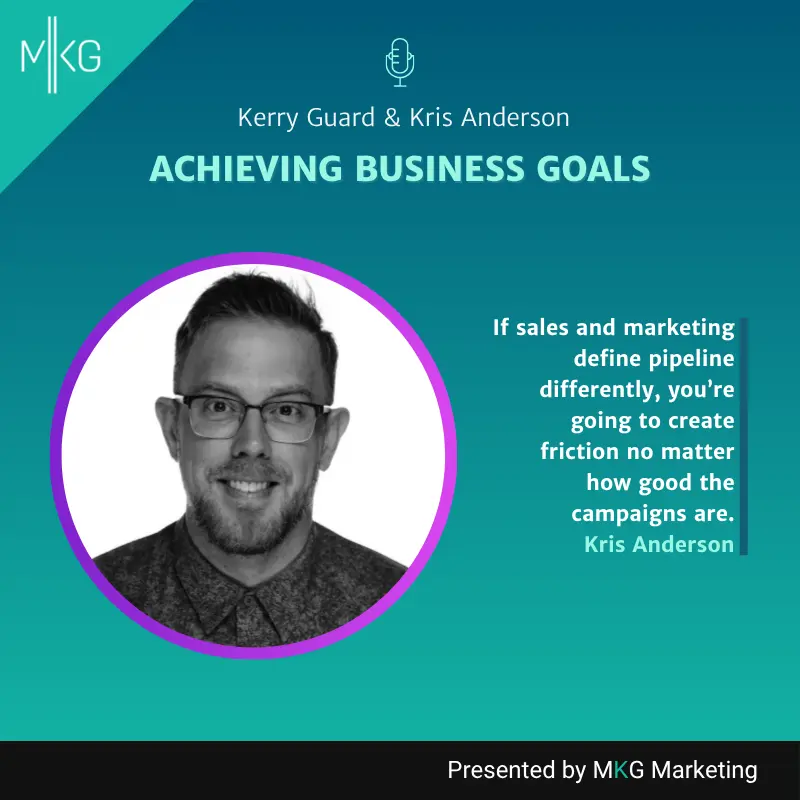
Kris Anderson
Kris Anderson is a strategic marketing leader who drives global pipeline growth through data-driven planning, cross-functional alignment, and scalable demand generation strategies.
Overview
Kris explains that many organizations struggle with the pipeline not because marketing isn’t generating demand, but because teams don’t share a clear definition of what the pipeline actually means. He highlights the shift from chasing lead volume to focusing on quality engagement, and why marketers need tighter alignment with sales, brand, and operations, supported by shared OKRs and better visibility, to turn brand awareness into real downstream demand and meaningful business impact.
Transcript:
Kris Anderson 0:00
Great. Now, now, sales knows that number. Now, marketing knows that number. Now, your analytics teams and ops teams know that number, and you can all develop strategies that are pointing in the same direction. Now, obviously, this is somewhat hyperbole to make a point, but it's the notion that when you've got a clear definition of your pipeline, you have some strong thinking behind it, in terms of how it's computed, and you have a clear understanding across all of the silos and all of the teams within your go-to market. Then you can all work together, because in this example, if I'm going to say, as a marketer, I would go talk to the salesperson on your team and be like, "Okay, great, I have a campaign idea, and based on the channels I've chosen, I think I can get like maybe 10,000 engagements within our ICP, and they're going to say, "Oh, great, what does it look like? What's the campaign? What are the touch points? They're going to be interested in it. That conversation is going to be a whole heck of a lot different if the salesperson doesn't know the number of leads or the number of accounts that marketing is trying to touch in order to keep that pipeline healthy.
Kerry Guard 1:16
Hello, I'm Kerry Guard, and welcome to Tea Time with Tech Marketing Leaders. Welcome back to the show. We are once again live here on LinkedIn, YouTube, and I'm working on Instagram. Sometimes Instagram works, sometimes it doesn't. We're figuring it out. I don't know if I'm figuring it out or if Instagram's figuring it out, but we're all figuring it out. And I look forward to the day that works. In the meantime, back at the show, if you are here with us on any of these platforms, we want to hear from you. That's the beauty of being live, is that it's interactive and engaging, and we get to answer your questions in real time, which I try to do. I really want to make sure that y'all feel like you get to walk away with something to either double down on, or try new, or feel validated in the great work y'all are doing. So we look forward to your questions. Make it happen, make it simple, or just let us know you're here and you're listening. That's cool too. We're here for that. We're here for that today. I have.. I loved this title, y'all. I was like, this is too good to be true, that I get to talk about this thing, pipeline perception, in line with some of the amazing conversations I've been having around supporting sales teams. I know I've made some pretty brunt hot takes around the fact that cold calling is dead, and it is not because you're not doing your jobs or kicking butt and taking names or working your tails off. As sales people, you are definitely doing all those things, but we as marketers need to support you better, and this conversation is going to help us do that, because pipeline is what you all are after, and we're going to help you make it happen, and this conversation is going to pull, just pull the string through, it's going to be beautiful, and I'm excited for it. Kris Anderson's here to help us figure it all out. A little bit about Kris before he tells us his own story in his own words, which I love. Before we get there, Kris has more than 13 years of experience in B2B and tech marketing. He was a director at VMware, leading a team of five direct reports to drive critical strategic initiatives for global demand generation. His mission is to enable VMware's growth and performance by overseeing and executing budget planning. Oh God, budgets, budgets, I could talk about that all day, tracking spend and investment across all marketing functions and regions. He also leads a strategic effort of global demand, identifying and analyzing program and business-level opportunities that drive outsized impact to the business. I mean, that's what it's all about. The end of the day, we're all here to serve the business. I know that's hard to hear, because it's like, but we want lives outside of business. You do, and you deserve it. Yes, and if there isn't a business that is that is making revenue, then you don't have a company to go to, and that's just a hard truth. And Kris is going to help us all find the way through. Kris, welcome to the show.
Kris Anderson 4:37
Yes, thank you for having me. I am so excited to be talking about this, I got to say, when, when we reached out and had this conversation a couple of weeks ago, just getting the chance to talk about how pipeline is perceived across organizations is, as Zoolander would say, it's so hot right now, right, it's the thing that everybody is interested in unpacking, so I can't wait.
Kerry Guard 5:00
We are, we do our best to do the later faces while we do it. It's accurate, exactly.
Kris Anderson 5:04
Yeah.
Kerry Guard 5:05
I agree. It is a hot topic. I had Tara Pollock on my show back in July of last year, where she was talking about marketing owning a revenue number. I feel like this is in line with it, but taking a step further, like how we bring people along, and so I love continuing the conversation, I love different points of view, and it's going to lend, it's going to be so helpful for us, Kris. Before we get there, we're jumping the gun, skipping to the end. Before we get there, your journey is important. I sort of just said some like blurbage around what you do, what matters is why you do it, and how you got there to doing it. So, what's your story?
Kris Anderson 5:45
Absolutely. No, it's.. I've had a very meandering career to this point, and I'm really thankful for all the different twists and turns that led me to this point, because I finally feel like I've landed in a space where I am excited to go to work. I'm excited to work with the people that I get to work with, and that's always going to be more valuable than anything else that you can get out of your career. I began actually in the sports world. I worked as a PR intern for the San Francisco ers for a couple of years and got my feet wet building a sense of urgency, a really high intense environment, and then from there I spent a few years doing some agency work out in the Silicon Valley, working on the early days of social media, so I was a member of the team that helped begin the original HP Twitter account way back in the day, which was a blast, and we had some great clients and some really big strategic thinking, and that eventually led me over to HP corporate, and I got to do some fun stuff there in the brand team with social media across analysis and campaign transcreation globally, and then when I joined VMware in 2018 I began in the field doing campaign work for regulated industry, so government, healthcare, education, and that was a blast. I mean, getting so close to supporting the sellers, learning exactly what made our customers tick, solving challenges together, and then eventually I moved on from the field role into a global demand role, and I am excited to say that I've got a brand new opportunity coming up in a couple of weeks that I could not be more thrilled to begin, and that would be doing a lot of campaign work as well. So, yeah, I'm just really lucky to have gone where I've gone, and I can't wait to get this new thing going.
Kerry Guard 7:56
We're on the edge of our seats, Kris. We can't wait to see where you end up and hear more about it.
Kerry Guard 8:02
Thank you for dangling the carrot. We are, we are here for it.
Kerry Guard 8:07
Let's talk about it. I have a question about your journey in terms of field versus demand. So, can you just help us understand what the differences are between those two things, like what field you were with field versus where you are today?
Kris Anderson 8:22
Yeah, yeah, I think one of the easiest ways to understand field versus demand is perhaps to use an overwrought military analogy, in the sense that when you are in a field marketing role, you're very, very close to the front lines, you are supporting events, you are having conversations with your sellers every day. If you're in the field and you're not talking to your sellers every day, that's an opportunity. Whereas in demand, that's more of like the command and control section, and trying to come up with diverse strategies that can take the business forward, and if both of those organizations are too siloed, then no one's going to go anywhere, and I think the biggest insight that I had transitioning from a field role into a global demand role was just how much communication is lost in the space between groups like that historically, right, and so I feel like without the experience of sitting in the field, my career in demand would have been far less impactful, and I think you know, vice versa, right, folks that I've known who have begun in global roles and then transitioned into the field bring some unique insights to those roles, and I'm a big proponent of taking on numerous and diverse challenges throughout your career. That's my story made on the stream.
Kerry Guard 9:51
I love that, and I'm in total agreement in terms of diversity. If we all live in one area, then it's hard to understand what the other person is feeling. I was a media planner back in the day, even though media planning is what it states itself.
Kris Anderson 10:07
Yes.
Kerry Guard 10:07
But it's really helped me from a data standpoint to really understand the impact of ads in placement and making decisions, because I had to negotiate with every single publisher.
Kris Anderson 10:19
Yes, do that.
Kerry Guard 10:20
That impact is gonna make us. It was a ton of work, and I wanted to make my life easier, because at the end of the day, we, that's what we're all trying to do, is make sure that the work we're doing is both impactful but easy on ourselves, right?
Kris Anderson 10:36
Yes, yes, exactly, exactly.
Kerry Guard 10:39
Let's talk about where you are today, Kris. In terms of, you got some new things happening, very exciting. You're gonna spill the tea on that on LinkedIn, and we're on the edge of our seats. But where.. But in terms of a challenge you're currently facing, or a challenge you know you're going to face, you could.. You could approach us in many ways. It's either a challenge you were facing at your previous role, a challenge you know you're going to face, or where you are in the middle. Like, I hate living in the in between. It's like purgatory for me, but, like.
Kris Anderson 11:15
Yeah.
Kerry Guard 11:15
You know what's hard for you right now.
Kris Anderson 11:17
Yeah, well, I mean, the first one is getting over this cold, that's what's hard for me at the moment. I would love to have that pass, but I will say a lot of the conversations that I've been having with former colleagues, some conversations with new colleagues coming up, are around the notion of how the pipeline is generated and how marketers talk about it, and yeah, it's just this big, you know, big hairy scary problem. Spent a lot of time recently thinking about not what necessarily can create a pipeline. I think that's the easy part, right? We're all marketers; actually, creating the pipeline is not difficult. How do we explain what we've done and make it relevant to the people that we work with, to our stakeholders, to our internal customers? I feel like that is a huge challenge, and those are unplumbed waters. And as marketers, there's an opportunity for us to potentially do a little bit better when it comes to working across the aisle with our sales stakeholders or with our leadership teams and explaining what we do in order to change that perception.
Kerry Guard 12:31
Well, I appreciate the easy segue. You've done my job for me, Kris. Once again, and maybe we should switch roles.
Speaker 2 12:41
Yeah, right.
Kerry Guard 12:43
No, I think this is, I think this is key. I think we're all feeling it, like we are creating a pipeline. What are you talking about? And it's like the perception of what a pipeline is. Before we get there, let's pull way up. Yeah, you said it's very easy to create.
Kris Anderson 13:02
Yes, pipeline.
Kerry Guard 13:03
I don't know that everybody would agree with you.
Kris Anderson 13:05
Yeah.
Kerry Guard 13:07
Feels easy for you.
Kris Anderson 13:09
straight from Hot Take Central. Yeah, I think if you take a group of marketers, talented marketers, and you get them in a room, landing from nothing and just saying, " Hey, give us a strategy and a plan for the coming fiscal year for pipeline generation. How are we going to generate demand by the end of a two or three-day working session? The internal stakeholder who made that request is going to receive a beautiful 35 slide deck that is totally on brand with lots of great illustrations and charts and a clear understanding of the channels in which the business can go to market, so when I say it's easy, I don't necessarily mean the execution of it is easy, I mean getting a general understanding for how we want to go about generating pipeline, that's the stuff that I think is table stakes, right, all marketers have a great ability to think strategically, otherwise they wouldn't be marketers, and that ability grows with time. I think when we look at whether or not it executes, okay, great, we can get into a discussion on performance, but when I say I think the generation of the demand is easy, I'm referring to that notion of we can spin up plans and strategies, and we're really, really good at doing that kind of stuff. That's perhaps why we have a precluded.
Kerry Guard 14:27
We're great at creating pretty presentations. Yes, all day, every day. Yes, we mastered that art for sure. Whether we can make it happen because the market changes, or Google updates its algorithms. Thank you, Google. Helpful, or the buyer decides that they're gonna put that lovely ad blocker on his story, right?
Kris Anderson 14:51
Right. And so I think it's exactly for those reasons that you know we love as marketers, we love to also do that kind of stuff. I think, right, I mean, I enjoy more than anything else getting into a room with people that I enjoy working with and coming up with things that we collectively feel are better than what we could have come up with individually, right? The power of the team, and so I think you know, to continue the point, this this notion of we can build in channels and go to markets and budgets and plans, and then we can run some simple math to come out the end of it, and say, okay, if we are effective in executing this plan, we can generate x number of leads or x coverage within the pipeline, so on and so forth, and when the conversation gets to that point, and then you go take it to an internal stakeholder, whether that's your CRO or, you know, the VP of a region for a particular sales group, the common response is, I, okay, great, but what does that mean? How does that make my life easier?
Kerry Guard 15:52
Yeah.
Kris Anderson 15:52
right. And I think that's the challenge that's really, really scary for a lot of us, you know, we just spent so much time coming up with this great stuff, and then the first question is, okay, great, but what does that all mean? And it's like, you know, the anxiety just ratchets up really, really, really quickly.
Kerry Guard 16:08
It could be more fun, but we don't always know that it means more money, because we don't have control over the pipeline. I think that you touched on so many things there, Kris. In terms of the struggle we're all feeling when it comes to a little laid out for folks in terms of what I'm seeing in what's happening, and then you're going to pile on, or correct me if I'm wrong, in terms of your experience, it's going to be great. There's a shift of the universe in terms of leads drying up, non-existent, hard to find when you do find them, it's a bit more down funnel, which is great. Yes, and to that, but it's harder to, it's continuously getting harder to get on my feet here, continuously harder to see more top of funnel, so when you're talking about that easy math, the math all sounds well and good based off of like historical stuff that's been happening, and we say yeah, $500 cost per lead, no problem, and then you pile in more spend because you're like well, we just need to put in more money here, and then your cost per lead goes up, and you're like, oh, just kidding, I know, I promised like 500 leads, I really need like 200 like.
Kris Anderson 17:30
Exactly, I mean, gosh, I can't tell you how many conversations I have had in the past year that specifically stem from this exact topic, I remember we were having a conversation with the lead of the execution team globally, and we've come to this realization that to a degree the KPIs that we would have focused on in the past only are measuring the amount of spend that we put in, right, so if we were going to come in and say, oh great, well, we're going to generate whatever it is, 1000 MQLs, that's not a reflection of the quality of our campaigns, the quality of our strategy, the quality of our engagements with our customers, that's merely the output number from the amount that we spent on media for a given channel. Okay, great, we're going to go do content indication, and we're going to spend x number of dollars, and that's going to get us y number of leads. Well, yeah, that is the fallacy that a lot of us have relied on in the past. And I think you spoke to it very well when you said we're going through a shift. That strategy, maybe six or seven years ago, was great because we needed volume, you needed volume to convert, and you were looking at a waterfall heuristic where if you had x at the beginning of the waterfall, then that meant you would get y coming out of the bottom, and that was your demand. Now we can't get away with that anymore. There are too many channels, there's too much noise competing for the attention within our prospect base, and so quality, the focus on quality, I think, is one of the big drivers for how we can shift this notion of how our internal customers perceive the pipeline. It's not just a raw number of leads or a single dollar value attached to your ACV. It is not just the amount that you're spending; it is the quality of the leads that you are getting into the funnel.
Kerry Guard 19:21
Oh my gosh, mic drop right there. I think we.. I want to sit with that for a second, because the quality we all ultimately want to get to is quality. Quality is what matters, but I feel like in using the old method of lead generation, we're burning leads and bridges faster than we can build quality, because the people who may have considered us the way that we're marketing to them don't work for them anymore.
Kris Anderson 19:50
Absolutely.
Kerry Guard 19:51
Let's talk about what pipeline means to you. I feel like everybody has sort of a little bit of a different, a different definition. Regarding opportunities and pipeline, so is that just like SQL, who are having sales conversations, and then you can sort of like attribute some sort of revenue to them. What does pipeline mean to you?
Kris Anderson 20:16
I'm going to be horrible in this answer, so I'm going to apologize. Pipeline should be the way that a team defines pipeline, should be dependent on the business, and I think that's where we make a lot of mistakes. We're going to hear, well, pipeline for a large enterprise, you know, Fortune 50 company is going to be just straight leads, right, leads by solution, right. And say, okay, great. Well, if I'm going to get leads for a given solution, I need to invest a certain number of dollars in my campaigns, in my go-to market, in order to get coverage to make up for whatever my conversion rate is, right? Lead to an opportunity that may work for that kind of business, but that's not going to work for you, you know, a company that's got $500,000 in annual revenue. It's just that we can't define it similarly. I think the right way to approach this is that every business should have a very clear definition of pipeline and the KPIs within that definition that all your GTM should be marching behind, right? So we need to make a bespoke pipeline for the thing that we're selling and to the audience we're selling to, and that's how we should do it. I'll say from past experience, we had a far too simple definition of pipeline, which was an attribution of marketing influence, right? While we had to hit a certain dollar amount, I think that can work in some cases. I certainly think that it requires some caveats and definition, and some quality discussion. I've also been a part of teams that looked and said, " You know, we're going to build a pipeline to cover our average deal size, and we're going to compare the average deal size to the sales targets in the field. You multiply those two things together, and you're going to get a pipeline number. Okay, great. So, marketing needs to engage with all of that potential revenue, so it's not necessarily a $1 value, something that's attributable, attributable to $1 value, but it is the number of engagements within prospect accounts that are already in some sort of opportunity flow, right? So you can define pipeline, as you can see, in a multitude of ways, but the way that makes the most sense is the way that everybody in your GTM can understand and have a conversation about, and then make decisions, right? If nobody understands how your pipeline is defined, that's the first thing to fix.
Kerry Guard 22:51
Yeah, and I think it comes back to, I love what you're saying, it really depends on the company. As a business owner, the first day I look at is straight up profit, yeah. Right, revenue minus expenses, profit, and that profit over expenses gives me a percentage to know I roughly want to be within this tier to say that I'm doing well, right, so if everyone knows what that profit to then revenue number is, and how you all get after that. I don't know that there's enough. You tell me, Kris, is there enough transparency in knowing, like, what your company's revenue is after the number is?
Kris Anderson 23:36
I think so. I mean, I think you would want to maybe build on that a little bit. I think it's a lovely example to unpack, because it can test the theory. In this case, I would ask, begin asking questions of, say, okay, how many customers would you need in order to hit that profit number? Okay, great, so you have your number of customers, and you can begin doing some back-of-the-napkin math, and begin starting to think through, okay, so maybe you need x number of customers at a y average contract value, right? Okay, if you multiply those two things together in order to hit your profit number, that's going to give you two pieces of information. It's going to give you a quality number, right? So, your average contract value has to be above a certain level, and it's going to give you a quantity number. Okay, so how many people do I need to actually get to that point? Then you can go to a marketing team, and you can say, " Okay, if we convert.
Kerry Guard 24:29
Marketing or sales?
Kris Anderson 24:31
I think that's a good question. So, at this size, are those teams different?
Kerry Guard 24:36
Oh, good question. Yeah.
Kris Anderson 24:38
Right. Because at the small business size, everybody is selling to a degree, right? So you can come back to your.. and I think you.. I think you are correct, so I don't want to gloss past it, but go back to your sales teams, and you're going to say, okay, you know, in order to hit the number of customers that we need to get to this profit number, in order to have an average customer value to get to this profit number. If we convert at 10%, that means that we need to have 1500 quality accounts this year, right? That's the goal. Okay. Great. So, your pipeline, in order to cover 1500 quality accounts at a 10% engagement rate, then you do the math back up again. Okay, great. So, we need to have at least 20,000 leads, or 20,000 accounts in the pipeline, right?
Kerry Guard 25:22
Yeah.
Kris Anderson 25:23
Okay. Great. Now, now, sales knows that number. Now, marketing knows that number. Now, your analytics teams and ops teams know that number, and you can all develop strategies that are pointing in the same direction. Now, obviously, this is somewhat hyperbole to make a point, but it's the notion that when you've got a clear definition of your pipeline, you have some strong thinking behind it in terms of how it's computed, and you have a clear understanding across all of the silos and all of the teams within your go-to market. Then you can all work together, because in this example, if I'm going to say, as a marketer, I would go talk to the salesperson on your team and be like, okay, great, I have a campaign idea, and based on the channels I've chosen, I think I can get like maybe 10,000 engagements within our ICP, and they're going to say, oh great, what, what does it look like, what's the campaign, what are the touch points, they're going to be interested in it, that conversation is going to be a whole heck of a lot different if the salesperson doesn't know the number of leads or the number of accounts that marketing is trying to touch in order to keep that pipeline healthy, right. So, let's say in this example, if sales have no understanding of the way we are computing pipeline, they're going to come back and say, look, my commission depends on whether or not I get a certain number of closures in this month, so your engagements aren't helping me. It's like, okay, so that statement is not a reflection of a bad go-to market or a bad pipeline or an unhealthy pipeline. That statement is one where the teams within the go-to market org are not perhaps on the same plane, right? Yeah, exactly, exactly.
Kerry Guard 27:07
No, I think that's really key. I had a wonderful... so I host a monthly gathering of folks who've been on the show. We have a little VIP group, which I look forward to introducing you to, Kris.
Kris Anderson 27:20
Very cool.
Kerry Guard 27:21
Where we just had this conversation, what they're calling ABX, so not tying it to marketing, but thinking about the full account experience as it relates to both sales and marketing pipeline being the ultimate driver. We all know we need to make money, like that's just what needs to happen in the day, but one thing that came up was this idea of sales and marketing alignment, and the struggle of shifting to this more intentional realm of these intentional conversations, and somebody said, Who's a sales guy who I appreciate to the nth degree, where he said sales is going to sell based off of what they were told to sell.
Kris Anderson 28:04
Absolutely.
Kerry Guard 28:05
Right. So, if you're a marketer trying to come in and say, okay, here's our pipeline, and we're gonna go after these 30 accounts, and like, you got this, if we're pumping them up and making them feel free about the end of the day, is 30 accounts going to make their quota right?
Kris Anderson 28:18
Absolutely, I mean, that's exactly the kind of conversation that I think we miss out on, particularly as you scale up in size of the business, right? So, in your smaller businesses, if there's 100 total headcount in the company, theoretically you can close those gaps and you can move really quickly, but if you have a 30,000 person company and it's globally distributed across 250 offices with a mostly remote workhorse that is an immense challenge, and such a huge component of professionalism is entering into every single conversation with an open mind and with empathy, and when a salesperson would come in and say, look, I appreciate what you guys are doing, but this isn't going to help me hit my quota. Okay, great. But, like, if I heard that statement, then my first thought is this is no longer a conversation about how marketing can help you. This is where I need to listen. Okay, great. So, how are you making your quota, because I may not understand it? What is your number? How do you hit that number? Is that number the same for every rep in your team? Do you have a higher quota because you're carrying more tier one accounts, or what have you? Right, so building in that level of understanding and trust is going to lead to an opportunity at the end of that conversation for the marketer to go, okay, great, I understand. In order to help you hit your quota, we have to do a handful of things. We haven't defined our pipeline goals really well across the organization. Let me go talk to my leader, and maybe we can establish a shared OKR between our teams that brings us together, right? Maybe sales and marketing should share an OKR that isn't just generating more pipeline, you. Grow the pipeline by 12%, right? Those are tough, those are bulls. That's what the business needs to succeed. And OKR is going to unify your go-to-market teams in order to do that, right? Like that's the result of all of the work. The OKR is going to help shape how people get there.
Kerry Guard 30:16
It's a step, it's a step in the right direction.
Speaker 1 30:19
Yeah.
Kerry Guard 30:19
It sounds very iterative, too, which is tricky.
Kris Anderson 30:22
Yes, yeah.
Kerry Guard 30:23
Because like things need space and time to actually work, but you also need to make quick decisions. So, how do you manage being able to know what your pipeline is, and then finding those OKRs? You do OKRs on a quarterly basis or a monthly basis? How do you get after those?
Kris Anderson 30:38
Yes, I am a big, big fan of OKRs being so big that you worry that you're not going to achieve them. I mean, that's effectively why they were created, but if they are to be that big, they must have space to breathe, and I think that means yearly OKRs. You check on how you're tracking, but you know, you check on them at whatever intervals you prefer as a team, or as a business, or as a leader, quarterly, monthly, what have you, but you shouldn't be setting such a big goal within an OKR that you think you can achieve it within six months. I think that's too small. So, for instance, we can say leadership is going to get together, the CRO, your STP of sales, EDP of sales, your CMO, they're all going to get together and they're going to establish the objective, the O, within the OKR, and you're going to say, okay, within 12 months we will engage 80% of our ICP and convert them from a level zero opportunity to a level three opportunity, right. So, something that's just like, how are you going to take within a very short time period someone that's showing no interest in your business at all, and then getting them to mature into a high level of interest, right? Okay, great.
Kerry Guard 31:55
Yeah.
Kris Anderson 31:56
Now everybody is aligned on that fact. Okay. So, what are the key results? Well, for marketing, the key results to hit that are going to be, you know, all campaigns designed for this ICP are going to have high-quality engagements, they're going to leverage intent data, they're going to do, you know, all of the advanced things that we love to discuss in those planning meetings, but for sales that may mean, okay, well, we actually, we need to adjust how quotas are calculated, what does it comp like, comp doesn't line up with the goal that the leadership has set here, right? So we get into all these little nitty gritty areas where when there's no alignment or the alignment isn't super tight, sales is going to come back and say, like, look, this isn't going to, like, engagements are pretty, but that's not going to help me close the deal, right? He's like, okay, this is something broken way up the chain.
Kerry Guard 32:44
Yeah, no, I think that's tough conversations to have, and I'm not sure we're all brave enough to have them.
Kris Anderson 32:51
Yeah, very true.
Kerry Guard 32:53
But having stakes in the ground to say we're all rowing in this direction towards this ultimate pipeline goal, and then using OKRs sheds light on the core issues of why this is so damn hard
Kris Anderson 33:11
Yes, yeah, and I think it speaks, you know, again to this notion of like the perception of your pipeline sales may have a different perception of it than brand, brand may not have, may have a very limited perception of it, which would, you know, be unfortunate. PR, AR, those groups contribute heavily to the pipeline; there's just no attribution, so they can't point to and be like, " Oh, well, you know.
Kerry Guard 33:37
I did that.
Kris Anderson 33:37
Our, yeah, exactly, and so that's why it's so important to, as you begin this journey of annual planning for those that are at the beginning of their fiscal years, like how does leadership and other teams perceive the pipeline? How do they think it helps them? How do they think it doesn't have enough coverage for them? How do they think it's defined right? Start having those conversations as soon as possible, because if you're having them at the end of a campaign, or even as a campaign has just gone into flight, it might not be enough time to make adjustments, or to shift those perceptions, or to have those difficult conversations.
Kerry Guard 34:17
I would argue that once a campaign's in flight, it's already too late, especially with the way some channels are different, like LinkedIn, you can generally pour in more, and they're happy to spend your money all day, every day, but Google, every time you make a change, no matter how small or big, they go into a learning phase, and then you're looking at weeks to recoup those benefits, so understanding what those campaigns are going to be, ideally months ahead. I know that's a tall order, I get it, but like having sort of a to your point, what's that pipeline that we need to go after? What are the campaigns that worked in the past? What are those evergreen campaigns? You're always gonna have trial running, you're always gonna have demo running, you're always gonna have whatever demo. On the bottom of the funnel, call to action, running against your brand, and then what are those educational campaigns that are going to bring people along and help them understand that you're the answer to their problems, is hard to do ahead of time, but also gonna be like, you need to do it ahead of time.
Kris Anderson 35:19
I think, I mean, again, you said it beautifully. Even when you talk about those campaigns, there are brand campaigns, or awareness campaigns, there are messaging campaigns, solution campaigns - all of those things are right at the top of the funnel, right? Just because you can't attribute a demand dollar to a top-of-funnel campaign does not mean that that top-of-funnel campaign didn't support the pipeline, and I think.
Kerry Guard 35:45
Just go turn it off and see what happens.
Kris Anderson 35:47
Exactly.
Kerry Guard 35:48
Right, I like it when it's dairy, but I also don't want to, like, dare you, right.
Kris Anderson 35:50
Well, and so I don't know if you've seen this, but lately there's this, there's this movement. I've talked a little bit about it, and I'm certainly I didn't come up with it, but I think it resonated really well with me, and it's this 95 five heuristic, which says, and the numbers can effectively be different, but 95% of your buyers are not in market at the moment your campaign is, and that has just wild implications, the more you unpack it, particularly for pipeline, but also for brand, and it explains very, very clearly how you know your brand team, your communications team, your exec comms team, all of these other teams that don't have demand dollars attributed to their KPIs, they all work on the 95% right, and so by the time someone goes from being in the 95% cohort, where they're not in market, when that buyer goes in market, the moment that they get approval to start looking at vendors, and they become one of the 5% they already have a general sense for the number of vendors they're looking at, they're bringing with them some preconceived notions about each of those different vendors, they're bringing with them some general buyer's knowledge about what those vendors offer, maybe what the pros and cons are. So, if you're telling me, as you know, a leader, that well, brand doesn't do demand, they've been doing all of that work on that 95% before the buyer went into market to ensure that that was a warmed, like, even to make the final cut of the vendor list by the time they go to market, like that is a huge insight.
Kerry Guard 37:24
The easiest way to see it, I want you all to open up your own Google Search Console domains right now, and I want you to look at the search volume and the click volume that has come to your site, and I guarantee that most of it is brand terms, it'll be attached to a product or wanting to know of a thing or solution to solve, but your brand term will be in there. I, the data shows it, and I'm totally in agreement, Kris, that there.. I feel like we all abandoned the brand. We sort of swung right, we were like brand, brand, brand, brand, brand, they were like no solution, solution, solution, and now like.
Kris Anderson 38:09
We over-rotated.
Kerry Guard 38:10
We did, we did, and now we need to bring these things together around your brand and the solution it solves, right, the solution it creates, and that's where, like, the rubber is going to meet the road, and the magic is going to happen, especially with this new Google algorithm update.
Kris Anderson 38:26
Which, I know it, I know, but I think here's, here's where we can get, here's where it gets really cool, and where, if you'll forgive me, we can get tactical.
Kerry Guard 38:35
Yes.
Kris Anderson 38:36
In this example, where our audience is going in and looking at the terms that bring traffic to their site, a demand team that has a really good relationship with the brand team is going to feed the demand team, which feeds into the brand team. Hey, here are the solutions that are impacting our close one rates. Right, people are buying this one solution hand over fist when they go into the market. Can you integrate or build some messaging that can precede some of this solution purchase mechanism, so that could be problem statements, it could be a competitive attack, whatever the case may be, right? And the demand team can go in and see, okay, who did the brand team target? Right, it can take those same brand terms and run them through an intent engine. Yes, then you go in, and you take all of the first-party cookies again. Thanks, Google. You take all of the first-party cookies that have hit your site as a result of this brand campaign.
Kris Anderson 39:38
You find out where those cookies navigated, and you build custom segments to then retarget with demand messaging that can then build in a buyer journey, so now you've built the bridge from brand to demand just using data, and that's why what I said, you know, harking back to the beginning, when I said like, actually. Executing on the demand is the easy part. I could go take a budget, find content syndication, or find SEO, or find a channel - doesn't matter - and just go spend it. Or I could try to have higher quality engagements by making sure I'm working with all of the other teams that are in the go-to market, understand how we bring those together and use data to tell the story, because if I'm retargeting the pre-engaged, pre-warmed cookies that the brand team has already driven success with, and I'm creating new audience segments that are not just static data pieces, but are living, and they can be supplemented with intent data, and then retarget them with the demand messaging, like that is a very, very powerful approach to increasing high-quality engagements. Now, I'm not going to be able to go back and say I generated 2 million leads, but it's like I don't want 2 million leads, I want 10 really good ones, exactly in market, right?
Kerry Guard 40:54
That 5% 10 in market, ready to rip and roar and go, which is what the sales dream is, of making my life easier, that I don't have to warm these folks up, and they're ready to go. I think this is such an important one of the things that you said that's sticking with me, that I don't know that I've ever pulled apart so intentionally and thoughtfully, but I see it now, I cannot see, of we actually did this with our client Extra Hop, where they actually pulled apart their demand budget, which was more funnel-based. I don't even say funnel was more customer journey faced, of like to your point, ABM segmentation, retargeting branded keywords, product-led stuff, right over here, and then brand, where we did branded keywords, display banner ads that were agnostic of product direct site buys. Right, I know anomaly, direct site buys, ah, but like when you pull those two things apart, and you can just give them different OKRs, see what did there, yep.
Kerry Guard 42:04
Then one can support the other without needing to be responsible.
Kris Anderson 42:11
yes.
Kerry Guard 42:12
For the other, I think what you're saying.
Kris Anderson 42:15
Yes, and I think that that does a great job of explaining, like marketing should own a number, but attribution shouldn't get in the way, and so if you haven't gotten full alignment of attribution across all of these different teams yet, I don't think it's necessarily fair for one team to be responsible for it. However, every single employee at the company should feel somewhat connected to driving better outcomes for the business, driving higher profit, driving better revenue, right? Like, how do we build that level of intrinsic motivation? You don't ostracize teams because you can't measure them, right? And I think in the example you just gave, like the brand team, the demand team, the field team, the ops teams, everybody knows that we are helping drive a better number. Sales feels like they're getting better engaged leads, like that's where everybody can pull support together, and we all feel like we're owning the total number, not just well, sales has to hit a quota, so let's like just throw leads over the fence and cross our fingers, you know. I know I had a guy one time, he did an event, and it was within a regulated industry, and so within regulated industries historically you're not going to get high volumes of leads, and we scage scanned a bunch of badges after our event, and he was like, "Okay, great, I have a bunch of stuff to follow through, and then he's like came back to us the week later, he's like, "Why do I have 6500 leads to follow up with? Like, the total event attendance was like 2000 people, like there's no way we can do that many leads. I can't, like, he was like freaking out. It turns out the Excel ran a macro and tripled the size of the list, and so at first his first reaction was like, "Oh man, I have so many leads, I'm totally gonna hit my number, and then he realized, like, oh, like, volume of leads doesn't matter, give me 10 good conversations instead of 100 random ones, and I'd be much happier.
Kerry Guard 44:09
Yeah, it is coming back to the quality over quantity, and the more we can support sales and give them those really intentional conversations, the better they can do their job. That is the shift that's happened in the universe. Kris is saying it. I have a wonderful podcast last week with Larry Long, who was saying it, Tara Pollock, who we mentioned, is saying it like it's no longer sales responsibility to like pull it over the line, and we need to support them, and it's not necessarily a one to one ratio of who is responsible for what, we're all responsible at the end of day, we all need our own OKRs to know how we're going to hit that. Kris, this conversation has been so eye-opening. What's your last piece of advice for people who are trying to create this perception internally and build better relationships internally? Like, what's the one we all have? Is terrible, but like the thing you wish you knew when you were trying to initially create this. What do you wish you.. what do you wish you knew?
Kris Anderson 45:10
I love that framing. I wish I knew before going down this journey. I wish I knew that no one really knows how pipeline is actually created in your company, like we objectively we can come up with data points, and we can try to define it, we can reverse engineer it, but if you go into this with an open mind and you say, like, it's okay to not really know the answer and to know that you can work with your team to uncover a good proximity or get closer to it, that's how those relationships are built, right. So it's okay to not know how your pipeline is generated, in so far as you're eager to understand it and eager to cross that line, because once you start the journey, then it becomes a lot less intimidating, and your anxiety goes down when sales says, " Well, what does this do for me? You know, and you can build a lot more high-quality relationships that way.
Kerry Guard 46:08
I've seen that rainbow from W H Y, like, a million years. I think it's true. I think the more you understand how business works, in terms of building revenue and pipe, and then backing that into the pipeline. There's a numbers game to a certain extent, but then getting into the weeds and the nitty gritty with each of your team members, from a sales, from a different department, you've got sales, you've got marketing, do you have demand, you've got customer service. Once you understand how all of these contribute to pipeline, and you can start to see the numbers sort of unfold, you can start to back into some math and give you some direction, and the key here that Kris has built an underlying for us all is the iteration piece, the conversion rate piece of how, when you start to unpack those conversations and understand how these work together, your conversion rates will get better, and I know the forest is for the trees, and the proof is in the pudding, but I believe in you all.
Kris Anderson 47:09
Yes, very much.
Kerry Guard 47:11
Kris, where can people find you? They want to learn more about this, they want to pay attention, they want to see where you're going next. We're on the edge of repeats.
Kris Anderson 47:18
I mean, on LinkedIn, linkedin.com/in/anderson Kris. Kris
Kerry Guard 47:23
Anderson Kris. We will put that in the notes. You can also, if you're on LinkedIn, you can just click on his profile and go follow and DM and all of the things. Kris, you are more than a marketer. You're more than a marketer. You've built this wonderful career for yourself. We're excited to see where you go next. But what are you most looking forward to? We're about to head into Q, we're days away. Yes, I know everyone, it's like this beautiful, scary thing. But what are you most looking forward to in the next nine months now that COVID sort of like petered out, spring is coming in, like what are you excited about?
Kris Anderson 47:59
Well, obviously, with the new opportunity coming, I am most, most excited about building some new relationships and beginning a new journey. This has been a very interesting experience to date, and I think that getting the chance to continue it with some really great people is a rare opportunity, so I'm just excited to get going.
Kerry Guard 48:24
And they can't wait to meet you. I know it, I just know it. And if they.. I hope they've all listened to the show, because I would be excited to work with you, Kris. I would be excited to work with you. Thank you so much for joining me. If you liked this episode, please like, subscribe, and share. This episode is brought to you by MKG Marketing, the digital marketing agency that helps cybersecurity and complex brands get found via SEO and digital ads. Companies like Extra Hop, where we help them go from to $900 million and get bought out by Bain, they're here for you. I'm your host, Kerry Guard, CEO and co-founder of MKG Marketing. If you'd like to be a guest like Kris here, I'd love to have you. As I mentioned, there is a VIP group, so if you want to join that over there, we'd love to have you there too. But you got to be a guest first, so DM me, let's hang out, let's have you on the show, Kris. Thank you again, so great.
Kris Anderson 49:16
Thank you, guys, I appreciate



 (7).png)