Moni Oloyede
Moni Oloyede helps businesses build trust-driven marketing systems that turn genuine customer understanding into sustainable word-of-mouth growth.
Overview
Moni explains why businesses often jump straight into websites, content, and lead generation before doing the deeper work of understanding their audience, market, and messaging. She shares how strong marketing is built on consumer psychology, emotional outcomes, and genuine customer understanding—not just tactics and funnels. The conversation also explores word-of-mouth marketing, the power of market research, and why founders who slow down to build the right foundation ultimately create more sustainable growth.
Transcript:
Moni Oloyede 0:00
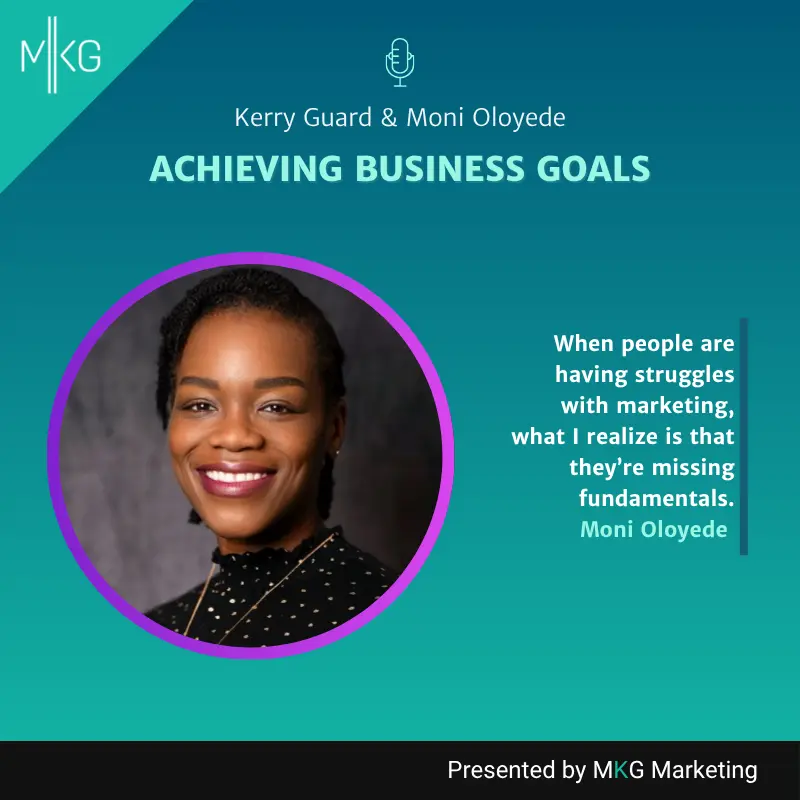
When people are having struggles with marketing, what I realize is that they're missing fundamentals. They really don't understand their audience, they really don't understand their market, they really don't have a good message, and they think they do, but they really don't. They haven't done that sort of deep-level layer work to really make those things work for them. So now I'll focus on helping small businesses in those areas, so they can start building the right foundation and grow and scale their marketing without having to stress and get off the hamster wheel chasing these.
Kerry Guard 0:37
And we're live. Welcome back to the show. This is Back on Track. I'm Kerry Guard, your host and CEO of MKG Marketing, the digital marketing agency that helps B2B tech and cybersecurity teams turn visibility into pipeline. We're here to get you back to the beginning and in the right order. Back on track, that's what the show is called. And today, my guest knows the messy middle of getting back on track. She's going to walk us through it. I'm so happy to introduce Mani Oloidy, founder of Mo Martech and former director of marketing infrastructure. Mani left the corporate machine because she didn't love how it treats marketing, that dollar in, dollar 20 out mentality, and she now helps small businesses build marketing from the ground up, the fundamentals first, the hard work first, and her not-so-secret weapon is the oldest, most durable channel there is, word of mouth. Monty, welcome to the show. So good to have you.
Moni Oloyede 1:32
Hey Kerry, thank you so much for having me. I'm so excited to be here.
Kerry Guard 1:36
So excited for the show. I was priming a little early because I was like, for my own sanity, I need to figure this out. I was just telling Monty that, you know, for MKG marketing, we've been around for over 15 years, and in the beginning it was very much about networking, and it was wow, wow, west of whatever we sold in, we figured out, and now that we really know what we're doing, getting back to figuring out that network effect is real, and so I am personally very excited for the show.
Kerry Guard 2:04
Why don't you tell folks, before we get into it a bit, a little bit about Mo Martech and the two lanes you work in, and, you know, what got you here?
Moni Oloyede 2:12
Yeah, sure, thanks for asking. So next year, 2027, will be 20 years in marketing. It's the only profession, professional profession I've ever had, right, historical McDonald's, but that's not a good nor there. But I spent the first half of my career in operations and on the tech side, and really focused in on digital marketing processes and lead funnels and all that sorts of things, and I got let go from my corporate job in 2023, and I decided to focus on what I call marketing fundamentals. When people are having struggles with marketing, what I realize is that they're missing fundamentals. They really don't understand their audience, they really don't understand their market, they really don't have a good message, and they think they do, but they really don't. They haven't done that sort of deep-level layer work to really make those things work for them, so now I'll focus on helping small businesses in those areas, so they can start building the right foundation and grow and scale their marketing without having to stress and get off the hamster wheel. Chasing these.
Kerry Guard 3:13
We all went off that hamster wheel. This is so key. I've been beating this drum for a while now, because, especially with the way search has changed and how customers are searching, having your positioning and messaging dialed in, so that it's consistent, not just on your website, but everywhere, and also aligned to how your customers are talking about you, is no longer optional. So, thank you for getting out there and helping founders do this work early, really is humanly possible. When do you normally start with founders? You said you start with them early. Is that like, you know, when's that sort of rubber meets the road moment where they're like, I need help, and they call you?
Moni Oloyede 3:56
My sweet spot is like, I call it zero to three years, so even when you're like thinking about it, and the ideation stage, you have a lot of business owners who are switching from their corporate business or their government job and trying to move into maybe doing their own thing. I'll help you there, and what I get you to is what I call pre-seed. So, if you're looking for investment or funding or money in any sort of way, you're looking for angel investing, you're looking for grants, you're looking for loans, any type of funding for your business before you get there, that's sort of the sweet spot in which I work with, because if anyone's going to give you money, they want to understand how they're going to get that money back, and solid as your market and market understanding can be is the better position for you to be able to get that sort of money.
Kerry Guard 4:36
As a truly unique skill, I'm not going to lie, I worked with a startup who had already gotten their first round of funding, but they needed to go look for more, and it was definitely a muscle where I was like, I might be in over my head for this, because it's, it's not, it's about, I always say this to my, to my 10 year old daughter, you know, read the room like who you're talking to, and so it is the. That right, with you're not talking to the end user who's going to buy your product, you are talking to investors, and that's a very different, very different audience in terms of how you sell in that messaging. So, yes, to having an expert help you do that. You've said corporate marketing is too transactional, that dollar in, dollar 20 out mentality, what does that get wrong, and what does it cost a business in the long run?
Moni Oloyede 5:26
You know, there are kind of two phases. This is their marketing point of view, and then there is the executive point of view on that. You have to understand both in order to sort of tackle this correctly. The marketing, what happens from a marketing point of view when you have $1 in, dollar 20 out mentality is that you become very myopic, right? Anything that leads to revenue is good, so you just throw stuff at a wall. All you do is get leads, and then they're going to magically fall down this funnel and raise their hand, and then end up being a pipeline revenue, and that never really works. You never do the fundamentals that we talk about, like, let's home this message. What are they really asking for here? The problem is really what is coming out as X, but underneath it, there's some sort of emotional, you know, corporate, you know, structural issue that they're really kind of dealing with here. You never get to those sorts of things because you're just doing campaigns and trying to get leads and trying to qualify them and turn them in kills, or however that turns out for your business, right? The executive, or the leadership version of that, is what the reason why they're focusing on dollar in, dollar 20 out, is they need to justify the spend, right? That's all they're trying to do. If I give you money, what am I getting out of it? We fall into the trap of the only way I can do that is to tie this to revenue. That's the trap. It's like they're really just trying to tie this to business outcomes, and what is that that's going to be different for every business, right? It could be more subscriptions, it could be penetrating this market, it could be this percentage of growth. Right, how is the campaign, the webinar, the thing tying to the business outcome? That's the question that they're trying to answer. We fall into this funnel trap every single time. We can't get out of it.
Kerry Guard 7:12
Every time. I just had a client ask me, what would happen if I doubled our ad budget, and I said nothing good.
Moni Oloyede 7:18
Yeah, you spend more money, that's about that.
Kerry Guard 7:24
The more money you spend, the more your CAC will go through the roof, and we will have nothing to show for it. So I highly do not recommend it. What talk to me about why this is important to you? And then he ended the conversation there. I wonder why?
Moni Oloyede 7:37
That's legit. I asked the same thing, I have, I cannot tell you how many business owners that say, you know, my goal is to have, you know, 10,000 followers on YouTube, or like, you know, x amount of followers or x amount of likes on whatever social media platform. I'm like, why, what does that mean, right? And that's the, that's, that's the marketing we actually have to do. That's a good marketer. Like, what are you really trying to get to here? What does that mean to you? I had a conversation with a physical therapist recently, trying to help her with her marketing, and she was doing consultative work for a soccer team, but not really getting the result, not really getting clients out of it, right? She was like, " It's a waste of time. We went through it, and all she really wanted was not to feel like she was being used, right? Well, it's then like, well, then let's think about, can you get testimonials from them? Can you get social media content from them? Can you get some sort of, you know, like reviews from them? Like, how do you make this valuable for you? That's the conversation. So, instead of trying to chase down ways so she can get paid when these people don't have money, we just found out ways to make it valuable for her. That's a different approach.
Kerry Guard 8:45
Totally different. Sometimes getting to the... we're almost therapists a little bit for our founders as we get to some root issues here. So, I, I, I love that it was an emotional root issue for her, of like wanting to feel not like just a cog in whatever wheel she was in, but to actually.
Moni Oloyede 9:04
Exactly!
Kerry Guard 9:05
Be valued, so important.
Moni Oloyede 9:09
Just not someone feels taken advantage of, right? Am I being just used here? Okay.
Kerry Guard 9:14
I love that. Speaking of emotion, you sort of mentioned this when you were talking earlier about emotion and messaging, I just saw a post on LinkedIn, actually was today or yesterday, about how you know, as B2B marketers, we need to be, you know, sort of looking over at B2C and what they've been doing in terms of their messaging and making it a more emotional, because we are emotional buyers at the end of the day. Do you agree with this? Do you think there's a happy medium? What is your take on emotion in B messaging?
Moni Oloyede 9:46
I agree with it 100%. It's just gonna look different, but the sentiment is absolutely true. We buy based on emotion justified with logic; that's a fact. These are emotional plays, right, and the. But the emotional in B to B isn't reactionary like it is in B to C, that's the difference, right? It's much more of internal politics and not wanting to look bad and wanting to protect your territory, and those sorts of emotional pulls, but yeah, the emotion is 1,000%. I wish B-to-B would focus more on that. I've been trying, Kerry, so hard, and you're dealing with multiple people, that's also the case, right? You're maybe dealing with someone who is the influencer or the practitioner, or the, and then you, the, you know, head of the department, and actually the C-level, whoever. So, right, there are different emotions there and different things that stay there for sure, so it's a little bit more complex, but again, the emotions are the same when you boil them down.
Kerry Guard 10:50
Is it in terms of like I think the post was talking more about stop talking about features, yes, and so it's more about are the outcomes? Is it like you saw it looks different in B to C, see it like it, buy it right. You're right, it's more complicated in B2B. So, when you, when, how do you, how do we show up emotionally in that way?
Moni Oloyede 11:14
Yes, 1,000% Yes, I, that's a phenomenal question, and it is outcomes, but it's the emotional outcome. So, if they reach the attainable goal, right, if they use your solution and can solve the problem, what does that mean for them in their role? What does that mean for them emotionally? What does that mean for what they can become, do accomplish, right? What is the outcome from the individual's level, and it has to do a lot around in a bb conception about perception, right? There's a lot of in bb, it's we are, it's very risk-averse, right? I'm trying to protect territory, I'm trying not to lose my job, I'm not trying to get yelled at. I don't want to be the spotlight on me. You're trying to protect something in some way, so exactly. So, if you can do that, what does that look like? If I had your solution, that's what you need to focus on from a B2B perspective. I totally agree. Stop focusing on features and functionality; no one cares, and everyone's doing something similar at a base level anyway.
Kerry Guard 12:25
So, well, that was going to be my next question. Actually, how do you not sound like everybody else? Because even if you're talking about the outcomes, all of our customers, you know, if we're in marketing and marketing to marketers, which is probably one of the hardest jobs on the face of the planet, because we all know the ins and outs, right? We're all looking for similar things in terms of those outcomes. I just need the pipeline to happen. I need to not babysit you. I need, I need these things to get off my plate, right? So, everybody's sort of saying those things.
Moni Oloyede 12:55
exactly right. So, like, what's my.. The exercise that I take my clients through is what does that look like, so you'll hear a lot about, like, productivity, or you know, success. What does that look like? If you say productivity, you mean what? Great, because that's going to look different for the role, per organization. It's very similar to the exercise I went through with the physical therapist, right? It's coming out like this, but what you really want is to be valued, so even like you're, if you're marketing to marketers and you're marketing an attribution platform, yes, you want to be able to tie things to revenue and be able to show your worth and your value to the organization, but underneath of that is a feeling of I'm doing a lot of things and they keep asking me, what is happening. I need to be able to show them what's going on underneath that is a frustration of I'm doing things, and no one's seeing me, I'm not being seen, which means I'm not being valued. I want to be valued. Same, it's the same conversation. Right, here's how you then become valued and be seen as a rock star in your marketing organization, what? How much more powerful a message would that be, other than, hey, you can tie your webinar campaign attribution, and here's the funnel, little, here's what it looks like.
Kerry Guard 14:12
That's what a pipeline is. Pipeline is table stakes; we all have to deliver. Yeah. Oh my gosh, I love that so much. I think being valued, I think, is in your job, is definitely, I don't say half the battle is probably like the whole thing wanting to be, as my coach calls it, seen, heard, known, and accepted, that's all we want as humans. It's not too much to ask for.
Moni Oloyede 14:35
Exactly. And that's across all the B roles, right? That's what I mean, the emotion is the same, you think your CEO doesn't want to be valued, seen, and accepted. He's got a board and a private equity firm breathing down his neck all the time. Same thing, we're all trying to do the same thing.
Kerry Guard 14:51
Absolutely, and founders, especially, have you know leaders in general at the top are definitely on the struggle bus in terms of feeling like they have to. Carry the load alone.
Moni Oloyede 15:01
so
Kerry Guard 15:02
Yeah, no, totally. You have this phrase, I love businesses jump into the middle, they put content out, they figure it out, they build it, people will come, if you build it, they will come. What does starting at the beginning actually look like? I mean, I think we've talked a little bit about this, but really lay it out there for us, like, where, where do you start?
Moni Oloyede 15:22
So, a lot of what I call fundamentals, and those are three areas, so it's brand, audience, and messaging. Businesses will do surface work there, check boxes, and then jump straight to building websites and creating content, and trying to get leads. You see, they have it. Yeah, you haven't done the work, especially when I'm talking to, like, startup businesses. Like, listen, AI is cute, but that's not supposed to be your logo, for real. That's supposed to be like a prototype, and you take it to a professional, like, do you stop doing this? But the work hasn't been done, so, like, on a on a brand level, as I said, they'll go have AI create a logo and maybe brand guidelines if I'm really lucky, and they'll check a box and think, yeah, I've done my branding. When really branding is the communication of your business without words, so if you aren't saying anything, does somebody understand, recognize, associate your brand with whatever you want to have come across. Is that happening a lot of times? It's not. You're not consistent. You have, you don't understand the relationship you want to have with your audience. How do you want them to perceive you? You haven't thought about that. You have not done the work around actually conveying what your brand wants to be without words, like the golden arches have a meaning behind them without the words to them, right? The Coca-Cola calligraphy has a meaning behind it. It's very purposeful, what they're trying to convey. You haven't thought about those things, so therefore when someone looks at your brand, they don't associate it with anything, they don't know what they don't know what it is, right? You haven't done that work from an audience standpoint, similar very thing, you've created, you've identified the demographics, but you don't understand the psychology. To our earlier point, what do they really value? What are the emotional pulls there? Right, that work hasn't been done, cultural aspects, there are all types of like deep psychology, consumer psychology work that just doesn't get done right. It's like, oh, I'm going after Fortune 5000 financial companies. Okay, okay, that doesn't really mean anything, gets you nowhere. And then on the messaging side, right, when those two things aren't done. Very verbose language, I call it verbose. It's like, what do these words mean? What are you saying to me? If, like, if we.. if you just give me these, I call them McKinsey words. It's like McKinsey and BGC and Deloitte, and all these Gartners, all these. What does like customer journey orchestration? What does that mean? What are you saying to me? We haven't done that work to break those words out, like very similar again. Another thing that B to C does very well, plain language, right? I'm loving it, you know. Just do it, you have to be super, just don't be complicated. It's very simple to work. So, yeah, they haven't done that deep level of work, they've done the surface level, they check boxes, and then they jump and go try to get leads, quote air quotes, and then wonder why they struggle.
Kerry Guard 18:30
Yes, I think I know I said it earlier on, but in case people are just joining us now, I'm going to triple down on it. This work has got to be where everybody starts, even if you join an organization for the first time, and it's enterprise. I just talked, I just talked to my team about this, where we're working with a with a few scale ups and bigger enterprise companies who are now going back to basics of like trying to redefine what their product does and who it truly helps, because in the lead generation of it all, of chasing those leads, we've all lost sight of it, and so now with the rubber meeting the road with how customers are searching using LLMs, what how LLMs work is they look at your website, but then they go and validate that across your digital footprint, right, and if you're not saying something drastically different than everybody else, they're just going to roll you up into a mumbo jumbo of what the general consensus is saying.
Moni Oloyede 19:30
correct?
Kerry Guard 19:32
You're not being mentioned, so you have to say something different and meaningful for a problem you solve in a way that nobody else does.
Moni Oloyede 19:40
That's correct. That's all. Then that's always been a fundamental principle of marketing, right? Like one of the, you know, main principles, like be first to market, which means you have to be different in a different category, in a different, you know, space than what somebody else is doing, or you're never going to win. You're just going to be chasing the leaders. Good luck with that.
Kerry Guard 19:59
Yeah. That's a whole different
Moni Oloyede 20:01
Holy, that could
Kerry Guard 20:01
Be a whole other show.
Moni Oloyede 20:02
Another rabbit hole.
Kerry Guard 20:06
So many teams say the same thing. I'm doing a lot, but I don't know what I'm.. What's working. Why do you think that's so universal? And what's the first thing you have them stop doing?
Moni Oloyede 20:17
For sure, it is universal. I hear it all the time, and it's universal because there's a lack of understanding. You're nobody's frustrated when they know, so, like, for example, you're in traffic, right, and you're stopped at traffic, you're pissed off because you're not going anywhere, but you realize when you get up to the front, oh, there was a two car accident, and you know, there's an ambulance, like people are hurt. You instantly calm down once you know what's going on, right? If you knew two miles back that there was this big old thing going on, this massive accident, his ambulance, you're not as pissed off, right? Everything comes around to just a level of understanding. You're frustrated because you don't know what is working, you don't know, so that's another reason why I focus on fundamentals, is to answer that question. It's like, if you understood this, if you had a base understanding of consumer psychology and human behavior and communication, you would not be so frustrated. You would know now. All you have to do now that you know is practice and implement. That's a different thing; that's more patience and consistency, and not a lack of understanding, and just doing a bunch of stuff because you see somebody else doing it. So it is very, very true. And that's the crux of my work, to get people to understand this is how this works. This is why it's not working. People aren't responding to you because you're seen as a risk; they don't know your risks are a no-go if you don't know a company, and that's the first time you ever see them, they could be selling you the sun, the moon, and the stars. You're going to say no because you don't know them. I always tell businesses, if somebody's walking down the street and giving away free donuts, are you going to take it? They say no every time. It's like, no, I don't know you. Who are you? What is this? What are you doing right now? You start to question everything perfectly. The donut, nothing wrong with it. You're going to say no. Same thing, you're thinking of all of the risk. You, that's just basic human psychology. If you know that now, you can, you know, try to approach that in a different way. Now I'm going to try to minimize all of the risk. Go find a partner who's not as risky, who people already trust, right? You just need to know, so that's the answer. The question you don't understand, that's why you're frustrated.
Kerry Guard 22:25
It's so true, it's just so true. The minute you have an understanding, it's like when you're my husband, and I talk about this all the time, in terms of our fight, like when we have spats or arguments, it comes back from basically just not understanding one another, but when we like ask those deeper questions, we get to the root issue, and we have an understanding. It's like this huge relief of, like, ah, we were saying the same thing just from different places.
Moni Oloyede 22:51
1,000,000%
Kerry Guard 22:53
We're actually on the same page.
Moni Oloyede 22:54
Exactly. We're saying the same thing, my fiance and I. It's like we're saying the same thing.
Kerry Guard 23:01
We're still yelling at each other.
Moni Oloyede 23:03
Why are we arguing?
Kerry Guard 23:06
So good? Let's get into it. In terms of word of mouth, and actually putting, you know, helping the rubber meet the road. Here we have you: we go through the fundamentals and understand our audience. Now we've got to get that messaging out there. Word of mouth is your timeless channel. Break down the anatomy for us. What actually makes a brand walkable? How do you engineer something people want to share?
Moni Oloyede 23:30
That is a phenomenal question, and the answer is going to be so simple. Yeah, it's one of the hardest things for people to do, which is you have to understand what people want, and we don't do that work that much anymore. This is another reason why that dollar in dollar 20 out mentality is kind of harmful, because it's based on a lot of assumptions, it's not based on actually understanding your audience. We don't do the work I'm seeing; we, as marketers, don't really do the work of, like, market research anymore from a consumer standpoint. What I mean is, we talk to our customers, but they have already bought from us. That's kind of a skewed perspective. We don't talk to the people who are in our target audience who have not bought from us before. What's the real pain point? How do they translate that pain point? How do they talk about it? Because the way that I talk about it, and the way you talk about it, could be totally different, right? Like, what's the emotion under that? What's driving that? What's the real goal? What do you want to do if you could do this? What does that mean? Right, it's the jobs to be done theory, right? It's not really about the drill, it's about the quarter-inch hole. Right, what is that? What are you really trying to accomplish here? And that, if you had that information, I.. It's so that I can work with that; that's powerful. I'm not guessing, I know now. I just need to find the correct phrasing, the correct vehicle, and the correct channels to then deliver that particular vehicle mechanism through. But what I'm saying is, like, it, it could be the product, it could. Be the product plus the service, it could be the service, and then the product on the back end, like that's a packaging issue. We still have to work through those sorts of those sorts of things, but like at least I now know what it is that you truly desire, the emotion driving that desire, and the ultimate outcome that you're looking for. You're looking to be, you could be looking to be seen in a certain light, you want to be a lot of services businesses, right? You're selling a vision that I use, like, give me Tony Robbins, right? Tony Robbins is packaging his book and his plans through actually a vision of who you want to become, like he's actually, that's what he's selling, he knows that, because he talks to his audience a lot. So, if you're selling a service, you're normally selling like an outcome of something, right? If you're selling something practical, that's the quarter-inch hole, right? It's like you're selling an iPhone, or you're selling a tool, or whatever, but you're really selling the ability to do xyz, you're trying to accomplish something, right? You need to, those are the levels that you need to sort of understand and go through, right? If you understood, here are the four drivers of consumer behavior, and here are the four outcomes that they're normally looking for. All right, once I understand what they really want, I'm just matching those things, and then developing my marketing materials, and identifying the channel to then deliver that to them, so it is complicated because you need to understand a lot of things, but it's actually simple. Go ask people what they want and give it to them. It's really the simple thing to do.
Kerry Guard 26:34
I find the hardest part is just getting people to even talk to you.
Moni Oloyede 26:37
Sure, yeah, because the reason why is that we don't want to be sold to.
Kerry Guard 26:44
I know, right?
Moni Oloyede 26:45
So, like, then don't sell to them, be genuinely curious and ask questions. People want to talk, they want to share their ideas all day long, they're happy to do that, but they don't want to sit in a pitch call, that's the thing. So, just reframe the conversation, right? It's not a pitch call. You're not going to sell them anything. You're just gonna be gathering information. You're gonna ask them questions. You want to do an interview, you want to do a questionnaire. You just want to pick their brain about something. You want to get their expertise on something. I'm open to having those conversations. I don't want to sit in a pitch call now.
Kerry Guard 27:14
Sorry, podcasting is great.
Moni Oloyede 27:16
It's fantastic.
Kerry Guard 27:19
You said the best way to get your foot in the door, as you're talking right now, is to just have conversations and ask people instead of relying on your own expertise. How do you coach a founder to slow down and actually do that? As founders, we love to talk about ourselves. Now you're telling us not to,
Moni Oloyede 27:34
Right? So, for a founder, a lot of founders, the goal is what we call traction. So, this traction is an investment term of like show me that you are actually either on your way to getting customers or you have some plan to routinely get customers. They're looking for traction. The way that you get traction is to understand what your audience really wants, so it's really a here's how you get to the goal, not quickly, but as efficiently as possible. I tell them, and some of them want to, hey, you can go do 20 LinkedIn DMs a day and go put them in your funnel and send them emails and try to get them to have a phone call with you. You can do that and have a 1% to 5% effectiveness rate. Sure, or you can do this longer tail work, which is gather information about them, do some sort of market research process, have these interviews, turn that interview kind of content into an actual marketing message that's effective. That's going to take probably six to eight months to ramp up, and then you'll have a pipeline that you can then set and structure around. If here's where I'm going to go meet them, here's the entry offer, here's the nurture process, and here's the close-of-business process that's going to take you maybe a year to 18 months. It is, but it's going to be way more scalable. You're going to be way more confident in it, and eventually you won't have to chase, or you can do the LinkedIn thing. Good luck, those are your options.
Kerry Guard 29:10
Oh man, some of the LinkedIn messages flying around right now that people are like using Claude to automate so much, and it's just so they think they're being, they think they're being so clever like that. We don't know, it's so painful, and poor founders are seeing this, and they're looking for that quick win, and so they're falling into this trap. Please do not fall into this trap of what Claude can automate for you in terms of that human connection. It cannot, cannot facilitate human connection; only you can do that, so spend the time creating that connection, because that is going to be what helps you build a business in the long run.
Moni Oloyede 29:47
1,000% yeah. And it's the biggest thing that I tell businesses is this is a hamster wheel you cannot get off of. You may have a couple of percent success, or you may get one meter. In a week or whatever it is, and think if it's your winning as soon as you stop, it's over, versus if you do the word of mouth long tail way, that engine is going to run on its own eventually, right? You eventually do all this exactly.
Kerry Guard 30:12
I do a couple of things because SEO is so big right now, and everybody's trying to figure out why their traffic's gone off a cliff, but answer engines are showing up and gobbling all up, all of our traffic. I'm now pulling, I'm doing two things. If this is interesting to anybody, in terms of giving some ideas, I'm using a tool for our industry called Semrush, where I'm pulling down reports around my ideal customers, and I'm doing a really big deep dive on trying to understand how these brands are getting cited or mentioned. I'm really interested more in the mentions than the citations, because we can get you cited all day. It's the mentions that's really hard to figure out, and so then I'm understanding actually who's struggling in the industry, and who could I actually reach out to and understand what's going on, and what they're doing, and where they're on the struggle bus, and see if I can support them. So that's sort of how I'm thinking about this long tail outreach. It's definitely not easy. It's still not, even though I have tools and I have data, and I have all these things, it's still.. it's.. it.. I can maybe get out like three messages a day if I'm
Moni Oloyede 31:23
lucky. Yeah, yeah, it's work. I don't... that's just the internet era. The last 20 years make us feel like anything marketing-related should be a quick turnaround, like you should be going viral, you should be in tons of engagement. You should.. That's still a very rare feat, right? It's not... that's not the norm, and I tell people all the time, it's like, be careful using social media as your gauge, because people will see you, they just won't respond. Is that a bad thing? I don't think so. It's like, it's good, they see you, right? How many people have come up to you, like, " Oh, Kerry, I loved your podcast, and you got like three likes on you, like, but when could you, like, hit the like button? It's like, it happens all the time. People see you, they see you. It's okay, relax, calm down, just be consistent, right? Work on holding that message, build that structure. You can build a pipeline and make, and just understand the mechanisms and the levers, and make it work for you. It can work. You just, people don't have patience anymore. It's like the organic thing, I'm like, how many businesses I've talked to be like, I have a blog, or I have a newsletter, I have this thing, and like, no one responds, and no one does this, no one does that, and I'd be like, How long has it been? They're like three months, and I'm like, that's no time, that's a zero time, that's a no time frame, like a lot of people who have been successful, been doing this for years with an S on it, three years, four years, five years, like you're looking, you're looking at them, they're in state, not their beginning, not their alpha state. Like, stop comparing yourself to people who've been doing this for like 10 years, 15 years, it's not the same.
Kerry Guard 32:50
Yeah, you're at the start, they're their way down the road. And I, one of the things you're sort of alluding to, but I sort of want to like tie a bow off with, is that it's a system.
Moni Oloyede 32:59
Yes.
Kerry Guard 33:00
So the consistency happens when you build a system where you take your messaging pillars of what you understand be the pain of your customer and how you solve it, and you build that into daily, well, I've - we've been, we've been testing with my LinkedIn, we're finding about posting about three times a week is sort of the sweet spot, and it's about, and because my message is really consistent, I don't want to say boring, but it's not like I'm not really saying I'm saying the same thing from a lot of different angles. Yes, yes, so I can't say it every day, right? So three seems to be the sweet spot, and so showing up every, you know, the three times a week on LinkedIn, doing that, I'm then sending out three messages a day. I did my deep research, I tried to understand where the brand is in relation to LLMs, and then I sent out a message, and I said, "Hey, I saw this in a report, just thought you'd find this interesting. I do 16 to 15 to 30 net new connections a day, like this is a system that you build and then it compounds, right? So I do 15 to 30 connections a day. I see who's net new, I look at it, then build the report, and then I send out the report, and then I'm messaging on LinkedIn, and so that sort of starts to sort of surround that audience, and in that they're probably not going to like the post, but they're probably seeing it, because yes, the messaging is connecting.
Moni Oloyede 34:23
Exactly, and that's also how you stop feeling like you're doing a ton of stuff and just not getting anywhere. The system is there for a reason; let it work for you, right? Like, stop, like, oh, I gotta, not, I gotta be on TikTok now, because this is the thing, and I need to be on Snapchat, and I need to be over here, and I need to be over there, and, like, you don't, you do not make sense. I think it's important to find the right channels.
Kerry Guard 34:50
Let's talk about that for a second. Yes, in because you know, for me, I know that LinkedIn is right, it's where all of us marketers hang out day in and day out. True, but obviously, if you're not until you work with a ton of different types of clients, how do you help them understand where their customers are and where it makes sense for them to be from a word-of-mouth standpoint?
Moni Oloyede 35:11
It depends on what you're selling and the type of content that you like to create. One of the things that I run into in business all the time is that like they find social media hard because they don't like doing it. I don't like talking about myself. I hate being on camera. I hate doing this. I hate doing that. That's gonna eventually come across in your content, and you're not going to be consistent because you don't - you're not going to be consistent doing something you don't like to do. So it's one, what are you selling, but also like, what do you like to do, like, if you like to, I have, I have a couple clients who just like, like, long form, they like to write, they like to write long form content, get yourself a stuff sack, lead, have your LinkedIn lead to the sub stack, that's fine, right, like some people love doing video, they love it. Okay, then you can do like Instagram, and then have that lead to your YouTube, you know? Like, you can again, it's systems, you can connect these things together and make them work for you. It's just, what do you enjoy doing? And I think the other thing is just understanding that they have to understand the audience, too. There is a huge piece of that, as far as how the audience consumes information, that long-form content can work. It's just you have to find the right channel, the right medium to make that work for you. Where is an audience that likes to sit and read long-form content? It's not going to be on TikTok, pumpkin, those things don't work go together, right? So it's that kind of thing, too, as well. Like, where is the audience that likes to consume the kind of content that you like to create?
Kerry Guard 36:49
In this report that I'm pulling together, across, I'm looking mostly at cybersecurity companies right now, and one of the categories, AppSec, is really geared towards developers, and one of the things that popped in my research, which was really interesting, is that for developers, GitHub was like one of the top five resources that were being cited, right? So it also connects to the LLMs that way, so if you're in a place where your audience is consuming this information and you're creating conversation around topics in terms of the problems you solve, and you're building that community that's going to then feed that LLM information as well, so it all ties together, and it's one big customer journey. I like to talk about it in terms of Ticket to Ride. I don't know if you're a board gamer, Ani.
Speaker 1 37:40
I'm not sorry.
Kerry Guard 37:42
That's okay. That's okay. It's like a train system, or even a subway system, where each destination is part of the customer journey, and then you're building the train tracks and the systems that connect those journeys, so that the customer can decide where they get on and where they get off, and it's their journey to ride, and we're, we're helping, but we have to create the connected systems between those customer journeys to bring them along where they are, so.
Moni Oloyede 38:07
Absolutely, absolutely, and you see this too, feeds 1,000% and you'll see this with a big creator will have a big following on one platform and not on another, you see it all the time, it's like they're big on YouTube, but they're not, doesn't have a massive following on instagram, or they're big on LinkedIn, but they don't have a massive following on this other thing, and that's okay, that is all right, right, like find your what I call like your stake in the ground, exactly, just find that place, and then build around that, that's fine.
Kerry Guard 38:36
That's absolutely fine, and you can, again, be where your customers are. Another really great channel for citations is YouTube, so if you do like creating videos, and that's something you love to do, being on YouTube and creating an audience there is actually low-hanging fruit. If you, if it's something you can consistently do on a regular basis, because you can build up an audience, you can build up connections, you there's conversation that's happening, and then again that feeds the LLMs, which is what we all need to be on a mission to do right now.
Moni Oloyede 39:06
Exactly.
Kerry Guard 39:07
Oh my gosh, we answered so many of these questions naturally. So fun for the marketing leaders listening to those who think they've got messaging and positioning locked. What's your gut check? How do they know it still fits the market today, and not the market from 10 years ago?
Moni Oloyede 39:24
Oh, as simple as a litmus test, if you are talking to people who don't, are not in your market category, or don't know what you do, and they're confused by how you talk about your business, your messaging isn't locked. Period. Um, that, that's my litmus test, always. You know, I've always been in companies, I've worked in cyber, SAS, and tech, and stuff like that, and like trying to explain to my family what my company did, painful, the messaging wasn't good, right? Can it be translated into layman's terms?
Kerry Guard 39:58
I always take lessons from my husband when he sits at the. Table and talks to our 10 year old about the databases he works on, and as he simplifies it, and simplifies it, and simplifies it, because he just sees the blank stare on their faces, like, okay, let me simplify it again, let me simplify it again, and then they have that aha moment of, oh, I see how that connects, so yeah.
Moni Oloyede 40:17
Yeah, a lot of comfort.
Kerry Guard 40:19
A 10 - year old.
Moni Oloyede 40:20
That's come on, that's the oh man, I wish I could do a focus group with 10-year-olds and do a messaging exercise, my dream.
Kerry Guard 40:29
Make amazing videos.
Moni Oloyede 40:30
Oh, so good, but a lot of businesses, especially in b, they chase the industry, right, they chase the gardener or the forester or whoever is the kind of leading industry voice in their market to be the indicator of what the audience really wants, and it's really not. They understand from a corporate standpoint, right, but that's not from a messaging standpoint. Please stop chasing them. The people are, these companies are afraid to be simple, and that's the best route for you. I always say, like, the way that the easiest way to be different is to put some slang, some colloquialisms, some cultural references into your marketing. I guarantee you, it's going to get attention, and it's the easiest way to simplify, because it's something that some people, but people will know. So, if you want to live dangerously, do that. But again, a lot of companies are scaredy cats; they don't want to stand out.
Kerry Guard 41:19
I love throwing in a good 90s reference, my go-to. Not everyone listening is the boss.
Kerry Guard 41:29
How do you influence strategy and lead from behind when you don't have the final call?
Moni Oloyede 41:35
Yeah, it's a good one. I'm going to tell you up front, it's, it's hard, but the, again, the answer is simple, yet it's difficult to do for a lot of people, and you have to understand the business. I cannot tell you how many kinds of marketers I speak to when I really kind of get in there, they don't really understand the business, they have a surface-level understanding what their business does, and they know they need to attach what they do to revenue, but beyond that, they don't really understand. So, I would - my first advice to them is to always go ask a C-level leader how your company makes money, because I guarantee you, they're not going to say, "Oh, we just sell blah blah blah. Right, there are other models, mechanisms at play of how this business makes money that is tied to the structure of that business, or, aka, the business model. So, SAS is just one, but there are different types of SAS structures. There is a channel; there are wholesome distributors; there are a bunch of ways businesses are structured that help them make money, and you need to understand that. And then, if you understand that, then you will understand the business outcomes, or the ones that are important to your executive leadership and your board, and then you can start having conversations tying what it is you do to marketing to that, because that's ultimately what they're looking for. So, long answer, short is under, you gotta understand your business better.
Kerry Guard 42:55
I love that. How do you go? Ask your C-suite, " How do we make money? Because there are so many different ways, so many different ways. Absolutely. Oh my gosh, money. I could talk to you all day. I am so grateful for this conversation. People want to know more, especially around trying to figure out their own positioning and messaging and the fundamentals. Where can they find you?
Moni Oloyede 43:16
So it's my name on all channels. Thank God, my name is unique enough where it's never taken. So, LinkedIn is my kind of primary house. It's where I kind of post the most business stuff, but I'm growing my Instagram too as well. My business Instagram is M O underscore M A R T E C H Mo Martech. Follow me there. I'm doing more of a sort of practical advice. Here's exactly how to do this sort of stuff over there. So, LinkedIn and Instagram are two channels you can follow me on.
Kerry Guard 43:46
Do it, go follow her right now. Her content is amazing. That's how I found her, and that's how I was like, "Hey, over here. So, definitely go check it out. Mai, this was every bit as good as I knew it would be. Thank you for coming and sharing it so generously. As she mentioned, where you can find her, please go connect with her and bring her into your world. If you're in those early days, building from the ground up, if there's one thing to take with you, you're not going to escape the work. Small businesses are usually doing plenty of it. It's just the wrong work or the right work too fast. So slow down, do the fundamentals first. Slow is smooth, and smooth is fast. This episode was brought to you by MKG Marketing, the digital marketing agency that helps B2B tech and cybersecurity companies build the foundation first. So visibility compounds into trust and trust into pipeline. If you're tired of shouting into the void, that's the work we do. Thanks for being here. We'll catch you next Thursday as you work.