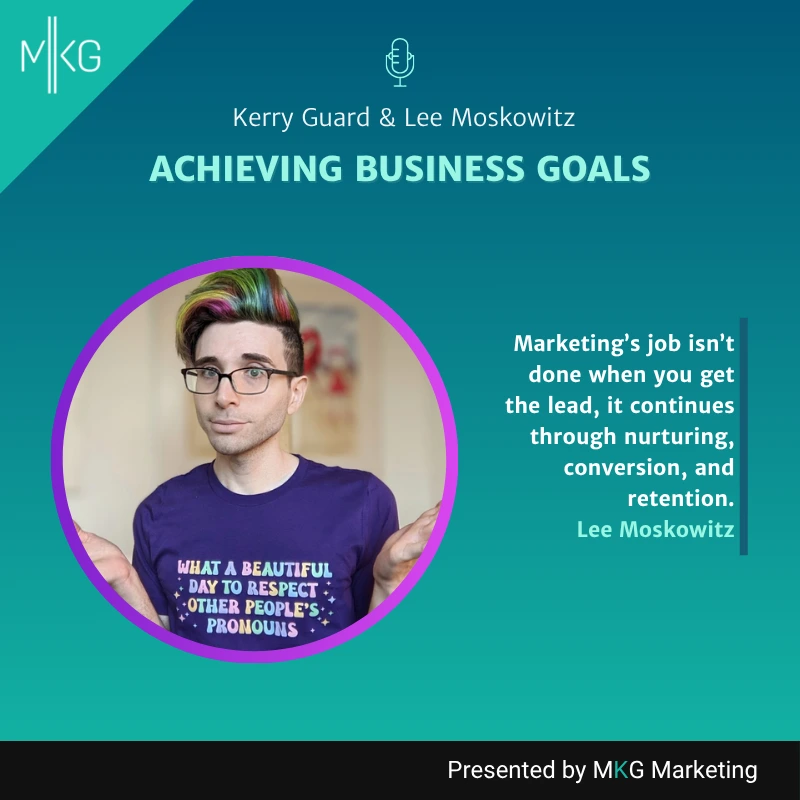
Lee Moskowitz
Lee Moskowitz is a data-informed growth marketing expert specializing in demand generation, brand awareness, and scalable B2B SaaS growth.
Overview:
Lee Moskowitz joins the show to break down the difference between demand generation and growth marketing, and why confusing the two creates gaps across the funnel. They cover the risks of focusing only on pipeline, how brand impacts conversion more than most teams realize, and why marketing’s job doesn’t stop at lead capture. Lee also shares how intent data, lead scoring, and prioritization should actually support sales—not overwhelm it. If your team is stuck chasing leads without sustainable growth, this episode offers a clearer way forward.
Transcript:
Kerry Guard 0:10
Kerry, hello. I'm Kerry Guard. Welcome to Tea Time with tech marketing leaders. Welcome back to the show. I love a good life because that means that we have listeners who have questions, and we are here for it. So if you have joined us on LinkedIn or YouTube, please say hello. We'd love to know you are here, and then we look forward to all of your Burning Questions. I'm sure you have many. I know I do, so if you know, I'll be asking tons. And if you want to drop yours in, that's great. And if we get to them, we will, and if we can't, we will address them asynchronously. If you watch this after the show, because it's the beauty of LinkedIn live, like we will have this live, and then it'll live on. It'll live on. It's wonderful. I'm a fan. I'm a fan. This week, I have Lee Moskowitz. Lee is a data-driven growth marketing expert specializing in generating awareness, engagement, leads, and revenue. He has helped a wide range of organizations, ranging from SMBs to enterprise companies, to innovate startups' growth through an impactful digital marketing experience. He's passionate about B2B and SaaS marketing, CRM, and data hygiene, paid media content strategy, rev ops, and inbound marketing experience in growth marketing and digital marketing strategy, management, and execution. Right now, he is a fractional growth marketing consultant and advisor, as well as a podcast host on the sassiest podcast that, if you haven't tuned in, you definitely, definitely should. And sassiest by design. I love that so much. I love telling people about it. I just it's the best. It's the best. Lee, welcome to the show.
Lee Moscowitz 1:54
Hey, Kerry, thanks so much for having me. I'm so excited to be here and spill the tea. You're I like how your show is dedicated to the tea. I have a segment on Spill the Tea called "on leader B," called "Spill the Tea with Lee"-exactly what it sounds like. So, so excited to have tea time with you.
Kerry Guard 2:13
Oh, we're going to spill all of the tea. Every segment is about some tea spillage. So yes to yes to that. I love that you have a little hat tip in your own show, because it is fun to, you know, get down to it right, like no holds bar. Let's really share with each other our journeys and what's in our way, and, most importantly, how we can learn from one another. I think that's one of the most the things that I've really loved about podcasting the last four years. I don't know about you, Lee, but especially in sort of these industries, these complex audience industries, like cybersecurity and data management platforms and those sort of things, where marketers aren't afraid to share what's working, we always feel so scared. We're like, oh, our secret sauce, and we can't share the secret sauce. It's like, no, like, let's figure this out together. And it's been, it's been a wonderful journey that way for me. How about how about you? You've been podcasting for a while now. Are you getting the same experience?
Lee Moscowitz 3:11
Yeah. So I haven't been doing it quite as long as you, by the way. What's up? Trevor, thanks for joining us today. I've been doing it for a few months now. And I think just one of the beautiful things about marketing is marketers are always, I mean, maybe not all marketers, but most marketers are so willing to share with each other what works, what doesn't, even if, even if you're kind of quasi competitors, like people are very willing. And I think it just speaks to marketers, because there are always places to find inspiration. There's different things that keep us up at night, but also there are so many components of marketing, and I know that's what we're going to get into, that one person isn't going to know every single thing about it, so I'm a firm believer shows like this podcast, there's no better way to build a relationship with somebody while also learning a lot.
Kerry Guard 4:00
And one of the great things for me having having done it for a bit now, is I feel like I've been able to be on, like, the cutting edge of it, because I could sort of feel the trends of like, what was coming, which is going to be beautiful for this conversation today, of how we really lean into where where we are, and how We got there before we get there, though. Lee, you know, sprinkle a little little trail there for people to hang on to. Trevor, always lovely to see you. Thank you for joining us before we get into the heart of our conversation. What's your story where you know you have a podcast, now you're helping out from a demand gen standpoint, for some consulting? But how did you get there?
Lee Moscowitz 4:43
That is a great question. And I think again, speaking to the different aspects in marketing, it's a matter of kind of falling into digital marketing is what I did. First, I fell into digital marketing. Like most people, you're like, I'm going to be a man. Man. Work on commercials. I'm. And everyone's working, you know, working on digital. So fell into digital. Realized that was it. And each time I worked on things and spent more time doing things, I fell into something else. So it's like, oh, digital marketing, oh, digital ads, and HubSpot, oh, demand gen, oh, growth marketing. So, really doing that, like I got my career started by being at a really small, out-of-home and digital marketing agency, and I literally learned by doing. And I think that's exactly what it sounds like. So learning by doing, failing, learning from your failures, and then leading from that. So my story, Taylor told us, time agency marketer worked on more campaigns than hairstyles I've had, and after I built marketing teams at my agencies, led marketing ops and paid media teams, I knew I needed to go in house, and that's where I really fell in love with the whole startup be one model to vibe, but also just like the work culture and the output, and that is what brings me here today with you. And then I started leading the sassiest podcast for B to B and beyond. You have to say it every time, because you have to. And yeah, it's really just, you know, a conversation like this, where I have guests who I find are interesting or smarter than me, or funny, or all the above. And we talk about different issues that mostly impact B-to-B marketing, but I also go into DEI recruiting, things like that, and it's really just a place where I'm somebody who likes to listen, but I also just can't listen to ABM all day. I can't listen to email marketing all day. And, like, I also need to have some fun in the mix. Like, I need to talk about pop culture and fun. And so I make this podcast for me, but obviously for everyone else, I would make it if nobody else was listening.
Kerry Guard 6:58
I love that because I've sort of, like, struggled with, you know, do I just have tech marketing leaders on the show? But then I've run into really interesting people. Actually, had me and a friend were talking right before a client joined, and we were having this really fun conversation, and the client joined, and they were like, This is, like, the best podcast ever. And I was like, I turned to my friend and was like, "You should come on my podcast." So, like, that's happening next week, because sometimes you just need to have a great conversation in the realm of the thing versus, like, exactly about the thing. So I totally love that. And you had a really great guest last week. Peter Wheeler, what a great show. Oh, so good.
Lee Moscowitz 7:43
Did you know Peter worked with Kanye? Like, literally, that's what I love about doing these podcasts, talking to these guests. Like, if you don't know Peter Wheeler, Peter led growth, product-led growth. Most of us know him as this awesome product-led growth marketer, but then he's like, Oh, by the way, like he just casually listed Kanye with his other brands. And I'm like, Hold on hold on hold on I got to talk about this, and that's what my smoke the tea segments for. But he did this kick ass experiential shit, and, yeah, and, like, that's just part of the fun about having that, like talking about things that don't normally get spoken about.
Kerry Guard 8:17
Yes, and people's backgrounds. Like, that's why I love hearing people's stories, and your story is so fascinating because I grew up in a similar realm. I'm still in the agency world. I haven't left. But I do love this aspect for you, of like, it sounds like there was, we're gonna go on a tangent here, people, welcome to the show. This is what I do. There's this lovely dichotomy of like you growing up in the agency world, but then you sort of like adulting in the brand world, like getting to join a startup and a brand and being in-house, and you said that the culture was really important to you there. I'd love to understand what the difference in culture was for you and why you're like, Ah, I found my home brand side, and that's where I want to be.
Lee Moscowitz 9:04
Yeah. I mean, I think there are a few things. One is just the accountability aspect, in terms of a startup, like there is that complete ownership, and you see things through to through agencies, you can do this as well, especially as you build long-lasting relationships with clients. But many times on the agency side, you are in reactive mode, or you're restricted to whatever that retainer is, or you're working on 20 different accounts that are kind of similar, but maybe different, and stuff like that. Biggest thing, though, is I think calls, though, like the amount that I can, I just I'm able to manage my energy so much better in these in these environments, than I kind of was at an agency, meaning I was on calls all day. Everyone wanted to talk to me. I was on client, sales, and internal calls. And it's not that I'm anti-call, it's that I'm also pro doing work, which can be hard to be when you're always just on call.
Kerry Guard 10:08
Yes, especially if you're managing 20 accounts, which isn't productive for anyone, even if you run an agency, and I limit. We're, like, on the three-to-five plan per person. That's about as much context switching as anyone would.
Lee Moscowitz 10:24
I mean the positive stuff, because I don't, I don't want to come across like, because, like, I've learned so much. That's where I spent my career. I don't think there's a better place you can pick up so many different skills than an agency. Again, not every agency is the same, but when you're at an agency and there's someone who's good at SEO and good at paying media, and then good at PR, and then there's all these different departments and people, you see other people work, you pick up all these skills, and it's like, it's a great way to learn things and be immersed. But, yeah, that's a drawback.
Kerry Guard 10:57
Yeah, no. I mean, there are pros and cons to both. And I also, having grown up, it was in a similar vein, right? Like you're working long hours, you're on multiple accounts, and you're learning from other departments. It is definitely a grind. But it's also like, where you want to be in your 20s, like you want to be, you want to be soaking it all up. It's like the best place to be. And then you get to adult later and take all those skills elsewhere. And yes, it's a wonderful journey, and I am totally here for it. Let's talk about where you are right now in terms of, like, a challenge you're currently facing. We're all human. This is hard. It's an interesting, it's an interesting, it's an interesting. Like, in just, I don't say like, world out there, in terms of, you know, there's tons of layoffs that are happening right now. There's the site concept of doing less, doing more, more, more, with a lot less. There are resource challenges, for sure. What is it for you? What's your biggest challenge right now?
Lee Moscowitz 12:00
So I think, like, obviously, when talking about, like, the state of marketing and the job market and all those things, but I think as a marketer, and speaking from the marketing industry, I think the most dangerous thing and the biggest challenge is the commoditization of marketing, meaning marketing is now a commodity. It's not an investment. It's just we're sinking money into this, or we're going to be super transactional about it. And what I again meaning by that, it's like marketing should have that seat at the table, and CMOs and marketing leaders shouldn't just be task takers or button pushers and things like that. These are people who have ideas and are growth-oriented, but as costs go down, as people don't buy net new software, as everyone's worried about the economy, marketing costs money, and there's especially in digital and demand, there is such scrutiny on every single dollar spent. So I think this also shows with the rise of fractional too. And again, there are so many great fractional people. I'm not I'm not saying anything bad about that, but I think that's why there are more fractional people than ever, because these organizations maybe view marketing more as that commodity than less as that investment and long-term commitment.
Kerry Guard 13:21
Yeah, it's really tricky. When they see the price tag you have, like, what marketing really costs to make it really effective, and it's a much harder story. What I feel like I hearing you say is, it's like a harder sell. It's a harder story to tell these days, given the uncertainty of, like, where everybody's jobs are, to where the economy might or might not go. It's that is definitely a, I don't say downfall, but, you know, like a happenstance of where we are.
Lee Moscowitz 13:55
I think that's just why a lot of marketers, too, are out of work. Because there are all of these. There's this viewpoint of marketing as a commodity. There are more fractions than ever now because of that, and again, there are also reasons why there are more fractional tons of people who love it. There's more freedom. Also, if you're a startup, there are tons of great reasons to work with freelancers, because you don't need full-time positions for everything, especially if you're scrappy or bootstrapped, like working with freelancers. Yeah, working with freelancers is very much a part of that. But like, the best time to work with the best way you work with a freelancer, especially in marketing, is when there's that marketing point of contact, at least. So just around that, and going back to more of marketing, is a fun Brand Builder as well as a revenue generator.
Kerry Guard 14:48
Well, that leads perfectly to our conversation, because it's this concept of yes, and you need
Lee Moscowitz 14:57
Hashtag, Ariana Grande, hashtag. Like, improv rules.
Kerry Guard 15:01
Yes, improv does rule, and you need, oh, sorry, guys, you need both. I know that brand, like, took a back seat for a while there, and was like hanging out in, you know, backstage and chilling while lead sort of took, took the front stage to build that revenue and that bottom of the funnel. And then all of a sudden, we looked up and said, Where'd all of our leads go? It's because the brand has been in the green room. We forgot about it, so need to bring that front and center. Let's, let's unpack this, though, for folks who are skipping to the end, it has been like this interesting trans, you know, flow, for the last 10 years, in terms of, like, hacks, right? We need to grow. We need to grow now. What are the hacks we can do between, like, putting things in the emails, to cold calling, or to whatever, to them being like, okay, cool. We could just, like, get leads in all day, we got white papers, download, download, download, download. And now this shift is sort of happening to demand from your point of view. What does demand gen mean, and what has been the evolution of it in the last few years?
Lee Moscowitz 16:16
Yeah, and so one, I think in general, there has been that evolution of demand generation, and now more than ever, you see demand generation. To me, a demand gen specialist is the new associate marketer or marketing coordinator. Like you look at jobs, you look at job positions out there. There could be a demand gen specialist, that's like an entry-level job, but should be like a director, and then vice versa. So demand gen is in a state. But I think one the reasons why demand gen is so popular now is because when people say demand gen, they're like, Oh, well, this this is more about pipeline and it's more about revenue than other tactics and strategies. So that's where demand gen comes in. And I think the other part of it is a lot of people use ABM and demand gen interchangeably, interchangeably, I think so, yeah, because, like, they're parts of they're parts of one another. And like, if you look, if you look at a demand gen job position, too, like the first thing is, like, running ABM campaigns a lot of times too. So I think that is part of that rise. But to me, demand gen like it's literally, it's filling the pipeline. It's funnel-focused. There is that growth aspect and awareness aspect, but it's typically a bit more campaign-focused. And a lot of times, there are more targeted towns, and that's why ABM comes into play. But to me, demand gen is more of that, campaign type focused, failing, pipeline, awareness, acquisition, not necessarily the other aspects of a of a customer journey, of a buyer's journey, demand gen is really more on the tactics to drive those MQLs and accepted meetings and pipeline, it's the blogging, it's the ads. It's all these different tactics to get people to fill things out, and it's just very, very pipeline-focused.
Kerry Guard 18:25
So the goal at the end of the day is pipeline and it's thinking about all the tactics you need throughout the funnel to ultimately capture those people in the long run. In the long run.
Lee Moscowitz 18:40
Like, to me, demand gen is very much something now synonymous with, like, marketing focused on pipeline, which means marketing focused on filling the first few stages in our deal pipeline. And I'll be focused on the pipeline. Well, yeah, so one customer success should be focused on customers. I mean, engineering should be focused on that. But yes, we all should be in every, every, every real marketing concept should be related to pipeline. And there always should be the why about it? Now, sometimes people will take that don't be like, Oh, well, this won't immediately lead to a meeting. So why should we invest in this for six months? And that falls away with some of those demand-gen parts of it. So that's where I come in, and that's where other marketing parts come in. And I think that's also why, you know, growth marketing, it's also pipeline-focused, product-led. Growth product marketing, it's also pipeline focused, because at that it should be, it should be pipeline focused, but there are those other areas. And to me, it's kind of like, obviously, pipeline is the focus, but it's not necessarily the only thing your marketing team can be doing, because sooner or later, whatever demand gen actions you've been doing, if you've only been doing that. That it's going to start drying up, and you don't want to put all your chickens and what eggs or chickens in one basket. I don't know either one of them.
Kerry Guard 20:06
One of them at the same time, because that's you don't know which one's first. I think this is important because Trevor says it so fondly here, around demand, Gen without good brand building doesn't do well, and the market is barely starting to wake up to that. And the implications of that, I think, I think some brands have caught on simply because their pipeline is straight up, and they're like, trying to catch up. I think this is interesting. So my understanding, and this is why you're the expert here, and I'm just taking my understanding based off of all the podcasts I've done and everyone else's points of view. So this is why your point of view is so important, because it's different. My understanding is that demand gen is a framework around how we get to pipeline. And then there are different approaches and tactics we can take within that, whether it's plg, whether it's sales led, whether it's name this lead thing here, and then the tactics that meet best with that, whether it's blogging or SEO, SEO should be and everything. But you know, whether it's paid or getting social or influencer, apparently, is like, make it a huge B to be in flux here. I don't say, I don't know that it was ever a thing, but, like, it's Forbes, just an article about it. So I think it's a it's sort of these things that you start, you start starting very, very high level demand gen being sort of the umbrella, and then how you want to go after it. And then the tactics that fall under that approach is sort of like how I've come to understand it.
Lee Moscowitz 21:46
I think, I mean, I think going off of Trevor's point here in the Commons is the going thing. Demand Jam without brand building doesn't do well. And breaking that down is, if your brand's not known and you're only trying to get a meeting, a very, you know, transactional thing. It's harder, like imagine getting an email from a salesperson from a company you've never heard of before, asking for a meeting, which people do all the time. But then imagine, imagine getting an email from a company you do know really well, or that you actually went to yourself, and the reason that works and why a lot of and the reason why a lot of large or big brand organizations do really well with demand gen is because they already have that Brand established. So with that, you can really just go into those demand gen tactics of, you know, ads, blogging, webinars, all of that stuff. And you mentioned, it's a framework. Yeah, it's a framework to strategy. Demand gen is a tactic that has other tactics. The Way Partners talk so that brand, that brand component, is really what we're talking about here. Where, like, if nobody knows you, if the market's super saturated, if you have zero market share, demand gen can do a whole lot for you, but we also need some of that other aspects here, those more holistic aspects that help get that meeting all the more easily.
Kerry Guard 23:25
Yeah, I do think there's nothing worse. I think I got one earlier this week where somebody showed my LinkedIn, not on, like the, you know, how you have the you have your DMS and LinkedIn, there's like two sides of it now. There's like your direction side and then your other side. I got something in my direct connection side that was, like, a straight-up pitch slap. I was like, Dude, I don't know you. Why is this even happening? Unfollow, on, on all of the things, right? Like, that's my initial visceral reaction to that, because I have no idea who you are. Let's talk about this from a growth standpoint, because I think that's like, where the rubber meets the road on this and where demand, demand falls down, if you're not thinking about it, from that initial I feel like what I'm hearing you say, Lee, which I I really love, is like demand gen is about building pipeline and that sort of like mid to bottom funnel. But those won't work unless you add to the top, which is the brand and the growth aspect, am I?
Lee Moscowitz 24:27
Yes, so add to the top, but also add to the bottom, so it's making it so let's say like, I'm talking about sandwiches here, right? Demand gen could be like the meat in the sandwich, and like that, we're filling the pipeline, but a slice of bread. Up top, here is your tofu. It's, I shouldn't say tofu, because Robert sandwich. So it's your top-of-funnel tofu sandwich. Why not? And it's all that stuff. It's the brand-building stuff. It's, well, I'm a vegetarian, so tofu literally isn't my sandwich. I just meant for confusing stuff. But like so bread here, this is your top. Funnel stuff. It's your brand building. Meat is in demand, Gen, pipeline stuff, and then on the other side. And why I call myself a growth market with the holistic thing is, all right, we have them in here, but marketing's job isn't done because there are nurtures that come into play. There is Peter. Peter said a great quote. He was quoting somebody else, so I'll just give him the quote. But on my episode with him, he was like, " You don't have a customer until they renew. And he said something like that, so true. So it's working with the, you know, CS, and making sure there's the right resources for customers, and keeping one like your, your job as a marketer isn't done, because some of your customers might not even know your, your brand name. They just know it's a tool they use and stuff. So there is that element, and that's, that's where I add those other parts to it.
Kerry Guard 25:55
Oh my gosh, that's so interesting. Because when you think about growth, you don't necessarily think about it from, I mean, obviously you have the chart, right? You have the hockey stick, sort of going from, you know, nothing, to, you know, good, you know, strong pipeline. And it's a bend, right? It's not linear. It's not like you're just gonna slowly make your way up. It's like, slow, slow, slow, and then bam, like you're hitting that flywheel. And so that's what growth has always meant in my mind, but I never thought about it, which is so obvious now that it would start at that place where you already have the lead. You just got to figure out what to do with them, which I think is where so much of marketing falls down these days. Trevor and I have had this conversation so many times about just because marketing gets a lead does not mean that you should immediately call them as sales and start pitching to them like yesterday. It's that growth element that needs to come in and play a really important part towards that, like helping them feel like they're ready to make a decision. People don't want to talk to sales until they're ready. I'm sorry, guys, like I. The days of cold calling. I said this on a podcast that comes out on March 13, whether you know I'm going to live and die by now, because it's going to be out there in the world. But like, cold calling is dead in my eyes, and this is where growth becomes so important. And if we think about it this way, is huge. It's huge. So talk to me. You mentioned customer success, you mentioned email. But what of those makes it feel like it's, it's the thing that makes the thing grow, like it just feels like, Okay, we have a lead, so we're gonna email them and then like, we'll close the deal, right?
Lee Moscowitz 27:41
So I think, a better way, and we're kind of talking around this, and I know you were waiting to get there, but like, a better way to answer this is really the growth marketing versus demand gen type of, sorry, if I'm cutting there, get to it. That's the real answer. That's the real answer with those other components. So step one for me, sometimes literally, growth marketing and demand gen are the same thing, and it's just semantics, and it's a buzzword thing. And fine, whatever you can call me. I've been called the Social Media kid, the HubSpot guy, the demand gen marketer, the growth marketer, whatever, semantics sometimes, and that's fine, whatever, if we're focused on results, semantics, sure, yeah, that's one scenario. The other scenario is really understanding what those differences are. And honestly, like, there's more similarities than there are differences, but I think that's where we go in with this holistic approach. So like, like, Oprah, let's, let's take Oprah. Let's take, let's take book clubs, for example. Like, to me, like, growth marketing is like a book club. And maybe you have different books coming in, you're promoting, maybe you have, like, different authors coming in, maybe you have the best snacks now. So people keep coming back, and like, that's growth marketing. But then we got Oprah here with her book list, her recommended list, whatever she does every year. And if you're on that, like you're golden. Yeah. So demand gen is kind of like we're going to do everything to be on Oprah's list and really focus on on that, because that's going to lead to so many sales, and we're going to put our efforts there and and that's that's more of the demand, Gen and growth marketing is like that, book club, community, everything, and then we're testing which book to like, and we're doing stuff like that. Yeah, that's where I say. I don't know, Oprah came into my head.
Kerry Guard 29:41
I mean, we could talk about Oprah all day. Should talk about brand building. Oh my gosh, the epitome, right there, her and Taylor Swift, right now. Taylor is another one.
Lee Moscowitz 29:52
The economy, right there. Taylor Swift.
Kerry Guard 29:56
So it's still coming up to me. I'm. I love that we're talking about semantics, and I think that's important. And I actually prefer pulling these things apart, because I do think that they get cobbled together, and it's bad. They should not be cobbled together. I also think growth got kind of a bad name, a bad rap, these last, like, 10 years, because it felt like, and I mentioned this earlier, when you mentioned growth marketing, it feels like, how you're going to hack your way there. Like, what's that? It's kind of like the Oprah scenario, of, like, well, if I can just get on Oprah's book club, then, like, I've made it right, not counting all the ways you have to, sort of, like, work your way into Oprah's sphere to, like, make that happen. And the huge lift that that is, but growth hacking, like, one example that always comes up, I think, is for Google, right? When Google, early days of Google, when they wanted to get their email out there and get more people into their email system, it was that they just added this stupid link at the bottom of your email that said, email from Google, right? And then people wanted to know what this Google thing was, and then they clicked on it, and they signed up, and now they had an account, right? Like, that's a hack, and unfortunately, I don't say those days are done. They're just harder to come up with and harder to find and harder to, like, figure out. And so I think growth got a bit of a bad name, because it got tied into you having to hack your way there. Where are the shortcuts? It's like Zoom info lists, right? Like, you know, there was a time where you could just download a list and then go cold call these people, and then you would end up with a bunch of leads that actually wanted to buy, and that was great for like, a hot second. But those days are, like, gone because buyers figured out that they're big.
Lee Moscowitz 31:32
I still think you can cold call the right way for the right people. I still think you can.
Kerry Guard 31:36
We might need to circle back on that, but I do, I do think that growth and hack sort of got tangled up together. And I also feel like, from what you're saying, demand gen and growth, I think they're two different things.
Lee Moscowitz 31:54
I 100% they are, they are. They're different things. Because, to me, like that is, and again, like demand gen is more of that strategy tactic, where I see growth marketing more as a strategy or methodology or approach type thing, and to me, demand gen is a part of growth marketing, and there is that distinction. But we can go even further. I mean, let's go back to the textbook. Marketing is an umbrella term. There are so many things under marketing. It's not just it's not just ads, public relations is its own category, but that's marketing, and it's under that umbrella. So that's why there are so many of these breakdowns, that there is growth marketing and product-led growth and demand gen and ABM managers, because like, like, all things, as more technologies come out, and as people have gotten better with certain skills we've had that need to really differentiate ourselves. Marketers. To mark, I'll make one last point, sir, I'm talking over you. I'll make one last like. So I think marketers have a tendency to over-architect and over-analyze and really put things in buckets. And to me, sometimes I'm like, I don't care if we call this a demand gen campaign. You call me a growth marketer, demand gen as long as we get the results, yeah, that's what focus other times I'm like, okay, though we have to be really, really, like, focused on you, or where are we putting our efforts? Because to me, that growth marketing strategy again, is you're splitting yourself a bit more. Yes, you're pipeline-focused, but you're also on the right brand, building the right acquisition and then the right nurturing, or the right referral program afterward, or things like that.
Kerry Guard 33:50
Yeah, you do need to have what's going to work for you, right? Every brand is a little different in terms of what recipe you sort of need to bring it together and not do random acts of marketing, right? That's really, I think that's why we all sort of need, like, a framework, give me a strategy, give me an approach, give me a thing that, like, I can hang my tactics on, and make sure we're all driving towards the ultimate goal of revenue. Let's talk about I'm really want to sit here on the growth side of it, though, because I feel like we all got the lead, and then we don't know what to do with them, and it sounds like that's where the magic sort of happens, whether we call it growth or the car demand or both. What is that for you, in you mentioned customer success, is that is there tactics under Customer Success? Or break this apart for me, from a nurture standpoint, versus a customer success standpoint.
Lee Moscowitz 34:43
Before we get to, like, the CS, there is that part where, like, one, it's like, the talking to the sales and AES, and that obvious stuff about, okay, have we gotten them the right lead? So there's, that's that obvious element. You can do the same, you can do the same thing with CS. It's like, okay. Like, yes, they're onboarded. But are they happy customers? Did? Did? Did they understand the product and the website properly? From the website, from the marketing, are certain customers churning for a certain reason that we should make adjustments on the marketing side to either back up on or clarify? Are there certain things that customers are complaining about or loving? So, joining calls is amazing. Obviously, you can listen to Gong calls and recordings, but literally, like sometimes your customers and your CS, people will explain things in a way that marketers just didn't and, like, sometimes it's awesome, and you really just do that. The others, the other thing, like CS, is just the unsung heroes of everything. So they're so busy, I try not to bother them. But like, I want to make sure that when we do have them these customers, they're not just going to churn in six months, because all we cared about was getting anybody here. And marketing works somehow, but they weren't right, and not that that would, but, I mean, it could.
Kerry Guard 36:09
It has no for sure. Let's talk about that. So let's talk about the sales side of it, first, like before they're actually a customer, and the tactics from a growth standpoint of like, you have all of these leads sitting in your CRM that you did a great job through demand getting, but like, now, what do you honestly do? You send them directly to sales and let sales vet them and then tell you whether a good lead or not, or do you have a system that vets them up front? Like, what's sort of your approach to figuring out how to get somebody from a lead over to sales appropriately?
Lee Moscowitz 36:43
So, figuring out when they should get their part of it honestly depends on how busy sales are. So if you're in a scenario where they're not fully packed schedules and on calls all day, you know, it could be worth being a bit more lenient upfront on who we're sending sales if they're not as busy. But let's say we're in a situation where, you know, they're already pretty busy, with enough calls, yeah, there is room for more, but they have, they have a good amount. That's that's the situation where we don't necessarily want to send them everyone because they're already busy. But I also don't. I want them to believe in marketing, trust me, as their teammate, as their marketer. So I only want to be sending them a lead when that lead is ready. I don't want them to be like, Why are you calling me? And this really varies, because, like, I know companies that they literally call people after downloading ebooks, and it worked great for them. I know other companies were like, " Don't do that, obviously. So there is that part of it. But like, I'd say, all right, we have too many, we have a lot of leads here. We're doing great. Who do we prioritize? That's where your lead scoring comes into play.
Kerry Guard 37:55
The lead scoring. Okay, great.
Lee Moscowitz 37:56
I believe, do people not believe in lead score?
Kerry Guard 37:59
I think everybody just approaches it differently.
Lee Moscowitz 38:02
LEAD SCORING isn't Jesus people. It's not a religion thing. You can, you don't get this, like, lead score is a thing.
Kerry Guard 38:07
Lead scoring is a thing. I think it's just, it's just that everybody approaches it differently. So, for you, how do you lead score? Do you use, like, a certain system, like lattice, or do you just do it based off of, like, how many opens and engages? Yeah, sort of your approach.
Lee Moscowitz 38:20
So again, it really depends on how complex and how many actions are going on. But I think this really talks to, again, going back to marketers over architecting things, it doesn't always need to be crazy. It could literally just be like, hey, these people opened three emails, viewed these pages. Let's give them additive scores. They viewed the pricing page or did a product tour. Let's give them another score. Oh, they unsubscribe, negative, whatever. So it doesn't always need to be like this big, massive thing that makes everybody nervous. In fact, it shouldn't be, because then it gets even harder to change, because you should be changing as you go along, that maybe we're getting too many points here, and everybody opens up tons of emails. It's not a good thing. Yeah, so that's where lead routing really comes into play. The other is intent data. So again, another thing that people over are over architect tons of great intent data tools that will tell you everything from what the person had to breakfast to their mother's maiden name to, like, how they're shopping, like so again, so many good, good things out there. You want to know if that person's in market, but you don't also need to go overboard with that data. So sometimes just knowing if they've been to your website or certain pages is enough, other times, yes, we do want to have them. Yes, they're an in-market audience because of something else they did and yada yada yada. But again, it's using all that data points to inform and then push the sales.
Kerry Guard 39:58
This leads kind of nicely into AB. Am for a hot second, because we talked about how ABM and demand sort of get tangled together. I'll put my stake in the ground. ABM is a is a tactic, slash-like approach to demand, kind of like you could sort of use ABM to help PLG, but it's, it's not the only thing in demand that you can be doing, it's a part of demand. Yes, agree, disagree, agree.
Lee Moscowitz 40:31
I agree again. I think it's like ABM is part of that demand gen, which can be part of growth marketing, but it is demand gen isn't necessarily you're doing that account part of it. It's not saying you're getting specific. Demand gen doesn't have to be account-specific. It just, again, focused more on getting the actual demand for that product, so creating it. We're doing everything like that. That's that's where that comes in.
Kerry Guard 41:02
Oh, Trevor says it so nicely here. Intent should inform all phases of sales readiness. ABM shouldn't be based on intent, and intent should inform how you treat a target account at any given time. Yes, I agree that ABM is really about what accounts you want to go after, of like, who's in your ideal customer profile and but intent can inform whether they who within the account is the ones that are actually investigating this thing, and who you might want to be talking to, and how you market to, to the to all the people involved. So intent plays a role, but it shouldn't be the thing that tells you what accounts you should be going after.
Lee Moscowitz 41:43
Yeah, that's the point, like your intent shouldn't change your ICP criteria until, unless it's some crazy situation where nobody in your ICP ever has, like you have your ICP wrong and your persona wrong. I think where intent does come into play, it's more of that prior prioritization. So if things are going awesome, if we are getting all these leads, how do I help my sales people do spend their day on the most effective things that are most likely to add value?
Kerry Guard 42:16
I totally agree with that. I think that's, man, if we could all get that right. It would be, it would be magical.
Lee Moscowitz 42:24
Sometimes it is literally as simple as we have, like this, AE, or this, SDR is focused on these, this long list, because we have our ICP right. We've got our target accounts. It could be as simple as, hey, this person viewed our website or the pricing page delay, let's bump them to the top of the list, or something like that. It could be that simple, like changes like that, that just help your sales people prior prioritize who to talk to first, can make all the difference, and then that's why people get crazy with intent data.
Kerry Guard 42:59
It's easy to do, especially if your website's really big. But I think just bucketing it in terms of the funnel, top funnel, consideration, purchase.
Lee Moscowitz 43:08
Intent data tools have also done a great job of FOMO, where it's like, if you're not using our intent data, then you're reaching the wrong people. And I am when I see, like, a 30k line item in any tool, and they're saying, Oh, our match rate for your ads is going to be better. Like, I'm like, okay, like, what do you do differently from me? Why can't I just upload the list myself? And, like, a lot of times they can't answer it, or they're like, Oh, well, we have, like, their personal email address too, or something like that, so like that. That's why intent data has gotten some of that rap because people were obsessed with it for a hot minute.
Kerry Guard 43:46
It seems like I generally only work because I'm on the agency side. I generally don't get to, like, hang out within all the CRMs that I would love to. I was marked certified, like, a million years ago, and I've dabbled in HubSpot. I use Active Campaign. I'm for my own agency, and for some of my clients, I'm a hub spotter. Yeah, so, but I do feel like CRMs have stepped up their game in terms of being able to create some of that scoring pretty easily without needing to buy more martech tools to weigh us down.
Lee Moscowitz 44:22
That said, those CRMs really just like, if you do need some kind of intent, they don't do it like, you need another tool with it.
Kerry Guard 44:29
For HubSpot specifically, you need another tool.
Lee Moscowitz 44:32
I mean, like, it sure again, like you can if you really want intent, like HubSpot, for example, like they have, like, a prospecting thing that they bury. But like, like, it's not, it's not as useful. Like, if you're really trying to, like, especially if you're working in a SAS motion where there's long sales cycle, which is pretty much everyone in B to B, yeah. Prioritization just comes into play, like crazy. So if you have a target account. List, and your salespeople are just reaching out. And then when you add intent data, and if their rates start increasing, which they should, that means intent data is doing a good job. If it stays the same, it just means you're making everyone's life harder.
Kerry Guard 45:16
Well, let's just talk about this for a second, because we've sort of bounced around to topics, which I think is awesome, and I'm here, I mean, you've met me, like, that's hilarious. It's the best.
Kerry Guard 45:24
I think there are so many nuggets here that people are going to walk away with. Let's give them one thing to really chomp down on, which is what we've liked, really laid out here around intent data, and what intent data really is. So in terms of, like, how you quantify when you're saying intent, data, what I'm hearing you say, Lee is, it comes down to basically website I'm oversimplifying, of course, but basically website interaction, what pages they visited. Maybe you could go by channel, in terms of, like, organic, social, versus SEO that helps, versus a paid ad, right in terms of like, how you grade those.
Lee Moscowitz 46:05
Websites are like website view is like, the easy like, that's like the basic intent data, like another, another good one that, like a lot of tools use, is intent data, as in, all right, this person is viewing Ji Cho and trust radius, like all these places for a certain category. And it should be, right, that's another huge play, knowing that people are like, bum bores, like, you know, another tool like that, does it? So it's like taking intent. Data is just other things, other pieces of information that indicate these people are more likely to buy for some reason. So it's typically like these people have indicated, by some way, that they're more interested in your category, in your product category, they're looking for that solution, and that's where all these tools have it. They visited G2, or they're searching for this stuff, or all these different motions. And again, the more intent data there is, the more it gets complicated. But that's why people go really ham on it, because it's like, why reach out to everybody when I can only be reaching out to the people that are ready to buy again? The problem is, just because intent data says they're ready to buy might not mean that they actually are, but that's typically why it I do encourage some kind of intent data when you're you're really trying to help sales figure out what to focus on and marketing what to focus on.
Kerry Guard 47:49
It sounds like there are different layers of how you can go about intent. Because, like you said, marketers love to over-engineer everything. How many tools can we throw out on this thing, and how much can we wire them up, and how much can we automate, and how much can we like not touch this and then let it do its thing until it hits sales. I think there are different layers of that. So it sounds like there are some aspects within your CRM that you could wire up to get some intent data, like, depending on how big you are, right?
Lee Moscowitz 48:14
What you're saying is about the first-party versus third-party intent data differences. So first party, your website, your CRM, that stuff, third party, that's where all those other tools come into play, where these buyers are doing all these actions that we are tracking, because our tool is amazing, and we know that they're they're engaging with your product or your your category, and that's, that's what it is.
Kerry Guard 48:39
Yes, and I think what I'm trying to get to is to help people figure out when they need which thing, right? So to your point, if you should hire me, if they need that, one thing that you said, I think is really important is that if you are a SAS, and you have multiple layers in which people have to go through your buying cycle, and if you're and especially if you're trying to do plg, where it is very hands off, right, you do want this thing to basically scale itself. That's the whole point of product line growth. Then having these extra tools is going to be huge, because you're probably not investing as much in potentially a sales team. So putting that money and effort into that intent data, that's third-party, is awesome. But if you're more heavy on sales, if you're more heavy on not on them, needing to call a salesperson, and your website is, you know, more around that engagement piece of telling people what they need and why they need it, then you starting off in a place of first party is probably a great place to start. You might need third-party data later, and that would be great to layer in. But I know all of these martech tools can get over daunting, so knowing like where to begin, I think, is really helpful, and that's why I was trying to pull them apart.
Lee Moscowitz 49:51
Yeah, always, always, always begin with anything first party you can, you can do, and it. If your SaaS, again, doesn't always need all these extra steps, but if you are a larger organization, or if you're more complex, or if the tool is a pretty high ticket item, which, again, a lot of SaaS are, that's where this comes into play, and putting all that in, yeah.
Kerry Guard 50:19
I mean, that third-party data is like, sounds totally magical, especially if you get into the G2 stuff to really understand, like, what people are searching for. That's wild. That's wild. We went through quite a few topics here, really, from defining demand gen to understanding how growth fits in or around to getting into the to the meat of it, the of the sandwich, in terms of talking about Oprah because, I mean, can't not have a conversation about Oprah or Taylor Swift right now. I sneak Kerry wherever I can, and how you can really bring in that intent, data that ABM, those channels to help you cultivate your audience to and really help sale at the end of the day, pipeline and sales folks, so like, how can we support our sales teams to get to that pipeline and make everyone's jobs easier all around?
Lee Moscowitz 51:13
Right? Yes. And these marketing distinctions are important. They exist for a reason: because, like, it becomes very helpful, especially when a marketing leader is building their team. Do I need a demand gen person who is really going to be focusing on those tactics specifically? Or maybe, do we want to put more into growth marketing, which has that pipeline focus as well, but also comes into play with the brand building, with customer referral, parts of it, success, parts of it, and things like that. So I get, if you're not sure, feel free to hit me up on it. But I'd like always go back to what your goal is and what the results you want to be, and where you also want to be in not just a month from now, but next quarter, and the quarter after that, and next year.
Kerry Guard 52:11
And how your product is built, it's going to play, you know, play a part, especially if it's SAS. And if you need more tips and tricks from the sassiest podcast. Be sure to check out Lee to be. The link is in the show notes. Lee, you and I met on LinkedIn. Is that the best place to find you?
Lee Moscowitz 52:31
Yeah, message me on LinkedIn. That's, that's really the only one. People should contact me again, Google. Lead to be, it'll come up. Listen to me on Spotify, Apple, anywhere. I have a bunch of ABM-specific episodes that, if you're interested, we can go in further with Mason, Cosby, Karina Owens, it's the plg episode. Have some sales ones as well, because I always like talking to salespeople, but, but, yeah. Thank you so, so much, Kerry, for letting me come on and spew demand, Gen, and growth marketing at your audience.
Kerry Guard 53:06
I loved every minute. I do want to say, closing on here. Lee, you are more than a marketer. So, 2024, I feel like this is the year where we're coming out of this smog, the fog that was COVID. We're living with it. We're figuring it out. But like, what are you most looking forward to this year, now that that dust has settled?
Lee Moscowitz 53:25
Well, I don't know. Like, I feel like I've gotten past the part of, like, looking forward to things and just hoping more bad things don't happen. I mean, I'm kind of kidding, but like, this is an election year, so like, this is an election year?
Kerry Guard 53:40
It is. It's definitely a tough year. I'm on the edge of my seat. I have registered. I'm across seas. But don't you worry.
Lee Moscowitz 53:46
I should say something more positive, though, at the end, though, I shouldn't just say what your question was? I just went negative.
Kerry Guard 53:51
Why don't you tell me my other favorite question, asking people is coming out of COVID? What is a hobby you've picked up over the last few years? What have you learned? What are you totally doing?
Lee Moscowitz 54:03
Oh, yes, perfect answer for this. That's much I'm a homebody, so perfect answer for me. So covid, COVID, The Queen's Gambit came out on Netflix. Amazing show, amazing show. I played chess, you know, as a kid, like, like many people did, but like, I stopped. So we watched Queen's Gambit, my boyfriend and I, like, episode one. And then, like, played, played some games of chess, horrible, horrible games of chess. We didn't really know it. Then we finished Queen's Gambit. And then, like, we kind of just, you know, I started playing online with different people. He went crazy into it, like I used to be better. He studied and knows lines and all this stuff with chess. But yeah, like, literally went from like never really playing chess as an adult or in years, to like I play, I play at least one game of chess a day, like you can if you want, if you're not. If you're on chess.com, feel free to play me. I also think it's very much like digital marketing. I'm not going to do a cheesy analogy, like, I want to, but like, one of the reasons I also like it is because it's, like, it involves some kind of brain stimulation, but it's not like, overpowering where, like, I have to, like, I'm not a big video game person because, like, I don't want to learn all like, the rules and controls and like, it feels like work, like, I don't know how people like, play some of these games. Like, like, so, yeah.
Kerry Guard 55:31
Yeah, I totally feel you. The only video game I play these days is with my son. It's called fall guys, and it's because you basically tried running a straight line from point to point B and not get knocked over.
Lee Moscowitz 55:42
Yes, I will always play Smash Bros with somebody who likes that. Yeah, yes,
Kerry Guard 55:48
Yes, very simple. I'm here for it. Lee, this was amazing. I'm so grateful. Thank you for joining me. If you enjoyed the episode, please like, subscribe, and share. This episode is brought to you by mkg marketing, the digital marketing agency that helps complex brands get found via SEO and digital ads. The show is hosted by me, Kerry Guard, CEO and co-founder of MKG Marketing. And if you'd like to be a guest, I love to have you hit me up on LinkedIn, and we'll hang out. But Trevor, so grateful for you, Lee. Thank you again. You you.



 (7).png)