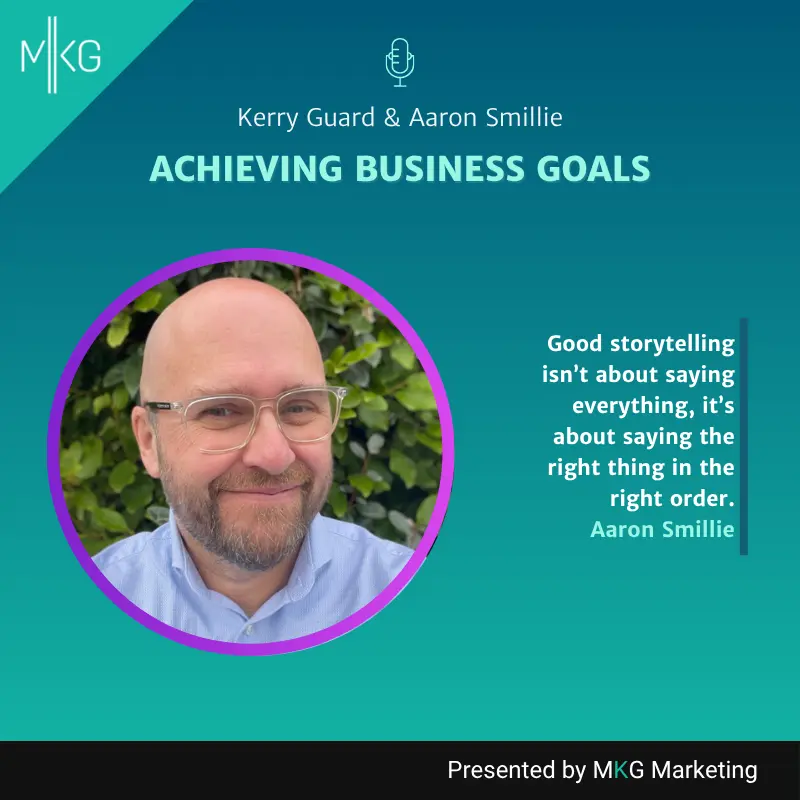
Aaron Smillie
Aaron Smilie is a creative strategist and motion expert who helps brands simplify complex ideas into clear, compelling visual stories that connect and convert.
Overview:
Aaron Smilie joins the show to unpack how great creative work starts long before anything gets designed. They cover the importance of deeply understanding the subject matter, why simplification is harder than it looks, and how to balance visual storytelling with strategic clarity. Aaron also shares lessons from news graphics, social media, startup work, and healthcare marketing — including why not every creative asset needs paid promotion, how communities form around the right topics, and why understanding the audience is the key to making anything resonate. If you’re trying to explain something complex in a way people actually understand, this episode is full of smart, practical insight.
Transcript:
Aaron Smilie 0:00
You put it all in a pot, and then you start cutting away. You cut away until all your all you're left with is the is the most beautiful, simplest version of what that thing is. And then you make that.
Kerry Guard 0:16
Hello, I'm Kerry Guard. Welcome to Tea Time with Tech Marketing Leaders. Welcome back to the show today with me. I've Erin Smiley. I think, Aaron, your last name is so appropriate because you have this beautiful smile that I just love.
Aaron Smilie 0:33
No one takes someone with the name Smiley seriously when they're sad; they just find it fun.
Kerry Guard 0:41
So, plus to get a curse. Plus, they get a curse.
Aaron Smilie 0:45
But you get a lot of old ladies at supermarkets telling you how nice your name is.
Kerry Guard 0:52
Well, it is quite the conversation starter, clearly. I mean, and the people in Guernsey, in particular, like especially in the supermarkets, are just so lovely, like when they would call me, when I would love as I'd be leaving, and always wish me a happy day and say cheers, I'm like, where am I? What's happening?
Aaron Smilie 1:17
It's a wonderful island.
Kerry Guard 1:19
Did you grew up here?
Aaron Smilie 1:21
Yeah, I did. Yeah, I did. I grew up here until I was 18. And if you're an 18-year-old here, all you really want to do is want to escape. But then I had kids, it's what Guernsey people normally do. Then they have kids, and they go, what's a better place they grow up than a five-mile-by-nine-mile island in the middle of the channel?
Kerry Guard 1:44
I mean, it's why we're here. My husband did the same thing. 19, pieced out, went to Jersey, then he went to the US for our stint, where he met me, had some kids, and then we were like, Hmm, kids are. Do you know what?
Aaron Smilie 1:57
It's interesting. It's interesting because we both, we both do a lot of remote work, and actually, coming to Guernsey, when I came, it was this thing where you were leaving the world and going to live on this small island, and you were constrained. Oh, my God. What's that going to be like? But that, that constraint has now been completely evaporated, and everybody lives wherever they want, really, I think.
Kerry Guard 2:23
Yeah, COVID has really opened up the opportunity to do that, I think, in tech and the tech as well. I mean, we're on a five-mile island, like you mentioned, in the middle of the channel between England and France. There's a bunch of us in terms of the Channel Islands in Guernsey, Ballywick, but we have fiber. I don't know if every house has fiber, but like the island, it's fired up with fiber. It's pretty. Yeah, we've got great fiber, remarkable just because, yeah, there's red works everywhere. Don't try to get anywhere in a hurry. Yes, it's so true. Aaron, what's your story in terms of your career? So you left Guernsey, and you went to the UK, and what happened from there?
Aaron Smilie 3:12
Sure, so I left Guernsey. And when Guernsey people tend to want to leave, but then they leave to England and go to the closest place possible, which is Portsmouth. So you leave, you don't leave too far, just accessible to Southampton airport. You get back, you know, within two hours. So I went to uni there and did documentary making in my first degree, and then I did a master's in design for digital media. After that, I ended up those amalgamating those two things, working for one of the one of the main broadcasters in the UK, which is ITV, and working in regional news. Now, each region of the UK has a separate news channel for local news. Guernsey has Channel News down south of England. It has a meridian, and it separated into its different regions. And I ended up working across all those regions for live television for a couple of years, which was what was called Old, now it was, it was when analog was going to digital. And there was this thing, this new thing called technical operator, a tech op, which meant that you basically vision mixed live news bulletins, and you did sound, and you did the cameras, and you did it all. And I did that for a couple of years. And then this, this kind of department which I've never really heard of before, which was motion graphics, kind of presented itself. I thought this was amazing. You get to sit down all day, which, which I love sitting which, because I'm extremely lazy and do graphics, which was, which was awesome. So I ended up going for this traineeship, for ITV, this kind of posh traineeship, and ended up getting a spot. And then. It ended up traveling around the regions, which led me to, after I left ITV, I went to, basically, you kind of you go from regional news and then you go to national news. Usually, that's the way journalists do it, and that's a lot of the way production teams do it as well. And I ended up going to Sky News for the first stint at Sky, which was for five years, and basically, if you saw between a certain time, if you saw an over-the-top, ridiculous graphic on Sky News, it was probably done by one or two other guys or me. We did all the real-time, rendered 3d systems. And I was kind of, well, I still am a geek, but I was kind of obsessed with elections, not the election coverage, the election night, the presentation, the idea of data, the kind of theatrics of it. So I kind of ended up specializing in elections and kind of big data. Yeah, it was, it was fun. And then I'll try made as short as possible. But then I think all Twitter came out. I thought, That's cool, you know, now, now sky isn't the first for breaking news, Twitter is so I gave them a call via LinkedIn, I think, and there was no job, but they asked to see me, which was nice, and then went there and made a bunch of stuff for them, and they gave me a job there, which was great. So I was in the brand strategy team, and I went from doing news graphics to working with brands like Visa and Adidas on leveraging the Twitter platform, as it was. And then I went back to Sky, another stint at Sky News, but then when became the ridiculously titled creative controller of entertainment marketing in Sky, which essentially which was essentially doing all the creative for their TV shows. So what I mean is TV shows on social that are so Game of Thrones is coming out, and you need a bunch of tweets that go with Game of Thrones. You also need an event going on at London Waterloo. I ran the teams that did all that stuff. And that was cool. That was cool. It was it was a fun, a fun gig. And then it kind of, I was such a sales, such a geek in my spare time, I used to work at New Scientist magazine. So, making the infographics and stuff, they paid. They paid really badly, but it wasn't something that I could do full-time. And I, you know, I had days off in the week, so I love doing that. I would have done that for free. And then during that, we had children, which led me to Guernsey, back to Guernsey, and we quit our jobs. My wife and I, two sons, went to Guernsey, two kinds of big companies over here. One is Spec Savers, which is their headquarters over in Guernsey, and the other is Healthspan. And I went to work in Healthspan, and I took all my skills, my social media skills that I learned from working on big TV shows, and I applied them to vitamin supplements, and they didn't work at all.
Kerry Guard 8:09
It's a different market. It is a totally different I actually think the best advertising that works in currency is car wrappers. I mean, how often do you drive down the road and go, oh, I need a gardener. And then you take a picture of the van and the number.
Aaron Smilie 8:27
Really bugs me that they don't, I mean, this is the Guernsey thing, but they don't like to make it big on the back, there's always this tiny thing you're looking at. Healthspan ended up being like the leading online supplier of vitamins in the UK, and it was a fun gig, but from a social mix, I was their social media director and their brand creator director. And talking and connecting with people about stuff that people are interested in is actually really easy. Driving conversation about stuff that people are already talking about is very straightforward, talking about stuff that people aren't, or having to find an avenue to connect with people, was was really interesting thing to do. And then at the end of that, so I worked there three years, and then I started, I managed some of the relationships with with agencies in London, and I would kind of see how the agencies worked. And I felt like I was sitting there signing off budgets or signing off content calendars, and I would think, do you know what I want to get back to, actually making stuff and working with people? And it was really interesting. It was kind of this, let's see. Let's start the DMw digital motion workshop, and let's see if I can do this. If I could take all the things that I've done, I could take, you know, the social stuff, the creative stuff, the 3d stuff, put them together, and the journalistic stuff, put it all together, and help businesses. And I've been paying the mortgage now for four and a half years doing that. To be, yeah, it's fun. It's been fun. So there are ups and downs, you know, you start, you start just before COVID, and that was interesting. But you know, you go through those ups and downs. And I think actually what you learn when anyone does a startup, or when anyone, I work with a lot of startups, is that it's never as bad as you think, and it's never as good as you think. And if you can stay kind of emotionally, emotional intelligence, the wrong word. But yeah, I think so. I think so, you know, centered through that whole thing, and not panic or not get overly excited, then you can kind of, you know, last, and that's how we started working together.
Kerry Guard 10:43
It is, it is how we thought you were in my back garden, and I was looking everywhere else for an animator. And then my husband was like, Oh, I know someone. And not only did he know somebody, but he knew someone who worked for big brands like sky and Twitter, and did you know, branding for, like, Marvel and Adidas, so, you know, like, not just, I think that's what's so miraculous about Guernsey, too, is I, you know, in there's so many ways that this tiny island punches up, yeah, in terms of its arts, especially, I mean, the music scene here is ridiculous. They have a full-blown symphony. They have an arts performance every summer where they all the street performers come out and perform, and it's incredibly well organized and really well done, and the bands are awesome. And then the, like I said, the design work here for branding is like, so clever and fun and great, like, technically sound. And so while I was surprised, I was also like, not surprised. I was like, Duh, like, of course there would be this genius sitting here in my back garden who could do this worked brilliantly for me, and it was, yeah, so we did this really fun project together. But what I really loved about you, working with you, Aaron, is more about the in-between spaces. So Aaron and I, like, once a month would go grab coffee in this little coffee shop called the Terrace. And it's cool because it's like, a it's like, upstairs, you got to sort of walk. And it's got this beautiful outdoor sitting area that we sit through in during the summer, where we met, and then an inside cafe, and hours go play a quick look up. We're like, oh yeah. Probably like, need to go home and start working now, because we'll just sit there over a cup of coffee for three hours. But I've learned so much from you in those chats around, I mean, I've been doing art and design for, you know, for my career as well. I went to school for photography. I studied the technical side. I was I was dragged out of the dark room. I was unlike you. I did not want to be sitting in front of a computer editing photos. I wanted exactly the opposite for as long as humanly possible. And my professors were like, sorry, you really need to, like, catch up here. And I absolutely loved photography, and then I took some design courses. But when I got into marketing, what I loved about it was I could, like, bring these two very technical and artistic things together. I can tell stories with data and build these presentations and tell a story in a way that didn't require me finding models and lighting equipment and really expensive cameras, and so gave me this beautiful outlet, but I'm self-taught to a degree, right? Like I've sort of, I don't want to say I've plateaued, I don't want to say I've topped out, but I've definitely plateaued. And then I met you, and it was just gave me so many ideas that were just like, uh, leveled me up in a way that made me take what I already know how to do. So I went to school, like I said, I went to school photography, and in my thesis, my professor actually sat me down, like maybe two or three months before the show, and he was like, I get it. Congratulations. You know how to take a photograph. Does technically sound, but it's missing, like it's missing something. It's missing. He didn't say soul, but I feel like that's what he was getting at. Like it's missing that story, it's missing that thing. You need to let go, like it's okay. You could take a photograph. Congratulations. And I did, and I got experimental, and I these are all these are actually from that, where I took books and just destroyed, destroyed them in trying to tell the story of what the words were saying by messing up the pages. So I put one book in a freezer. After I wet it, I tied up another book, I shot another one through water. So, like, I put a glass of water, and then I put lighting in it all with a four by five camera, and I let go, and I feel like, like, these sessions with you, I feel like that's what you're sort of like, helping me get to of, like, you know how to use the tools now you generally know how to do layout. Like, let's talk about the point of view. Let's talk about the soul of what it is you're trying to accomplish. So what is it for you? Aaron, like, when you think about when you sit down to create anything, right, whether it's very technical piece, like something for a medical company, where you take literally something out of thin air and do all your medical you know, there's no pictures of this thing, and you have to create what it would essentially be to something very simple, like a beautiful PowerPoint presentation and a branding element. Like, how do you get started in really understanding the point of view you want to bring to the table in that chair?
Aaron Smilie 15:59
It's a great question, and I think it's different in every case, but it starts, it always starts with understanding essentially what you're trying to communicate. And that's actually harder than it sounds, because, say, you're doing a medical proposition, or a science proposition, or even a SAS business proposition, where someone's trying to communicate value through a selection of automated systems that's in a piece of software that's fairly abstract, or if you're trying to describe a financial piece of software that's talking about actuals versus projected costs. Or, you know, if you're talking about DNA and how a cell goes into a or a motor protein kind of moves another bit of DNA around. Or, you know, they all, they all start with having to deeply understand the subject, then simplifying it down to its core elements. Because, first of all, you know, what's the what's the graphic trying to accomplish? What's the narrative, the beginning, middle, and end of that, of that graphic, you know, what's the call to action at the end? Who's the target audience? So the graphic that I would make for a generalist graphic for a science, one, for example, is going to communicate efficacy. It's going to communicate here's here's a problem, here's something that's coming in that's new, which is a solution. There's a reaction somewhere, and there's an output. And actually, most things actually follow a similar, a similar set of, set of narratives. You know, there's there's there's, there's always a problem, there's always a solution, there's always a thing going on, and then there's always an outcome. And if you have that kind of core premise in your head, you're thinking, and it might not be the same for everyone, but it's like so, then how do you, how do you take the core elements of what they're trying to communicate and then distill it down to a story? So I end up doing, I end up putting a huge amount of work in before I've got a lot of gigs, actually, because what it does do is it tests you to the client. So if I do an enormous storyboard, or I even put together some animations, and then I'm trying to describe to them what they've communicated to me. And then they come back, and they say, it's, it's 90% there, but you didn't get this thing right. This thing is super important. We need to focus on this thing. Then you can go, "brilliant, I get it." Now you've exposed what you didn't know right at the beginning. You can focus on, like, I work, I work, kind of, principally designers and creatives in animation tend to sit in two camps, really. They sit in a kind of flat After Effects world, or they sit in a kind of 3d world. And there's normally, normally, one tends to enjoy one or the other, and I kind of have always sat in the 3d world. I like 3d intricate stuff, and I like a camera zooming around it, those over-the-top sky graphics, which I used to do all the time. I feel comfortable in that space. So when it's a case of doing a cell, well, actually, I did. I did a guardian course. Once I was sent on a guardian course by Sky, and it was they got this kind of information graphic bit, and they were famous for doing infographics. And they said, they said, if we can't think of anything to do, we'll just put the numbers in circles, and then it'll look amazing. And then you, I looked at the I looked at the I looked at the paper, and saw, yeah, there's just a bunch of numbers in a bunch of circles. And it does look wicked. And you think, and so if you're doing this, if you're doing a cell, it's effectively this kind of, like weird, organic blob that's moving around, and then it's got a load of other blobs in it. And then you're kind of, your brain goes, Oh, yeah, that's definitely a cell. Cell. When you actually look at a cell and you look at how they connect, it's a very different thing, and it's your It's same as same as logo design. Away. You take the ideas, you take the ideas, and you take what you're trying to communicate, you put it all in a pot, and then you start cutting away. You cut away until all your all you're left with is the is the most beautiful, simplest version of what that thing is. And then you make that, does that make sense?
Kerry Guard 20:32
Yes, I think that's so helpful, because we tend to oversaturate or overcomplicate. One of the things that you said, though, that you said, though, that I think is really important, that we don't always do because we are taught, especially in the in the industries that I work with, it's so hard to find the space, to do the due diligence, to really know the subject, and it's tricky too, because you're when you join a New Company, specifically talking about like my my marketing managers and directors and VPs, like when they join a new company, there's so much they have to do. They have to not only learn the product, but they have to learn their team, their vendors, and the audience, and then they have to somehow figure out how to put all these things together. But if you don't do the due diligence of really understanding the thing, yeah, and the audience in which you're trying to sell the thing, too. Oh my gosh, right, like, the, what are we all doing here, and we don't give enough time to it, to your point, like, wow, you do all that work without even getting paid.
Aaron Smilie 21:42
But some of my best work never, has never seen the light of day. It will never see the light day. And that's okay. That is completely okay because, because the process was a thing, and the process, you know, you're building on layers of knowledge, and layer and it does pay off in the end. But the people that, the people that you're talking to as a brand, as a brand proposition, you know, startups need to know who their audience is, and it's not everyone. And you know, your heart sinks, doesn't? I'm sure, when you speak to a new client, and you ask them who their audience is, who's their customer, and they say, everyone. I said, Well, it's not, it's not babies, is it? So we can take babies off. It's not, it's not people, it's not 99-year-olds who are just about, you know, so we can, we can start to shrink that down without sounding like I just did.
Kerry Guard 22:34
But even like CEOs, okay, well, what kind of site uses a pretty expensive ticket item, so we're probably not talking to small businesses. Yeah, right. Okay, well, we can chip away the small businesses and put them to the side, right? So I love what you're saying. Of like, start high level, but then, like, really start to hone in on who actually does buy this thing already? But then what makes sense? What's logical
Aaron Smilie 23:05
for me, if they invest the money in creating animations, I need that to be I need that to work for them. I need that to be an effective piece of content for them. Because if they're a startup, you know, startups have a vision. They have an amazing group of people driving that. I love working with startups, but they're effectively bleeding to death. Most startups are bleeding like, and so a lot of the time, I'll start with, " Do you know your audience? Okay, we need to do some work in that space first to kind of really hone down how we create this thing. But also, do you have any media spend for this like, you know, this all a brand is, is a a a from a creative perspective, or from a content perspective, is a tool to get you to the next stage of your business, that might be investment, that might be customers, that might be, you know, then whatever it is, it's a tool to get you there. And so, because sometimes there's a kind of, was that film with Kevin Costner, The Field of Dreams, if you, if you create it, they'll come, and it's just they will not come, no. And it was, it was really interesting. I learned that a long time, when I went back to sky, I was given this task. They used to make these amazing infographics. They were like mobile-first infographics that explain loads of stuff, and they sat on the on the app, the Sky app, so you'd have 3 million people would see the headlines, the top three stories, and then about 250,000 people would click onto the story and read it. When it got to the third click on the Sky News app, it was like six or seven people. It was like, no, no one clicked on these, no one, and it just opened up. It was, yeah, it was crazy. Because people, that's not the that's not how the consumers used it. They looked at the headline. If they read the stories and they navigated to the next one, we understood the audience. So we stopped those, and we took that resource and moved it to some other creative, so I'm always really cognizant of a startup's best use of their funds. So I turned down. I turn like so, you know, if you've got a media spend, you know, your media spend should be 80%, take 20% that's your creative, then constrain yourself within the context of that and say, Well, what can what is it that I'm creating? But a lot of the time, I go to startups and they've got it flipped the other way around. They want to spend 80% on the creative, and they want to spend 20% on on, on get so it's a fascinating journey. Do you have that same experience?
Kerry Guard 25:49
I don't control the budgets on the client side, so it's hard to know exactly how their budgets are broken down. So that's really fascinating for me to know that that's generally how it goes. And it's helpful from a perspective of, like, Okay, what? What to ask that question to understand, because a lot of the times, they'll say, oh, no, we don't have creative, right? Which is text ads, right? You're just doing paid search. It's like, Well, to start, but then you're going to need retargeting, and you're gonna need some banner ads for that, and then you're gonna need, you're gonna need to branch out and do more like search is only to get you so far, you got to start building the brand and the identity and getting that awareness out there. So you're gonna need creative. So let's take 10 20% of your budget and carve that out, kind of put a little savings, and let's get you some creative going. I think it's something to start considering, and how we approach that.
Aaron Smilie 26:45
It's interesting. Because of cybersecurity, I've got a cybersecurity client, and it was, I was amazed. I love going into these businesses and kind of getting a sense of what they do. And I was when I, when I went into meet the guys, they're incredible guys. They're doing really well. And to kind of like, pitch them a bunch of ideas, and they kind of said to me, yeah, but we don't want to be too visible, because, you know, we're a cyber security agency, and that's not something within the context of a cyber security brand. I was like, oh, yeah, of course, because you don't want to start singing to everybody because you make yourself a target, or you make yourself too much than you're supposed to, and it was the first time I'd worked in that space. And that's really interesting how sometimes, like for example, I'll make I'll make explainer graphics for science, explainer graphics for SAS. Businesses that don't need budget. They exist, maybe in the user journey of the homepage. So they exist as part of the of the explaining the proposition when the budget's been spent on getting people to that page, and that's great. It's just, it's just, when I get to making kind of promotional animations that are kind of, they think that organic is going to be the thing that that is going to kind of, and also people, people always overestimate how interested people are going to be. And it's very difficult to say, it's very difficult to be able to say, you know, that it was the same with vitamins and supplements. We had loads of different vitamins and supplements, and no one was interested in some of them, and some people, some of them, you know, like, there isn't really anything to talk about. Vitamin D, you know, it's the sunshine, you know. Like, it's all been said but, but CBD was this new thing, and I created this Facebook group. It certainly had like, an 80% organic engagement rate, of like, it was 1000s of people just talking about how they were using CBD, because there's a thing called claims within vitamins and supplements. It meant that you can't talk about efficacy without it being tested properly. So you can't talk about what it actually does, but people within the community that are purchasing that product can. So we built this Facebook, yeah, so they can talk about it. And if we build a kind of safe space where they can talk about it, they did, oh my god, they talked about it all the time, it's brilliant.
Kerry Guard 29:21
First-party data right there. I'm not that you could use it like, but it could, but the validation of it, right to say, like, this is what's happening. Then to invite people, then to be able to come be part of that community is coming. I don't know when you did that Facebook group, but community is definitely like hot button to press right now, and I think people are trying to figure out how to do it and do it well, and that's a wonderful example of like, bringing folks together who are really passionate about a thing and giving them space to be able to talk about it when they normally can't.
Aaron Smilie 29:55
So I did a ton of Facebook groups to varying success. Some of them. And so driving engagement on Facebook groups is almost impossible. You can't build the engagement if, the if, if, if people want to engage in that space, they'll find you. And, you know, you can kind of give them a signpost and say, " Hey, here we're talking about it, and they'll come. And that's what we did. It's because I set up a menopause group as well. I mean, I wasn't visible in the group because it was a safe space for women, and it was a safe space to communicate the journey of menopause. And so one of my team was the ones that looked after it, and I thought it was going to do the same as the CBD. But actually, there are some amazing groups for menopause. Mine, wasn't it?
Kerry Guard 30:48
Yeah, the competition piece is hard.
Aaron Smilie 30:51
Well, it's not even it was kind of like, it was kind of like people were actively what at the time, people are more open about menopause now, but at the time, it felt like it was a struggle to get people to communicate and to be there, whether it's you know, people have done it way better than I did, but the CBD one worked because everyone felt like what we should do in regard to groups Is facilitate a space where everyone feels safe to communicate, I suppose, authentically about the thing they want to communicate without fear of reprisal or ridicule. And I spent an enormous amount of time just getting rid of people. You know, they'd have to sign, I'd have they'd have to be allowed in the group, and if they kind of broke the rules, like they were just gone. Yeah, because the minute you the minute that trust within a group is broken, like it's, it's, it's game over, really.
Kerry Guard 31:49
I remember this actually happened. I was part of a mom's group many years ago, before COVID. Oh no, it was during. COVID is when the Black Lives Matter. An event happened with George Floyd, and all the women broke out wanting to talk about it, and the woman who ran the group shut it down. She's like, " We will not be talking about that here. And I was like, you have just alienated, like, I don't know what her drop off was, but I was certainly one of them. And I was like, You did not listen to what people were saying. It was very much, " What do we do about this? And how do we help each other? What needs to happen here, and how do we fix this? It wasn't like a barrage of negativity. It was very much like coming from a place of wanting to do something about it, and she just, like, didn't know what to do with it and shut it down. I was like, sorry. Like, it's cool.
Aaron Smilie 32:44
Gotta listen. Listening, like that, is a tough thing because, yeah, you can, you can misinterpret the context of a conversation. You can, you know, and, I mean, I remember, I looked, I had the team healthspan, had a team and Gosport that answered the social media posts, they were amazing, and we would get a mixture, and I'm sure they still do a mixture of people, both with queries in regard to their orders, but also conversations about efficacy and conversation. You know, there's a nuance to conversations, and you don't necessarily understand the biases and the premises of which people are coming to at these groups. So, yeah, I haven't done, I mean, I'm off Facebook. Now I have left Facebook, and I shut it down. I have LinkedIn, and all the rest of my personal accounts have gone. So I went from, like, working at Twitter, working heavily in social, to, you know, just kind of shutting it all down.
Kerry Guard 33:47
Yeah, yeah. I quit Facebook. I'm still on Instagram, because I just love the picture, like I just it as a photographer in me. And LinkedIn, I don't go near x with a 10-foot pole, if I can help it, I just, it's just so negative and condescending and hurtful that I'm just like, nope, so I don't need to be there. But I, I think this all comes back to the point where all we've been we've been making through this whole show naturally, which is wonderful. I love it when it happens. Thank you for doing my job. For me, it's around point of view, right? Like we're talking about the elements of having a point of view, from really understanding the topic deeply. I actually work with a client right now who's actually my coach, so I'm writing. I'm helping him cultivate his newsletters and his social media, and I can write from a place of a first draft, because then he goes back over it to get into his voice, but like I can write from a place of understanding, because I'm living it. I'm living the experience of him being my coach. And so it's so. Easy for me to talk about the power of it and its coaching techniques, because I literally went through it. And so it's hard when you're not a cybersecurity practitioner, then going into the marketing world, like those things do not compute, right? So then, trying to market something that's hard to understand deeply when you're not given the space to understand it deeply, I think there's an opportunity for us to do better, and give our marketers a chance to really sit with the knowing.
Aaron Smilie 35:37
Cyber security was a funny one when I when I worked with us, you know, and I still work with them. I thought of cyber security as the thing that you have on your computer, which is an anti-virus thing. And then I learned, you know, and that is actually a narrative which kind of sits at this kind of base level of people's kind of thoughts on it. And actually, a lot of how many CEOs see it, they see it as an IT problem. They see it as a thing that happens in an update. Whereas when I started working with the guys, it was like, you know, understanding deeply that it's this human thing. And actually, a lot of cybersecurity breaches happen between humans. They happen through just leaving stuff out. They happen with a phone call. They happen in these kinds of moments. And it was one thing I love about working with the kind of startups I'm in. I kind of tried to simplify my proposition down kind of halfway through, because I was trying to do it all, and I simplified it down to working with smart people on cool things. And that was it. If it was smart people and it was cool things, I'd want to be part of it, and that's worked really well, because the clients I have, the clients I work with, all have something to say. And, you know, social media, social media, forgive me, cyber security guys, you know, watching them grow, watching that business grow. And for your for your team, you know, having to do all the having to do all the content and all the all the strategy and all the marketing that they do, as well as understand deeply the expertise of those people, is actually a lot to ask for, isn't it? But, but if you can get kind of halfway there, if you can communicate it from, almost from a journalistic perspective. So you understand the periphery, you know, that's kind of, if you can understand, if you can understand the hooks, the ability to kind of navigate, to gain the interest, and then those people going into the deeper knowledge who want to, if you can get them in, that's how much they need to know. I think.
Kerry Guard 37:45
Well, I think for my team, the beauty of being, and I love what it's similar for you, too, right? So your focus, while it's working with very cool people who have something to say, you've also become sort of an expert in sort of the medical area, right? Like you've niche down even further to say, I want to truly understand these, some of these medical things, and to become somewhat of an expert in that is really powerful, because it's, it's an easy yes, when you show up to the front door of a healthcare company to say, I want to bring what you do to life, and here's my expertise in it, and here's my experience in it, and I can speak to it The way that you speak to it, because I understand it deeply. And so for us, we've done something similar, where it's like if we are going into the cybersecurity space, we cannot do it willy-nilly. We have to truly understand what all of these acronyms are, what they do, what they mean, and the audiences that they contribute to, and so we haven't cracked the code on all of them, because we haven't had a chance to work across all of them. There's a lot now, and there's more coming. As you know, new industries pop up, new categories pop up. But even just doing, you know, sitting in some of those very specific acronyms to really understand the, you know, endpoint security, or XDR, or, you know, name it. And then the that, not just the VP or the CISO, that's going to sign off on it, but the practitioner. And most importantly, what their day-to-day is, it's going back to what you said earlier. Their day-to-day problems are right? We don't need to necessarily understand how all the products work in the nitty-gritty, but what is in their way that's making their jobs harder than they need to be, and how can we unblock them, right? Like that, at the end of the day, is where, like, the rubber meets the road for my team and the power of what I think it's so true. You're right. There's a lot to unpack in trying to understand any industry, but if you can really narrow down to knowing roughly what the product solves, the audience that it's for, and the problems in their way, like, yeah, that's a point of view, right there. So, where do you take that? How do you then take? This concept of, like, understanding those three things and then making a visual out of it that's compelling, but not over-simplified and also not too complex. You do, I don't know how you do it, honestly.
Aaron Smilie 40:16
Yeah, it's funny, isn't it? I think so. What I mean, I said it before. What's strange about the very small is it's very similar to the very big. So, you know, when you go very large, the galaxies, it's all a bunch of circles and a bunch of things moving around. And then when you go very small, it's all kind of the same. And those two things are cool because I'm a big sci-fi geek, so I kind of love those spaces. But it's, it's so how do you get into that space without being patronizing? Because what you want to do is you want, like, it's like those, you know, in movies where everybody goes, Yeah, I knew that was going to happen. Well, yeah, the film meant for you to know. It gave you a series of things to and made you feel smart, and you feel great, and I think in regard to graphics, you want the person who's watched it to feel smart at the end. You don't want them to feel patronized. You don't want them to feel like they've been shown this kind of, this, this graphic they might have been shown when they were five, that kind of goes through a series of steps. You want them to feel like they've been sucked into to a small world, and they've been, they've been taken on this journey, and they're like, I totally get that, and it's, and I always kind of think if I get it, and sometimes I don't. I mean a couple of times where I've, I've listened to because scientists, part of my job is to distill down a very, very smart person's knowledge into something that I can understand, and if I can't, and if you fake it, and people do if you fake it, if you're having a conversation with a very smart person, a scientist, a medical researcher, and they're explaining to you what this thing is. And if you sit there and you go, yep, yep, okay, yeah, and then you go off and you've, you've, you've not, you know, through awkwardness, or through, through a feeling that you just want to, kind of like, nod and say, you know, you don't want to feel bad, yeah, so, but, but then it's about building a script so that the visuals can be dynamic, but also simply, you can create simplicity and complexity. So imagine a cell, but there's this beautiful refraction. In regard to the photography we're talking about, it's backlit beautifully. It's sitting within a space that feels real, and the text itself is giving you something more complex. So, the balance of the text, you're trying to understand the text, but the visuals are quite simple. It's very sometimes, sometimes that relation, if you're showing too much in the visuals and the text is too complicated as well. You'll lose, lose, you lose people. And it's the same way, if it's too simple. And I think, I think it's a balance. I think it's a real balance. And what's interesting is how much people, when they see images, how much they believe them. And so working on elections was an interesting one, which was, I used to do this talk about infographics and elections and how reality can be warped based on the way you construct a narrative visually. And one of those things with the election coming up. One of those things was first past the post. You know, you'll see an election going on. You'll have two numbers going up, and there'll be a line, and whoever crosses that number, Whoever crosses that line wins. Well, what's happened there is that the journalist, the newsroom, has created a fictitious narrative. They've contradicted a conceit, which is that there is a race going on based on input data, but that race is only exists because elections are being called at different places, and that race would have looked completely different if those people had got their data in at different times. So it's a fiction that the race that you're seeing is a construct of how the data comes into the building, not the reality of the situation. And what's interesting about that is that's what happened in their last Donald Trump election, that they were doing this race, but the votes were late in an area. So he contested it. And the reason I talk about this is that when you build narratives, when you build visual narratives, you've got to be kind of super clear that you're not telling a story that doesn't exist. And that's the kind of simple this. That's the simplicity. Does that make sense?
Kerry Guard 44:56
Yes, no, I, and that's the problem with data, right? Right? Is that because there's so much of it, you can really construct whatever story you want based off of what you're seeing versus what's actually happening. I love going down the rabbit hole, right, and never taking data at face value and continuing to ask, why, but why? Why is this happening, and why is being caused, and what's doing this and why? Because I want to get to the true understanding of what's happening and and being able to tell a true story, not just a well, the data's this actually just happened with with one of our team, with our team, when you look at the top line data of for SEO, of rankings, and you just looked at the whole the whole list and rankings, they didn't really move, they actually and they even kind of went down a little bit. But actually, what happened was we honed in by product, on specific keywords that we needed to move to get more volume within those products. And we had massive wins, but it was buried in the top line, right? If you just take that top line, then it looks like, yeah, nothing happened. It's like, right? But actually, if you look at that top line, then you dig into where we where the wins happen, and then you go even further down the funnel, and look at sessions and engagement, those went up, so rankings came down, but there was momentum on the back half, which is what you want. So, yeah, yeah, I really, really do need to dig in and not take data at face value and be able to tell that story in the way, exactly what we're talking about, I think, is so powerful. We don't do it enough because we feel like we have to pack slides so heavily, right? So it's like, how can you start high-level, right? Show the slide with the rankings that has everything showing that nothing actually happened. And then we're going to bring you in, and we're going to show you, okay, here were the wins that we wanted, and here's what we got, and thanks to that, here's how we're seeing it net out over here, and here's how we're going to continue to capitalize on that. And that's the outcome, right? So bring them on this journey deeper through that lens. And it's those windows that you're so great at making that how that to your point, like you want to take somebody and bring them in and show them the messy middle and then pop them out the other side of like, it's all good, and we're okay. And if we're not okay, here's what we're going to do about not being okay.
Aaron Smilie 47:30
And we said there's really interesting, because it's just kind of, it's kind of like, dawned on me that when we're talking about funnel, and you're talking about what phase someone's in within, that is so important as well. You know, if it's an awareness piece, and you're just trying to get people to understand what what it is, then it's a broad brushstroke, isn't it? And then, you know, when you when you're diving down, you know, you end up in these kind of quite dry, analytical places that only that 1% that 2% really are interested in. And that can be something which is, which is the scientist has created. It's the slides that they've created. We've got them there. Yeah, we found those people. Yeah, it's really interesting. I mean, I loved, I love data and creating, you know, distilling it down to a narrative. But usually it's like, it's, it's three points of data, it's this, plus this doesn't just equal this, because there's some other, you know, it's all contextual. And that was the thing with elections, why I love them so much? Because you could, you could build out narratives. And it was a, it was a clean set of data. I didn't like data from social where they, you know, it was the poor, it was the poor man's money. You know, we would go around in the room on the business I worked at, and you'd have, like, direct email getting all the love. And you would have, you know, you would go through all the different bits, and then socially, it would be like, brand sentiment, I'd had this amount of, and it was just, you know, I'd be going through my, my my numbers. And it was, yeah, because, because, I think, in a marketing team, which I do, I did love working marketing teams, and I love the kind of energies, the energy that exists at both creative teams and marketing. But, you know, everyone's talking about attribution. And, you know, if it's last click or if it's kind of, you know, are you part of that? Yeah, and social was never, was never there. And, I mean, I remember doing, I remember doing there was, there was a phase. I don't know, I haven't done social now for a while, but it was a big influence of phase. And then there was a massive, yeah, I mean, there was a massive backlash. Wasn't there about, like, influences on Instagram, and you know, how much of their, how much of their engagement was real? But I remember doing a few influencer campaigns right at the beginning, and they were just so off the mark. We get, you know, that the age. GC, do we work with got us these, these groups of people, and we were trying to sell, like, chocolate bars, and it was just ridiculous, yeah, how these people, you know, that they got us authentic?
Kerry Guard 50:14
Yeah, I think it's shifting now where, yeah, I think it's shifting now where, when we're talking about influencers as people who are actually living and breathing the thing, and it's in a more authentic space. So influencer and community is definitely coming back in an interesting sort of learned from our past sort of way, which is helpful. Gosh, Aaron, I could talk to you, you know this, I could talk to you all day, but this conversation, I think, in terms of and all the little roads we went down is so powerful in terms of reminding us of having that clear point of view, understanding our audience, understanding their pain, and then being able to tell that story and in the data in in the contextual way that brings them from that high level down into you know what The thing is, and out the out the end that that makes them feel like, okay, I get it, and you're solving my problem, and I'm here for it. Let's go right, like, it's hard to do. It's hard to do well, but when you can do the upfront work of really sitting with those things, you can get there, and it's pretty that you're such a testament to the magic that comes out the other end. If you, Aaron, where can people see your work? We've talked so much about it. I'm sure they're on the edge of their seats, being like, I want to see what he does.
Aaron Smilie 51:29
Head over to I've made it short. The Digital Motion workshop was a terrible name because it's very long, and I wish I called it something shorter, so I abbreviated it to DMw. So So dmw.gg GG, is Guernsey's, I mean, as well. It's used around the world, isn't it, for good games. It's for gamers and stuff, but, but yes, DM dmw.gg that's, that's way shorter than, than, than my ridiculously long title.
Kerry Guard 52:04
Yeah. Head on over there. Check it out. We love to hear your feedback in the comments on what you thought. And if you have any questions for Aaron or want to know more about 3d animation and storytelling, definitely hit him up. Link. LinkedIn, Aaron, or on your website. What's best?
Aaron Smilie 52:21
Yeah, yeah, LinkedIn, LinkedIn, message. Messaging on LinkedIn is great. I still use LinkedIn. It's, it's, it's good. It's still a good place. This Island's great. It's great to get off it as well. I think, yeah, the winter here, you don't know whether until you've lived on an island. I think Is that safe to say?
Kerry Guard 52:45
Yeah, no, this is this. Especially the last few years have been particularly, yeah, interesting. We had windstorms up to recently at 80 miles an hour. Windstorms are wild. It's wild, but yeah, I'm looking forward to the sunshine for sure. Awesome. Well, thank you, Aaron, and thank you to those who hung out with us and listened and joined in our journey. We appreciate you. If you like this episode, please like subscribe and share this episode was brought to you by mkg marketing, the digital marketing agency that helps complex brands like cybersecurity and data management platforms and all those brands that have something hard to say to a hard audience, like the CISOs developers and even ourselves, marketers are the toughest audience to market to let me tell you, we are here to support you with SEO, digital ads and analytics. This episode was hosted by me. Kerry Guard, CEO of MKG Marketing, and if you want to be a guest, hang out with me. DM me.
 (2).png)

 (7).png)