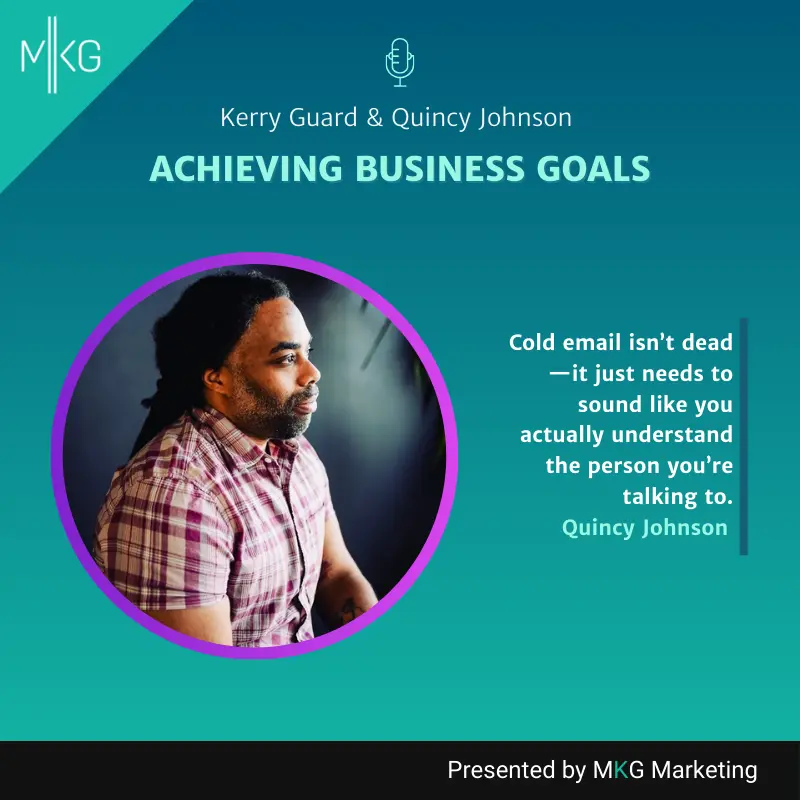
Quincy Johnson
Quincy Johnson is a marketing ops expert with nearly 20 years of experience helping B2B teams drive revenue through data-driven demand systems and smart, scalable execution.
Overview:
In this episode of Back on T-R-A-C-K, Quincy Johnson joins Kerry Guard to explore why marketing operations are mission-critical for startups and small businesses heading into 2026. Drawing from years of hands‑on experience, Quincy shares how poor planning leads to broken attribution, unreliable reporting, and missed growth opportunities—and why ops needs to be in place before systems get messy. Together, they explore the shift away from spray‑and‑pray marketing, the real role of data in decision‑making, and how cold email, nurture, and newsletters work best when powered by clean systems and thoughtful frameworks.
Transcript:
Quincy Johnson 0:00
One of the challenges that happens in these situations is that your system becomes so mangled, and you're like, why can't I tell where my NQLs are coming from, or where my leads are coming from? Or, like, how come the reporting is off, or how come things are messed up? And it's because, as the artist that you alluded to, like, a lot of times, before I even pick up an instrument, I think about frameworks. I think about, like, how the thing is going to go into the song, what's the song that I'm trying to write, and things like that. So you do a lot of the pre-planning before you actually touch anything, versus the hey, let's just stand stuff up and, like, do these things and put leads in here, and it'll be fine, right?
Kerry Guard 0:49
And we're live. Welcome back to the show, back on track. We are here, kicking off the new year with one of my faves, one of my faves. Quincy Johnson joined us on Tea Time with Tech Marketing Leaders many moons ago, and ever since, I've been on a mission to work with him, and we have figured it out. And for the last few years, we have teamed up across multiple accounts and helped them bring their marketing ops to tier one quality. And we're going to walk you through all of that before I dive in, just a little background on our friend here, Quincy Johnson, a good friend of mine, as I've already mentioned, is looking for my notes. Here we go, joining So joining me is a man who knows a thing or two about rhythm and flow. Literally, he's a former musician turned marketing ops heavyweight. He is the owner of Magnetic Theory Consulting, a lecturer at YouTube, Dallas, UT, and the host, or previous host, we'll have to, I wonder if the show's still going. Quincyis gonna follow up on that compound growth marketing show. He's here to help us tune up our engines for 2026. Please welcome Quincy Johnson to the show. Quincy, as always, welcome back.
Quincy Johnson 1:57
What's up? Thank you for having me. I didn't know how embarrassing that intro was gonna get. So yeah.
Kerry Guard 2:04
Love my intros. Are you still doing? Are you still podcasting?
Quincy Johnson 2:09
I am not. I'm in the process of revamping and thinking about the subject matter for the podcast that I want to launch. So yeah, it's coming soon.
Kerry Guard 2:19
I'll be following up with you on that, for sure, for sure, we got a tight 20-year, y'all, so I'm gonna, I'm just gonna dive right on in Quincy. Let's start with a reality check. When you look back at 2025, what was the one marketing best practice that actually stopped working? And looking ahead at 2026 What is your number one prediction for where the biggest opportunity lies for small businesses?
Quincy Johnson 2:44
Oh, man, that wasn't a big question. Oh, I, yeah, no, that's a really good question. The thing that stops working, I would say, blanketed, demand, Legion tactics, and like, the generic, right? Like, so, like, we're in this age where we can get there's data everywhere, right? And so the people who don't really know their target, like Target ICP, aren't really speaking the language of the people that they're trying to speak to, and they're just trying to do the spray and pray, like in marketing, cliché turns right. Like, I think people are really starting to realize that everybody knows they're being marketed to. And like, I want to understand and feel like you're talking to me and that you understand me. And so like, I think what I've seen is the realization that that's not a thing anymore, right? And then, like predictions for 2026, I think people are going to be, are going to be able to be a whole lot more efficient with processes. And I think like that efficiency will lead to, like, how we can be more thoughtful about those kinds of personalization things, and how we can get out of the mindset of one of the things that I dislike, and especially in performance marketing, you probably know this is like reporting to clients on impressions. Oh, we got like 50 million impressions. And like, your campaigns are doing great. And it's like, well, what does impressions actually mean? Yeah, what does impressions actually mean? And so getting comfortable with, like, okay, cool. Like, we only got maybe 500 impressions, but think about the quality of traffic and the people that are coming through our funnel, etc.
Kerry Guard 4:38
So, yeah, yeah, I would say, you know, the blanket marketing tactics are definitely didn't work in 2025 are definitely not going to work in 2026, but did they ever work? Not at all. Yeah. I think it just became very, very clear. Were like they weren't ever working. And it's very, very clear that they're definitely, yeah, they're not working. Love it. Data is definitely going to be at the forefront of everything. Data was always at the forefront of everything that we've ever done. And in working together, it's definitely become sort of the backbone to, you know, all the questions that we sort of ask each other of, of, why is this important, and where is this going, and what is the data telling us of how to make this better? And I think we'll get into it, but I think AI is going to be an interesting role in that. Let's talk about, you know, you and me, working together, we primarily help smaller businesses and startups who often think operations is, you know, a word reserved for bigger corporations. Can you define the role of marketing ops in a startup or small business, and why it's dangerous to hire your ops too late?
Quincy Johnson 5:56
Yeah, oh my god. Like, this is a really amazing question, because I have worked with a startup recently. They were under like, venture capital, right? And so, like, a lot of times in those situations, like the Capital Partners are just thinking about getting stuff off the ground, they're like, we don't really need this, or we don't really need to do this, or just upload this sheet here and it'll be fine, and we can figure it out later. And so, like, one of the challenges that happens in these situations is like, your system becomes so mangled, and you're like, why can't I tell where my MQLs are coming from, or where my leads are coming from? Or, like, how come the reporting is off, or how come things are messed up? And it's because, as the artist that you alluded to, like, a lot of times, before I even pick up an instrument, I think about frameworks. I think about, like, how the thing is going to go into the song, what's the song that I'm trying to write, and things like that. So you do a lot of the pre-planning before you actually touch anything. Versus the hey, let's just stand stuff up and like, do these things and put leads in here, and it'll be fine, right?
Kerry Guard 7:04
So it will not, it will not be fine. I mean, that was one of my favorite projects that we worked on. I tell this story all the time. Quincy is my marketing ops guy for the law firm that we work with. And the very first thing we did, and the thing that really propelled their 2024 growth at the very end of the year, was marketing ops. I was like, All right, Quincy, they're sitting on 12,000 contacts. What do we do? And we just shook that tree with some nurture sequences. We revamped their newsletter. And the end of 2024 did better, 26% better year over year, giving their year 12% boost because their first half of the year had just broken even. So, like the the too late is definitely an is a problem, but also kind of an opportunity, if you look at it from that lens.
Quincy Johnson 7:59
I was gonna say, I think one of the things, and sorry to interrupt, I think one of the things that's very interesting is that, like, you want leaders need to be able to tell the story as to why things are working right. And like, you can't tell, like, if your ops isn't set up, or if you're if it's not funneling the right way, your reporting is going to be crap, right? And so like, you're not going to understand why what you're doing is working or isn't working, or all these false signals, and like, should we test something else if the piping is out there?
Kerry Guard 8:28
So let's talk about attribution for a second, because I literally just had this conversation with a client. Hi, Trevor van Warden, appreciate you're here. Yes. Yes. Ops, early for the win. I literally just got off a call with a client because he was like, I don't understand. I'm looking at this for I'm looking at this report, and it says that we booked 20 meetings, but we have 23 qualified leads. So if I do 20 divided by 23, that's kind of insane. So you're telling me that we booked like 90% of leads? I'm like, No, we didn't book 90% because the leads that booked this week probably came from previous weeks. Looking at it from a week-to-week basis is actually incredibly misleading. We only booked 13 this week from the 23, not 20, and he just couldn't quite like wrap his head around it until I showed him a dashboard and walked him through it. But let's talk about data and the importance of it being right, and how to even look at it. So how do you walk clients through? How do you how do you explain this notion of attribution, and then making sure that the data is correct, correct and then B, how you look at it?
Quincy Johnson 9:40
Man, these questions are crazy, by the way.
Kerry Guard 9:47
Your brain is working. Oh, fired it off.
Quincy Johnson 9:50
Yeah, like one of the things that, as we think about attribution, and I love this, because I think a lot of clients, or a lot. Of companies get stuck in this, the last touch thing, right? And it's like, okay, cool. So it's the last touch, and it's time-boxed by this week, and it's like, okay, cool. So, like, this week we're up on conversions to the thing, and, like, it's paid blah, blah. And then, like, last week we were down. And it's like, the question I always have, and I always try to relate, is, okay, did these people come in last week and now they're converting this week, and so it looks like it's up, or like, what's the cohort? When are they coming back? Like, three months later? Like, is there some way that we're tying the things back to? Like, try and identify the user and their path, and then try and predict signals of like up and down and frequency, source, and channel. To know that like hey For if, if we look at all our closed bond deals and where their original sources and where their last source, last touch is, and before conversion or whatever, like, we know that, like a lot of people come in on like meta, for example, and then they end up closing on email, or maybe they close direct digital on the site and so and things like that. So like refraining from like this last touch in this, like time box, and like week over week, and like, Oh, we're down, oh, we're up over down again. It's just, I think is the biggest thing that I do for clients, right?
Kerry Guard 11:23
So, yeah, yeah. I think trying to understand, I always look at the way I look at it, and you're gonna tell me if I'm right or wrong, which is gonna be so great, because you're totally the expert in this. And I'm flying by seating my pants when it comes to marketing ops. But the way that I sort of approach it is, what created the lead? Yep, where did, where did they come from that actually, like, help them do a thing. Was it booking a demo? Was it downloading? I know some people still don't download. Some people do. Was it a contact form? Like, what created the lead, and from what channel, and from which piece of content thing, and then how many touches did they need? And what were they looking at, and what was their journey that creation to then actually booking, and how do we recreate that over and over again? How long did it take? And how do we make it shorter? Is sort of how I think about attribution, but it's really hard, especially for smaller businesses are a little bit more transactional. Man, it's really hard to help them. Sort of, should they care like we as marketers care about that? I think a lot of the times we get this, where marketers sort of get a quote, unquote bad rap, is because there's a lot of things we care about that. Do we really need to be having that conversation with CEOs and board members, or, you know, how do we make sure we're telling the right story without confusing them? But then also, like, what should we pay attention to versus what we should be telling the board, man?
Quincy Johnson 12:48
And I'm gonna go really vibey here, and I think that, like, the board only cares about, like, obviously, like, are we making revenue? And are we putting our energy in the right place, right like, and so, like, if we can get to be like, hey, like, all our like, we're aware of our surroundings. We know where energy is flowing in and out. And like, maybe we should invest more here. And like, relating. And again, this goes back to why you need ops. Is because, like, we can take that of our close one opportunities, like, where are they coming from, where, like, is like, the the cost per cost per acquisition, like, cheaper, like, and more efficient. Or is it actually even more efficient? Or is it just look lower because, like, the quantity, etc, and things like that, and so, like, just leveling up, being like, Hey, we should spend more energy here. This is where we need the investment. Like, based on this investment, we can likely forecast this amount of return, like, based on those efforts, right? So I would, that's how I would relate it up,
Kerry Guard 13:55
up level. So, yeah, forecasting for sure, I think, is pretty magical, but you do need all the data behind it. And I think it's really hard to, you know, people ask us for forecasting all the time, and it's like, we need, we need all your we can give you forecasting, but we're going to need all the data to help us get there. Marketing Ops is definitely the keys to that castle. Let's talk about the Holy Trinity, cold email, nurture, and newsletter, at least. I call this the Holy Trinity, because it's the three things that you and I have touched across all of our clients, to some degree, cold email with AI flooding inboxes. How do we stand out right now in terms of a is cold email I got on a pedestal of a year or two ago, and I said that cold outreach was dead, I retracted that since, because I feel like I actually responded to a couple cold outreaches recently, because they were so spot on, it actually probably should have terrified me more than anything that it was so spot on. Yeah, but I feel like with AI, it's making a resurgence and getting better, and sort of making this comeback because of it. How? What's your, you know, your I can only talk about this from my personal experience and a handful of clients. You're seeing a lot more than me being the expert here. So you tell me is a was called meal email, almost on the verge of death, and now making a comeback, was it never actually never actually dead. And what should we be doing in terms of cold outreach these days?
Quincy Johnson 15:27
Given AI, yeah, I think it's, yeah, I was gonna say, I think it's a mixed bag, right? Like, and so, like, I think it works if we go back to this data thing, or, like, understanding your ICP, it works if you actually understand who you're trying to talk to, right, like, and then you truly know, like, your brand, your product, your customer pain points, like, in and out, and you can kind of speak to those. And I think it's really funny that you brought up, that you responded to a couple, because like, the ones that you responded to, like, again, they knew your pain points and then so that caused us, as we're working on like sequences and things like that, for together, like, to be like, hey, like, I know what our pain points are based on, like the people that we have as customers, again, closed one data. We're taking that insight, that first-party data, and then we're trying to poke and prod at those kinds of like pain points to be like, Hey, I'm speaking your language. I know where you probably are hiding in under your desk, trying to figure out how I'm going to make things work right now, just give us a call, sort of thing. And so, like, I think that, I think that's the big thing is, like understanding, like, who you're trying to talk to, and I don't think it's dead. And I think with the AI thing, I think we have to build in things to catch signals, like there are people who are doing intent, like they're searching and like they're surging on these things, they're on your site, they're digging around. And if we can identify those signals, and we have a system set up, like, I think that is, like a warm, essentially, prospect, so it's not really cold email, but you've never emailed that person before. Like, Hey, how can we take that signal and be like, not creepy, like, I know you're digging around, but like, to that point, like, I understand, as we talked about, like the revenue chasm, I think, is what you called it, right? Like, and so, like, we know that you're probably in the situation and you're looking for growth and things like that, still speaking that language, but knowing that they're they're researching, right?
Kerry Guard 17:31
So, yeah, yeah, I do. I have to say, as somebody who's been, you know, we've been working for a while, and we've wired up a couple of cold email systems for clients, and knowing the ICP is the absolute most critical part in terms of those signals. And I can attest that having a marketing ops person is especially helpful with all the tools that are out these days, like they're i It is a forest, and you need an expert, like, don't just think you're going to start standing up a cold email outreach campaign. And there are so many nuances to just making sure that the emails are correct and that you're not going to blow up your domain name. And there's just and then making sure that you have that right ICP and that right audience. There's just a lot to it. I've watched Quincy behind the scenes, wiring it all up and, oh, man, I'm so glad that I have an expert at my wings. Please, please, please, for your own safety, if you're thinking about cold email outreach, definitely bring in an expert to do it. It is, it is hard. It is hard to get right. I gotta say, like, it's almost, it's almost harder now, thanks to AI.
Quincy Johnson 18:53
Yeah, and I think one of the things that's actually very interesting to that point is, like, there is the sending of the email, and that's fantastic. But then, like, the orchestration of, like, once you get a, like, a signal or a bite on the line, to use a cliche fishing term, right? Like, how do you then engage or reel them in, or, like, soften the blow to where you can actually directly reach out to them and, like, a lot of like, what we've, we've built, is just the playbook of, hey, like, they're responding, they're engaging. I'm gonna I send you a task, Kerry, and I'm like, hey, you need to reach out to this person on LinkedIn, or you need to comment on the thing, or you need to engage and, like, sort of introduce yourself, so that they're like, oh, like, Okay, I'm putting two and two together, right?
Kerry Guard 19:38
So, yeah, yeah. I think that is really crucial, is that it, and it's everything we talk about at mkg, and by why it's so important to have an operating system, because it is never just one thing, and why I call it the Holy Trinity, because you have, and we're going to talk about the other two in a second, but you have cold email outrage, you have nurture, and you have newsletter, right? And the importance. Of all three of those, plus a multi-pronged approach. You know, love that Trevor's here because he's definitely on the sales side. So, you know, being able to ping your sales team to say this person is has opened the email they've been on our website. You know, go connect with them on LinkedIn and see if you can get a conversation going. Because they're they're warmer now, it makes that a lot easier to do.
Quincy Johnson 20:20
And Trevor was gonna love this. Hey, we need feedback from sales. Like, is this a quality person? Are you getting contacted? Like, what are, what are you getting from the customer, as far as, like, readiness and like, can we adjust the signal? And so I think it's always optimizing to
Kerry Guard 20:35
Yes, the iteration piece for sure, the date come back to the data, and making sure the data is clean so you knew you're what you're iterating on. For short. Let's talk about nurture. Where do people usually drop the ball? Here? Is it timing? Is it content? You know, a lot of times people will sign up for a white paper or some sort of download asset, and then, and then they don't. I've seen clients not do anything like, like, I said, we had a client who was sitting on 12,000 contacts. They were like, doing a newsletter, and that was it. So do you see that often where people collect email addresses like, it's, you know, candy, but then they don't actually, like, do anything? Pretty standard.
Quincy Johnson 21:15
I think people are confused about nurture versus. Let me punch you in the face with a product in every email. And so, like, I think nurturing is meant to inform, slowly, guide people upon their like, learning journey, right? And then, hey, like, we do offer this product if, like, blah, blah or like adjusting the nurture based on they're coming back to your site, you're seeing signals of like intent. They're going to like a pricing page. They're going to like resources and things like, and like, maybe it's now, let's do one-on-one outreach and things like that, and hand it over to sales. But like, I've seen a lot of companies, they just say, Hey, I'm going to sell, sell, sell every email and hey, buy, hey, book a demo. Hey, buy this thing. And I think that's where people drop the ball with nurture. They're trying to sell in every email.
Kerry Guard 22:07
I love that. I mean, we figured out what I what I love about our sequences of how we use nurture that I think is really thoughtful, is based on signals, like you've been saying. So we see a couple of signals fly. We assign you've done a great job of creating scoring. And then, based off of those being engaged contacts, then we drop them into a nurture sequence that's more around storytelling, so introducing what it is that this company does, and then telling clients stories around that, and then calling them to action over the, you know, the course of weeks. I just absolutely love that we've done. We do that. We do all these are the playbooks. These are literally the tracks guys that we run for all of our clients together, whether it's cold with nerd, with nurture, or with newsletter. Let's talk about the newsletter for a second, because I feel like that is a also another sort of resurgence, so to speak. Why is owning your audience and having a newsletter more critical in 2026 than just having social followers?
Quincy Johnson 23:07
Building a relationship? Man, like, I really think that, like, there's a lot of noise on social right, like, and so people are, I'll use like, the weight loss, the weight loss thing, just from like, a consumer standpoint, right? There are so many influencers, and it's like, oh, you can eat this, or oh, you can't have carbs, or oh, keto is the way, or oh, these things. And so, like, people get, like, distracted, like, in every way. And so, like focusing attention, like becoming a thought leader in your space. And I think that this is awesome for when we think about Ruth's house key in the fact that, like, they have a very niche product that requires a lot of education. And the thing that they do, like some newsletters, isn't all it's not always going to be relevant for you, but the content that comes through, I think, more times than not, like is stitched together based on phases of your life, right? Like, so you can be in this phase of your life, and I'm in my, like, early 30s, I'm starting to build assets, but now I'm seeing this information about, like, Man, I need to be planning like for a late stage in life and things like that. And so like, I think newsletters are fantastic, and we've even used news and others in that sense to stitch together into a nurture because it's like, hey, this person is engaging at this particular thing on the content poll for the newsletter, and now we need to nurture this person, right?
Kerry Guard 24:38
So, yeah, it's an awesome signal nurture the newsletter. I couldn't believe the power of what that newsletter did when we revamped it. It was, it was night and day, and in terms of, like, Monday's always our best day in terms of bookings, because the newsletter goes out on Mondays. So I know Monday is going to be a good day. But. So yes, I think that, and that's because of just that consistency of showing up and saying something really thoughtful.
Quincy Johnson 25:06
And I will, I will highlight that we did have to experiment with days of the week, of sending, because understanding our customer again, trying to figure out. So we went from Tuesday, we went to Thursday, Friday, and so like, yeah. So yeah,
Kerry Guard 25:22
and time of day too, right? So luckily, they're east coast. So we figured out that seven that 7:30am was spot on, and use that for all of our clients. Now all of our clients, our emails go out on Monday at 730 Eastern Time, and then we have a west coast we have a client, one client, who's also got a bunch of people on the west coast. So we sent a separate email for the west coasters at their 7:30 am because we just know that that's Mondays at 7:30
Quincy Johnson 25:46
Another reason you need ops to figure these things out.
Kerry Guard 25:50
You gotta test and learn, it's so the testing piece is just so critical in setting that up and knowing when you're doing what and for how long and what's happening. Oh, Quincy, this was not long enough. I could talk to you all day, but I'm so grateful that we were able to share some tracks with folks on how we got our own clients back on track in terms of their marketing ops. There's so much more that marketing ops can do beyond email. We focused on email because it's what we work together on but, but you should know that marketing Ops is just so critical. Quincy touched on the dashboarding and the data piece, but they're integral for that. If you have in terms of like the customer experience side of it, there's so much that marketing ops do, does in streamlining, and it just goes on and on and on. I could talk about marketing apps for days, especially with you. So thank you, Quincy, for joining me. We will have him back, folks. We'll have him back. But if you have any more questions in relation to setting up cold email, getting after a newsletter, or figuring out what that scoring should be for those nurture sequences, be sure to reach out to us. We are here for you, Quincy. Where can people find you?
Quincy Johnson 27:00
I am on LinkedIn, posting consistently, thanks to Kerry, and yeah, magnetic theory consulting.com
Kerry Guard 27:10
There you go. There you go. For everyone listening who wants to fix their funnel, be sure to reach out to Quincy and find him on his website. We are back on track to helping you build a better business. I'm Kerry. That was Quincy. Go execute on what you learned today and see y'all next time. Thank you all so much. You.
 (2).png)
 (7).png)