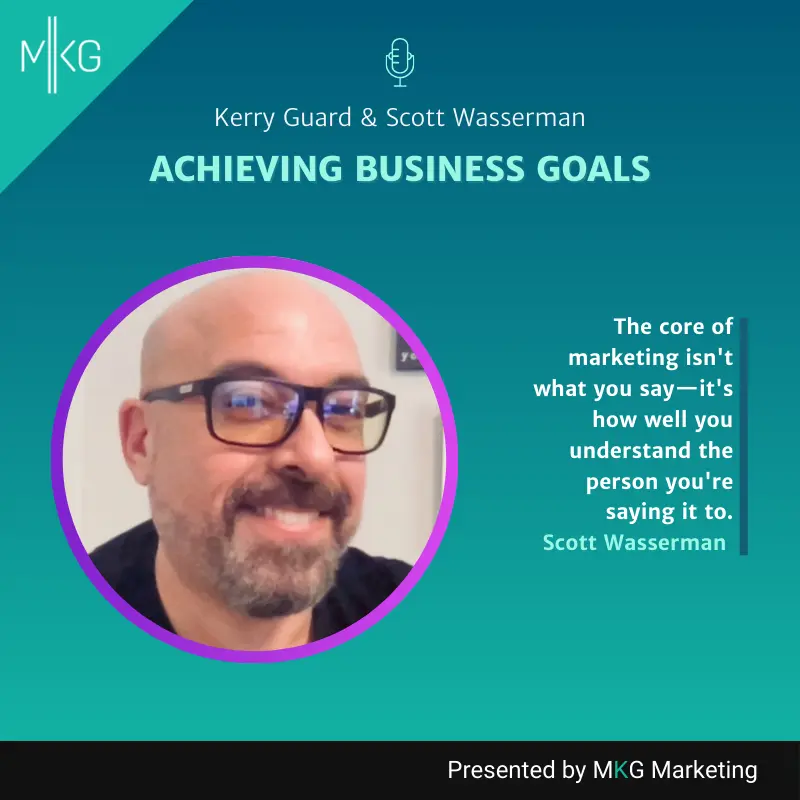
Scott Wasserman
Scott Wasserman is a SaaS marketing leader with 20+ years of experience driving revenue through data-backed GTM strategies, ABM, and AI-powered campaigns that scale.
Overview:
In this episode of Back on T-R-A-C-K, Kerry Guard sits down with Scott Wasserman to explore what it really takes to build growth systems that work—without chasing every shiny new tool. From connecting marketing, sales, and product to grounding strategy in behavioral data, Scott shares what he’s learned scaling revenue teams across SaaS. He dives into the role of AI (and where it doesn’t help), how to build trust in your GTM process, and why understanding your customer beats flashy messaging every time. If you’re building a lean, effective growth engine, this episode delivers practical insights that go beyond buzzwords.
Transcript:
Scott Wasserman 0:00
I am here to help you. I am here to not just guide you, but I'm also here to learn from you, you know. I mean, I want to know what you guys are doing. I want to know how you're doing it, why you're doing it, but not in a like I'm trying to judge you, you know, let's, let's hear what's happening there. Let's hear what's going on there. That's, you know, and also, just say, My door is always open, you know, going back to before, way before all this stuff. I owned my company. I know you're not the states anymore, but you were at the time. At the time, it was called Hair Club for Men. Now it's just HAIR CLUB men's and now men and men and women's hair replacement. And, you know, I hired a new admin. And the admin, I always said to people, my door is always open. Come in. I want your ideas. I want your thoughts. I want anything, you know, not I don't know at all. I don't know at all. So, you know, she was young, just out of school, very shy, and she said, I want to try something, you know? And I said, Okay, what? And she said, Well, you know, with these customers come in, and I don't remember the specifics, this is a long time ago. And I said, go for it. She's like, just like that. I'm like, just like that.
Kerry Guard 1:22
We are here. We are live. This is Back on Track, previously known as Tea Time, with Tech Marketing Leaders, and I am here today with Scott Wasserman. A little bit about Scott before we dive on in, Scott helps brands like AstraZeneca, Merck, and Roche close multi-million dollar contracts through data-driven ABM, launched advocacy programs that quadrupled LinkedIn reach, and used AI to streamline workflows without adding headcount. In this episode, we unpack how to transfer marketing into a true revenue partner, what modern ABM and dark social really look like in practice, and why leadership in the AI era requires both agility and empathy. Welcome to the show. Scott, grateful you're here.
Scott Wasserman 2:06
Thank you. I do want to clarify something, so it's not from what you said. It's a very nice introduction. However, I came in at the end of the ABM on Zenica and those different companies, so I can't, by any means, these guys did a phenomenal job. I was happy to be a part of it at the end. And, you know, but it was good, yeah, just to clarify, in case anybody's listening, it's like Scott didn't pull all this.
Kerry Guard 2:37
Scott, stop taking our credit. No, I appreciate the clarification. And Trevor van Warden, welcome to the show. Appreciate you, Trevor. He also enjoys the sound of his voice, and has worked at Merck his first sales job. So maybe your paths have crossed.
Scott Wasserman 2:53
I doubt it, but it's they're huge.
Kerry Guard 2:58
Well, this is a great a great time if you don't know Trevor, to go hang out with him, because he's a wonderful, wonderful, wonderful human.
Scott Wasserman 3:04
Nice to meet you, Trevor. Yeah, thanks. You know Boston, if you're a Bostonian.
Kerry Guard 3:11
He's a West Coaster. He's over there in Washington State. Yeah, little time zone action, but I'm sure it's lovely. Thanks to all this tech. We'll figure it out. If you're here with us, be sure to chime in. We love your questions. We saw some popping up in before we were even live. People were fired off questions. So we'll be sure to circle back on those. But yeah, Scott, you ready to get after it? Let's do it all right? We'll start off with a quick game. It's called scale or scrap. So I'm going to read five modern marketing tactics, and you're going to have 30 seconds for each one to say whether you scale it or scrap it completely. And why Cool. Alright, cold email, sequence, sequencing in 2025, are you scaling it or scrapping it? Scrap. Why are you scrapping it?
Scott Wasserman 4:05
I've done it for years. I I was, I'm not a big believer in cold email, but all the adjustments I've made, you know, I believe emails, especially if they are cold, should be strictly text, very short, just two or three sentences, just enough to get them to respond, whether it be a positive or negative response, whether it be, you know, sometimes my aunts, you know, I read a sentence or two when I'd say, you know, just give me a yay or nay, if or whatever, if you want to hear back. You know, sometimes I'd hear it, and even if it was a no, it was a con. You know, they did connect. But, you know, cold emails usually mean cold, you know, cold leads, you know, they really are, and that's, that's, that's not the way I like to go about this. Demand Generation is inbound. Demand Generation is going to where the clients are. People don't like getting emails, especially. Solicited emails on a regular basis. I know, I don't even, no matter how small they are. You know, of course, back I would, you know, back in the day, we all sent those long emails with 15 links and everything else. Those get dumped, and attention spans these days. They are ridiculous, but still, they weren't requested. And if they hear your company, and hear your company because you're slimming with them with these cold emails. I don't for myself. If I hear that name, I'm like, not crazy about them. You know, they keep bombarding me, all right.
Kerry Guard 5:31
Well, drop it in the comments, folks. If you are a fan of cold email, I have some thoughts, but we'll circle back on it. Scott, LinkedIn, employee attribution. Oops, sorry. LinkedIn, employee advocacy programs, are you scaling it or scrapping it? Scaling?
Scott Wasserman 5:44
Ooh, scaling. Yeah. I learned about employee advocacy several years ago. You know, it was always marketing, and sales were what drove the company. Some, of course, lean towards sales. Some, of course, lead towards marketing. But the reality is, people, entire companies should represent the marketing. You know, the entire company should be going after it. So if you can get, especially from, you know, top level down, C level down, to buy into the concept of going onto a platform that marketing sets up, that their employees would opt into this, and when they opt into this, let's say we talked about Slack before, I think, before we get on and teams, you know, they'd be set up for it. We write all a little bit of content, and then they would go ahead and just, yeah, I want to, you know, this would pop up and just say, Do you want to post this on your page, not the company page, on your page. And of course, now there's a little AI where, you know, you can jumble around the what's written. So not everybody's writing the same thing, but it works. I mean, the idea is building a brand. The idea is getting everything out there. And you know, a lot of people they see pages. They see a company page as a marketing page. But let's say, okay, let's go back to that cold email a second. Let's say somebody did get a cold email, and somebody actually did look at it, and it's from there, and it's so they had five seconds. They might say, Let me look this person up. If they haven't posted in 10 months, they're going to say, Who is this person, but if they are posting on a regular basis about the industry, the business. It really shows them that they know what they're talking about. So that's on the sales end, usually, you know. But it also spreads. It goes wide, it goes deep, you know. And it gets the conversation going, because people like to talk to people. People buy from people. They want to buy, they don't want to be sold, and this allows them, and it's not like, you know, one other thing I'm against, and I'll slow it down here, because I can go on in this forever. It's like a passion, you know, when people buy, you know, yo, what's, what's the typical thing? Call to action at the end. Call to action at the end. No call to action at the end. Just get comments. See, just like we're doing right now, get their feedback, see what they want to say. Do you have anything you want to say? And that's something that the teams can follow and see. You know, what might be a high-intent lead over time?
Kerry Guard 8:12
Yeah, it's, I've been hearing a lot more about it. I'm hearing a lot more about it all right, we're gonna keep moving dark, social, attribution tracking. Yeah, that seems to be it.
Scott Wasserman 8:22
Something I'm still it is something that I guess can be, you know, attribution platforms, attribution settings. You know, for a while, the whole thing was, you know, everything can be automated. Everything can be automated, you know, through paid ads, whatever, whatever you're doing. So just as an example, but attribution for in the dark social era, meaning, you know what is dark social? Dark Social basically means that people, again, want to look at different areas. They're not just going to your website anymore. They're on podcasts. They're listening to people. They're talking to people. I heard this before, and I mentioned this the other day. It's like being a better to a private party and discussing this with your friends, talking about it, and getting ideas and getting input. Now there's no way to automatically get information about that. There's no way to know if a person is high intent from that yet. Then you can sit there and, let's say, take a podcast, break it up into snippets, and in those snippets, you post it in different places, not just on LinkedIn, but, you know, where are they? They could be on Facebook, they could be on Twitter, they could be on Insta. They could be on TikTok and putting those out there as well. And again, watching for the con, you know, watching the conversation, and in doing so, by the time they get to your website. Because, you know, by putting a paid at old school, paid ad, download that ebook, which really needs to go by the way of the dinosaur, download that ebook, free, free, free. And then what was considered to be an MQL turned into, because, you know, senior, senior level would sit there and say, we need more MQLs. So what company, you know, what departments would do is take that lead into. Earn that one lead into an MQL, why? Because I couldn't sleep last night, and I wanted to download an ebook at two in the morning, and all of a sudden, the next day, I get a phone call talk about turning me off. You know, it's like, I just wanted to see what you had, man, I couldn't sleep. I just want to see what was going on. That's that, you know, that's it.
Kerry Guard 10:19
Yeah, I think I actually had a really interesting conversation two days ago where somebody wanted to know what revenue was generated from the leads created that month in that month. And I was like, it's going to be a sliver, a fraction, because it's actually mostly from all the leads created from months and weeks before. So it that's that's not possible. And like, he wanted to turn off one of the programs, and I was like, but we can't measure that, that's true. Like, Google is going to capture all of the actual revenue, like, we can't say whether that program is or isn't working. What we can say is whether brand search volume went up, which did, and whether that, you know, the volume of leads went up in general, which it did. So I'm kind of afraid to turn that program off, because I think we're going to see everything they go down.
Scott Wasserman 11:20
Well, you know, it's, it's to that point, it's, I'm glad you brought that up, because, you know, again, years ago, paid ads, and if you weren't getting two to three to one ratio on a return from that paid ad, then you're wasting your money. I mean, even today, it's like, if you're not getting one, you're wasting your money. But again, people, when they are looking and researching, they know what paid ads are. They know it's going to take you to their site. Your site is your store. Your site is a selling tool. They don't want to go there. They want to research certain things. So they might eventually hit that paid ad button, but it could have been their 20th touch, not on their, yeah, not for the website, but they've been reading and talking and listening and, you know, I would rather a team that I work with or develop, or whatever. I would rather them receive, let's say, a sales team. I would rather them receive 20 high intent leads per week, as opposed to 100, it's, you know, throwing out these numbers, as opposed to 100, where it's a needle in a haystack, and focus on selling, not focusing on prospecting. Does that make sense? It?
Kerry Guard 12:35
It does. I want to get into it. We're gonna, we're gonna circle back on this, folks. So you worry. I agree that I think if you have enough leads, then they can all they have. All they have to do is sell because they are book solid and they're they're busy, exactly not busy, and they're not book solid, then I do think there's an opportunity.
Scott Wasserman 13:00
I'm not saying, yeah, I'm not saying outbound can exist. Absolutely, of course. But when they come in, in bond, you know? And this was a, and I hope I got these, these reference, these numbers, right? Gartner, I believe, put out a study a couple of years ago where, I think it was over 80, 87% over 80% of C-level and VPs do research all over the web before they get to the site they want to get to. So when they get to that site, and they ask for that demo, or they want to talk to somebody, they're already, in a sense, 80% done. They've done their work, they've done their research, because this is how they like to buy. So when they get to you, it's like, okay, I this. I know all this stuff now, I just want to hear from you. Hear from you, and hopefully it's a higher intent lead, and they're selling. They're not just prospecting.
Kerry Guard 13:47
Absolutely, at that point for sure, at that point for sure. And I think the thing that really is allows for that to happen is the brand-building piece. Oh man, getting off topic here, folks, I'm sorry. We're on, we're on.
Scott Wasserman 14:02
That's my fault. I can, I can first.
Kerry Guard 14:06
We're gonna hang here for a second because I think, I think it's interesting. You know, I'm working with a client right now, and they don't have to do prospecting because and they're so busy, because we've done a really good job. But it took, I'm not gonna say it didn't take a while. It took the last 18 months to do it. But now there's so much brand initiative, initiative out there that somebody actually drove an hour and a half to sit down with this law firm and said, I'm coming to you because clearly, you're the guru about this stuff, because you're everywhere, right, right? So when you get to that point where you know you don't, the selling sort of just happens naturally. To your point, I think is what you're saying. Like, when they show up, they're 80% sure that this is where they're going to go, and they're just showing up for that final 20% it isn't a selling conversation. It's a here's what I'm they come very prepared. I think I had this lovely woman on my show called Heidi, and she was like, they come with very clear questions. They know exactly what they're looking for. There isn't a lot of selling. That's where it needs to happen. This is a demo. This is a validation. This is a whether they're going to move forward or not. It's pretty hot and dry at that point.
Scott Wasserman 15:08
You know what's interesting? The attribution on that the easiest way to set it up the most just simplifying this whole thing. Years ago, you know, we used to ask, How did you hear of us? And over time, that kind of dwindled, because we knew what we thought. We knew what we heard from them. They got to our site, they went ran a blog. They, you know, paid ad, but they might have seen a clip on, so they might have, you know, seen listen to the podcast, whatever. So now I try, when I recommend that people create these forms, add one more question, and how did you hear of us again? And let them tick it off. So this way, we might say, you know, we're not getting a lot of hits on TikTok. So even though a lot of B2B is on TikTok these days, you know, we're not getting a lot of hits. So let's not focused on that. Let's focus on the ones that we are really getting some responses on.
Kerry Guard 16:04
Yeah, that's a great Anne Gote, who was on my show earlier this year, was very much all about that form field and getting that, getting that on there, for sure, and it's really cool when you see, like, when people respond with like, a paragraph.
Scott Wasserman 16:20
Oh, when they Oh, yeah. In addition, right, right, I've left, like, an open field before to see anything else.
Kerry Guard 16:25
Yeah, it's just really cool.
Scott Wasserman 16:28
The other night, and they told me about you, you know, or GBT
Kerry Guard 16:32
Or they went on to chat GBT. And here was the prompt that they used, and here's how they ended up, right. Like, more when you leave it open-ended, and not just a drop-down of like, where you think they came from.
Scott Wasserman 16:42
Like that is going to tell you that's going to be the goal, to really start getting into chat, GPT, because even if you go on, I mean, was it Gemini on Google, if you go on to Google, what happens, you know, the days of front page. And when I saw, I saw somebody sent me a thing the other day on LinkedIn, you know, an advertising agency or something, and it said, We're going to get you first page on LinkedIn, I'm sorry, on Google. And I was like, is this 19? Not 19? Sorry, that's bad. Is this 20? You know, 15. I mean, those days are gone. Those days are done. I mean, the majority of that of that page is all, you know, it's all AI.
Kerry Guard 17:26
I will say, though, I will say, as an SEO company, and our expertise in POV on that, is that while the first page isn't important, or being number one or whatever, isn't necessarily, quote, unquote, important, the same fundamentals of getting into those llms still apply, right? So being number, you know, in the top three for your primary keywords should be a good indicator of whether you're going to show up in those llms or not.
Scott Wasserman 17:49
Well, and that's something I'm still studying to see how that works, and that's the because SEO is still critical. I mean, SEO, especially for your site, you know, blogs, blogs, blogs, you want to get more new content in there, but it really is more so for content, it's, it's, you know, I'm sure you've seen this also, you know, you can write the best blog in the world, shorter, longer, whatever. But what's the bounce rate? Typical? 89 no one will sit there and read that blog, you know, video.
Kerry Guard 18:18
Or they will, and they'll, they got what they wanted, and they leave.
Scott Wasserman 18:21
Right exactly, you know. You know, the goal years ago was to get them on the blog, use internal links, get them to another blog, get them to, you know, call to action or something. But that's not the case anymore. And of course, the comments at the end of the blog, you know that when was less.
Kerry Guard 18:36
Yeah, haven't done comments in a long time, and
Scott Wasserman 18:40
They were usually bots anyway, that wound up after a while, right? But now again, take those blogs, take those articles, put them on LinkedIn, then you'll hopefully see content and people responding that you're going to see, but other people are going to see, yeah.
Kerry Guard 18:58
So the syndication piece is definitely huge in the mentions across the web. You know, PR, if you're a PR firm, you're you're in your heyday, because getting into llms, it's important to be mentioned across the web in a multitude of ways, in a positive, reinforced way too. And so PR firms are definitely where we're sending when people talk about link building and getting into llms, it's like you need to do all the technical SEO best practices, and that's where we sit. And you need to go get a really good PR firm who can make sure that you're being mentioned throughout. So yes to all this. All right, Scott, let's get into some of these questions I have around leadership and career insight, strategy, demand, generation, AI, all the things. Here we go. You've spent over 20 years leading marketing in SaaS. What's changed most and what hasn't?
Scott Wasserman 19:50
I think what's changed most initially, when I first got into this, and this is around 2009, I believe. So I guess is that really, it's not really 20 years yet. I've been in marketing since. I was going back to college, and my previous career, and I was still very active in marketing, but marketing has changed. Actually, a guy did a podcast with last week, he was talking about, he pulled out his old marketing book from college, and how just none of it applies. It's just nothing at all. So fast forwarding. What has changed over demand? Well, you know, HubSpot was my go-to to that's how I started to learn. There were no training, there were no classes. Back around 2009 or 2008, It was what was out there, and HubSpot was putting out so much collateral, I mean, webinars and content, and that's how most people learned. And that's when I started to become, I became a reseller for HubSpot, and they're the ones that really came out with the term inbound marketing. Marketing qualified leads. Sales qualified lead. I want to say ambassador, but influencer. What's the other word I'm missing? I forget. But you know, just speaking out on behalf of your company because they're happy, yeah, on behalf of your company. So that is the same concept. But, you know, MQLs these days. I mean, I'm on the so tired of the MQL bandwagon, you know, it's because companies are just saying, like I mentioned earlier, you know, oh, here's your lead. That's an MQL. Not so much, you know, not so much. It may make your MQLs look good to somebody else, but what's the bottom line? Revenue? That's all it really comes down to. So get them qualified, get them out there. Get, you know, get, get them to come to you when they are ready. Go to them. Let them find you after you go to, you know, after you show them that you're everywhere. That's so, as far as what else has changed? Gated content. You know, another way to get a great lead, you know, gate, all those ebooks, get all those, you know, on demand, webinars, gate, everything. Sometimes people just want to see it. They don't want to sit there and, you know, have to, Oh, I gotta give them my name. And okay, first, you could put the email address in and make it a wrong email, because it's going to pop up on the screen. We know that. Then we said, Okay, well, they now we get to send it to them. They really want it. We got to send it to them. So we need to really email people don't like that either. They want to be like, almost like a ghost on your website.
Kerry Guard 22:10
Yeah. I also think tools like six cents and things that help you know, they've opened that up where you don't need, you don't need their email address, because you'll capture it at some point, if you don't already have it, right?
Scott Wasserman 22:22
And ABM, I'm, you know, I love ABM. ABM certainly has its place, but I do believe that by doing all these other things that we're talking about will help ABM in the long run. You know, it really will, because now it's going to start pulling those high-intent leads, especially when they come to your site or go to other places that you can post on. You know, on the platform.
Kerry Guard 22:43
What drew you toward fractional leadership after a career in executive roles?
Scott Wasserman 22:48
It's more than I like to build and help companies build something for nothing. You know, when I see companies doing things that may not be right, I might reach out. They might reach out to me, but it'll help me give them ideas and help, you know, guide them on what they could be doing, what they should be doing, and that fractional could be. You know, I've done simple, just freelance stuff, where it could be, hey, can you help train? We have a bunch of new people coming in. Can you help train them? Hey, you know, you've been working with HubSpot now, since, you know, 2009. I was a reseller. I was a beta tester when they came out with the CRM. You know, can you help them with that? Help us get set up with that? So it's allowing me as a marketer to do things with different companies. Why? Because companies look at marketing, in my opinion, in many cases, not all, as a luxury. It's a luxury to them. If the they feel the economy is having issues, if they feel the company is having issues, they look at, oh, well, we better come back on that marketing and let our sales team try to sell. That's what, that's
Kerry Guard 23:55
What got us here, you know.
Scott Wasserman 23:56
And what happened, I have, you know, you and I caught, you know, I started to really start to network with different people. And you, you, and I can't remember if I reached out to you. You reached out to me initially, but I've been networking and talking to people and talking to people and talking to a lot of CMOs. And, you know, they said I could be out of a job tomorrow. You know, that's I've heard that so many times, or we just got back, or, you know, it might say that there's still somewhere on LinkedIn, but they haven't taken it down yet, or said I'm done because there was a big layoff. So it's more of comforting. It's more comforting to me that, you know, I can do what I want with certain companies. And, you know, sometimes a fractional could turn into a permanent position, and I haven't made that decision if I want to stick with that or try it again, because I've been with a couple of startups that just didn't work out so well. Really, you know, I go when they're just pumped up, I want to get up and, you know, be able to keep that passion running and help people tough to do that when you're with a company that may be dropping budget that you do need. Um. Might be, you know, cutting back on your team might be giving you two or three jobs, which, you know, AI can help with. We can talk about that later. Give you two or three jobs than you did before. So you're working three times as hard. It's different. And of course, the whole battle between sales and marketing, and making sure that everybody's on the same page.
Kerry Guard 25:19
I want to sit in the conversation, because I think it's so critical, and one that's happening more and more. And I felt this too. You know, I'm a founder of a company. I'm also a marketer at heart, but ironically, one of the things we did not invest in consistently was marketing, and we've been very dependent on referrals, and that's how we've grown, and we've grown very well from that, but it's very unpredictable.
Scott Wasserman 25:47
I hear that all the time. All we've been in business for 10 years, but we never really had a marketing department, because we've gotten everything off referrals.
Kerry Guard 25:55
Yep, and now the market changed, and things are happening. It's like now we are investing in marketing, but are we? The question is, are we too late, right? So I'm looking at some of these other companies. I just talked to this wonderful gal who started a rev ops company in the UK, and she's only nine months in, and she's already talking about how to market, get her marketing up and running. And I'm like, oh, man, I wish. I wish I had that mindset early on, when we started, you know, 15 years ago, because that is exactly what you need to be doing. So hats off to her, and I love what you're saying. Of it's just the validation of that I'm because I'm trying to help founders understand, like, even if it's just a fraction a percent, a small percentage of profit from last year that you can then put into this year, just to start right. Like, and it's untouchable. Like, create a little vote around it, no matter what happens to the company. You've invested this money in a marketing, and that's what needs to it's going to build that runway for you in the future. So protect it with your with everything you got.
Scott Wasserman 27:04
You know, and absolutely, and you know to that point also. And this is something that always bothers me, that if a company is not also investing in customer success, then what's going to happen? They're walking out the back door, there's even if they decide to say, there's no chance of, you know, cross-selling or upselling them. And marketing is hopefully doing their job and bringing new business in. So they always look at our profits are flat. Marketing isn't doing bobcas, you know, they're not doing anything, so, but yeah, you know, once I was, I was talking to a company, and that, you know, working with a company. I think this is one of the ABM things. And I said, you know, he contacted me. We were at the kind of one-on-one stage at that point. And he said, Yeah, back up a little bit, back off with them. I'm like, why? What's up? I think we're close to the finish line here, aren't we? And he said, Well, they're kind of upset with us right now. Why? Well, there's like three they have, like, 350 tickets out there that really haven't have kind of gone unanswered, and they're kind of mad. Or you hear they hate us right now.
Kerry Guard 28:13
And I said
Scott Wasserman 28:15
Okay, that's not good. You know, that's not good. And, yeah,
Kerry Guard 28:21
Yeah, it's a customer success is so, I mean, I think that's one of the things we did right is we have clients that have been with us for anywhere from three to six to eight years, where they keep, they keep, you know, they'll leave their current company and then they'll go to the next one and bring us on, and we kept friends at the existing one, so we keep them, and then we bring on the next one. And that's why we've been able to do this for so long. Because we do, we have an amazing account team, which is basically our customer success, and they truly put, you know, they do a really good job of balancing both protecting the team and making sure there's good like work-life balance and being proactive in communication with the client to make sure that they have what they need to be successful. And so, yes, I mean, you have to figure out what that front line is that's going to hold on to that client and meet them where they are, and if they can't, even if the ticket's not happening, because there's a backlog that there's open communication around where it is and what's happening with it and when it's going to get done. And what's the road map? And we got you, and here are some workarounds. In the meantime, is like, yeah.
Scott Wasserman 29:29
I was listening to a podcast the other day. Boy, I forgot the name of the podcast, but it's by a company, Refine Labs, which you may or may not have heard. Yep, I know. Yep, you know. Okay. And I was listening to Megan, oh my God. And I was listening to Chris Walker over the years. Also was the founder, and, you know, she said, You know, usually companies look at in this direction, shareholders. And I believe, I hope, I'm correct, if she's listening to this, shareholders. And shareholders. Customers, Employees, she flipped it, employees, customers, shareholders will last 100% that's the bottom line. You know, which I heard that I said that is a great simple, the simplest way to put it.
Kerry Guard 30:15
Same here, people. First, we take care of our team and our people. They will then take care of the customers, and then the and then.
Scott Wasserman 30:22
Hopefully the shareholders will be happy they're not always are, but hopefully they will be right.
Kerry Guard 30:27
Well, the numbers are going up to the right. That's all the exactly right, right? Oh my gosh, I'm so grateful we could just sit in that for a second. All right? Second last, next question. How do you quickly align so many questions so little time? How do you quickly align new teams when you're brought in as a fractional CMO or advisor? How do you get that trust so quickly?
Scott Wasserman 30:49
That's okay. What I like to do is, first of all, say that I am here to help you. I am here not just to guide you, but I'm also here to learn from you. You know. I mean, I want to know what you guys are doing. I want to know how you're doing it, why you're doing it, but not in a like, I'm trying to judge you, you know, let's, let's hear what's happening there. Let's hear what's going on there. That's, you know. And also, just say My door is always open, you know, going back to before, way before all this stuff. I owned my company. I know you're not the states anymore, but you were at the time. At the time, it was called Hair Club for Men. Now it's just HAIR CLUB men's and now men and men and women's hair replacement. And you know, I hired new admin. And the admin, I always said to people, my door is always open. Come in. I want your ideas. I want your thoughts. I want anything. You know, not I don't know at all. I don't know at all. So, you know, she was young, just out of school, very shy, and she said, I want to try something, you know. And I said, Okay, what? And she said, Well, you know, when these customers come in, and I don't remember the specifics, this is a long time ago, and I said, go for it. She's like, just like that. I'm like, just like that. You gotta try things. And she's like, You're not scared. I said, Let me I said, Put it this way. You're not going to hurt me. You're not going to hurt the company. So go for it if it works great, and it did. And what I love to do is to give that person the confidence to keep trying and keep going and keep looking at new things and keep testing. And as they grow, listen, if they stay with the company, great, but if they choose to move on, they learn something, and they're happy, and you can stay in touch with them, and they love what they learned from you and from the company, and also how the company treated them, yeah.
Kerry Guard 32:41
So good. I yep, yep. When I joined one of my clients about a year and a half ago, it was the salesperson that I felt like I ran over because I said, I'm here to I'm here for you, like I'm here to make your job easier, exactly. So you tell me what you need and what your ideal customer looks like, and who's easier to close, and you just tell you, and like, actually, we're hopping on a call later today because I want to launch a new campaign. And he's like, Can we? Can we? Before you do that, let's talk about the type of customer that shows up for that thing and see if we're actually aligned on this, right?
Scott Wasserman 33:27
Yeah, that if that customer profile is not there, then you know.
Kerry Guard 33:31
yeah, or if they're, if it, yeah, it's, it's got to be. I'm here to make his job easier. So if he's got a tough sell ahead of him, then what am I doing? Then that's not the right campaign.
Scott Wasserman 33:39
Somebody once said, an old boss once said to me, which I loved. It was just a simple statement she got. She said, How can I make your life easier? Great, open-ended question. I thought, you know, just great. Open-ended question.
Kerry Guard 33:53
Yep, that's what we're here for as leaders, isn't it? How do we make people steps? How I said that as CEO when I stepped in the CEO role five years ago, I looked at my team. We were in person in Denver, and I had everybody around the table, and I was my first all-hands, having stepped in as CEO, and I said, I want you all to know my job is to make your job easier. Yes, exactly, that's my job.
Scott Wasserman 34:17
Yep, it's not just sit there and say, you know, I don't like to micromanage. I don't want to tell people what to do and say, Do this, do this, do this. That's not my style. I don't like to be micromanaged either. You know, that's, that's not going to work for me, you know, and I've been, for the most part, I've had some wonderful, wonderful people that I've worked with that have never tried that or, you know, they respect. You do run into, especially in smaller startups, you get the CEO, you get the President, or somebody that maybe they dabbled in marketing in the past, but you get this one sentence that I hear. It's almost like the same one from all I'm on a marketer, but then that's it. You know, they want to throw you idea and. Like, listen, I'll throw all my ideas off of them and see what they like. But you're right. You're not a marketer, you know. So let us do our job. This is what you're paying us for.
Kerry Guard 35:09
Yep, I found that initially in engagements, people will come to you with all of their ideas and wanting to sort of continue to run the show, and then now and tell you how to do your job. But after building that trust and giving it time, it flips where they show up with ideas or asking the right questions, of like, okay, my number is leads. So for my client, as he's the CEO, and he's like, my number is leads, and just straight up volume. And your job is quality, of making sure that we're working together on this. But like my number, I'm not hitting my number, so what do I got to do? What more do we need to be doing so that I can hit my number? And it's just nice for him to sort of throw the question back into my court, and I can be like, Yeah, I know that's your number, and my number, and my number is quality, so I got to make sure that your number my number are working together. So here's what I'm thinking, right, and then we can go tackle it together. And so I, I love that he's now showing up with the right questions, versus saying, we're going to do this, we're going to do this, and we're going to do this, and it's like, like, he wanted to run Facebook ads. And I was like, we could try, but, you know, so it's, it's nice to now, like, have his trust in that, and it does take time, not gonna lie, but man, it's nice when that flips, yes, how do you balance? You know, you've seen everything from 5k to 1 million ARR contracts. What's the key to building a demand engine that scales across deal sizes?
Scott Wasserman 36:46
Okay, I'm going to say this, and I'll probably get from pushback on this, but not much. You're you're dealing you're dealing with people. You're dealing with a person. I don't care if they're smaller, I don't care if they're larger. If they're larger, if a company's, you know, if persons at a company, and, you know, their big deal is five grand a month, great, you know. But the other person's at, you know, looks is looking for a million. It's a million-dollar deal you're looking for. Now, yes, would it have to go through a lot of different people to get to that level? Absolutely, but you are still dealing with people, one-to-one. You know, it's not, you're not dealing with a company. So that's how I look at it. And I love to hear feedback from the your audience. I really wanted on that, what they think?
Kerry Guard 37:30
Yeah, drops. Drop some comments. But I would, I would agree that it if you have a good foundation of the of the of the best practices, then the scaling piece becomes a heck of a lot easier. And really, I would say it's the positioning and messaging, right? If you have that, and you have open space in the market that you're able to then take up, like, yeah, then it's just following continuously, following those best practices over and over again to fill that space, right? Yeah, you've, in terms of, I have so many questions here. I'm trying to I'm trying to be choosy, because we're running out of time. I know. How do you balance long-term brand building with short-term lead generation pressure?
Scott Wasserman 38:16
Tell when you say lead pressure, like coming from above, saying, you know, we need to, okay, yep, I'm very straightforward with that. I'm straightforward, whether I'm in a fractional position, consulting, or an employee, saying, "You got to be realistic about this." You know, short term, you're going to get a couple. Sure, but you got a brand, you got to do all these things, and you better be patient, because you're talking about at least six months before something seriously starts to happen. And if you're not, and you know, when agencies say, you know, oh, we're gonna rock this out, you know, we're gonna kill it, we're gonna do this, we're gonna that, get you all pumped up, and all of a sudden, it doesn't happen. And what are they gonna say, You lied to me, you know? It's like, well, you know? And then they now they're backtracking and saying, Well, it could take longer, just be upfront. And if they, if they can do it, and they're willing to do it, great, and if they're not, say, then, you know, something, I'd rather not take your money.
Kerry Guard 39:16
Slow, smooth, and smooth is fast. Yeah we, that's our mantra at MKG. And I could, I mean, we always want to try and find, quote, unquote, quick wins or low-hanging fruit, right? There might be some adjustments that you can make that like for us. For one of my clients, a few years ago, it was their email. They were sitting on a huge CRM and so, and they had a newsletter, but the newsletter was a p, it was really weird. It was basically a picture. And I was like, this isn't mobile-friendly. Nobody can read this, right? So we just revamped the newsletter, and now it's like one of the reasons why leads to, you know, leads from yesterday are conversions and revenue. Do today, right?
Scott Wasserman 40:01
Video Newsletters are wonderful there.
Kerry Guard 40:03
Yeah, that's a great one.
Scott Wasserman 40:06
Video is, and I have, I can't say that. I've tried it that often, but people love video. You know, people have video now, you know, I mentioned before, this is like my second guest podcast thing, and I'm kind of getting used to this whole dynamic. But so many people. I try to post at least three or four times a week on LinkedIn. And so many people have said, you know, if you just take that post and, you know, throw it into, you know, chat GPT or something, and get a script, sort of speak a quick whatever, just do a minute on what you wrote, and that will they, I think I'm not sure what they said the number was, but it could be four or five times the reach that you would have in comments than you would have if you just wrote it down.
Kerry Guard 40:50
I would say, too, that I haven't experienced that on LinkedIn, but LinkedIn has become LinkedIn.
Scott Wasserman 41:02
We're gonna want to get us off right now.
Kerry Guard 41:07
I don't know that they will. I don't, I don't know about LinkedIn, but what I will say is, the beauty of it is, it will be LinkedIn. And I would say, because now that you have clips, it can be anywhere. It can be, it can be on YouTube. It can be on TikTok, which is something you mentioned earlier, right? Like so that surround sound that now you can create with video and clips is so easy and so huge. So yes to that.
Scott Wasserman 41:35
And also, you know, think about it, 10. What year, 1015, years ago, you know, social media was really just, you know, coming up, and how was I going to put this? I really lost my train of thought. That's terrible. I hate when I do that. But you said, okay, the snippets, you know, taking those snippets, like we just kind of talked about, and putting them in all these different places, and, you know, finding out where they're reaching. Oh, I noticed them say, Okay, Google. What was the search engine? 10-15 years ago? It was Google, you know, that was it, you know, that was, that was the, that's where everybody went. But, you know, something, TikTok is a search engine. You know, Instagram and LinkedIn is a search engines. They're in all these podcasts, in a weird way of search engines. I mean, they're all, you know, all those, all that stuff in there is all optimized so people can find it. So these are all search engines too. It's not just Google anymore.
Kerry Guard 42:34
Yep, Sparktoro. That's why Sparktoro got started, right? Because originally, the founder of Sparktoro created Moz, which was primarily for Google, yeah, and now he's like, "but everything's a search engine." So let's figure out where your mentions are so it's across everywhere. Let's talk about AI for a hot second. Okay, y'all with us still. We have so many comments. Trevor's blowing us up over here, Trevor. We are going to follow up with you afterwards, comment away, and keep the conversation going. Don't you worry, because there's some there's some nuggets in there, especially from your sales perspective, which we always appreciate. In terms of AI, Scott, you've integrated AI into multiple workflows. What's one underrated use case every marketing team should explore right now?
Scott Wasserman 43:18
I would say metrics, and I would say presentations, you know, you know, people spend so much time on presentations, on spreadsheets, on all these things. AI can make these things so much better and so much easier and so much quicker than that, you know, you know, AI, in my opinion, first of all, it's, there were so many companies out there that are doing amazing things with AI in all different aspects, not just marketing in everything. There were also companies out there that feel, if they splash, you know, AI on the front of their web page, that they're part of the game. You know, you get that too. They think, if they're using ChatGPT, then, you know, that's, that's AI. AI, in many cases, is they're not all ready for prime time yet. You know, if you remember the days the center live, you know, not ready for prime time players, they're not ready for prime time yet. Not all of them. Some are, though, and it's only going to get better. It's only going to get better. And, but I already has, oh, without a doubt, but there's, it's a double-edged sword right now, meaning companies, you know, they again, senior C-level execs, you know, they, they look, oh, wow, look at this. Ai, we can cut our marketing department in half. How exciting we can save all this money, right? And then there's the other company, the other side that said, you know, oh, you know, has it on AI. I don't want my people becoming drones. I don't want them, you know, no, we're not touching AI. First of all, if you went into a company like that, in my opinion, run away because they're you. They're not looking at now in the future. But then there's also the middle ground, and that's where I think we should be testing different platforms, seeing what different platforms will do for you, seeing where you can maybe, you know, I would talk to a guy the other day who said, you know, we are actively getting involved in AI, and I said, tell me how it's working out for the team. He said, Well, everyone, of course, is panicking that, you know, they're going to lose their job, and I am not planning on letting anybody go. I am planning on making adjustments and changes, meaning these people will focus on this, and these people will focus on this, and so on. But I love that, because, you know, you still need a person behind it. You really, you really, do? You need a human touch.
Kerry Guard 45:47
You do. I actually said to my team, because they were talking about, they're talking about a content workflow, which we're totally excited to get out into the market in early January. And I said, this is awesome, and I love how you've streamlined it, and it's going to save you time. But how are you going to use the additional time to make it better? Right?
Scott Wasserman 46:07
Right? Exactly.
Kerry Guard 46:10
That doesn't mean we just flip this over and it's done, like, we could elevate this now, what's the next level of elevation? And they were like, oh, yeah, that's such a good point. And then they started, like, riffing on it was really cool. So stay tuned on that, folks, we're going to be, we're going to be getting our content ended up and running here shortly. And you're going to be fun to learn.
Scott Wasserman 46:29
I mean, it's fun to learn. It really is, and to do certain I mean, I just, you know, I would do all these things and, you know, all these prompts, and I, you know, get all these platforms to like, you know, know me and talk like me, but I still, even if, let's say I needed a content written up, I needed, you know, quick, and I need some, you know, just an email written up, or something just quick, I still go through it, review it, you know, make sure it does it is me, and then go, you know, or make the changes necessary. It's not like, you know, you don't want to sit there and say, okay, boom, boom, boom, boom, boom. Get all these words, Post-it, you know. No, yep, that's not. I think it's wrong, you know. I think it's wrong, agree.
Kerry Guard 47:12
And it's along those lines. I think when I think you're starting to hit on it, but let's just make sure we double down. How do you prevent AI from creating more noise or inefficiency instead of clarity? I'm a little worried we're going to have, like, what do they call it, a broken internet, or a dead internet, right, where it's just a whole bunch of bots talking to a bot.
Scott Wasserman 47:35
Well, that I was just going to say that, you know, a bot talking to a bot. So let's say, you know, you write an article. I'll use LinkedIn again. You write an article on LinkedIn, and you know, then all of a sudden, someone wants to comment on that article, but they don't want to read the article, so they'll copy it, put it into, you know, chat, and say, you know, write a 100-word response on this. Some people will say that don't use em dashes. That's the fun part of you know what's happening right now?
Kerry Guard 48:04
Oh my gosh. Which is funny. You know, having this conversation.
Scott Wasserman 48:07
I'm not gonna get into it, but you know something, Kerry, I've used those. A guy for years ago showed me what an M dash was and how to do it on, you know, my keyboard, and I used it all the time. Oh, me too. And now I feel like, Oh, I better take it out. You know, it's, it's.
Kerry Guard 48:25
Nope, I'm keeping it in.
Scott Wasserman 48:29
Yeah, I've always did. I always did, so you know. So to answer your question, I think it's just making sure it's all you, you know, making sure it's still all you, AI will take you to that next level. It can help better you, you know, and help bring out a better you, as opposed to taking over what you're doing.
Kerry Guard 48:53
Well, I wrote a post about this a long time ago, and it didn't get any air, which is fine, but I like to bring it back up, because it was so it was so in the moment, I got an ad that was a photo lens, this beautiful, beautiful photo lens from a DSLR, and it was smashed to pieces, and it was an ad saying that you no longer need this. And I was like, You have missed the point. Because the point of AI is not to say that if you don't have the skill, you can now do this thing. The point of AI is to say if you already have the skill and the foundation, you can elevate your skill set and go so much further and faster than you ever could before. And I was, I was like, you have just crushed the hearts of your primary audience everywhere. Like, take this down effective immediately. You were doing yourself no good.
Scott Wasserman 49:50
If anybody wants to learn the basics of AI, not just the basics, but what it can potentially do. Oof, I'm gonna have to pull up my podcast just. I can see which one it is. Man. It was great. This woman is the it was on the Mel Robbins Podcast. I'm not sure if you've heard of her. She's, she really is a great podcaster, and she brought on last week. Her name was, is, I'll have to look it up. You can post it later. She is known as she is known. I feel so bad. I hope she's not listening. She is like Matt. She's been working on AI for years, for years, and she brought up so many things about it and what it is, and some of the things that I've even just mentioned that we're at the beginning of AI, but she, you know, Mel was asking her questions, okay, explain this to me. Explain this to me. Tell me how this works. Tell my audience how this works. And she was very clear. I mean she, she advises government, she advises, you know, major companies, major CEOs. I mean, she, she really is deep, deep, deep into this, you know, and she'll give you a great some great ideas and thoughts. I was like, Wow, I didn't do that. I forgot about that. Oh, my goodness. So now I'm trying new things and testing new things, and this is going to kill me. I'm looking, I'm getting her name, because I know I feel terrible. Ally, Ally, come on, Ally. I want to say Ally Miller. Ally Miller.
Kerry Guard 51:29
We'll find her. Yeah, find her that we comment and tag her, and all of I was so impressed. I was just so impressed. That's amazing. So I love that. We'll get we'll make sure that it's linked in the bottom. Trevor. Thank you for your ideas in terms of how you've been using AI, from a low-code perspective, to multiple websites and testing all of the things. For me I built my first. I've been building zaps like it's going out of style. I've been automating everything because Zapier was always so scary for me to try and wire all this stuff up. But now that I could just talk to an LLM, right, like, game-changing.
Scott Wasserman 52:08
I haven't done it yet. I haven't tried. I haven't done it yet. But somebody here to me because Zapier used to be like, you know, the bane of my existence. Sometimes, yeah, you want to make things easier, but sometimes it's making it more difficult.
Kerry Guard 52:20
No, no, to wire that up was, yeah, I felt the same way. But go check out the just start asking, oh, it's I want this, to do this. After I do this and, it goes and builds it for you. If it's not working, get to tell why it's not always right. It told me it could do a big integration, and it can't. I was like that. That was a lie. You can't do big integration. You made me go down this rabbit hole for so long.
Scott Wasserman 52:45
So it's like, you know, all this is wonderful, so the robots rise up, right? You understand that? Yeah, yeah, this is all great until it happens.
Kerry Guard 52:51
Yeah. Indeed. Last question for you, Scott, because clearly we could talk all day, no problem. And so grateful to all those folks who, especially Trevor Van Warden and Christopher Caro, joined us today. Keep the conversation going in the comments. We will join you there shortly. Last question, live here today on LinkedIn, YouTube. If you could give every B-to-B marketer leader one piece of advice for 2026, what would it be?
Scott Wasserman 53:16
Always and well, this isn't just now, always be forward thinking, always test, always try, do not be afraid. So many marketing departments, marketing leaders, you know, we talked about, but we talked about best practices, and best practices are important, but they also stick to what used to be what they might consider tried and true, meaning, paid ads, ebooks, you know, the top of the funnel to the bottom of the funnel. You know, marketing, qualify leads, and so on. Maybe because they're getting pressure from above, I don't know, but always be willing to test. Always be willing to try very quickly. I did something a couple years ago, called a mini webinar, meaning, as opposed to, I mean, let's, Okay, webinars. Webinars are, what, 45 minutes long, usually boring. Signup rate is what, you know, low. Bounce rate is high. You know, people don't have time to sit there and, you know, do all this stuff. But I this I got from a consumer product called Quibi. I think Quibi was a consumer product that was, it was an app that was out years ago. It was almost like taking Netflix and combining it into an hour and a half, 10 minutes. Remember that one? Remember that was a Quibi? I think it was quick, quick bites. They went out of business, but still. But the idea is, now I could, it's, you can sit there and say it's 25 minutes. Sometimes I put up, make it fun—a 24-minute webinar. And you have a, you know, a panel, you get a great show, Rick, because someone's like, oh, I can, I can jump into that. Now you do that over three weeks, you know, 2525 25, now let's say it's on demand, ungated. Someone will see, oh, wow. Look at this, you know, and then they see, oh, there was one recorded last week, too. Same one, same people. My dog is lying there. He's not going to jump on me. He's like a 65-pound pit, you know. They'll see, they'll see all these things. And it's almost like we'll create that little funnel within a funnel, and pull up more leads. And the bounce rate is nominal. It really is. I mean, people will stay on there for 25 minutes. They'll ask a question. They'll, you know, bring up new things, and then we say, Okay, we're going to continue this next week, you know, lead them into next week, give them a teaser into next week. And it's, in a way, like a podcast, I guess, but you're obviously interacting with people, and it really does work. It really does work, and people like it.
Kerry Guard 55:47
I love it. I love it. We're going to test out speaking of episodes. If you liked this one, be sure to go check out my episode with Alyssa Maker from last week on building global demand engines in the AI era. And we are not here next week, as it is Thanksgiving in the US, but we will be back the following week, where I will hang out with JD Miller, who used who was on the show last year. He's coming back. He's got a new book out, and we're going to unpack it, so be sure to go check out last week's and join us next time here on Back on Track. If you found this conversation helpful, connect with Scott Wasserman on LinkedIn. You can learn more about his fractional leadership work and mentor programs, and don't forget to follow Back on Track for more stories, marketing leader builders from marketers, marketing leaders building smart systems, strong teams, and sustainable growth. Thank you all, see you next time.
 (2).png)

 (7).png)