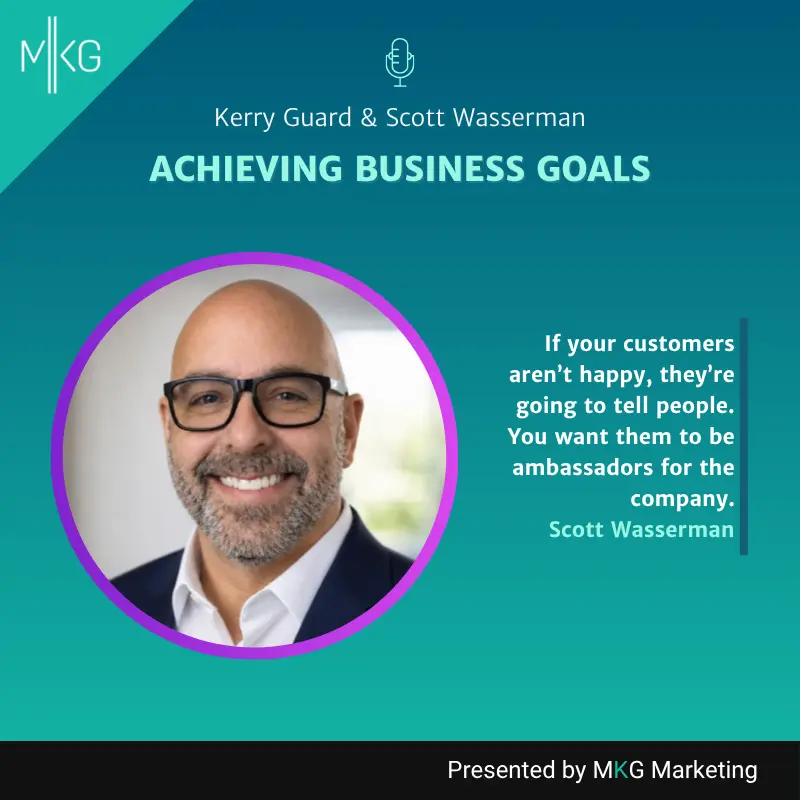
Scott Wasserman
Scott Wasserman helps B2B SaaS companies build revenue-focused marketing strategies that align sales, marketing, and AI-driven demand generation to create pipeline that converts.
Overview
Scott explains why rankings have become a lagging indicator and why today's marketers should focus on becoming the trusted answer instead of simply winning search results. He explores how AI search, dark social, customer advocacy, and consistent messaging are reshaping B2B buying behavior, while emphasizing that listening to customers, creating valuable content, and building genuine trust are the foundations of sustainable growth.
Transcript:
Kerry Guard 0:11
Well, welcome back to the show, and welcome to our listeners. If you are here with us today, comment away. We want this to be a conversation, that's why I go live, and even if you are listening to this after it is already closed, or we are no longer live, whatever you want to call it, feel free to comment anyway, because we will get back to you. We are a sucker for a good comment, and we are here for the conversation. Before we get into it, a quick word on who's behind the show. I'm the CEO of MKG Marketing. Here's the thing: I'm proudest of Dan hiring us once, then he took us to five companies. Joanne hired us twice. Marguerite took us left, right, and center all over the shop, because every agency promises pipeline now, but that's the floor. What's hard to find is an agency that actually gets you, your category, your buyers, the way you work; that's the one that gets rehired, and it's a good lens for today's conversation. Being an agency or the brand that gets the buyer is exactly what it takes to become the answer they're looking for. This show is for the marketing and go-to marketer leaders, figuring out how to do more meaningful work, often with leaner teams, more tools, and a whole lot of noise about AI. It's that's you, you're not behind, you're probably just jumped into the middle. We're here to get you back to the beginning in the right order. And today I get to do one of my favorite things on the show. Welcome back, a returning guest, Scott Wasserman, is a fractional CMO for B2B SaaS and PE-backed companies. The founder of Wasserman Revenue Advisors and the founder of the AI Fix, he's spent his career building demand gen and dark social programs that create pipeline instead of just capturing it, and he's now working AI into every layer of the engagement, from the signal-based intent systems to rev ops workflows, less volume, more position, that's the Scott Wasserman way, and he is coming in hot today with a take I can't wait to dig into that. Rankings have quietly become a lagging indicator. The thing that actually matters now isn't where you rank, it's how often you're the answer, and AI chooses to surface, and he's not the one, he's got the receipts, a cybersecurity client that proves it out. Scott, welcome to the show. So glad you have it.
Scott Wasserman 2:32
Thank you for the welcome back. Thank you, it was fun. Let's do it again.
Kerry Guard 2:37
I know, I know, I'll have you back again and again.
Scott Wasserman 2:40
I hope I can. I hope I can live up to that grand introduction that you just gave me.
Kerry Guard 2:46
Well, honestly, I just do a big intro because I got to give people time to like get into the comments and come hang out with us. So, hopefully you're all here now for the real juicy bit where we're going to spill all of the tea. All right, real quick, Scott, for anyone meeting you for the first time, where are you now? What Wasserman Revenue Advisors does, and what the AI fix is. Sure, then I want to get right into the talk that you brought today.
Scott Wasserman 3:12
Sure, I mean, what is.. let's see.. where do I start? I started. well, I was consulting many for several years, back from around 20 2016 to 2020 no, I'm sorry, 2008 to 2016 and it was basically when digital marketing first kind of was really rearing itself, and you could start seeing metrics for what they are, as opposed to tracking phone numbers, you know, old school marketing, and I sold the company that I owned, bought or built this new consulting company, not really knowing what I was doing, and you know, worked with all the content that HubSpot was putting out, because they were putting out so much training material as far as how to be a quote unquote inbound marketer, and I just loved it, and I love what, yeah, and I love working with, with all these new, different, different people. I would bring in agencies to help me do the things that I could not do, as a company brought me in within a month and a half of doing this. Somebody said, "Hey, Scott, I got a referral for you, and I said, "Okay, great, who is this? And they said, "It, this is, you know, the company Foster Grant, the sunglasses, and I'm like, yeah, and they said, well, the VP wants to VP, and marketing wants to meet you out of the blue. Now, coincidentally, I was living in Rhode Island, in the northeast part, right outside of, right outside of Massachusetts, outside of Boston, and they happen to be, that's where their headquarters are, and I went in there, and the guy said to me, " You know, do you? Okay, listen, here's the deal. We have three big sub brands, we're not just Foster Grant, we got these big time, you know, money makers, you know, they sponsor NASCAR, they do this, they do this. We need three websites, we, you know, can you do it? I'm not going to say no, I just didn't know how to do it. It, so I like, what do I do now? So, as the assistant literally just goes out, comes back, and hands me a check, that was it. And, yeah, I mean, okay, I'm like, this is a cool world, they like this. And I just reached out to a couple of friends of mine, and they referred me to a couple of agencies that wound up being able to do all the heavy lifting for me, and build the sides and do what I had to do, and start working on back in the day, which was like SEO and all that, all that other crazy stuff. So that's what I did for many years, and then I wanted to go back to an internal company, a company I was referred to as a consultant. They asked me to come on full-time, and I did that, and it was a blast. We, it was a total, totally away from everything I always did. This was a total bc. It was a company called Poseidon Expeditions. I'll give a little plug. It's a, it's a Arctic, Antarctic, almost expedition to the North Pole, South Pole, well, North Pole, Arctic, Antarctic, you know, all those different countries. West, I was in. They sent me to West Greenland on an expedition.
Kerry Guard 6:11
Actually, though, did you see penguins? I gotta ask, of course.
Scott Wasserman 6:13
I saw penguins.
Kerry Guard 6:15
Laura, you saw penguins.
Scott Wasserman 6:16
I saw penguins. I did not. I never made the trip down to the Antarctic, but I learned a lot about penguins. I saw a video, yeah, penguins are penguins are fun, but actually it's funny, and I was not to get up totally off topic, like we always do, but that more recent thing, over the past month or so, or two months ago, when there was a ship-borne illness that people were freaking out about, and the ship that they kept calling it a ship and a cruise ship that people were getting sick from rats, and this and that. You remember all that stuff that was happening a few months ago. Well, they were actually an expedition company, not this one, I'm not going to name that, but a different one, and people didn't really like this. Is not a cruise ship; this is an expedition ship. We're talking not 5000 people on a ship, we're talking usually about 150 people on a ship, much, much smaller. So that was driving me nuts for a while, but anyway, it was an expedition thing. Went up there, saw the, saw the, what's whatchamacallit Aurora Borealis, and you know, you know, took those, took those little figure out the names of this stuff, those little black boats to shore from the ships, like they have when you watch like SEAL Team movies and stuff, those little black quiet boats, I hear what they're called, anyway, I know I'm going off on a tangent, but I was in, like, I said, around Boston, wound up moving down south, and you know, I basically stuck to getting back into more B2B, more tech, more SaaS, and I started working with smaller companies, working there internally, whether it be as a director of demand gen, or whether it be as a director of marketing, whatever, but as you know, with many small companies and many small startups, whether they be bootstrapped or whether they be PE backed, or you know, they get heavy funding, they don't always make it, you know, for whatever reason, they don't, they don't always make it, and you know, marketing, I've always said is you marketing is in many cases a lot, a lot of companies consider it a luxury. They may not admit that, but they consider it a luxury. They may be, maybe they start their business right. It is, and you know it's sad because everyone always knows they need sales, but the sales come from marketing. People don't buy the hard way. Used to, we all do. We all do. People don't buy the way they used to. They don't sit there, you know, when you're making, you know, sales people making cold call after cold call after cold email, and follow up, and all these things, trying to find that needle in a haystack, whereas marketing, if the job is done right, that they bring in those high intent leads, and you know, we've talked about this. I know we talked about this last minute. I'm sure we did about things like MQLs that really have just been watered down over the years, and people, you know, a company saying to the marketing team, " Why aren't your MQLs high? And you know, when you get what they consider to be what they consider to be an MQL, they'll say, "Well, just let the sales team call them. We need to get some things going. That's not how it works. And people don't buy like that. They buy in a new way. They, 87% of all C-level and VPs, exec levels will do research on what they're looking for before they even decide what company they're going to go with, and that kind of brings me back to your point about, and I'm not sure if this is what we talked about before we went live here, buyers do not buy the way they used to, you know, they do all their research, and like I said, getting back to your point, we were talking about AI and talking about how people like search in all.
Scott Wasserman 9:59
These large models, Chat GPT, Claude, whatever, and they, that's where they do their lot of their search now, very, very common, very simple, and some people don't know how to use the prompts necessarily, but you can just ask the most simplest thing, I mean, I look at, you know, I use, I use Chat GPT for my everyday fun stuff, you know, just every day, you know, we have this, this, and this in the fridge, we need to, we're trying to find something to make. Give me a couple of recipes, and that's great. And I use Claude for all my heavy lifting, you know, and do everything else on that. Yeah, it's.. I just found it much better. I made that switch about six months ago, after being on ChatGPT for years. But you had mentioned how, you know, let's say you get a large company, you know, big, big, big, big, you know, they're, you know, all over the place, very well funded. They have everything; they offer so many different things. And then you have a smaller startup company, and maybe doing something similar, and in many cases, that smaller company will wind up beating them out as far as being found. That's what my research is showing.
Kerry Guard 11:01
I'm doing a big research project. I look forward to sharing it with everybody shortly, but yeah, that's what I did. When I looked at cybersecurity specifically, I looked at six categories, and I wanted to know. My thesis was, is enterprise going to beat out the startups because they naturally have a huge, massive digital footprint that the scale-ups now need to go create, and funny enough, it's actually the opposite. Enterprise is their branded search is falling off a cliff, they're not getting mentioned as much, and the startups and the scale ups are are coming in with guns blazing, because they not only are building a digital footprint, but they're building like a targeted digital footprint, and they're doing it with a very specific message around the exact problem they solve with language that the buyers can pick up and use that ties it back to the brand, like abnormal AI created behavioral security, right? Things behavioral, or behavioral AI, it's something like that. But because they have this word "behavioral" in front of it, which has never been used before in the industry, people immediately understood what it meant, and now they're using it, and so they're actually like up and coming. So it's very interesting to, like, see that shift and be proven wrong. I was so sure that we were going to be in trouble trying to like go up against these guys, these enterprises, and that is not the case.
Scott Wasserman 12:31
I don’t think so at all. I mean, I actually think that again it goes back to that bureaucracy, big, you have to get so many things done to do something within a big company, whereas smaller companies that are more streamlined, that can, you know, just spin on a dime, just, you know, make changes as they need to make changes, and are willing to try, they're willing to try new things, they're willing to fail, it's not like they've been there for 100 years, they want to know what's going to work and what's not going to work, and they're going to go after the best and the brightest, and I'm not downing big, large companies by any means, but that's just, you know, sometimes the more people you get into a pot, the more people you get to deal with, whereas, yeah.
Kerry Guard 13:15
Yeah, the other challenge is that as you build up your feature set, and as you solve more problems, you're now not solving any problems, you're, you're, you don't have any clear messaging that, like, why you're different and why you're better. It's actually why, like, a challenge we have as an agency, there are so many agencies out there, and pipelines become table stakes, you no longer can talk about, oh, we deliver pipeline, you better deliver pipeline, right? So it's like, why you, and you really have to do that deep work, and I think enterprises are now sort of coming to the realization that they have to get back to basics and get back to that work of like, what problem do they really solve for customers, and more importantly, why are they different? Why are they better, and why should people pick them? And they haven't done that work in so long.
Speaker 1 14:10
Yes,
Kerry Guard 14:11
that they're out behind the curve. It's, it's, yeah, it's really interesting how, how this is sort of shifted.
Scott Wasserman 14:20
But also, things go in cycles, you know, and this is a very common thing that we've all seen in the past. So, let's go back to, I don't know, the 90s hypothetical. I'm just going to give you an example. IBM was called Big Blue; nothing could touch it, you know, nothing could touch it. Well, as other companies started to come in and take away some of their market, as other companies would do things differently, they really stuck to that button-up. This is who we are. We are IBM, you know. And all of a sudden, IBM was losing and losing big and losing shares, and things were changing. Dramatically, they have all of a sudden to realize, what do we do? How do we keep up? How do we make these changes? But when you have these smaller companies that are easy to pivot and easy to move and easy to just get around these larger companies, it's the same thing. It's just different technology. It's just different technology, that's all it is. And it's a matter of just trying to stay acclimated and stay up to date, you know, when it gets back to marketing, a lot of marketers, especially at these larger companies, you know, they go in there because it's safe, they go in there because, you know, they can do what they know, they can do what they are expected, what's expected of them, but they're not always willing to make waves, they're not, they're a corporate person, yeah, exactly. They deal with the political, you know, the political nature behind a company, whereas they're not willing to stand up and say, you know, something, this may have worked a year ago, five years ago, 10 years ago, but it's not going to work today. And then having to have that conversation over and over and over again.
Kerry Guard 16:01
Managing up as a, as you know, within your marketing team, and then as like the CMO to the board and to the founder, like that is a, that is a muscle and a skill that is just absolutely something you have to have when you're in that seat, especially now.
Scott Wasserman 16:18
It's a skill I never had, it's, I guess you can call it patience, lack of, but I think you know, I'll tell you why. I think it's where I started. I was never ever.. I didn't start off like, oh, let me start off with this big company out of college. Well, I did. I was working for finance, American Express Financial directly out of college for a very short period of time, and it wasn't like I was working for the corporate end, I was working for a very small subsect, financial planning, which was originally called IDS, before it was changed to American Express Financial, and they bought it out, and but it was still a larger company, and just finance wasn't for me, that was like probably the biggest thing I ever did, and I'm sure you remember from our conversation my next jump from there, because I was losing my hair very, very young, was to, well, at least people in the States, the Hair Club for Men, you know? I wound up becoming a Hair Club client because I was losing my hair very young. It really worked amazingly. This is back around, I'm going to date myself, back around 9293, and you know, I was bringing some people to see me, and we were talking, and I brought friends in, and they said, "Hey, would you be willing to work here? My father always had a breakdown when he said, "Man, you were working for me, I sent you to school, you're working for American Express, and now you're going to go work for the hair club, are you kidding me? You know, but what I'm getting at is that I was always in a position working for a franchisee who owns several offices, working with a very small type of company, where you know we had an owner that people knew of. I'm not only the hair club president, but also a client size, Berlin. May he rest in peace. He's, you know, passed away several years ago. Um, great guy, that these were.. we were like a family. It was a smaller thing, but we had no problem opening up to each other, and we used to get into battles, you know, and discussions, and... but it was all like devil's advocate stuff. It was like, you know, we'd always kiss and make up.
Kerry Guard 18:16
Important.
Scott Wasserman 18:17
Yeah, and this is how we grew the business, and even Sai said, you know, I can't grow this anymore." And the funny thing was, it was when he finally decided to sell that it was a big change for the company. You know, it wasn't the same, and it was different. And I'm not saying, saying it hasn't finally, you know, grown and thrived over the years. It certainly has, after several owners beyond that. But, you know, this is the kind of company I was with all the time, and when I sold, I bought that franchise, sold it nine years later, and I wound up doing the independent consulting, like I mentioned, the digital marketing that was still working for myself, and then I wound up working with some smaller companies, I only wound up within one large bureaucracy years later, for no more than six months, it just wasn't for me. It was not for me at all.
Kerry Guard 19:08
I think that's.. I do think it takes a certain person. I'm in the same boat. I can work with clients, and I've figured out how to build those relationships and plant those seeds, and then, you know, from founder to founder, I think helps as well, that is, but I am managing up, so to speak, in educating them on how marketing works, and I've built a lot of trust there to be able to do it, but yes, when you have that pressure of being within a big conglomerate and you got lots of teams under you and you're then trying to convince the board of X Y and Z, especially in the changing.. we just had a client who's enterprise years ago. Their board showed up and was like, "We want to be number one for all of these terms, go bid on them, so that we're number one. And like, the cost of that is insane. Yes, right. Like my point is, there has to be somebody in that seat. It takes a certain special person to be able to push back and to say this is why, and it takes time to build up that trust. But going back to something you said earlier.
Scott Wasserman 20:10
Yeah.
Kerry Guard 20:12
Regarding you, you sort of bought into the inbound HubSpot way of doing things.
Scott Wasserman 20:22
Yes.
Kerry Guard 20:24
It feels like because we were just talking about the MQL and gated content and all these other things, and you know, our previous conversation we had, we talked about this too, but it feels like that you've moved away from that. When was that moment for you where, like, sort of the just forgive the analogy, but that's sort of come to Jesus, like, oh, this is not what I thought it was, this isn't working anymore, if it ever worked. Where was sort of that moment for you when you said this.
Scott Wasserman 20:57
Is when you said this is what I thought it was, meaning the type of work we were doing as inbound at the time.
Kerry Guard 21:05
So I have the opinion, yeah. And you're gonna just maybe you're gonna disagree with me, which is gonna be great, because that's what makes this show so awesome. I love it when people disagree with me, but I'm of the opinion, and hindsight is 2020, right? Looking back on it, for sure, yes, but I have, I sort of have this feeling that inbound and lead gen and this chasing the lead sort of mentality, the MQL sort of broke marketing, and we're kind of like now in this bed that we have to lie in that we made and figure out how to fix it, and the fix is not some silver bullet that's going to show up and allow us to just, you know, flip the covers over, like this is a big brand build initiative that we have to get back to, and I'm just curious, where you feel like that shift happened, and you agree with me that that that is the case.
Scott Wasserman 22:01
Yes, and I actually do agree with you more than you probably think. No, it's just true. You know, several years ago, I was working with a company, part of the demand generation team. It was for health, health tech stuff that we did, and you know, I was brought up, let's say, brought up, meaning from my days of, you know, HubSpot, I was, I was a reseller for HubSpot, I did a lot of early training with them, I did a lot of beta testing for their CRM when they were kind of breaking off with Salesforce at the time, and I, you know, would you know, MQLs were a thing, it made sense. It's like, okay, let's set up a scoring system, and let's say HubSpot, and you know, if they have this touch, this touch, this touch, they're going to get this point, this point, this point, and you know, when they hit a certain level, that's when, okay, boom, it's now an MQL, they show they're showing enough intent, let's toss them over the wall to sales, and let's see what they can do to get them to an SQL. Okay, made sense. It's, it's, you know, seems like common sense. Unfortunately, companies relied, especially people that don't understand marketing, rely on this term MQL, that this is a marketing qualified lead, and that marketing qualified lead sometimes turned into, wow, he downloaded an ebook last night, you know, that's what we used to do, top of the funnel, you know, let's put on an ebook on a paid ad, and you know, free download, ebook, yada yada yada, you know, and okay, and they do, and that was just supposed to be an initial boom, again, top of the funnel, the first touch, that was the idea behind it, and now you can open them up to email marketing. You can open up to a lot of different things, retargeting, and so on, so forth. So you could do all these things to just.. and the goal, what was.. what was the goal? Get them back to your website, show them the new blogs that you're putting out, put links, internal links in those blogs, so that you keep them on your website. Why? Because it will help with SEO. The more people who see your page, the more people who are on your page, the higher your rankings will be. At least that's what we were told, and that worked for a while, but over time, the buying structure changed. Google is no longer the only search engine out there, and I'm not talking about in comparison to, you know, Microsoft, or anything like that. I'm talking about using, and let's even talk about before Chat GPT, which, you know, basically just, you know, comes to search engines, but I'm talking about things such as LinkedIn. LinkedIn is a search engine, you know, TikTok is a search engine, Instagram is a search engine, YouTube is absolutely... they were all certain. There's a ton of them, and you know, they all have their own algorithms. You can go down any rabbit hole you want on them. You'll get stuck in a lot of these rabbit holes you can't get out of, such as me with cooking and stuff like that. Our foods and... and things that I start looking up. And, of course, once I got into a quad thing for a while now, it's all I see. They already have a million cloud prompts that they think they're going to change the world, you know, it's just a different rabbit hole. But my point is that people buy differently now. They're not just relying on Google; they're not relying on, okay, let's get to the first page of Google. Great, that's the goal. We're on the first page. Why? Because back in the day, we used to say, because over 90% of people don't click over to a second page, they see what's on the first page. So, initially, it was ads on the right-hand side of the screen, organic on the left-hand side of the screen, and that was it. Then they started putting ads at the top of the screen, so now it's pushing down what was the original, quote unquote, you know, top 10 on that first page. So then that happened.
Scott Wasserman 25:40
Now we're moving to a point where Gemini is taking over what happens on the initial search when you go on Google, so getting on the first page doesn't even matter anymore. It really doesn't matter. I mean, yes, you can if you know how to click out of the Gemini thing, you can start to see more old school stuff, but that's not what it is, and that's not where people are always looking, you know. They used to come to your website and read your blogs, but now, if you're like, if your bounce rate is lower than 90%, you're doing well, you know. For a blog, you know, to get somebody seeing a blog, you know, was it launched? Should we do long, long blogs, or short blogs? I mean, I'm preaching to the choir, I'm sure to many in the audience here, but you know that's not what it's all about. It's putting that content in all different places, and not just in written content, in video, through podcasts, such as this, snippets of podcasts, you know. Then you get into the whole dark social thing, where you can't even see what's going on behind the scenes, but let's say you make your post, or I make a post, and you get a couple people that you know make comments in that post, and then maybe they like somebody likes a comment that somebody else made, and they reach out to them on the side. You can't track that. You have no idea how you're going to track that. So it goes back to that Gartner study, and I've mentioned it before, and before, and before, where you get people that you know, like I said, C-level and VPs that will do, I think it was like 87% of them will do their research before they even come close to a company, and the ones that are out there, like that, we talked about the smaller startups that are really out there, and they're all over, you know, all over the place, and they're found in AI, much bigger than larger than the big ones. They're going to sit there, and you know, somebody will eventually get to your website and hit that demo, or hit that request this, or request that.
Kerry Guard 27:36
Front center.
Scott Wasserman 27:37
Yeah, and say, I see you everywhere, I see you everywhere, and I know what I want, and I've.. and you don't know they've been discussing this in Slack channel, they've been discussing this in groups, they've been discussing this privately. Maybe they got on a call themselves, you know. How do you feel about this? Where do you feel about this? Have you heard of anybody? It almost goes back to, again, a full cycle prior to even the internet. You know, let's say you know you wanted a restaurant recommendation, you know, you asked your friend, you know, have you gone to a restaurant? Now a person will tell you one, a person will tell you one, "Oh, I had a great experience at this restaurant, and you may go, but if they say, "Oh, I had this worst experience at this restaurant, now not only will you not go, you're going to tell five friends, " Don't go.
Kerry Guard 28:21
It's true.
Scott Wasserman 28:22
You know. It's the negativity of it, but we're back in a cycle now because this whole concept of dark social and not knowing where people are actually talking about you or how they learned about you, which gets back to putting a question on the form when they do go ahead and get to your site and ask, How did you find us?
Kerry Guard 28:42
You find us.
Scott Wasserman 28:43
Yeah, you know, and old school, so you almost have, like, have to have, like, a manual attribution model, where it would say, you know, oh, you know, you know, YouTube or Insta, or, you know, TikTok, or LinkedIn, or whatever, you know, that's what they found you, they're not going to sit there and look at your website, is like, wow, that's a very good website, and they put up so much information just on your website, you know. No, they're still gonna, they might, they might see a couple pieces of content on there, but that's not going to be their final decision, it's going to be from whatever all the information they got from everybody else. So, when they get to you, they're basically high intent, 80% done, and, as I've always said, I'd rather, I'd rather get 20 solid high intent leads a week, and I'm just throwing that number out there, as opposed to 100 leads a week that maybe just hit that demo button for whatever reason, you know?
Kerry Guard 29:36
Yeah.
Scott Wasserman 29:38
That's it. Yeah.
Kerry Guard 29:38
I mean, back, I mean, before with getting a download, right, you wanted as many downloads as you could get, because to your point, then it became all that nurturing, but now we sort of, this is where I think HubSpot, and the, and the inbound sort of notion broke, was not just in how buyers research, but in how they engage, they don't want it anymore. They're afraid to give us their email address because they know what's straight behind it, in terms of the onslaught of emails, nurture sequences, and newsletters, like they protect that with their life now. So, if they're giving it to you, it's because they are serious about potentially working with you. I actually had a prospect today. I made the short list. I was like, so excited, right, because when you know your marketing's work, like, you did a thing, like your own marketing as an agency is doing a thing, and somebody shows up and fills in that form. I have to add that field, by the way, I keep meaning to. I have no idea. I sort of figured out how she found us. I knew I was connected to somebody who had been on my podcast five years ago. I see her in my feed all the time. I'm always engaging with her content. I know she gets our newsletter, so I know that our marketing for the last five years has been hanging out with this person, and now that they're ready to engage with an agency, we made the short list, and so she filled in the form. We had this great conversation this morning, but it's like you just have to create this consistency now of building that trust up, because they're not this woman, she filled in the form, we sent her an email that said wonderful, we're looking forward to meeting you, book a meeting, she couldn't book a meeting because she's in Australia and we're in the US, so she actually emailed us, and I was like, she's serious, like she really wants to work with us, right? It's those intense signals of like when you really work, when you really hit somebody with your message, and you really make that connection, like that's that's where we need to get to, and I just feel like we've broken so much trust over the years with buyers, because of how this sort of marketing system, this gamification sort of happened, and now we are where we are. Let's get back to the AI search of it all.
Scott Wasserman 31:51
Yeah.
Kerry Guard 31:52
And talk about, and dark social is sort of an indicator of this, too. We have to measure this differently, right?
Scott Wasserman 32:00
Yep.
Kerry Guard 32:00
So it's the lead, the leading indicators have changed. It's not the MQL, it's not the click-through rate, it's not even sessions on a website, although your conversion rate is something you should definitely be checking out.
Scott Wasserman 32:14
See, of course.
Kerry Guard 32:14
If that's actually gone up, fewer sessions but better conversions. To your point, so in your opinion, Scott, now what you know, we have that form fill, which I think is great. We need to all get that on our website. What other leading indicators should we really be measuring to know that, like, we're doing all of this activity, we're trying to show up as many places as possible now, and build that digital footprint? Is any of it working? How do we know?
Scott Wasserman 32:39
I think the best way to know if something is working or not is to ask them, is to ask that potential client, is to put that out there when you're putting your content out there, asking them what kind of content they want to read about, you know, these are things that I've kind of drifted away from, because I kind of get down these little rabbit holes of things that I love to, you know, really preach about, get on my soapbox about whatever, but you know, finding out what they want to learn about and finding out what they need to see, that is the way, again, like we said, people buy differently than they used to buy, you know, it's those days of, you know, like I mentioned, I worked in that, in that health tech company. You know, you get that lead just because the guy couldn't sleep at two in the morning and decided to download an ebook, and you know, just was interested, and he gets a phone call the next day, within, as they said, has to be within 24 hours. You know, I mean, that to me is off-putting. You know, it's, it's very off-putting, that all of a sudden it's like, whoa, whoa, whoa, I just wanted to see something, you know, and it's like now this salesperson is going down this, you know, let's find a needle in the haystack kind of thing. So, how do you find out? Well, you know, you have to find out, first of all, where your audience sits. Well, they're not sitting on your website, you know, they're sitting in different places, they're as I mentioned, you know. How did you find us? You know, are we focusing too much on, you know, reels on Insta? Are we focusing too much, and I'm talking organic, are we focusing too much on there are so many different things, you know, focusing on just one thing too much, but finding out. Okay, put together this manual attribution model that says, okay, we're getting a lot of responses that people are seeing our live podcasts on YouTube, you know, that's where they're seeing us, or they're seeing us on LinkedIn, but nobody ever checks off TikTok, and nobody ever checks off Instagram. Okay, so well, we can put our stuff on there, but let's not focus too much on it, you know. Let's focus more on the other things, and that I think is just engaging in creative conversation with different people in different audiences, and at the same time understanding that you just, you don't. Put out things that you're trying to sell, sell, sell, sell, sell. You're putting out information that they can use, you know, for free. And people sometimes are afraid to do that. They think they're giving away the store, and I'm like, "No, you're not giving away the store. If you're putting out content after content after content about what they can do and how they can do it, and this is what they should be doing, and this is, you know, the stuff they should try. Then, you know, people are going to listen, and they'll look at you as an expert, and then they say, you know, something. If they're putting out this kind of stuff for free, I wonder what they'll put out if I pay them, you know. So, I think that's probably the best way to do it it's not new, it's not new at all, but I mean, how many times do you get in mails or cold emails that give you a plethora list of, you know, everything that they do and what they've done, and all their examples, and all their use cases, and links to their calendars, and do you want to chat? Do you? I don't know who you are. Who are you sending this information to? I have no idea, you know. And then I go to look for you.
Kerry Guard 36:10
I always start off with, like, trying to connect with you, of how they saw this case study, or they read the, yeah.
Scott Wasserman 36:17
yeah, yeah.
Kerry Guard 36:18
Feels so forced.
Scott Wasserman 36:20
Yeah. And when I reach out, it's more, you know, I, I saw you here, I love, you know, I love that you commented on this, you know, love to chat with you, and just learn, not, no, no, and I always, I always tell it when I sit there and write it, I say, you know, you know, no, what's the wording I always use, you know, nothing, like there's nothing, I have, no, what's that?
Kerry Guard 36:42
Not pitching.
Scott Wasserman 36:43
Yeah, it's.. I'm not trying to pitch anything, it's not.. I just want to learn more about what you're doing, how you're doing it, you know. Because I saw that it was a great post, you know, that's it. I mean, LinkedIn is great in so many ways, but one of the downfalls I think of LinkedIn, this goes back to the beginning, was that it was just.. just like, you know, it was just hooking up with anybody you can meet, you know, anybody that friend that try to connect with you, connect with, you know, and I connect with them. How many times has somebody come to you and said, " You know, geez, Kerry, I see you know so and so, can you give me an introduction? You know, I know them, but just from connecting with them 10 years ago, I don't necessarily know who they are. Yeah, I'm happy to let them know, I guess you know. But now you're introducing someone you don't know to someone you don't know. Yeah.
Kerry Guard 37:30
Yeah, I only try and do it for when, yeah, people are for people I know.
Kerry Guard 37:36
who've been on the podcast or have some sort of connection with, and they're looking for a job, even if I don't really have a good relationship with the person I'm connecting them to, I always try to follow that through, because, man, job hunting, right now, that's a whole other podcast.
Scott Wasserman 37:50
Well, that's a whole other story for people, absolutely, which is part of the reason I got back in. I started this up again, that was the exact reason I started up, because I was tired of being as much as I love working internally in startups, and I love working internally with small teams, you know, you're at the whim of the company, you know, and I was working with a company, as an example, that, you know, when I got there, there were, you know, like 15 marketers, a year later they were down to eight, you know, there were some issues. I was asked to kind of take over something that had to do with what should have been under customer success, but that customer success person had left, and I found out that we had customers who were just mostly miserable. They were, they were not happy, so as much as we might have been getting customers in the front door, they were walking out the back at the same time, and that's where Rev Ops, that's where things need to be fixed, and they don't, they say, "Whoa, but we're not getting any new business. Well, maybe because we don't have any good business behind it, you know, meaning customers that are so happy that they're willing to be, you know, a, you know, an ambassador for the company, in a sense, you know, I mean, they, I found a few that were very, very happy, and that's great, but that's where companies say, oh, well, we got to cut back on marketing now, because marketing isn't doing their job well, but yeah, as a company, we have to do this whole thing together, it's, we're not, we should not be living in silos at a company, you know, marketing does this, sales does this, customer success does this, you know, we have to be able to put it all together and find out what's working and what's not. I was with this larger company briefly, and you know, I was running this whole, these major ABM campaigns from these multi million dollar contracts, I kind of came in at the very end of it, this more one to one reach out, and I would get messages from my, you know, from sales teams in Japan and other, some other places that I was working with, and they would say, "Yeah, stop, stop with the message, stop the messaging to them, stop the messaging to them. I'm like, "Why? I said that. A customer, they're already a client of ours, and they said, "Well, because it was our new product, and he said, "He said, 'Yeah, but the problem is they have a lot of issues, and they're really not very happy right now. So, you kind of want to stay away from that, and I ran into that so often, and you know that's just not cool. You know, I mean, I'm sorry, it's not cool if you have unhappy clients and unhappy customers. Sorry, you're not going to make it.
Kerry Guard 40:30
That's one of the problems with how enterprises are functioning right now, and why they're also not showing up in AI: what their customers are saying about them, not always very good, is not aligned to what they're saying about themselves, and so because there's not that alignment, they're not getting recommended or mentioned, and so yes, you have to have fundamentally at your core, you have to have happy customers who are out there talking about your differentiators, and why you, because that's not going to align. So, man, people could get away with not having custom happy customers, maybe before, but they definitely need them. You need them now. If you are having a problem internally with your customers and your communication, and them not, you know, loving your product, definitely start there. Oh my gosh.
Scott Wasserman 41:22
Because you know, what's interesting is that it's to your point exactly. You know, just as it's so easy now, let's say a customer is so upset, or they're upset about something, or they're just, they were asked a question. Let's say they were on a Reddit or this or something else, and made comments. Well, guess what? AI is going to pull from everywhere, and I have seen, like, when I sit there and say, well, you know, I might go into, you know, can you give me a quick background about this company, what people are saying about them, this and that. Well, you will see the positive, and you will see the negative. It's it puts it on, it pulls it off, it's so it's not even a matter of
Kerry Guard 42:01
Talk about
Scott Wasserman 42:02
Exactly, and that's the point.
Kerry Guard 42:05
Yeah,
Scott Wasserman 42:05
And you nailed it. I mean, negative is so much easier, exactly. It's the same thing. People, well, I mean, come on, Yelp went through lawsuit after lawsuit after lawsuit about that, because you gave, you know, consumers so much power by sitting there saying, you know, oh, my bagel was bad the other morning, I'm taking you down, you know, kind of thing, or right? They went through a whole thing years ago about that. There were lawsuits involved, you know, regarding that. So I don't even look at any, and you know something, I used to, I, it's funny, I switched over to, you know, I always look at reviews. I love to look at reviews. Living is a quick example. Living in the South, you know, there are a couple of things that us northerners miss. It's Pete's good pizza, good bagels, and, sorry, good Chinese food too. You know, it's one thing that we miss, and you know you're always looking and trying to find, and you know what's out there and what's happening. Well, you know, I kind of, I tend to stay away from Yelp, and I started working more on Google reviews, and looking at those, but then I started realizing, especially since I was a part of it, because I was helping a company, you know, work on their brand, utilizing reviews, is that, and I'm sure you've gotten these, we've all gotten these, you go to go somewhere, could be a kerry, you know, your chiropractor could be the dentist, could be anybody, and they sit there and say, 'Hey, you know, did you like what you did? Would you be willing to give us a review on Google? They give you a link, boom, you do it, done. And I'm happy to do it in many cases, I really am. And I've actually, I've never given, I think, a bad review. I've just not given a review if it's bad, but this is how they get their five-star reviews. It's not because somebody's being, you know, somebody - if somebody's mad, oh, they'll get on there, and they'll knock the, don't knock the crap out of you, you know, without any, without anybody asking them to.
Kerry Guard 43:52
But yeah, they'll sometimes vote on the wrong profile, not even for us.
Scott Wasserman 43:56
And sometimes it'll get pulled down because, you know.
Kerry Guard 43:58
I can't get it. I can't get Google to take it down. Like, this has nothing to do with us, right? I even emailed the guy, I was like, "Could you please take this down? But he doesn't know how, and he's in Ireland. He's, I think, in Ireland, but he ended up in the US. It was anyway. So now, now.
Scott Wasserman 44:14
Oh, we have 505-star reviews. Well, that's because you asked 500 people who were, or actually probably 5000 people, to get those 500 that they were happy to please review, which is nice, but unfortunately, I think it skews it a lot. It's not independent, you know, and that's true.
Kerry Guard 44:32
You do like, well, even the G2 reviews aren't necessarily independent, right? Because the same thing, client, yeah, it's the same thing, so I, but you do need the reviews. Absolutely, I'm not saying initially now we're even thinking internally of like how we ask our customers who've been, you know, okay, you've been with us for three months, how's it going? Would you mind giving us a Google review if you've been with us for years? It's like, would you mind giving us a clutch review? Yeah. I mean, having a review system is imperative now, because again, you need that corroboration between what you think about you as a brand and what your customers are saying, so if it's skewed, it just needs to be part of the system exactly.
Scott Wasserman 45:19
And one thing I mean, one thing I do love is that when I look at reviews, I do look at reviews, especially for restaurants. I'm a foodie, we love to go out, you know. I want to see, okay, what people are saying, and you know, I want to see the good and the bad, but I also take everything with a grain of salt, you know, meaning if you see, because what does everybody focus on? You know, you see all these great five star reviews, then you see a couple, two or three star reviews, and there may be a one star review in there, and they just get slammed, and you know, a lot of people look at those, go, oh, they're going to take the power of those three over the other ones, you know, I mean, you know, some people are just miserable, some people just will never, you'll never make happy, no matter what.
Kerry Guard 45:59
Looking at the date, like, you know, looking if, like, it was 10 years ago, it's the other way around, where all the good reviews are like from months ago, but then the bad reviews start showing up, and they're newer, right? So you definitely need to be, like, critical about how you read them, but AI's... I don't know that AI is taking all that into consideration, so having a good review system is definitely key. What is Scott? We've talked to, we've kind of danced around a lot of ideas in terms of showing up in AI. We've planted a lot of seeds in terms of foundation reviews being one of them, consistent messaging being another. We talked about some tactics, but out of all the things we've talked about, if somebody were leaving this podcast right now, they only needed to go do one thing to start building that digital footprint for a B2B tech business. What would you, where would you recommend they start?
Scott Wasserman 46:53
I'd recommend they start putting out content everywhere, and I'm not just talking written content, I'm talking taking content that you've written, I'm talking, doing videos, podcasts, such as this, guest podcasting, getting yourself into groups and chat groups, whether it be on Slack or different mediums, where you can sit there and talk to people you know that look up those messages, look at what people are saying when you post something, respond to them, you know. If they don't like what you say, if they disagree with what you say, don't get into a battle with them, but just make it, you know, get into a discussion with them. Maybe it's offline, maybe it's offline. It'll help teach you what you should put out, what you shouldn't put out. But all this stuff, if it's in the public domain, even though it may be on a private site, it will start to be pulled out. It will start to be extracted. People will start to share it, and once it's shared, it will start to make its way into this whole vernacular of AI. You know, it will happen, but the idea is you have to really keep your ear to the ground and see what's happening, and listen to what people are saying, and respect what people are saying, and be willing to make those changes, and ask them questions, and ask them what they would like, and what they would prefer. It's really engaging that audience, you know, engaging with them, not saying, "this is what I am selling you, it's right here, do you want it or not? " You know, it's like, "no, what are you looking at?
Kerry Guard 48:18
Started a podcast, right?
Scott Wasserman 48:20
Yeah, you know, and that's why I love being, you know, a guest on a podcast. You know, what I listen to, what I say isn't the all-end-all be-all by any means. I don't think anybody has that end-all be-all. My process has always been that I'm not afraid to try new things, I'm not afraid to test new things, I'm unafraid to, you know, I embrace AI, but I don't. I'm not owned by AI, you know. I love it. I work with it. Yes. Do I write content with it? Absolutely. I'm not going to send people to say, " Oh, it's not AI. You know something you can write if you prepare and you know what you're doing, where you can actually create an article that is all you, because you have built this thing up that it knows exactly what your thing is. I mean, I've plugged in my, you know, my emails, how I write and how I talk, what I say, and what my thought process is, so it knows me. Do I still review it? Absolutely. The problem is, there's something now, a term which, frankly, I didn't hear about until just a few months ago, called AI slop, you know, where people are just saying, oh, well, now I can post on LinkedIn 345, times a week, and they put up the stuff, and it's so obvious, you know, that I mean, I have gotten stuff emailed to me, email marketing stuff, you know, that just, what did you do? Just pull the whole thing from my LinkedIn page, is that what you did? You just pulled my LinkedIn page, plugged it in, and said, write them an email, you know, because this is obvious, you know, I mean, there's the telltale signs, of course, the em dashes and all that stuff, but I'm just talking about the personality and the content of it, you know.
Kerry Guard 49:51
You can feel the tone of a total of where it's been well written, even with the even if it was the help with AI versus when it's here. Uh, AI, it's, but I love what you're saying, and I think it's so important, and I'm, I've been sort of shouting it from the mountaintops, even though we don't necessarily help with positioning and messaging, I have wonderful partners like yourself and some other people and some other fractional marketing leaders who do this, because it's just where you all like, where we all need to get back to basics. Even if you're an enterprise, you need to redefine your positioning and messaging in the new era of AI search. And I love what you're saying about listening.
Scott Wasserman 50:32
Yeah.
Kerry Guard 50:33
If you can first.
Scott Wasserman 50:35
yeah.
Kerry Guard 50:36
Oh, if you can listen first to your audience and really hear what they're saying, like, I, you know, the world is shifting underneath our feet. I'm literally writing a book about how to build the marketing systems from the ground up, and what you need to do it, and the unsexy foundation stuff that just needs to get done to allow you to build on something strong that can compound right, and the position, the listening piece, and the positioning and messaging is really that first step that everybody skips because they want to get into market and they want to just start spending money for whatever reason, and then none of it works, and they don't know why, and, man, yeah, listening to your audience and really understanding what the problem is, and what, and what you saw, everybody's talking about, they're not talking about a, they're not talking about AEO, they're not talking about geo, they're not even talking about SEO, now it's AI search, that is what people are talking about, right now, I had to pivot all my messaging to match the markets, like what you were talking about before. I'm a small, small business, I can pivot on a dime, and I sure as hell am to meet the market and hear what they're talking about, how they're talking about it, and it's yeah, you have to listen.
Scott Wasserman 51:57
Yeah, listening is what it always is. As we interrupt each other, I interrupt you all the time. Listening is what it's all about. Yeah, you have to listen to what people are looking for, what people want. You can't just shove it down their throat and say, " This is what we have to offer. Do you like it or not? And this is how we do business. Do you like it or not? You have to be willing to take care of these people. I mean, you know, customers are valuable, and your existing customers are even more valuable if you're not taking your existing customers. Forget about upselling them or cross-selling them, or whatever you do as a company. They're not going to be happy, and if they're not happy, trust me, they're going to tell their friends, you know, they're going to tell people they know. Do not do business with this company. Everybody has relationships with different people in the same industry, just to different companies, do not do business with this company. You know, why would you want that? You know, you want to be an ambassador for the company. You want people, you want your customers to say, "Yeah, I love this company. You want them to be willing to do a video testimonial for you. You want them to be willing to come on a podcast with you. You know, hey, we have this person, this person, you know. Yes, we chose some of our customers, but they're the first people we want to, because, you know, they seem very happy. So we're not paying them for this. This is, they're happy, you know. Yeah, and that's what they bring you along.
Kerry Guard 53:13
and they bring you along with them. They bring you along, yeah. That is, that has been our story, which has been the most amazing 15 years of just working with some amazing people who love what we do, leave the next company, and continuously bring us along. I just, that is what it's all about.
Scott Wasserman 53:30
Yeah, I love that.
Kerry Guard 53:31
One last question for you, where can people find you, follow along, and engage with your content and what you're doing?
Scott Wasserman 53:38
The best place is always LinkedIn, it's under Scott Wasserman on LinkedIn. I actually finally put up a website. Yes, you did. I did. Thank you, Claude. It's Wasserman revenue.com. It'll give you some basics. It also talks about something called the AI Fix, which I just kind of came up with out of a whim, but just because I used to see I was seeing these things and seeing what people were going through, and knowing what I've gone through over the years, as far as how to deal with, you know, the day to day stuff that AI can actually take away or take off their plate, in a sense, and they can focus on the things that need to get done, and I started doing that just as an additional thing, not just for B Texas asks, but for anybody that is overwhelmed with their day to day, you know, these emails that I have to send back, or these, you know, email follow-ups, content they never get to explain the same things over and over and over, and you know, admin scheduling, all that stuff, social media customers, you know, questions, customer support, you know, and they wind up doing this stuff like, you know, Sunday night or Friday night, because they just had no time during the week. I found a way to actually set up a system where one-shot deals, they, you know, come in, give me their biggest issues, we talked for a few minutes, I put the whole thing together for them, but all the promos. Together for them, show you how, show them how to use them, and it's done. And if it works, and it has, and the few, you know, this is fairly new, but the few people I've worked with on this love it have been so happy that it just saved them time. It saves them time, you know, which is kind of cool. When I, you know, I've always been in the business of helping people, whether it be through sales, like I said, I was part of the hair club. Look, what it did for me, not now, but look what it did for me. You know, and you know how it can make you feel, how it can make you look, all that stuff. Going forward in marketing, and I was, you know, I was a marketing major. Going forward in marketing, where you know what a marketer's job is, especially in demand generation. A marketer's job is to generate demand, a salesperson's job is to make sales, the sales team happy, you know, you make the sales team happy, everybody's happy, so you know, I guess it's called my people pleaser thing, I don't know, you know.
Kerry Guard 55:52
No, I love it, I love it, and so head on over, check it out, if you have anything that you're constantly executing on time and time again, that probably could be automated. Hit up Scott, and he'll help you streamline that asap. The time is now. Make it happen, Scott. I'm so grateful. Thank you so much for coming back on.
Scott Wasserman 56:12
Kerry. Thanks for the invite, that was fun. Always fun, always fun, always fun.
Kerry Guard 56:16
All right.
Kerry Guard 56:17
Yes, as you mentioned, you can find Scott Wasserman on LinkedIn and on his website. Go connect, especially if you're a founder or operator who needs a marketing leader who measures in pipeline, not activity. If there's one thing to take away with you, stop treating your ranking as the scorecard. Actually, I'm not going to read this, because we totally went off topic. And if there's one thing that you always do, this conversation, I know, but that's the beauty of it. I love it. There's one thing you need to take away from this: to listen to your customers, take care of your customers, and build a relationship with them, because they are your foundation and your fuel, and they will help you build up that marketing engine from the ground up, and take care of you along the way, while you do it. So be sure to, you know, go look internally and see where there's some opportunity that could be. It could be huge. It could be huge. I love this, and I haven't talked about this yet, so that's amazing. That's just, ah, amazing. This episode is brought to you by MKG Marketing. Dan hired us once, then took us to five companies. Every agency promises pipeline. Now that's just the floor. What you can't find is an agency that gets you, your category, your buyers, the way you work. That's the one that gets rehired. But thanks for being here. And we will catch you next time.
 (2).png)

 (7).png)