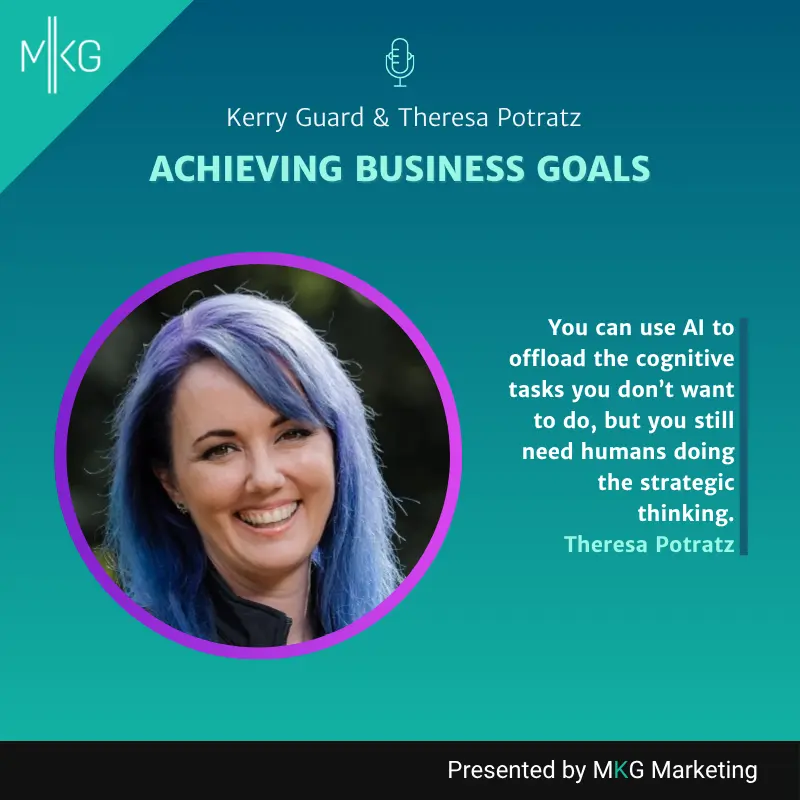
Theresa Potratz
Theresa Potratz is a growth marketer who blends data, storytelling, and curiosity-driven experimentation to build bold campaigns that drive demand and scale brands.
Overview:
Theresa explains why effective marketing starts with curiosity, experimentation, and an understanding of buyer psychology, sharing how layered data enrichment and AI-powered personalization have dramatically improved email performance, while warning against over-automation without thoughtful oversight. She also digs into the shift from founder-led to system-led growth, the need for tight sales–marketing alignment, and how AI can reduce cognitive load without replacing strategic thinking—ultimately reinforcing that data is meaningless without storytelling that gives people a reason to care.
Transcript:
Kerry Guard 0:09
Kerry, hello and welcome back to Back on Track, the show where B-to-B tech marketing leaders pull back the curtain on what's actually working, what's not, and how we can keep moving forward together. I'm Kerry Guard, host of the show and founder of MKG Marketing, where we help B2B tech companies build the kind of marketing that creates a real pipeline, not just pretty reports. Today's episode is going to be a little different because my guest doesn't just have a growth strategy, she has an unhinged one, and apparently, that's why it works. Theresa Potratz is back. If you caught our first episode many moons ago, you already know she's the kind of marketer who looks at the problem differently than everyone in the room, and that's not an accident. Theresa has managed $2 million in budgets in AI robotics, built demand gen programs at early-stage startups from the ground up, and used tools like Clay to hyper-personalize email campaigns so precisely that she doubled open rates and tripled reply rates. She thinks data without storytelling is just noise, and she's proven it. She's also the host of a top 10% global podcast called The Unhinged History podcast, where she covers things like Napoleon getting attacked by bunnies and a whiskey flood in Dublin. I promise that it will make sense in about 10 minutes. Theresa, welcome to the show.
Theresa Potratz 1:29
Thanks for having me. Kerry.
Kerry Guard 1:31
Oh, I love having you. I'm so excited to have you back. So exciting. Before we get right on into it. Let's just give people a bit of history here. Your growth strategy has been described as unhinged, and I mean that as a compliment. I think that's what I you think outside the box, I'm here for it. But where does that label come from? And do you lean into it?
Theresa Potratz 1:55
Yeah, so I tend to look at everything as data points. If something works great, why if something didn't work? Awesome. Why? Like everything, you can learn from right? And so it tends to take me down some weird rabbit holes, and then understanding the back end of things, and then just going from there, right? Letting, trusting the process, so to speak.
Kerry Guard 2:20
Sounds like you'd like to know how things work.
Theresa Potratz 2:23
Very much so, so much so that I think my high school, like we did the standard, what should you be when you grow up? Took the test and it said, mechanic. And I'm like, ew, no, but I think the truth is, I like understanding how the process works, maybe more of an engineer brain, but I decided to go into marketing. And so here we are.
Kerry Guard 2:46
Here we are, here we are, speaking of here we are. You've got a top 10% Global History podcast and a career in B-to-B demand gen; most people would keep those worlds separate. Why don't you? Where do those points collide for you?
Theresa Potratz 3:03
I learn a lot from random things. Okay, so you want to learn about psychology, and that informs how you're a better marketer. And so there's no better way to understand psychology than to look at historical events. And so it could be something like last week's episode was about the epidemic of the meowing nuns. In medieval France, there was a convent where these nuns just broke out into meowing, and they would not stop. It went on so long that the city had the police go up and threaten the nuns with bodily harm, and that's when the nuns were like, we're done. And it was just like, I'm sorry, what? And but it just, it's those bizarre things and kind of going into, why would they happen? What would cause that? How do we know that that happened? Can we prove it? And then, you know, taking that same frame and going, Well, why did this email campaign work? Why did it not work? What can we learn from it?
Kerry Guard 4:01
We're going to our annual summit in two weeks. The countdown is odd. We're going to Philly. I'm so excited, but the idea is to look into the future of our jobs and see what they could be in the next three years. But before we do that, I'm going to go we're in Philly, like so much history there, and so we're going to go on a little tour. First of all, not only some Philly fun history, but also a look back on our own careers, of big moments that we sort of ever overcame in the way that the industry shifted. And, you know, you got to look back before you can look forward. So I really love everything you're saying, in regards to both, you know, that's, that's really what the history is all about, both from, like, you know, Italian nuns, to the data of, you know, in terms of what's performing. So yes, yes to all of it. Let's talk about clay. You used it to double email, open rates, and triple. Replies, I know that so many people are trying to crack this code now, right now, everybody knows that personalization is the thing that we have got to figure out at some sort of scale. You did it, it sounds like.
Theresa Potratz 5:14
Yeah, I did it. And then I've also figured out why it worked and why it worked, the hurdle will be at another role, right? So the initial thing this the full background. There was, so we were marketing to realtors in the US, so that is a finite group. They are all registered as realtors, so you can get the list of them, and then it's like, okay, great to figure out their email, all of that stuff that's on their Zillow profiles, so you can build a clay sheet that makes an API call to Zillow, pulls in that relevant information that's up to date, and now you have pristine data. Then we did a step further right, because we were looking at the top percent of realtors that you know are in these markets. We then looked at the homes that they've had on market that have been on the market for just 10- 15% longer than their usual. So we had to do some math with that and build that into the algorithm. Then did another dive and just said, Why does the AI think that home has been on the market. And then how do we think our tool could help them with that? So then, after we have that payload of data, we enrich it and say, "Okay, I'll come up with a 45-word email that would describe this," and it's, "Hey, Kerry, I see you're having trouble selling 123, Main Street." Here's why we think that is. Click the link and let's learn more. That link takes them to a landing page. That landing page is a one-to-one and has a Hey, Jen, video where we have an avatar of our CEO, Kerry. Here's why we're seeing your house stay on the market. Here's how we think we can help you hit that book-a-demo button. We're going to show you it live. And we were able to send 2000 emails a day to scale that are hyper-personalized. And because the avatar video is so short, you don't have enough time to clock that it's AI.
Kerry Guard 7:19
Right?
Theresa Potratz 7:20
And then it was just boom. And we saw the demo attendance rate shoot up. We saw, you know, open rates go up, because now it's like, yeah, why am I not selling that house?
Kerry Guard 7:32
Yeah, yeah, I mean, but that's very available data.
Theresa Potratz 7:40
Yeah.
Kerry Guard 7:40
yeah.
Kerry Guard 7:41
right. So, real estate is a perfect example of that. You mentioned that you've learned a lot from doing this and getting it to work, but in terms of your next job, if it's a different audience, maybe with not so readily available data on a very different audience, who's maybe a little bit more behind the scenes. Behind the scenes. How are you thinking about that?
Theresa Potratz 8:05
So with that, it's looking at, you know, the data that clay inherently has. It's got a lower match rate than I'm comfortable with, like, when you do a manual scrape, you realize, oh, that person used to work at MasterCard, and so when I have it as MasterCard on the sheet, that's not wrong, but it's not currently correct, or they might still be listed there, but their headline says retired, or they've got the green banner. So maybe they have been laid off. Maybe they just want to go somewhere else. So that's not the best person to reach out to for a new project that you don't want to talk to about a tool. If they're not actually checked out, they are mentally gone. And so then it's like, okay, what can we do to layer on data to get complete enrichment and not fully rely on one singular tool? And right before this call, I was pinged with a message that is a lovely thread on LinkedIn. That's between me and several other humans, and one of them said that his CEO just published a video on how to replace clay and build your own thing that's better, faster, stronger, and cheaper from scratch. And I was like, Well, geez, I wish I didn't have anything else to do right now, because that's what I want to play with.
Kerry Guard 9:28
Yeah, yeah. I mean, AI in terms of people building things rapidly right now and trying to figure out that they can do it themselves before buying another platform. Seems to be a trend that's happening. I know I'm experiencing it with my clients, doing the same thing. Are you seeing this? I mean, is this your first interaction with that? Or is this happening all over the place?
Theresa Potratz 9:50
I think it's happening all over the place. And I mean, my current role, we do observability and AI observability slash AI, rely. Ability. And so we're looking at model drift and all this stuff, and trying to surface it to the devs, the SREs, and the powers that be, so they can find and fix the problem before it becomes a huge thing. And when we think about how AI is automating things, we're going to need safeguards and guide rails in place to ensure that fraud detection doesn't cause everything to go sideways, or your system doesn't go down, or, you know, like you want to catch all of those hallucinations before they bite you.
Kerry Guard 10:35
So I'm doing a lot of outreach on my own right now. I've stepped into the sales seat at mkg marketing for the first time, I've so reliant on my business partner, who did this for a very long time, and I'm so grateful for him, because now I'm doing it, and it's super hard, and I probably make it harder on myself than I need to, and I'm figuring out some systems that can be helpful, but it is that personalization, like the thing that takes me the longest is that data enrichment of making sure that I truly understand the person and the role they're in alongside the any data that I can bring to the table to say, Hey, are you experiencing this? Is this an opportunity for us to potentially help you? And it takes me forever to craft. I may send five messages a day.
Theresa Potratz 11:22
You know, like to that point, like one of the cool things I did in a recent round, even though the personnel data is where things cracked, I went through and did such a deep dive that the prompt looks at the 10k reports of these Companies, interviews from the leadership teams, and then pulls in that entire payload and compares it against our model clients, and says, who's going to be a good fit and why? Where do we have the most when? And then it excludes people who aren't talking about our needs and how we would help. And I think if you have that payload. You can be like, what are the salient points I should mention in this email. It offloads a lot of that cognitive load, and would speed things up, but then you have to go through, be like, Does this person still work at this company?
Kerry Guard 12:15
Yeah, so I'm still very much doing it one-to-one, because I am going to figure it out manually, and then start building certain systems that are going to help take some of this off my plate. But it is, it is wild, and how AI can be helpful. And also like not save time, helpful, not helpful, as we like to say, where does hyper-personalization cross a line? Is there a point where it stops feeling thoughtful and starts feeling well, you know.
Theresa Potratz 12:45
I think that's all in how you respond, right? I think if it's just like, when you have, like, the de-anonymizer on your website, it would be like, we see that you spent five and a half minutes on this one page. Does this mean you have a problem? You know? I think that if you get hyper-personalized, you spend 57 seconds longer than the average person. Maybe, maybe hammer it back a bit. Maybe at that point it's just like, hey, do you have a problem with what this page is trying to solve? We'd love to connect, you know, like, kind of veil it a tiny bit.
Kerry Guard 13:21
Yeah? Like we know exactly what you're looking at and what's important to you, but we don't need to tell you you know your IP address.
Theresa Potratz 13:28
Exactly, yeah.
Kerry Guard 13:30
yeah.
Kerry Guard 13:30
Yeah, that makes sense. You've said that. You've said data without storytelling is just noise. How does that philosophy show up in something as mechanical as email sequencing?
Theresa Potratz 13:44
So it's going to be like, you have to look at what are the open rates? What are the you know, show up rates to a demo? What are the like? First off, back up, when you're looking at an email sequence, what is the goal of that email sequence? Is it to get somebody to onboard quicker and use all of the features? Is it to get them to convert into a paying customer, or is it just to get them to respond to a sales email so they can get there for a demo once you establish the goal, and then you map out the steps you're going to take to hit it, now you look at what are the storytelling elements that human needs to feel confident in moving to that stage of the funnel.
Kerry Guard 14:24
It's that personalization piece that you're talking about and tying that back to the problem. It's basically problem-solving, right? What problem are they clearly trying to solve? And how are you the solution to that? And just succinctly, the succinct part.
Theresa Potratz 14:37
It's a word that has a lot of like, yeah, I get you, yeah.
Kerry Guard 14:42
I try to one of those things that is just like one AI can't do it. I must have spent ages on my homepage trying to nail down the language, because it was just coming. It can't do punchy copy. It could certainly help write blog posts when you give it all of the context and all of the first-party data and. All of that. But when you're looking for that quick and snappy thing, how do you navigate that with email in particular, because people don't have time to read a novel, and it's got to be short, it's got to be quippy. It's got to get to the point is a like, if you feeding it all the state, is it pretty good about that? Do you have to really hone it? Like, how are you navigating that in terms of the writing part of the emails?
Theresa Potratz 15:21
Yeah, I think with that, the true thing is, you know, if I'm going to spend, if I've got eight hours to cut down a tree, I'm going to spend 60% of it really sharpening that AX. And that's the same with AI prompting. So I'm going to come up with a prompt, and I'm going to run it with a payload of data, and I'm going to see how it how it happened. You know what? What was the output? Does that meet my, my, my thing? If it surprises me, great. Now give it another payload. Does it still meet? And if you run it through about 10 or so and you're like, "Okay, this hits the 90% mark, which means it's going to outperform me doing all of this myself." Now you run it at scale, are your emails converting? Are they doing what you hoped they would? No, try to figure out what's the piece right, and sometimes it could be as small as one word. So for one company, we were moving into a new vertical. We were going from fence serve to mortgage and lending, and things weren't working. We weren't seeing stuff do the right thing. And I had a conversation with a CSM at the organization who worked in mortgage and lending, and I showed him some of the ad copy, and he was like, " Monitor. It's a dirty word you should be using: supervise. I'm like, those are synonymous, like, how is what? So, just a B testing, in that case, for social media, and you just saw a huge uptick in conversions. And you're like, hey, content team, we need to make an update to the wording here, because apparently, unbeknownst to us, we spoke, you know, in French, and not the nice kind.
Kerry Guard 17:03
I had that happen yesterday, where I was listening to some calls with the sales team, and it was just a stupid word of, you know, they were trying to say, Hey, it's $100 for us to hold this appointment on a calendar, but they were using the word block. And I was just at the minute, I heard the conversation happened, and I heard that word block, I was, huh.
Theresa Potratz 17:22
Yeah.
Kerry Guard 17:23
It sounds so negative. When we're trying to give them an open door to come and have this meeting, and the $100 goes towards them working with us, or they can have it back. It's just to confirm the meeting.
Theresa Potratz 17:34
Secure your location.
Kerry Guard 17:35
Secure your Yes, but that word block, it's, yeah, same thing, so crazy, the English language.
Theresa Potratz 17:43
Well, it's that the color of a button can influence the conversion rate. And you're just like, really, really. You just want to look at humanity at large and be like, come on. But, yeah, hey, you know it's a data point, and that's what testing is for.
Kerry Guard 18:01
Gotta love a good A/B test. For sure. For sure. There's a moment a lot of B2B companies hit where founder-led growth stops scaling. What does that inflection point actually look like from the inside, and how do you know when you've hit it?
Theresa Potratz 18:16
I think the point is when you see your founder trying to do everything all at once and struggling, like that's what it is. And so then, for founders, they kind of have, and this is me looking from the outside. I've never been a founder. This is me just kind of, you know, being the hired help who comes in, there comes a point where they need to do that soul searching of, do I trust this subject matter expert that I hired to do the thing, to do the thing, or am I treating them like an AI agent that I have to handhold? And I think some founders get it, and you see the scale. Some founders struggle longer than others, and so that little journey is really dependent on human rights. I mean, we all take different times to learn the amount of you know things we learn in a given day. And so, who among us? But I think that's really, you know, ultimately, what happens. And when you get somebody who trusts their hired leaders, and they go, all right, you've got this much of a leash, go and have at it, then you judge them by their results, and you go, Oh my gosh, this worked. Or, Hey, why do you think that didn't work? What can we do differently? Do we need to flush the rest of the budget down this train? Do we, you know, throw more good money after bad, or do we make a different bet?
Kerry Guard 19:32
Yeah, yeah. I think for me, because I'm the founder who's currently doing a lot of it, I have had, I haven't found help for very specific things. For me, it's finding, you know, we're a small service-based company, so it's always about budget, right? And finding the money to do it. And I'm, I'm finding more as I find more, I'm like, good, what else can I offload? And it's very exciting. It's, but how do you help founders, sort of, under. Understand that too, of the investment piece of it versus the overhead, like this is taking up my budget, versus you're investing in the company, and yet.
Theresa Potratz 20:11
Yeah, I think, you know, and that's going to be a tough thing, and each founder is going to need something a little different. It's a struggle. There's a very British term that I've kind of used to encapsulate, it's being penny rich but pound poor. It's you want to hold on to all your funds. You're Penny rich, but because you're not making those bets or those investments, then you lose out on the potential growth. Right? The fear of loss is a greater motivator than the hope of gain, and so to really kind of get out of that mindset as a marketer, speaking to the founder, it has to be, hey, here is the potential growth based on this math, and here's how you can validate the math. And here are leading indicators that this is working. Here's when we're going to judge it, and here's when we're going to pull the plug. You know, if we don't hit these success metrics by x date, this is a failed test. But if I'm right.
Kerry Guard 21:11
That's the thing, yeah, yeah, no, I know what needs to get done, and I know I need the help. So every time I find a penny, I'm like, " Oh, where can I put this? I get very excited. What breaks would you try to systematize, something that used to live in one person's head and relationships? That's kind of like going back to the founder, piece of like founders doing all the manual stuff, and now you got to kind of try and scale what the founders doing, right?
Theresa Potratz 21:36
I mean, what breaks? I mean, the answer is probably a little bit of everything, right? And I think, when you come down to it, you need to understand that the founder could probably outdo the role of everybody at the company. The issue lies in that she can't do all of us. Like, it's a law of numbers. And so it's like, okay, great. And I think at that point you need to expect a certain level of atrophy in ability, because the founder is just like, hyper-focused, knows everything, knows every aspect. And you're like, Okay, if we can hit 80%, that's going to be incredible, and your output is going to be greater than what I could do for you, you know, trying to do everything. Does that answer your question? Because it's probably yes, everything, whether it's development or copy or communicating with a client, like everything.
Kerry Guard 22:27
Yeah, it's a learning curve, right? Like, as you sort of hand anything off, not just for a founder, handing stuff off from a marketing or sales perspective, it's, it's, anytime you're trading people up, there's going to be a learning curve, and moments of failure and learning from it and picking yourself up and keep it on, keeping on.
Kerry Guard 22:46
It's just, but you got to delegate folks. You just you can't do it. Can't do it all forever. Can't do it all forever. What does a system-led lead gen motion actually look like in practice? What are your core pieces, and what order do you build them in?
Theresa Potratz 23:02
Well, I think it depends on the organization, right? If you know that you're you've got to fill in the top of funnel, and you know, you've got to get the education there's an awareness piece, then you've got to do a ton to get your name out there, whether that's ads, whether that's being on the right podcasts, whether that's, you know, whatever that looks like, you know, you have to make sure that piece is at play. And then you need to figure out, you know, what are the pieces to get them to convert down that sales funnel, like, if you get a certain number of x, the output is y. And then just move everybody through the funnel and incrementally look at every segment of that sales funnel and say, How could this be 10% better? Or can it be? Is it logical to be like, if your landing page conversion rate is 12%, it's not logical to assume you could get it to 15? So focus on, you know what I mean? Like, yeah, it's really.
Kerry Guard 23:54
Good conversion rate if you got 12%, hats off to you.
Theresa Potratz 23:58
That's find a different problem that'll be easier to fix.
Kerry Guard 24:01
Absolutely? Yeah, I do love conversion rates, because there's even if you could find a half a percentage on something, you know, that's in more of the 3% range, that could be that, that could be huge. And I find with conversion rates, too, that it's more of an immediate impact if it's headed in the right direction and you don't break something, and it, you know, is a good impact versus a bad one. But you can notice very quickly which direction it's going to go, and it can have immediate results, which is not something that you can say about, you know, when you're looking at Google ads, or you're looking at svl, these things take time to actually see the results, where conversion rates a little bit more immediate, which is very handy marketing. Your marketing is a secret to sales alignment. Unpack that one for me, because a lot of marketers I talk to are still fighting the fight.
Theresa Potratz 24:51
You have to have a really good relationship with the sales team, and that means they have to understand what you're doing, why you're doing it.
Theresa Potratz 25:00
And so a lot of that at first is going to be, let's say, you've got two AES and a VP over them. You make sure that you talk to each of those three people individually. At first, this is very time-intensive; you're like, " Hey, here's what I'm doing. How can I make this better? And that brings them into the conversation. And so then when you pitch to all three of them at the same time, here's what we're going to do, they already are bought it. You know, they're bought in before the meeting starts, and they feel that they've got ownership of your idea. Because they were asked their opinion on how to improve it. Not what do you think of this, but how can I improve it? They're like, Oh, that small tweak, maybe in messaging, maybe in demographic of the ad, you know. Maybe you have the wrong-looking human, you know, and you don't have a supermodel for an SRE, you need to have somebody a bit more down to earth. And you go, okay, great. And then it's just communicating what you're doing in advance. Think of it as a doctor. When you go to the doctor, you know they're going to listen to your heart, you know they're going to check your pulse. But if you have somebody come in and just grab your arm and put their feet, you'll be like, What are you doing? But if they're saying, I'm going to take your pulse, I'm going to put my hands here, okay, you know, I'm a listen to your heart, you tell them what you're going to do before you do it, so they've got more buy-in.
Kerry Guard 26:20
I love that. I also find that that's just helpful in so many regards to building relationships across the org, is having those initial one-on-ones, and then bringing it to the full team. And you get that feedback, you get to iterate. And so when you present it, they could see their impact as well. It's just it is time-consuming, but for big moments where you know you need everybody on board. Totally, totally worth it. What's the one thing marketing does that sales almost never sees? And how do you fix that?
Theresa Potratz 26:52
Gosh, I feel like sales may not fully understand all of the testing that goes behind the scenes. Like when we say no, it has to be this color, it has to be this length, it has to be this they just may take that for granted, you know, and that that is what it is, to the point where at one org, we were able to automate all of the end of month emails that our sales team was sending out end of month. It's like, if your demo didn't close, you would send them this email. This email. We would provide sales with a template, and the expectation was they would take that template and modify it based on the call with the client that didn't happen. It was a copy, paste, and send because their sales, they don't have time, their expectation is to close more deals, get in front of more humans. And so they didn't see the time investment going back to clay, porting all that information in there, grabbing the transcripts from the calls, pushing that in there, and automating that outbound email. That really elevated it. And they saw people coming back to the table that had, you know, walked away, closing more deals there, and that's when sales goes all right, marketing, we see you, you know, like you just made my job easier. You took away something I didn't want to do, and gave me more money. And as a replacement, I like you.
Kerry Guard 28:17
It feels like such a victory, like a lap win right there, when sales are, like, happy and you've done something, and you've, like, relieved the pain, yes, yes, that, Oh yeah, we're running out of time. Let me see if I can get through a few more of these, because this is just so fun. Okay, I have to ask Napoleon and the bunnies what happened, and what does it have to do with marketing risk?
Theresa Potratz 28:41
So I mean, marketing risk, it's gonna be a leap for me to get there. Napoleon ended up wanting to go hunting. He took a huge rash of rabbits because his team were like, well, we're gonna go for a rabbit hunt. And they ended up getting too many bunnies in too small of a space, and when they released them, the bunny saw one point of exit, and that ended up being right behind Napoleon, and so they just charged, yeah, and it's not what you would want. Now, how can I relate that to marketing? Ooh, this is going to be a massive, weird LinkedIn post, um, you know, I think it could be. You don't assume what could go wrong before you do a test, you know, whether it's a product launch, whether it's an email release, and you just, you just don't ask yourself, What if this doesn't work? And then you go launch, and suddenly something blows up. Maybe, that's, maybe that's the takeaway,
Kerry Guard 29:37
Yeah, maybe think things through for a hot second before just, you know, pouring bunnies all into one space and not in the right direction
Theresa Potratz 29:45
Expecting a good hunt.
Kerry Guard 29:47
And, expecting a good hunt and looking forward, what's one thing B-to-B marketers are doing right now that they are going to look back on and cringe about in two years?
Theresa Potratz 29:57
I think it's going to be picking a side. On whether you're extremely pro AI or extremely anti AI. I think that's the wrong stance. I think it's how can I lean on AI to offload the cognitive tasks I don't want to do?
Kerry Guard 30:13
And it's really like, you should still be doing the bulk of the thinking. It's the system. Like I had it today, I was like, Oh my gosh, I need to comment on five people's posts, and I don't like anything in my feed because it's not they're not really relevant to what I'm trying to do. Yeah. So I sent AI on an excavator hunt and said, " You know all about my company and me, what I'm trying to do, go find me five posts that are relevant, that I should comment on, like and off it went. And I got other things done, and they came back, gave me a little bright, little ding, and said, Here you go. And I said, " Awesome. And I went through, and I made my comments, and off I went. So I think it's, you know, finding those moments, those in-between moments that could just kind of take stuff off your plate from an execution, nitty gritty, weeds, we still have to do the thinking. It gives us space to do more thinking.
Theresa Potratz 31:10
I think it's imagining AI as an intern. Intern. Go do this basic research. I'm going to make the decision, but I want you to tell me. What are the pros? What are the cons? What are the people on Reddit saying who have used it for five years? Good, bad, and different? Like, give me the dirt. And they can be like, "Okay, so here are the issues."
Kerry Guard 31:29
Here's the tape.
Theresa Potratz 31:30
Yeah.
Kerry Guard 31:32
Yes, it's so it there's so much it can do. And I think trying to say it's better to try and figure it out of what it can do for you today, and understanding how it works is you can't not. You just can't. You can't. Last question, Teresa, I could talk to you all day. Last question, what are you building or thinking about right now that you haven't really talked about publicly yet?
Theresa Potratz 31:58
Oh gosh, anything.
Kerry Guard 32:02
We're anything.
Theresa Potratz 32:03
I mean, I would love to say that I've got something formalized that I could be like, Oh, blank, but I mean, I know what I would love to do. There's a current Zapier workflow that's set up that is genius for me. And it looks at any new email that comes into my work inbox. And it looks at, you know, are there previous emails from this person? If so, what is that relationship? Then it does it back in search of the internet to get additional data, and then it drafts a response. It doesn't send the response, but it drafts the response. That has been a huge offload for me, because I can be like, No, I'm not interested in your tool, kick rocks. Or I can be like, hey, CEO, here is the information you asked for as per the previous email, and it surfaces it up without sounding snarky, because that would be career suicide. But I think like moving in and doing additional levels of that, like, how can I, you know, better, up that game, because Inbox Zero is a myth. It's a beautiful myth. But what can I do to actually get there more often than not and use AI to build personal relationships and maintain my own sanity?
Kerry Guard 33:11
Yes to that. And actually, get back to salespeople, even if it's not anything you should be using, I'm sure that they're incredibly grateful for that too.
Theresa Potratz 33:19
Right? And the phrase kick rocks.
Kerry Guard 33:23
Yeah, yeah, I know I got to pick it up. You're putting down. I'm not gonna go. I'm gonna go do that as well. I don't check my inbox nearly enough, and I definitely have client stuff that ends up in there, and I need to be more on top of it, so I'm gonna go steal that from you. Thank you, Theresa. I appreciate you. Oh my gosh. Where can people find you, Theresa, and learn more about how you're using AI to follow along, and maybe up their game from a personalization standpoint?
Theresa Potratz 33:49
For LinkedIn, that is where I talk about, you know, AI and work stuff beyond that, the socials in general, unhinged dot history pod tends to be the standard one for the crazy videos, and then also on TikTok and Instagram. I do my own personal versions that I don't bring my co-host in, and that's twiglyot, which is t, w, I, G, l, i o, t.
Kerry Guard 34:15
Thank you all so much for joining us on this episode of Back on Track. If you want to follow Theresa, as we mentioned, you should connect with her on LinkedIn and go to the unhinged History podcast wherever you listen. Fair warning, you will learn about the Dublin whiskey flood, and you will have opinions about it. This episode was brought to you by MKG Marketing. We turn B2B tech marketing into a pipeline. If your team is great at the product, but still figuring out your marketing, that's exactly where we come in. Give me a shout. We'd love to help you out. Thank you for listening to this episode of Back on Track. If this landed with you, share it with the parking leader who needs a little more unhinged in their strategy, and we'll see you next time. Thank you all so much.
 (2).png)

 (7).png)