

Even with strong writers, subject matter experts, and a clear marketing calendar, some teams can struggle to publish on time. Drafts sit unfinished for weeks, campaign launches get pushed back, and organic search traffic stalls. Leadership often sees these delays as a sign that the team needs more writing capacity.
But the bottleneck often lies in how work moves between people, not how quickly they write. Delays build up as content passes from strategy and technical research to expert interviews, multiple rounds of review, and preparation for publication on the website.
Without a clear process, drafts cycle through conflicting feedback, experts delay review requests because they don't explain what they need to check, and developers spend extra time turning poorly organized documents into publishable pages in the CMS. Hiring more writers won't solve those underlying problems. Improving production starts with reviewing the entire workflow, identifying where handoffs break down, and setting clear expectations for ownership, feedback, and delivery at each stage.
A content workflow is simply how your team takes an idea from the planning stage to a published piece. When projects stall, the holdup usually happens while writing briefs, interviewing internal experts, drafting, waiting on compliance approval, or uploading pages to your CMS. To keep work from falling through the cracks, make sure everyone knows who owns each task, set firm review deadlines, and track progress in one shared place.
The 5 Stages of a Modern Content Production Process
To identify where production stalls, you should view content creation as an assembly line rather than an isolated creative exercise. A structured content production process moves through what we’ve identified as five distinct stages:
- Strategy and Brief Standardization: Establishing who the content is for, what readers are searching for, which keywords and prompts to cover, how headings should be organized, and what key takeaway to present first using a Direct Answer approach, all before writing begins.
- Expert Information Additions: Gathering firsthand technical knowledge, proprietary company data, and practical lessons from internal projects by speaking with the company’s engineers, product architects, or executives.
- Editorial Drafting and Fact Integration: Turning technical research and insights from subject matter experts into a draft that automated systems can read, using tables, brief definitions, and clear subheadings with direct answers.
- Review, Compliance, and Governance: Conducting factual, legal, and brand editorial reviews against rigid service-level agreements to prevent endless revision cycles.
- Technical Staging and Quality Assurance: Uploading copy into the CMS, configuring structured JSON-LD schema markup, optimizing images, testing internal links, and verifying Core Web Vitals before indexing.

Diagnostic Framework: Bottleneck Symptoms and Actionable Fixes
If your content process has stalled, a few clear warning signs can show you exactly what's broken. Use the table below to spot what's holding things up and how to fix it:
| Workflow Bottleneck Symptom | Operational Breakdown | Actionable System Fix |
|---|---|---|
| Subject Matter Expert (SME) Delays | Technical experts ignore open-ended review requests or lack time to write documentation. | Replace written requests with a structured 20-minute recorded interview mapped to explicit brief questions. |
| Infinite Review Loops | Multiple stakeholders suggest conflicting revisions, dragging drafts out for weeks. | Implement a RACI framework establishing a single final approver and enforcing a strict 48-hour feedback SLA. |
| Vague Editorial Direction | Drafts require extensive structural rewrites because writers missed search intent or positioning. | Mandate standardized content briefs containing search intent, primary keywords, target audience, and outline rules before drafting begins. |
| Staging & Formatting Drag | Approved copy languishes in Google Docs because CMS input, schema, and QA are manual and slow. | Build standardized CMS components, pre-designed template blocks, and automated pre-flight QA checklists. |
Operational Production Benchmarks
Without defined turnaround deadlines and structured expert interviews, B2B content workflows routinely face publication delays of two to three weeks, driven almost entirely by open-ended approval loops and informal handoffs.
"Content delays are almost never a drafting problem; they are a structural handoff problem. When a marketing team lacks rigid review SLAs and standardized brief frameworks, drafts languish in approval purgatory. Building an efficient content engine requires treating your workflow as an operational supply chain rather than an ad-hoc creative exercise."
— Kerry Guard, CEO & Founder at MKG Marketing
Deconstructing the 4 Core Workflow Bottlenecks
1. SME Knowledge Extraction
Strong content depends on a thorough understanding of the subject. But the people with that expertise, including software engineers, solution architects, and product leads, are not usually the ones producing marketing content.
When a marketing manager asks an engineer to “write down thoughts on cloud security architecture” or sends a 3,000-word draft with a vague request to “review for accuracy,” that task often falls behind product priorities.
The Operational Fix:
Let your SMEs share their expertise without asking them to write. Instead, record a focused, 20-minute interview built around five specific questions the content strategist prepares from the technical brief. Use an AI transcription tool to turn the conversation into source material, giving writers direct quotes, precise technical language, and real operational examples they can verify.

2. The Multi-Stakeholder Review
The review stage is the most common operational failure point in enterprise content marketing. When drafts are shared across product marketing, legal, compliance, and executive leadership without clear boundaries, two problems arise:
- Scope Creep: Reviewers rewrite sections to match personal stylistic preferences rather than auditing factual accuracy.
- Conflicting Feedback: Product marketing requests more technical depth while brand communications demands broader high-level messaging, leaving the writer paralyzed.
The Operational Fix:
Implement a formal RACI framework for every content type:
- Responsible: The writer who drafts the asset.
- Accountable: The managing editor or content director who has sole authority to accept or reject edits.
- Consulted: The SME who verifies technical facts (not prose style).
- Informed: Peripheral stakeholders who receive the final asset upon publication.
Establish a mandatory 48-hour review SLA. If a stakeholder does not submit feedback within two business days, the draft advances automatically.
3. Vague Editorial Briefs and Directional Drift
An article that misses expectations often points to a problem that began with the brief itself. A broad request like “Write a 1,500-word post about API security best practices” leaves the writer guessing about what readers want to learn, their level of seniority, and how the article should be structured.
The Operational Fix:
Mandate a standardized content brief template that must be completed and approved before drafting begins. Every brief should include:
- Target Audience & Seniority: Explicitly define whether the piece targets a junior developer or a Chief Information Security Officer.
- Search Intent & Semantic Entities: List target primary keywords, prompts, and competitor search listings that the article must outperform.
- Structured Heading Architecture: Map explicit question-based H2 and H3 subheadings using direct answer formatting guidelines.
- Mandatory Data Points: Identify the exact internal metrics, case studies, or proprietary benchmark data required in the text (sources included).
4. CMS Staging and Technical Formatting Bottlenecks
Transferring copy from Google Docs or Notion into a CMS like WordPress, Webflow, or HubSpot often introduces hidden technical friction:
- Custom data tables break across mobile screen viewports.
- Images lack compression and descriptive alt text.
- JSON-LD schema markup is omitted or generated with syntax errors.
- Internal links are broken or point to redirected URLs.
The Operational Fix:
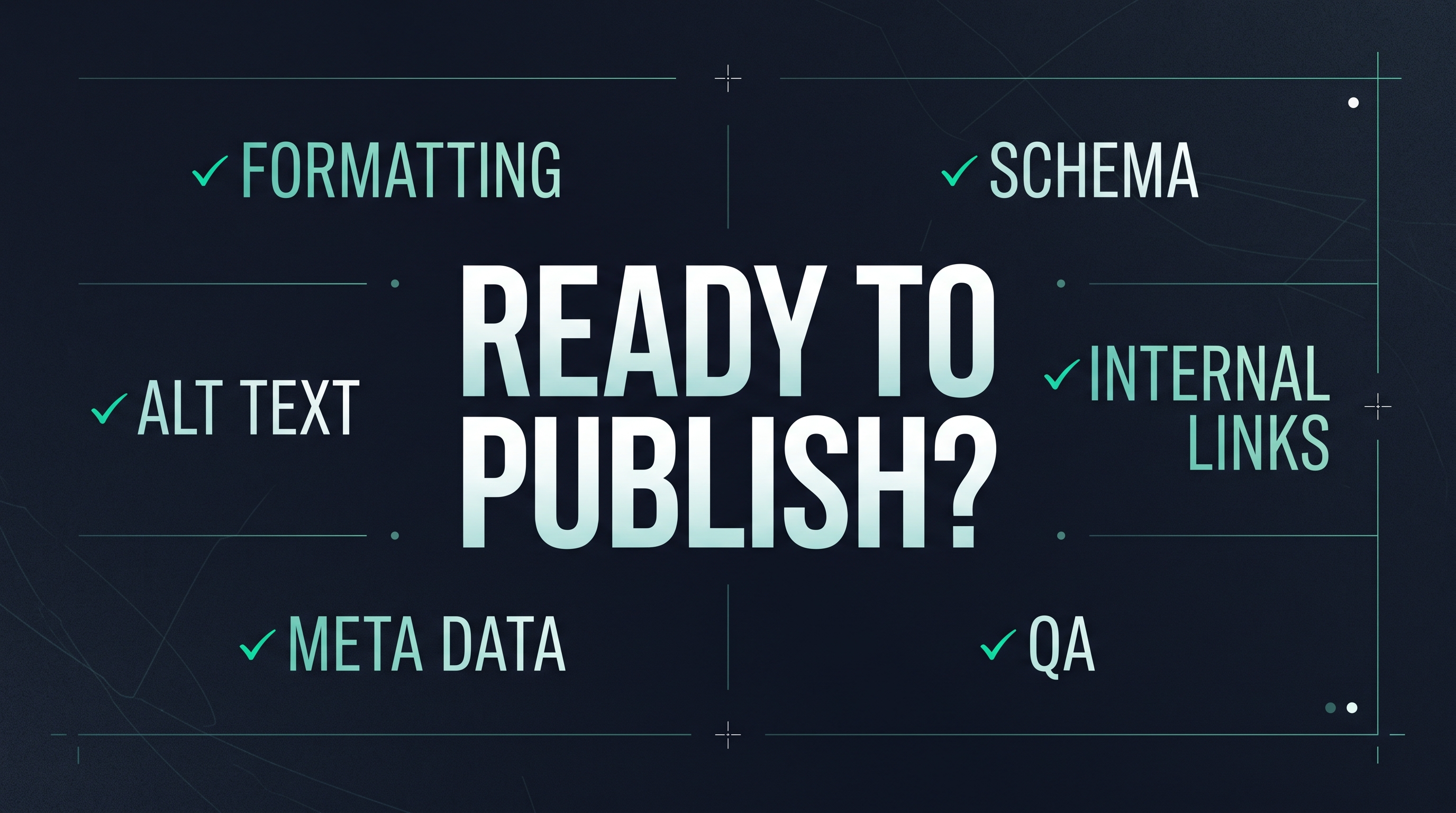
Make publishing smoother by using pre-built CMS templates and reusable blocks. Before hitting publish, run through a quick checklist to review formatting, meta tags, social preview cards, schema markup, and clean URLs. A clear, reliable routine like this can cut staging and review time from several days down to under 45 minutes per piece.
How to Conduct an Operational Workflow Audit
To uncover and resolve bottlenecks across your content production process, execute a 4-step operational audit:
- Calculate Cycle Time per Phase: Measure the exact number of business days an asset spends in each stage: Briefing, SME Interview, Drafting, Review, and Staging. Identify which stage consumes the largest percentage of total lead time.
- Audit Feedback Touchpoints: Review the revision history of your last ten published articles. Count how many total individuals left comments, how many conflicting edits occurred, and how many revision rounds were required before approval.
- Centralize Production in a Unified Kanban System: Eliminate email chains and disconnected Slack threads. Move all production tracking into a centralized operations platform (e.g., Asana, ClickUp, Jira) where card movements clearly visualize where drafts are currently bottlenecked.
- Conduct Bi-Weekly Process Retrospectives: Treat marketing content production like an engineering sprint. Every two weeks, evaluate what caused delivery delays and refine your operational templates accordingly.
Summary: Operational Efficiency Drives Search Scale
Producing more effective content depends on how well the workflow runs, not on whether the team has enough creative talent.
In practice, that means replacing vague requests for expert help with focused interviews, giving one person final say, setting firm 48-hour review deadlines, and streamlining CMS uploads. Together, these changes can cut production time in half, sharpen accuracy, and make your content much easier for search engines and AI to discover and recommend.
At MKG Marketing, we partner directly with marketing directors and CMOs to strip away the fluff and turn organic search into a steady revenue driver. We build straightforward, high-impact search strategies that actually generate leads and have been successful time and again.
Streamline Your Marketing Content Engine
- Ready to audit your content workflow and eliminate publishing delays? Request an MKG AI Search & Technical SEO Audit today.
- Exploring how to align your content operations with answer engine visibility? Explore MKG Marketing’s Search Engine & AEO Services.
- Need an actionable checklist to evaluate your team's internal handoffs? Download the B2B Content Production Workflow Audit Template to benchmark your processes.