Garrett Jestice
Garrett Jestice is a go-to-market strategist who helps consultants and agencies build repeatable offers, refine their positioning, and win more of their ideal clients.
Overview:
Garrett explains why service businesses should stop trying to market to everyone and instead focus on repeatedly selling the same outcome to the same type of client. He shares practical frameworks for identifying your best customers, designing low-friction introductory offers, standardizing delivery without sacrificing quality, and building a repeatable go-to-market strategy. Throughout the conversation, he reinforces that sustainable growth starts with clarity, focus, and solving the right problem—not simply generating more leads.
Transcript:
Kerry Guard 0:09
Welcome back to Back on Track, where B2B tech marketing leaders full-time and fractional trade what's actually working. I'm Kerry Guard, your host and founder of MKG Marketing. MKG is where we help B2B SaaS and tech companies become the answer buyers already trust across search, AI, and paid, and that's exactly why today's conversation is one I've been looking forward to, because before anyone can find you and trust you, you have to know who you're for. My guest, Garrett Justice, founder of 10 Time Solo and a former B2B SaaS CMO, says most elite consultants don't have a lead gen problem; they have an offer market fit problem. So let's get into how you get off the pipeline roller coaster and build something repeatable. Garrett, welcome to the show.
Garrett Jestice 1:01
Thanks, Kerry. Great to be here. Excited for the conversation.
Kerry Guard 1:04
Me too. And it's so timely because I just got off of a new biz pitch where I was saying this. They were like, "Okay, we've been doing. They were on board. They understood they were doing random-access marketing, and then they were like, "When we want to start building a dashboard," I was like, "Okay, we can do that." But let me just walk you through my process. And I started with positioning and messaging. Like, yeah, we don't need that.
Garrett Jestice 1:33
Yep, been there, been there.
Kerry Guard 1:37
How? You know what? I'm gonna slow my roll. I'm so excited. I am going to start with our icebreaker because it is super fun. And fun fact, this works really well on YouTube Shorts.
Garrett Jestice 1:50
Love it. Looking forward to it.
Kerry Guard 1:51
Make sure, make sure we get we follow the process. It's just a quick word association. Super easy. I'm just going to say a word, and you're gonna tell me the first thing that pops into mind for you. One or two words. Don't overthink it. Just what does it mean to you?
Garrett Jestice 2:08
Okay. Let's do it.
Kerry Guard 2:09
Rapid fire. All right. Here we go. Utah.
Garrett Jestice 2:14
My home.
Kerry Guard 2:17
Yeah, love it. Solo.
Garrett Jestice 2:20
My community
Kerry Guard 2:24
Niche
Garrett Jestice 2:26
Focus
Kerry Guard 2:29
Pipeline
Garrett Jestice 2:31
Revenue
Kerry Guard 2:34
CMO
Garrett Jestice 2:36
Meetings
Kerry Guard 2:41
Repeatable. The
Garrett Jestice 2:43
Goal.
Kerry Guard 2:46
AI.
Garrett Jestice 2:50
Fun, but potentially distracting.
Kerry Guard 2:53
Ooh, we're gonna unpack that one, and the last one is focus.
Garrett Jestice 2:58
The goal.
Kerry Guard 3:01
The goal, focus, yeah, repeatable focus. The goal. We got Garrick Van Buren here. Hi all. I hope you can hear us now, Garrick. We got started a little late, but we are here now, and hopefully you have joined us. We are excited to have you here. If you're here with us, feel free to comment away. Tell us what those words meant to you. Yeah, join in. Let's do this. Okay, now we're gonna get into it. Finally, you're about three and a half years into working for yourself, and you've told me that you've had a lot of big pivots: fractional CMO, building an agency, one-on-one advisory, and now mostly working with services businesses. Walk me through that arc. What kept moving you?
Garrett Jestice 3:45
Yeah, well, I don't know how much time we have, Kerry, but I'll give you the short version here. Right, as we could, we could definitely pull this out. So, I kind of fell into consulting about three and a half years ago, as many people have done the last couple of years. I grew up kind of in the startup world. I worked for B2B SaaS companies from solo marketer, product marketer, up to CMO. So I left my last CMO gig and wasn't sure what I was going to do next. I started interviewing for other types of companies and was a little bit burnt out on the SaaS grind, the startup grind, and decided to give the solo consulting thing a try, so I kind of fell into it. Started as a fractional CMO, realized you know it wasn't the best fit for exactly what I wanted to do, and so I've been on this experimentation train, I guess you can say, the last couple of years, trying to find the right model, the right fit for exactly what I want to do. It wasn't until I really sat down, maybe six to eight months ago, and wrote out my goals, like what do I actually want to build, who do I actually want to work with, that I then could had had a had a marker essentially to say, okay, now how far away from that am I, and how do I move closer towards that idea? Goal, and so that's been the journey that I've been on. So, and ultimately, where I landed is today. I still work with the occasional startup. I have some legacy clients that I work with, but most of my time is spent working with other solo consultants, smaller agency owners, helping them do the same thing that I did in early-stage startups: find what I call offer market fit and go to market with confidence, knowing exactly how to grow their business.
Kerry Guard 5:29
I got a test as an agency owner that we have been around for 15 years and just did that work about a year and a half ago, and I'd have to say, we're still doing that work.
Garrett Jestice 5:43
It takes on going forever, right?
Kerry Guard 5:46
Ongoing product offer fit. I want to get into it, but I'm going to stick to my questions. Actually, that is my next question. Fantastic. Define it plainly. Most people obsess over lead gen; you say the real problem is offer market fit. What does that actually mean, and how is it different from a lead gen problem?
Garrett Jestice 6:08
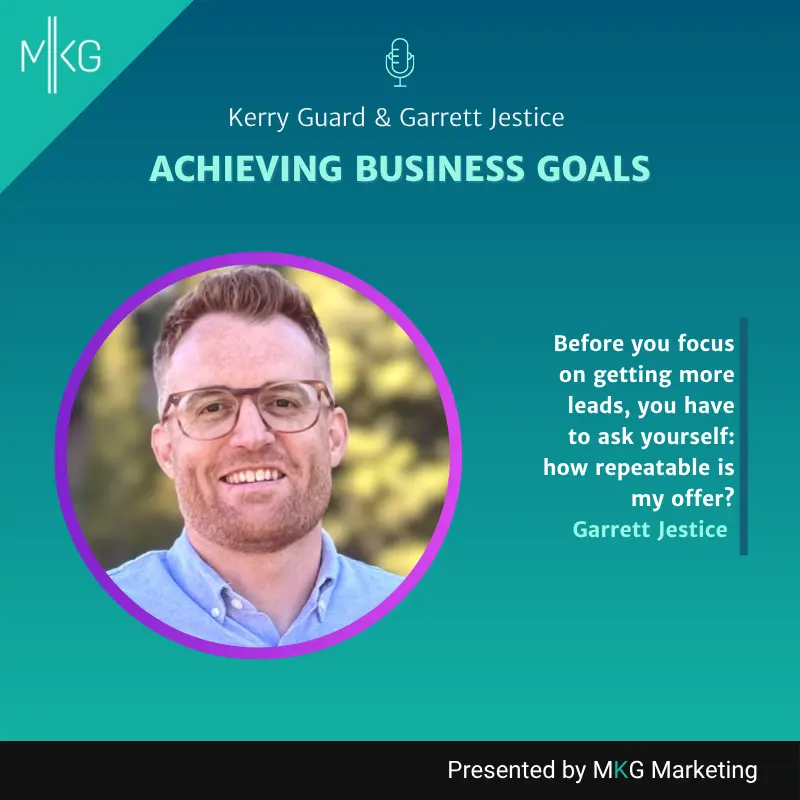
Yeah, so I compare the offer market fit to the startup world. Startups constantly talk about product-market fit and finding product-market fit. It's the exact same thing for a service business. Only we don't have products; we have offers, right? So the goal is finding repeatability. Who's your single best-fit client, and what's your single best-fit offer that solves their problem and makes what you do repeatable? When we, as solo service providers, start out, often it's custom services, right? And custom services can only take you so far because they're not repeatable, right? And so eventually, you have to be able to find something that's repeatable, and that's essentially what market fit is. Can you sell the same thing to the same type of buyer in the same way and get them the same results every time? Once you can do that, running your business becomes a lot easier, right? You're able to hire people, plug them into certain roles, and help them help you grow the business. You know how to go about finding who your best-fit clients are. You know exactly what to sell them. You know what their challenges are, and so ultimately, that's the goal of any business: finding repeatability, refining focus, and the core of that is what I call offer market fit. Before you focus on getting more leads, you've got to first ask yourself: how repeatable is my offer? How focused am I here on the right offer, the right audience, right?
Kerry Guard 7:43
I literally just had this conversation, Garrett. I wish I talked to you first, and then had the meeting, because she was very much like, well, we have a lot of offers and a lot of product, mostly offers because they're a service business for a whole bunch of types of different clients, and I was like, "That's wonderful that you can service so many people, but at the same time, when you go to market with that much, you end up diluting what you're able to actually accomplish. Yeah. So, taking that first step to really understand who is that single customer you can really support, and what it is that you offer them, man. I feel so validated right now. Like, I wasn't picking up what I was putting down, but I, I'm not wrong.
Garrett Jestice 8:28
Yeah, you're not wrong. Let me give you another like quick example. I had a conversation a few months ago with a small agency owner, and they were doing well. They were doing roughly 5 million in annual revenue. It was a custom dev shop, so they did custom development, right? But when I asked him, "Well, who do you? What type of businesses do you work with? And he said, "Any that will pay us. I said, "What type of projects do you work on? He said, "Anything that they want, right? And that's really hard to market, and he was feeling that pain because the only way that they could grow. The reason why we were talking is they had only grown through referrals and through manual outbound pounding the pavement, reaching out to people cold and trying to. It's exhausting. He and his founder had done that for years, and they had grown to a decent size, but they had kind of hit this ceiling where he's like, all other marketing doesn't work for us, and I had to explain to him, well, it's because you haven't focused yet. How are you going to communicate what you do to your audience if you don't even know who your audience is or can't even explain what you do, right? Especially through those one-to-many marketing channels outside of referrals and outbound. How are you going to run ads, right? How are you going to do one-to-many marketing and clearly communicate what you do? You can't, so it eliminates all of those other growth channels. But when you focus, it allows you to take that message from one to many people a lot more efficiently across a lot more.
Kerry Guard 10:02
I feel like you just described this, but let me just sort of double down on it. So you're saying phase one that most founders go through is that anything you'll work with anybody who pays you, man. I know that phase. I live with that phase. We had to work in the road where it was like we could either build websites or we could do SEO and digital ads, and so to really look at which one was actually profitable and brought in the right clients was like a real hard look in the mirror. But I'm so glad we did it so many moons ago, and definitely went with the ads and the SEO phase versus. To those who build websites, I appreciate you.
Garrett Jestice 10:43
yeah
Kerry Guard 10:44
It is a working with clients and building websites around who what they think their brand is is such an art, and I really greatly appreciate you. So yes, yes to that. So that's phase one. Phase two is your focus, which I feel like is what you're doubling down on right now, and then phase three is you expand. Where do most consultants and fractionals? Where do they get stuck? Is it a phase?
Garrett Jestice 11:09
They jump from phase one to phase three, and they skip phase two. Right, and so phase one is necessary. Right, we all need to understand and learn where our offer market fit is, who we are going to serve, and what we are going to offer them. And the best way to do that is through experimentation, right? It's trying to sell and learn. Do I enjoy doing this? Do I enjoy working with this audience? Is this the right offer fit for me? Can I get the results? But eventually, you start to see a pattern emerge among your clients. These are kind of my best fit ones, and that's when you need to focus, not add new offers and expand. Right. The first thing you need to do is focus on building a repeatable customer acquisition system for some of those best-fit clients. Once you do that, and it's kind of running, then you can look for opportunities to expand, and normally you expand by adding new offers, or you take the same offer to a different market, right? A new audience that's similar, and so there's a couple of horizontal versus vertical expansions, right? There are multiple ways to do that, but yeah, the biggest challenge or the biggest mistake that a lot of people make is they go, "I'm serving everyone, and now I'm adding more offers, and then it's just chaos instead of that focus piece in the middle.
Kerry Guard 12:32
Yeah, yeah, that focus piece is important, and let's talk a little bit about the who you serve piece because you sort of mentioned that you can go vertical or go horizontal. What is what does that mean? I mean, verticals are normally like industry-focused, right? Like we help cybersecurity companies, as an example. Is that what you mean by that? Are there other ways to be focused?
Garrett Jestice 12:56
Yeah. So you can focus on serving the same type of person, and then once you're in phase three, the expansion phase, you can build new offers to continue to sell them. Right, expansion offers other things beyond your core signature offer, or sometimes, and this is how a lot of software companies grow-they build one product, but they're able to sell that one product to multiple verticals. That's more of a horizontal play, right? And the way that that expansion typically works is you focus on serving your core best-fit customer or client, and then you naturally see that people just outside of that, maybe in this other industry over here, are also interested in it, and that then becomes your next expansion vertical that you focus on.
Kerry Guard 13:48
That makes, yeah, that makes a ton of sense. It sounds so easy, though.
Garrett Jestice 13:53
Yep, sounds so easy. It's not easy in practice, right?
Kerry Guard 13:58
It is not easy in practice. You talk about selling the exact same outcome to the same buyer on repeat, like you just mentioned. And like I said, that sounds really simple, but people resist it. They're scared of turning work away. How do you coach someone through that?
Garrett Jestice 14:14
Like,yeah. So the first thing to understand is, I believe positioning is about who you proactively focus on, not the business that you accept, and so what I mean by that is if you are speaking to this audience that you've decided is your best-fit market that I want to go after, this is your best-fit type of client I want to repeat, right? But someone in a different industry or vertical or slightly different-sized company comes inbound to you or through referral. If they can still get value from your core offer without you building something custom for them, then by all means sell them, close that deal, and service them. Right. What I think the biggest mistake is is a lot of times. Founders think, well, if I pick a niche, that means I have to turn away everyone else, and I don't think that's true. You can continue to service those people who find value in your core offer. What you don't want to do is build something custom for them, and what you don't want to do is proactively try to market to all of those different verticals or markets. You pick your target, you focus your positioning, your messaging, you know all of your go-to-market activity on finding more just like that. But if others come in, you're able to close those because some of them end up becoming those expansion verticals that we talked about in phase three, later on, right?
Kerry Guard 15:43
I will attest to our own experience. Like, we're trying a different offer right now because we've been doing SEO and digital ads forever, and we do generally know who our target audience is. But I became a fractional marketing leader a few years ago, and in doing so, I figured out that we could build into the team some, you know, some other things, and because I haven't really sold it or it hasn't been a core offering of what we do for a while, it is so much harder. Just I can sell SEO and digital ads all day, all day, but man, when you bring in a new offer, it is, and you're not comfortable with it. Like it makes you question. I'm like really glad we're having the conversation. It makes you really question, like, maybe this isn't something we should offer. I know fractionals need the support of a team behind them, and that's really what this thing is. But I don't think it's the right fit. There's not an alignment between the expectation of what it is and what it costs to actually be able to like have the thing. There's something out. It's not. Yeah. It doesn't feel easy, right? When you have a really good offer, like the one you're talking about, it should be, to your point, super easy to bring in and close. Then.
Garrett Jestice 16:59
Yep. Right. Exactly. Yeah. Well, I think you hit on another point too. That's really important to understand. Every unique offer and market that you go after needs its own go-to-market strategy. Meaning, there might be custom messaging that's needed for that offer and that market combo. Right. There might be different channels that you focus on, and that's one of the reasons why, when you jump from phase one to phase three expansion so early, you get tripped up because you don't have the bandwidth on your team to run three or four or five different go-to-market strategies at the same time. You just don't have the resources to do that, and so the advantage that smaller companies need to take advantage of is focus, right? That's something that they have and can do better than larger companies that have multiple offers, but also have more resources to be able to have custom strategies for all of those offers and markets.
Kerry Guard 17:58
And honestly, I'm running a report right now that is looking at, like, six four to six different companies inside different cybersecurity verticals, and my hypothesis was that if you're a big company and you're an enterprise, you're probably crushing it showing up in the LLMs because of just how big your digital footprint is and how much more you have to talk about. Like, you're probably just the incumbent that's just always being recommended, and it turns out that's actually not the case. It's the smaller startups and scale-ups that are winning because of the focus of their positioning and messaging in regard to what they offer, and they're being offered up more often because of their specificity.
Garrett Jestice 18:41
So so interesting, yeah.
Kerry Guard 18:42
Yeah. So in terms of AI search, right? If you want to get found, being specific about what your offer is helps you in that way too. Yeah.
Garrett Jestice 18:52
I love that.
Kerry Guard 18:53
You have an actual process for finding someone's best-fit client. Find your best client and clone them. How do you run that? Where do you even start looking?
Garrett Jestice 19:04
Yeah, it's a great question, and it can be an in-depth process that we go through. But really, when you zoom out, all we're doing is auditing their past clients. So we start with a list of their clients from the last 12 to 20-four months, and we're identifying which of those were the best ones across multiple dimensions. A lot of times, we think that it's naturally the ones that pay us the most, which is a factor, but it's not always true, right? Any business owner can attest that your highest-paying customer or client is not always your best client. It's not always the one that you want to continue working with, or get 10 more just like them, right? So we look across multiple dimensions, and we try to identify the ones that were the best clients, and then we try to identify how many more look just like that, are in similar verticals, have similar use cases, or need. Or problems that you can solve for them, similar size of companies, and that's essentially how we focus on finding your best fit client. That then becomes the blueprint for everyone that we're looking for going forward. Right, we're going to find more just like this. So that means we need to speak their language. Our positioning and our messaging need to speak to exactly what resonated with them. We need to find that we need to focus on the channels where we know those people are active and go find more just like them. Right?
Kerry Guard 20:32
Yes, we actually did something similar, but we looked back even further. We had like a handful of clients that were repeat offenders, where they kept they left their companies about like every 18 to two years, and then they just brought us along. We were able to hold on to the original company, and then we were brought on to the next company. It's just how we've really grown these last 15 years. And I was like, who are those people, and how do we go find more of them? And it turned out that while we worked for more enterprise companies now, we didn't start with them at enterprise. We started with them when they were more in that scale-up phase. Yeah. And so I was like, okay, I have to stop looking at enterprise because they're they already have their people, and they already have their people because they met them when they were scaling up. Yeah. And so so.
Garrett Jestice 21:18
important to find that out, right?
Kerry Guard 21:20
Yeah, and it just totally changes the mindset when you really look at the pattern of not only who you're working with, but how you got to work with them, and what that was, and why you're still working with them. So that was sort of our aha moment of we need to go find more of these people, and we need to. This is where we need to look.
Garrett Jestice 21:40
Yeah, and the thing that you said is exactly right. It's all about finding the pattern. It's all about pattern matching. That's exactly what you're trying to do, right? Again, in phase one, you're selling to anyone and everyone, but eventually you start to see a pattern emerge, and you want to double down on that best pattern that you find, that best combo of the market and the right offer, because that's what helps you build repeatability focus into your business.
Kerry Guard 22:05
And how do you find that pattern? Like, you know, for us, it was more. I don't want to say it was totally gut. I, I sort of had a hypothesis that I'm like, I keep seeing these people who keep rehiring us. How do we meet them? That was sort of like where I started. But where do you normally start? Is it in sales calls, case studies, money, energy? How do you decide who the best client really is?
Garrett Jestice 22:27
Yeah, I actually have a I have a scorecard that we work through, and so there are certain questions we identify, and so again, we'll look at past data. That's where we start. But again, most founders usually have a hunch of who the best-fit clients are, and so that's a really good place to start. But then we go through, and we score some of those. You know, you might have a list of five to 10, and we want to identify who the best are. And so again, we have certain criteria, but the categories that we go through and score are across strategic fit. So, do they fit? Are they in a segment, an industry, or a use case that we actually want to proactively target in the future, right? Did they purchase our core offer near or at list price? Those are all questions that we're asking within that strategic fit bubble, right? The second category is around how urgent their pain or problem that they came to you with, right? You want to find someone who has more urgent pain, or something that triggered, where you were the only option for them, and they had to buy today. It wasn't a nice-to-have; it was a need-to-have, right? So there are some questions around that. The third category is around the business impact. So, what's the outcome you were able to drive for their business, right? And was it measurable? Right. Sometimes you have clients where you can drive more measurable business impacts, but when you can show we made this impact, right, it's a lot more impactful for that company internally. The fourth is really around repeatability. So, is this a common problem that we see across other industries? There are questions like that, and then the fifth is like our access to the champion at that company and their willingness to, you know, build a relationship with us to share a testimonial. Sometimes you might have clients that are great, but you just can't get access to them. They, you know, they won't take the time to do a case study or a testimonial. So, anyway, we have a scorecard that goes across each of those five areas. We ask certain questions, and that helps us really hone in on who the best fit one or two clients are that we want to replicate. My gosh.
Kerry Guard 24:31
I love a good scorecard! Yay, spreadsheets!
Garrett Jestice 24:33
I know, me too, right?
Kerry Guard 24:36
Once someone knows who the best client is, how much of the rest of the positioning messaging channels offer actually falls out of that one decision.
Garrett Jestice 24:45
Almost everything. I really believe that once you can find your best fit client, like your single best fit client. I'm not talking about the Frankenstein ICP that's made up of you know a. Of 15 different clients, if you can pick your single best fit client, right, your entire go-to-market strategy comes out of understanding them and their journey. It's pretty simple, actually, when you think about it, right? But we make it so much more complicated than it needs to be. If you can understand that single best fit client and their journey with you from when they first had a problem to when they purchased and then got results. Right, that's everything that you need to go find more people just like them. Your positioning, your messaging, your channels, everything flows out of that.
Kerry Guard 25:36
It writes itself. It does.
Garrett Jestice 25:39
Yeah. Right.
Kerry Guard 25:40
Speaking from experience.
Garrett Jestice 25:41
yeah.
Kerry Guard 25:43
You talk about designing a low-friction intro, quote-unquote, intro offer to open corporate doors. What makes a good intro offer, and what do people get wrong when they try to build one?
Garrett Jestice 25:54
Yeah, I actually have an article that I wrote my newsletter about this recently, but it's one of my favorite ways to go to market successfully, especially for solo consultants or small agencies. And so, essentially, when you think about it and you back up, before a client hires you, there are two things that they need to do. They need to know who you are and what you do. So it's the awareness piece, and the second is they need to trust that you actually can get the results that you promise for them, right? If those two things exist-awareness and trust, right? Plus, if they have the right need and they're the right fit, all of that, which we've already talked about, then yeah, they would be weird not to buy from you, right? And so to help with that, I like this idea of the intro offer. So essentially, what an intro offer is is you have the core offer that you typically sell. Maybe it's a six-to eight-week program. Maybe it's a recurring monthly service that you provide. What's a small, scaled-down part of that offer, or maybe the first step in your offer that you could give away for free to a potential client, so that they can earn trust and realize you're the person that they want to work with going forward? Right? That could be a workshop. It could be an assessment. It could be, you know, a strategy that you build for them, something, and I think that that's the missing piece. When we reach, when we do outbound, most of the outbound that you and I get is pushing. What you know, set up a call, check out this demo. Like, let me tell you how I can do this. Blah blah blah. It's all about me, me, me, me, me. But when you can reach out and say, "Hey, I run this assessment for companies just like yours. These are the results that other people have gotten from this assessment. Whether we decide to work together or not, after this, the assessment's yours for free, and it's going to add value to you. Why would someone say no to that, right? If you're going to add value to them, and it gives you a chance to prove that you know what you're talking about, and can they can start to trust you, then naturally conversations happen after that. Okay, so what's it like to work with you, right? And so it's one of the best ways to really break in is when you start with that outreach with value upfront.
Kerry Guard 28:18
We're trying to figure out what that is. It's been an ongoing process of, like, what is that sort of quote-unquote foot in the door where we can just immediately show value? Audits are always good, but I feel like they're here's all your problems exactly, not necessarily a here's how to go fix them. So, as an agency, we're still figuring that out. But for one of my clients, we did this because he's an executive coach, and so we created a 10-question, 10 simple questions. Most of them are multiple choice. Like, you can just pick whatever answer you want, or you can write your own in, which is great because we get so much fodder from those. And then the coach writes back an assessment based on their answers in regard to where they are from a growth standpoint of their company and what's potentially holding them back as them as leaders, and it's been going, like, I don't want to say, like, gangbusters. Like, we get hundreds and hundreds a week, but like we get one or two solid people coming in each week that are net new that fill in the survey and say, "Yeah, I would like to know if I'm the bottleneck of growing my business. So they can totally work. But I do think it's-I mean, I'll speak for myself as an agency owner. I have been finding it tough to find the right thing. It is. It takes.
Garrett Jestice 29:32
It takes a little experimentation to find the right thing. Let me give you two examples of two that I've seen that work really well that I like. So I know a small agency owner who focuses on doing video content, kind of thought leadership video content, especially for like LinkedIn, right? And so, one of the things that he does, which is, I think, brilliant, is he runs a free 30-minute session for prospects and for partners, where he walks them through the process. And then a 30-minute call about what it's like to work with them. He asks some questions. He helps you set up your camera and your microphone so that you get the right picture, and then he creates a couple of videos for free for you to run. And you get that, and you're able to post that and use that. But it gives you a chance to learn what it's like working with him, you get value for free, and so naturally people say, "Oh, that was a great experience. Like when I have that need, or if I have that need now, then yes, I'm going to go to him and work with him. Or partners will say, "That was a great experience. When I come across one of my clients who has that need, I'm going to refer them to him, right? So that's one example that I think is awesome. There are plenty of other flavors of this. I know, I know someone who ran a workshop, a three-hour workshop once a month, but it was you had to apply to come to it. There was a lot of value that came out of that workshop. It was actually around this idea of building offers, right? So he ran this workshop. He helped them identify some of the ideas for kind of their own intro offer, and they left with the idea that they can then go and run. So it's an application process to get into it. But he has 10 or 15 people with whom he's running this once a month, and naturally, they learn what it's like working with him. And afterward, some of them say, "Well, what's it like to work with you, you know, full time, right? So there are lots of flavors of what these intro offers can look like. The idea is that you give value and you let someone leave with a specific outcome, something that is valuable upfront. I think, as you said, that's one of the reasons why assessments can struggle sometimes. Is you just give them a whole list of problems that maybe they already knew that they had. Instead, you want to give them something, an outcome that's complete, right?
Kerry Guard 31:49
Yes, a complete outcome. Absolutely. We have this offer. Then they're standardizing your delivery. You say it protects your calendar and your margins. For someone who prides themselves on bespoke custom work, how do you sell them on standardizing without it feeling like they're cheapening what they do?
Garrett Jestice 32:06
It's a really good question, right? And I think that there are a couple of points that I want to make. First, I believe you should standardize, not productize. And what I mean by that there's a there's a difference between that. When I say productize, I mean it's the exact same thing, same widget, no change. You know, for every person, for most service providers, that doesn't work, right? There's nuance to the clients that you're working with, but you do need a standardized process or sets of modules, right, or systems that you work through, and so what? What that ends up looking like a lot of times is the client comes in, you audit their current situation and identify where they're at because not everyone starts in the exact same spot, and then based on that initial audit, you apply module 123, right, in whatever order makes the most sense. So it's a standardized process. It's not a productized process, and I think that's the key, right? The customization, the bespoke process comes in as you apply and adapt your frameworks, your modules, your system to their current situation. But you're not creating from scratch every time, right? And I think that that's the major difference because once you have that standardized system, it becomes a lot easier to run effectively, increase your margins, plug other people and AI and tech into it to make your own operations more efficient.
Kerry Guard 33:44
Yes, so we have standard operating procedures that allow us to do just that. Where for every single out, every single thing we deliver to a client, there are steps that we follow for every single time, and it actually does the opposite of making it feel cheaper. It ensures the standard of excellence, no matter who's delivering it. So I think that's another way to look at it, too. It's not just that for whoever you're delivering it to. Obviously, it's going to be different because every client's different, but also it allows you to make sure that the quality of the product is the same, and sometimes even better. Like, especially with AI now, as we figure out what we can automate, we can then figure out where the human really needs to dig in and do a better job and produce something even better than we thought they could because they have so much. They were given time back in a sense, to go deeper and be more thoughtful. So, yeah, I'm a big believer in standard operating procedures.
Garrett Jestice 34:48
In that, and going back to what we were talking about at the beginning, market fit is about selling the same thing to the same audience and getting them the same result that you promised, and standardizing your procedure. Is how you consistently get them the same result, right? The same promised outcome. Without that, right, the chance that you're able to consistently get that same result goes down, right? So you want to ensure that that chance is high, and you do that by standardizing.
Kerry Guard 35:20
Absolutely, absolutely. We, my husband, my hero, built me because he's an engineer, and I do build websites here and there. It's not a standard offer at MKG, but if I do come across somebody, I feel like I can help. I just really love it, so I just pick up a project every once in a while. But he built me a standardized template. Now it's not like a WordPress template because I can literally change everything about it in terms of how it looks. But the thing that's standardized is all the things that make it so you can just tell it's WordPress because the spacing's inconsistent, the font sizes are inconsistent, and sometimes things are centered. Sometimes they're left-aligned. Like, there's just all these inconsistencies that he, like, ironed out for me. So now I can really just focus on the content, the layout, the colors, the branding. I add in like animations now, and I don't have to worry about just like trying to get the consistency to really bring that level of that that level of perfectionism that I sort of strive for every time. So yeah, yeah, that's standardization.
Garrett Jestice 36:33
I know. Amen.
Kerry Guard 36:35
Amen. You made a point on our call before this that I just loved: you help founders on the foundations, audience positioning, messaging, and offer, and then you hand execution to freelancers and agencies you trust. Why did you draw the line there, and how do you think about who you partner with for execution?
Garrett Jestice 36:58
Yeah, it's a really great question. Part of it comes back to what am I best at? I talked about, you know, it took me a while in my journey to figure that out. Like, what do I enjoy doing? What am I best at? Right, because that's where I want to spend my time on the things where I know I'm good at it and I enjoy doing it and I can get good results. And that's kind of how I'm wired, right? Those are the things that I like to focus on, and I feel like I'm best at. And so I've decided to really focus my offers there and spend as much time as I can on those things where I have that unique ability. And so what that has meant is I've needed to find really good partners that I can recommend or hand stuff off to if my clients don't have a team internally that can run with that ongoing execution, then I need to be able to recommend the right partners. And so it's taken some experimentation, truthfully, of feeling out who the right partners are and who's a good fit. And you know, I have a good bench now of partners that I can recommend and bring in at certain spots who are used to working with me and my process, and it helps me add more value to my clients when I can say, okay, we got these foundations locked in. Now we're moving into channel execution, and because we decided these are the right channels, here's a channel partner whom I would definitely recommend working with. Who's great at this thing, right?
Kerry Guard 38:26
I love that. Yes, I think it's good to identify, like, where your expertise begins, but also where it ends, and where you do not feel like you have to do it all. I think that's where we're all sort of like scrambling right now, feeling like, as a fractional marketing leader or as the first hire, we are responsible because our resources are limited. That we have to figure it all out, and I just really love that you're like, " Nope, this is where my expertise is, and then this is where I'm going to offset that, and I, yeah, there's a reason why we have experts doing certain work. You need partners, right?
Garrett Jestice 39:07
We can't. No one can do it all perfectly, right?
Kerry Guard 39:11
No, we need to stop trying.
Garrett Jestice 39:14
Yeah, exactly. Yep. The other thing that I think is really interesting about what you said for service providers is that there's this hidden piece to offer market fit, which is really the founder piece. So it's really founder-offer market fit when you're a service provider, right? A lot of times, I think this is a major difference between software companies. When I again, I've worked in a lot of software startups. Software founders don't necessarily have to have deep expertise in the value that their software provides because the software is providing the value. That's very different when you're a service provider and starting out. You have to tailor your offer to what your current expertise is, or you have to quickly gain some expertise if you're going to, you know, be valid. Serve customers with a certain offer, right? And so I think that's a hidden piece that we often forget. You start by actually understanding where is my expertise as a service provider, and then that shapes the type of business, the type of offer, the type of market that you go after. And so again, for me, we talked about my journey and all of the different, you know, models that I tried. Part of that was I hadn't sat down and really started with that lens of what's my expertise, what am I best at, and what does that eliminate from a business model or offer perspective for me, so I know where to focus. Once I did that, it became a lot more clear, you know. There are only a handful of potential offers and markets based on that expertise lens that I should focus on.
Kerry Guard 40:53
If I think about my journey over the last 15 years, when we started MKG, we were both me and my business partner at the time were media planners, both of us, where we came from, and so when we started the agency, we went into it offering media planning, which which worked until CPC really came into play, and was almost was a competition with it, and so we brought in a contractor who was an expert in Google and cost per click, and ended up really leaning into that, and that became sort of, and still is to stay, really what we offer. While we can do media planning, and we do, but that we start with the CPC of it all across Google and social and all those channels. But to your point, I think it took us so long to be able to do the marketing and sales side of it outside of referral, because as media planners, it's been really hard to talk about something that hasn't been our expertise, even SEO, to have to learn without doing. Right? We it wasn't until really I became a fractional marketing leader in the last few years that I actually started doing SEO on my own and had having to implement it on websites and pick it up and apply it. Now I can really speak to it. But yeah, I have to like sort of reflect. Of that's probably one of the reasons why this has been so dang hard.
Garrett Jestice 42:20
Yeah, yeah, I think you're absolutely right. You know, I'm sure that prospects who talk to you now can feel that expertise coming through because you've been in the trenches, you've done it, and that's why you're able to credibly offer the service that you offer today. It makes a huge difference in being able to sell. It's not saying that you can't offer a service that you have no expertise in, but man, that's a massive mountain to climb to overcome that gap. And so, for most service providers, you should start by filtering your offers through the lens of what your expertise is. Otherwise, you have to have a really great plan to gain that expertise, like becoming a fractional marketing leader, right, which gives you the experience and the expertise necessary to then go and sell the right offer or the right service.
Kerry Guard 43:10
Yeah, it's things I would tell my younger self.
Garrett Jestice 43:14
I know. Right,
Kerry Guard 43:16
I've learned a lot these last few years. I definitely get to my younger self to start marketing way earlier, way earlier. Oh my gosh, Garrett! I could, I have more questions, and I could sit and talk to you all day. The last question I want to ask, because I feel like this is coming up more and more for us as as us as marketers trying to figure this out. But you mentioned it was a it was a thread that was coming up in your community, and someone was asking, basically, is anyone else scared about what the next three to five years look like, in terms of our jobs? You're running an offsite around exactly that question. So let me ask you, what do you think our jobs will look like in three years.
Garrett Jestice 44:01
So I think it's such an interesting question, especially, you know, I mean, with AI and how everything is changing in the world. I mean, there are drastic changes. If you look back 1220-four months ago, I mean, the work that I'm doing today or how I'm working is so different from, you know, one or two years ago, even right. And so I do understand and totally get the anxiety around that many service providers have. That being said, in my experience so far, I don't think that we're ever going to not need experts, right? What I mean by that is if you think about the usage of AI today, what it takes to get a really good AI output is expertise on the front end to give AI the right context that it needs to then do some of the execution process, and then expertise on the back end to evaluate what AI is. Is it actually good, or is it not? Do I need to send it back through another loop and improve it? Right. We've all seen that. Like you, you see people who don't have expertise in copywriting put out AI-written copy that's bad because they don't have the expertise to judge that this was bad. Right. What's very different when someone who is a has deep expertise in copywriting can feed it the right context, evaluate whether it's good or not, right, and then put something out there. So, I don't think expertise is going away. I think we will always need experts. And so, for every service provider out there, I think you lean into your expertise, what it does is, which is great, is AI helps elevate the strategic side of most of our businesses. Right, we all need to be experts and become strategic partners. If you are focused on providing a service that's straight execution that AI can replace, then you should be worried, right? But if you can become a strategic partner for your clients, I don't think that's going away anytime soon.
Kerry Guard 46:11
Couldn't agree more. Couldn't agree more. We have to figure out how to work with AI because it's here to stay, but we can elevate our skill set by 100. It's like being able to go deeper on a deliverable and leveling it up than we ever could before, and it's just raising the bar. And that's exciting. I find that exciting.
Garrett Jestice 46:35
I do too.
Kerry Guard 46:37
Oh my gosh, Garrett, this was so good. Thank you so much. Two takeaways I'm walking away with are stop trying to fix a lead gen problem when it's really an offer market problem, and find your best client and clone them instead of reinventing yourself for every proposal. Where can people find you? I did post your Substack, so people should go subscribe to that, click on that link, make that happen. Where else do people want to learn more?
Garrett Jestice 47:03
I'm pretty active on LinkedIn, so I would love to chat. Reach out if you have any questions or just want to chat. Always open to it.
Kerry Guard 47:10
And I will say, I know we talked a lot about solopreneurs or in agencies and services today, but this applies to any business. Whether it's a product market fit or an offer market fit, you need to figure out your positioning and messaging first and foremost. And I guarantee that if you're a big company, you've been around a while, you probably still need to revisit your positioning and messaging given the world we live in.
Garrett Jestice 47:38
So, yep.
Kerry Guard 47:39
Yeah, take everything that Garrett said today and go apply it effective immediately. Find your customer, clone them, and everything will come from that in terms of exactly how to market to them and provide them real value. Ah, so good, so good. Thank you again, Garrett.
Garrett Jestice 47:59
Thanks for having me, Kerry. It was fun. Let's do it again.
Kerry Guard 48:02
Yes, I would love that. I would love that for everyone watching. This is all live all weekend, and we'll cut it into clips so you can keep the conversation going on LinkedIn and tag Garrett so he can keep up and have questions, and we'll get those answered. And that's a perfect place to bring us back to our sponsor because Garrett just spent 30 minutes knowing exactly who you are for. Once you know that, the next question is when they go looking. Do they find you? And that's where we come in. MKG Marketing search visibility optimization that makes you the sighted answer across search and AI, not just another vendor being evaluated. If you want to see where you stand today, start with an audit at mkgmarking.com. I'm Kerry Guard. Thanks for being here, and we'll see you next time.