
As the lone marketing leader in a growing organization, preparing monthly updates for executive leadership can quickly start to feel like a defensive drill. You open your standard analytics dashboard to build the performance report, and the headline charts look alarming. Total organic website sessions have declined sharply over the past two quarters. Click-through rates on your core keyword targets have stalled. To a CEO or board that’s used to gauging marketing health by steadily rising traffic graphs, this data signals an unmistakable operational breakdown. The immediate assumption is that your acquisition engine is stalling and your marketing budget is being squandered.
But when you move beyond surface-level web traffic and examine the actual sales pipeline in your CRM, a very different picture emerges. Sales-qualified opportunities are stable. The total value of your active pipeline is increasing, and customer acquisition timelines are actually accelerating. The core problem isn’t diminishing market demand or poor execution from your team. The real constraint is that your existing reporting models are completely blind to where high-intent pipeline is being created before prospects ever land on your website.
Traditional marketing dashboards are built on a simple, linear multi-channel attribution story: a prospect clicks an organic listing, browses your blog, and submits a form. Today, that critical mid-funnel research phase has shifted almost entirely into conversational search environments.
High-value enterprise buyers are now getting direct vendor comparisons, validating integration requirements, and checking compliance criteria long before they visit a URL or show up in your SEO tools. If you continue trying to justify marketing’s impact with legacy traffic volume, session length, and top-of-funnel MQL counts, you will keep appearing to lose momentum, even as your true revenue influence grows. To withstand serious boardroom scrutiny, you must let go of vanity traffic metrics and adopt an executive reporting framework built squarely around SVO ROI.
The Blind Spots of Legacy Attribution
To defend your marketing budget and protect your strategy from premature executive meddling, you first need to understand why legacy tracking tools fail to reflect the real high-value buyer journey. Traditional multi-channel attribution models are built on the idea that your corporate website is the primary hub for education and intent capture. As software purchasing moves away from simple click-through behavior, this assumption creates enormous data blind spots.
This measurement failure is at the heart of the Attribution 3.0 crisis. When an enterprise procurement leader turns to a conversational engine to compare your product’s deployment speed and API integrations with a competitor, the system pulls from thousands of distributed data sources to produce a single, authoritative recommendation. The buyer reads the synthesized insight, concludes that your brand is the best fit, and then goes straight to your site to book a demo.
By the time that lead appears in your CRM, legacy analytics tools label it as a direct visit or branded search. The pivotal mid-funnel research stage, the moment your technical optimization actually won the buyer’s attention, is completely invisible in your standard reporting.
If your executive updates continue to lean on top-of-funnel click volume, you are effectively punishing your marketing strategy for generating efficient, zero-click conversions. To reset this story in the boardroom, you must move beyond counting casual web sessions and start measuring Referential Authority. You need to demonstrate to leadership that marketing’s true value lies not in attracting passive visitors but in embedding your platform within the precise data ecosystems where buying decisions are made.
Building the Board-Ready SVO Metric Suite
Replacing defensive, traffic-focused explanations with an objective growth framework requires a complete re-engineering of your executive dashboard. A board of directors does not care about individual keyword movements, impressions, or fluctuating organic search charts. They require clear, financial-grade evidence showing that your digital distribution strategy is systematically capturing market share and feeding the revenue engine.
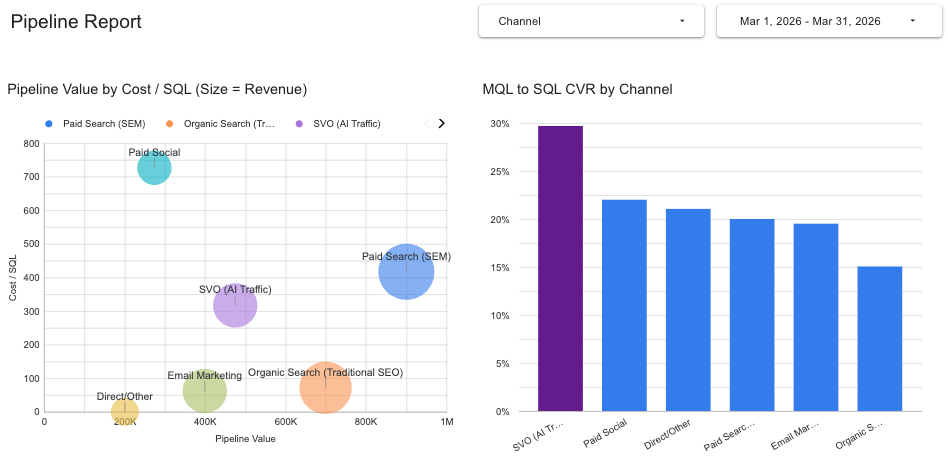
As explicitly illustrated in your active pipeline analytics, looking at revenue value relative to acquisition cost completely re-frames the value of your marketing channels. A sophisticated, Board-Ready Metrics suite shifts the focus from traffic volumes to actual funnel efficiency by isolating three primary pillars:
- AI Share of Voice: This metric tracks your brand's presence across specific procurement prompts relative to your primary competitors. By systematically auditing target commercial queries across major language models, you calculate the exact percentage of time your platform is recommended as a preferred solution.
- Verified Citation Frequencies: Instead of tracking superficial impressions, you document the exact number of times a conversational interface explicitly links to your domain or your authoritative third-party profiles to validate its recommendation. This provides absolute proof that your content infrastructure is acting as a trusted source of truth.
- MQL to SQL Conversion Velocity: Rather than celebrating a high volume of cheap, top-of-funnel clicks, this metric shows that your conversational optimization is driving pre-educated buyers who convert at a significantly higher rate through the sales pipeline.
By centering your dashboard on these pillars, you completely change the dynamic of your executive conversations. You stop talking about the web traffic you lost and start showing the high-value pipeline share you actively control.

Analyzing the High-Yield Channel Mix
A close examination of your performance data makes one thing unmistakably clear: the real business value lies elsewhere than traditional metrics suggest. Organic search may still deliver impressive traffic volume, but once you map each channel against pipeline value and cost per sales-qualified lead (SQL), the underlying structure comes into focus.
Conventional organic SEO often appears efficient on a cost-per-lead basis, yet it typically produces an oversized pool of low-intent visitors that converts poorly into a true pipeline. In contrast, optimization designed for modern conversational interfaces generates a smaller, highly concentrated stream of pre-qualified buyer intent. Prospects arriving through these paths have already completed their comparison research before they ever encounter your forms.
This behavioral shift is visible in your performance models. A traditional search visitor typically requires extensive nurturing through long, resource-intensive content sequences, whereas an SVO-driven lead advances from MQL to confirmed SQL at a significantly higher rate. In many enterprise environments, this conversion velocity surpasses traditional organic search by double-digit margins.
When you share these metrics with the board, you can show that declining raw web traffic is actually a sign of optimization. You are intentionally filtering out low-value, non-converting visitors while increasing your share of high-intent, high-value buyers. This reframes a traffic drop from an apparent marketing failure into a deliberate, highly efficient pipeline strategy.
Aligning the Funnel for Maximum Capital Efficiency
The ultimate business validation of a fully optimized reporting architecture is a dramatic increase in mid-funnel conversion velocity and overall capital efficiency. When your digital footprint is designed specifically to feed modern answer engines, you eliminate a massive amount of friction from the standard buyer journey.
As clearly demonstrated in recent performance datasets, including G2’s 2026 Answer Economy Report, 51% of B2B software buyers now actively bypass traditional search engine queries in favor of direct, conversational interfaces when evaluating options.
Consider the operational divergence between two distinct corporate marketing frameworks:
- The Traffic-Dependent Funnel: An organization spends heavily to maintain high-volume web traffic, driving users to gated content hubs and complex multi-page blogs. As user behavior shifts toward conversational search, click volume plummets, stalling lead metrics and forcing the marketing team to continually request more ad budget to sustain the pipeline.
- The Citation-Optimized Funnel: An organization focuses entirely on structuring its data for machine ingestion, deploying clean schema layers, ungated technical specifications, and consistent feature registries across the web. The brand is systematically surfaced at the top of every conversational procurement summary, routing highly educated, pre-validated buyers directly into the sales cycle.
This clear operational contrast explains why modern marketing maturity is no longer defined by how many visitors you drive to your website. It is defined by how effectively you position your company's core insights for synthesis by the platforms where your buyers already spend their time.

Operationalizing the Boardroom Presentation
Transitioning to a highly structured pipeline framework requires a permanent shift in how your daily marketing operations are structured, tracked, and defended. As a solo marketing leader, you can no longer operate as a creative services hub; you must run your department like a data-driven financial operations center.
Defending your marketing strategy to the board requires anchoring your weekly execution around three concrete operational cadences:
- SVO ROI Alignment: Update your revenue dashboards to chart pipeline value directly against cost per SQL across all channels, ensuring high-yield conversational paths are clearly highlighted ahead of legacy traffic channels.
- Data Layer Governance: Implement strict internal protocols to ensure that all public listings of your technical features, security standards, and integration protocols match perfectly across your website, product registries, and press releases.
- Citation Node Auditing: Monitor how frequently major conversational platforms cite your domain or your independent user review profiles relative to your primary competitors in response to category-focused research prompts.
When these tracking metrics run on a fixed, uninterrupted schedule, your organization builds a permanent competitive advantage. You stop chasing unpredictable web traffic algorithms and start managing the foundational data infrastructure that governs modern business decisions.
Proving Marketing Value in the New Boardroom Reality
A sudden drop in website sessions is only a true crisis for marketers who depend on vanity metrics, inflated content volume, and outdated multi-channel tracking models. For leaders who prioritize technical accuracy, operational rigor, and precise pipeline attribution, this shift in analytics is a powerful competitive advantage. It removes the edge from rivals who chase shallow web clicks and instead rewards organizations focused on delivering deep, verifiable revenue impact.
We design and build the advanced data layers and go-to-market reporting systems that shield growth-focused organizations from tracking blind spots and traffic volatility. By replacing fragmented, traffic-obsessed reports with a unified, boardroom-ready pipeline framework, we make your real marketing impact unmistakable, authoritative, and impossible for leadership to ignore.
Don’t let your organization’s true pipeline value be buried by an obsolete web analytics model. Examine your digital footprint, rebuild your executive dashboards, and implement an SVO reporting engine that wins the argument in every single boardroom presentation.
Summary
As traditional web tracking fails to reflect decentralized buyer research, solo marketing leaders are confronting a misleading reporting crisis: website sessions are declining, yet underlying sales pipeline performance remains strong. This disconnect exists because legacy attribution models cannot capture the critical middle-funnel validation that now occurs in modern conversational search environments. To preserve executive trust and safeguard growth budgets, organizations need a dashboard purpose-built for Attribution 3.0. By moving beyond raw traffic counts and focusing on financial-grade indicators such as AI Share of Voice, Verified Citation Frequency, and MQL-to-SQL Conversion Velocity, marketing leaders can definitively demonstrate SVO ROI and make a compelling case for clear market leadership.